
Results
-
 £127.30
Var sang - Svein H. Giske
Our song was commissioned by Knarvik Skolekorps for their junior band in 2020. They wanted an original piece that could challenge their young players.This became a suite in three movements with themes that run through the whole piece.In the 2. movement there is a possibility for the band to sing in Song of friendship.. Young people finding friendship through music, as I myself have done, is one of the nicest things one can experience, in my opinion.Should you choose not to sing, you can just play the notes as printed.Svein H. Giske-September 2022-
Estimated dispatch 5-14 working days
-
 £102.60
Cherubic Hymn of Ukraine - Yakiv Yatsynevych - John Philip Hannevik
Ukraine was invaded on February 24, 2022, and the world again became spectators to a conflict between unequal opponents. Once again we saw lies, injustice and brutality up close.I must admit that a feeling of powerlessness arose when experiencing this, an empty feeling of not being able to do anything useful.One early Monday morning, a few weeks into the conflict, I sat down to listen to Ukrainian music.I hardly knew any Ukrainian music, but I was familiar with the composer Mykola Leontovych, the man who composed "Carol of the Bells". He was a member of the Ukrainian liberation movement, and he was assassinated by a Soviet agent in 1921.One of his contemporary colleagues was the composer, teacher and conductor Yakiv Yatsynevych (1869-1945). He wrote church music and choral music, and I became very taken by his Hymn to the Cherubim, a part of the Orthodox Mass.I could not find any sheet music for this. But I have listened to numerous choral recordings, and I have tried to notate the music as I believe the composer himself has done originally.I chose to do the arrangement for a solo group of 4 players. These players can be placed at a distance from the ensemble, maybe on a gallery or at the back of your concert hall.The arrangement was made for Brottum Brass for their participation in the Oslo Brass Festival in April 2022.The performance in the church this particular night was met with a long-lasting silence after the last note. The warm respect, the moving response and love we felt from the audience is a memory I will carry with me for a long time.In the lyrics to this psalm, one finds the phrase:Let us now lay aside all earthly cares- John Philip Hannevik -
Estimated dispatch 5-14 working days
-
 £104.99
Sir Eu - Thomas Doss
Sir Eu was commissioned by the regional music authority of Upper Austria and the brass band SoundINNBrass. The composition was meant to be very virtuoso and was written for the euphonium player Steven Mead, who premiered it and has played it regularly worldwide. The title Sir Eu alludes to the master of the euphonium himself, and also to the concept of Europe. From jazz through romanticism to folkloristic elements - this work offers everything that the musical heart could wish for!
Estimated dispatch 5-14 working days
-
 £76.99
Last Call - Otto M. Schwarz
Last Call was commissioned by and written for Brass Band Oberosterreich (Austria) as a special concert finale. Austrian composer Otto M. Schwarz was asked to write an encore piece with which the band could really show off. Featuring all the sections of the band in turn, your audience will surely be dazzled by their skills!
Estimated dispatch 5-14 working days
-
 £69.99
Pastime with Good Company - King Henry VIII - Philip Sparke
The English King, Henry VIII (1491-1547), is mainly remembered for disposing of his wives on a regular basis and breaking with the Catholic Church when the Pope Clement VII refused to grant him a divorce so he could marry Anne Boleyn. He was, however, a gifted athlete, dancer and composer, writing many songs, poems and consort pieces (though not Greensleeves, as is often believed). Pastime with Good Company is undoubtedly the best-known of these, written in the first years of the 16th century while he was still a handsome prince, newly married to Catherine of Aragon and the envy of Europe. The lyrics tell of the joys of hunting, dancing and singing andwould have been sung as part of the court entertainment.
Estimated dispatch 5-14 working days
-
 £59.99
Jubiloso - Philip Sparke
Jubiloso was commissioned by Utsunomiya Brass Society, a talented and versatile group of brass players whom Philip Sparke has conducted on many occasions.When they asked him to compose a 'signature' march to celebrate their 30th anniversary, they asked for a bright and breezy march which they could use to open concerts.Jubiloso is in the same 'Broadway' style as Sparke's Slipstream and The Bandwagon with heavily syncopated melodies and the conventional cantabile trio section but also contains sudden bars with unusual time signatures which trip up the march rhythm.
Estimated dispatch 5-14 working days
-
 £59.99
Marcho Brioso - Philip Sparke
Marcho Brioso was commissioned by The Brioso Brass, a British-style brass band from Hokkaido, Japan. They gave the first performance in January 2012.The commission was for a bright and breezy march that the band could use as their theme tune, so Marcho Brioso falls into the composer's series of Broadway-style marches, which includes Slipstream, The Bandwagon and Jubiloso.After a short introduction a solo cornet plays the main theme, accompanied by a euphonium counter-melody. A secondary phrase from the horns and baritones leads to a tuttiversion of the main theme which is followed by the traditional 'bass' strain. A change of key heralds the trio section, which features a cantabile melody on euphonium; this is then taken up by the full band after a short bridge passage and further change of key.This takes us back to the home key which sees a quiet staccato version of the main theme lead to a recapitulation and a short coda which brings the march to a close.
Estimated dispatch 5-14 working days
-
 £183.99
Perihelion: Closer to the Sun - Philip Sparke
Perihelion was commissioned by the Cory Band as their own-choice piece for the 2013 European Brass Band Championships, held in Oslo, Norway. Winning the set piece section of the contest and coming second to Eikanger-Bjorsvik Musikklag with their own choice selection, Cory went on to become European Champions for the fifth time.Cory MD Philip Harper had asked for a 'Concerto for Band' to fully exploit his outstanding band of virtuosi, and composer Philip Sparke created a one-movement work with contiguous sections, first featuring horns and flugel, then trombones followed by cornets and a slower central section for percussion and baritones, euphonium andbasses.The piece is abstract in nature, without a specific programme, and the title merely reflects the fact that the piece was begun on January 2nd 2013, the day of Earth's perihelion - the point in its orbit when it is closest to the sun. It could also be argued that the piece weaves between moments of brilliant optimism and dark shadow, both of which can be the result of bright sunshine.
Estimated dispatch 5-14 working days
-
 £76.99
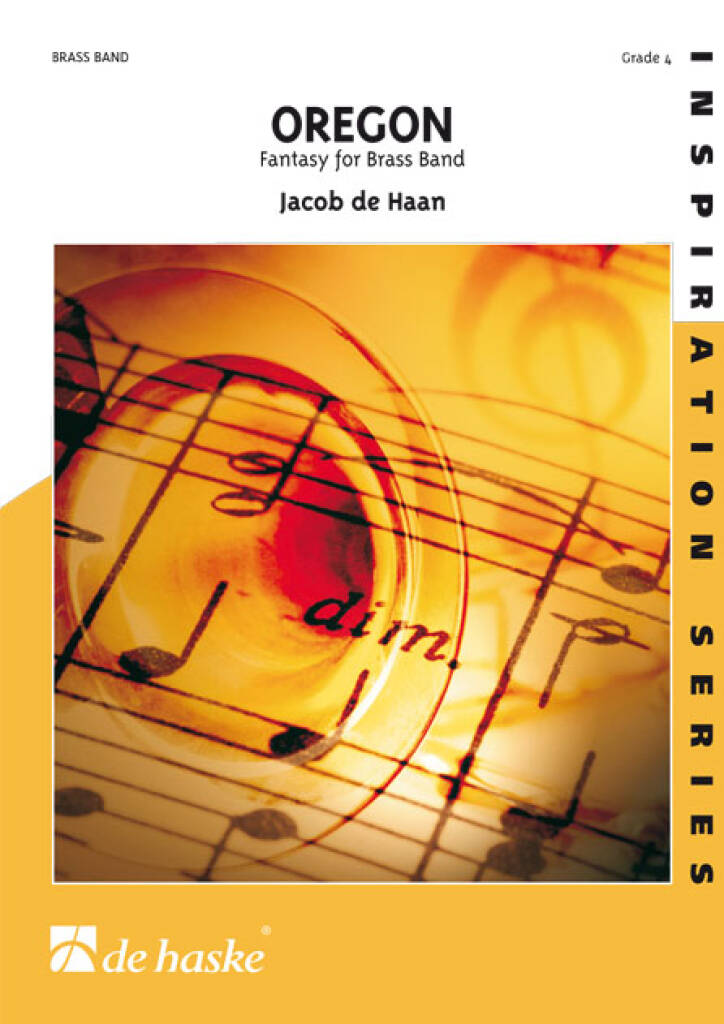
Oregon - Jacob de Haan
This fantasy tells the story of Oregon, one of Americas north-western states. Traveling by train on the Northern Pacific Railroad, the listener is taken through the fascinating Oregon landscape. Indians, cowboys, golddiggers and hooded wagons will file past on this adventurous journey. The piece has some similarities with a soundtrack of a movie. Various melodies, which could be the main themes of a movie, pass the review.The piece begins in a slow movement, introducing the first theme in minor. Then we hear in the following fast movement the trombones imitate the train, whistling the steam-flute. We hear the characteristic minor theme again, but now in differentvariants(also in major). The rythmic structure of 'western' stile and rock succeed each other. This is leading to the slow movement, where the signals of horns and trumpets introduce a wonderful vocal melody. After this characteristic melody, the fast movement appears shortly again, the trombones whistling the steam-flute again (now in major). We hear also some musical elements, that plays a part in the following Presto. Barchanges, jazzy chords, interesting rhytmic patterns (with bongo) and an original theme are the characteristics of this Presto. After this, the horns announce the last section of the piece. Interesting is the fact that we hear in this Allegro section a variant of the vocal melody in the slow movement. Also the Presto theme returns shortly, followed by the Allargando, which is a grand characteristic end of a soundtrack. The movie of our travelling fantasy has come to an end.
Estimated dispatch 5-14 working days
-
£60.99
Conzensus - Jan Van der Roost
This stately concert opener was originally written by Jan Van der Roost for a special event in which six respected wind orchestras (two Belgian and four Dutch) of different composition (two symphonic bands, two fanfare bands and two brass bands) were featured during six concerts. Each evening brought forth a performance by a symphonic band, a fanfare, and brass band, so that the audience could experience all three types of ensembles. This was indeed an original concept.The name, ConZEnSus, comes from a combination of the words, 'Concert Cyclus' (concert series) and 'zes' (Dutch for 'six'). This leads to a new word, which refers to 'consensus'. The general tenor of the cycle isthus immediately indicated. The richness of color of the various ensembles is revealed through an open and friendly atmosphere. During all six concerts (over a span of three years), ConZEnSus functioned as a permanent opening number for each orchestra. Thus the same musical story was portrayed in three different packages.
Estimated dispatch 5-14 working days
 View Music