
Results
-
 £89.99
Inspiration - Jan de Haan
This substantial work by Jan de Haan explores the many tonal qualities of the brass band. Following a quiet opening theme based on Phrygian tonality the band bursts into life with a massive climax. Following a jolly second theme characterised by large interval jumps peace and quiet is again restored. Both themes are developed with many poignant solo figures until we reach a resounding fortissimo climax with the solo cornet performing the first theme from the back of the auditorium. A spectacular concert work containing all the elements that bring out the best in brass band sound.
Estimated dispatch 5-14 working days
-
 £80.00
Fanfares and Love Songs - Gavin Higgins
Fanfares and Love Songs was commissioned by the National Children's Brass Band of Great Britain for performance on 25th July 2009. Its three movements contrast the extrovert and lyrical qualities of thetraditional brass band. The fanfare with which the work opens involves the whole cornet section. The second movement is reflective in mood, beginning somewhat pensively on muted brass, and building to an emotional climax beforesubsiding back to a distant pianissimo chord. The finale is a fast dance, which with a final recapitulation of the opening fanfare drives on to a breathless close. Brass Band Grade 4: Advanced Youth and 3rdSectionDuration: 12 minutes
Estimated dispatch 5-14 working days
-
 £119.99
Delta Energy - Jan Bosveld
The assignment to write a test piece for the National Brass Band Championships ended up also being a 'test piece' for myself as a composer. Although being quite familiar with the Brass Band phenomenon, as a composer I still have the feeling ofbeing an outsider. Delta Energy turned out to be a non-program composition. The Brass Band as orchestra form is depicted musically in this piece. All the specific characteristics are portrayed in varying settings. Solo passages for Euphonium,Flugelhorn and Cornet alternating with extensive tutti-passages and of course technical highlights form the ingredients for this work written in rhapsodic form. The title "Delta Energy" is derived from a project of the N.V. NederlandseGasunie in Groningen which also contributed in making this composition possible.
Estimated dispatch 5-14 working days
-
£83.60
Gang Guet Schuss - Jörg Ringgenberg
Jorg Ringgenberg's Gang Guet Im Schuss for Brass Band with solo instrument (Bb Cornet (Solo), Eb Cornet (Solo), Eb Horn (Solo), Euphonium Bb (Solo)). Score and parts.
Estimated dispatch 5-14 working days
-
 £69.99
Flying the Breeze - Philip Sparke
Flying the Breeze opens with three repeated B's (representing the initials of the Breeze Brass Band from Japan who commissioned this work). A short introduction leads to a robust theme from the baritones and euphoniums which is taken up by cornets and trombones. A restless bridge passage leads to a syncopated tune from the solo cornet and then to a third theme from a solo trombone. A graceful second subject leads back to a recall of the introductory material before a full-scale recapitulation. An intense allargando leads to a full-band version of the second subject under a running cornet passage, which leads to a short coda.
Estimated dispatch 5-14 working days
-
 £74.99
Dreamsong - Philip Sparke
Dreamsong was commissioned by Geir Ulseth and the Nidaros Brass Band from Trondheim, Norway. After a short introduction, the soloist introduces a rather nostalgic melody, accompanied by the lower brass parts. A fast central section is then played by the band, which leads to a climax. Eventually, the main melody played by the solo Cornet and Flugel Horn returns, overlaid with an ornamented counter-melody from the soloist, who then closes the piece with a short cadenza.
Estimated dispatch 5-14 working days
-
 £154.99
A Road Less Travelled By - Philip Sparke
A Road Less Travelled By was commissioned by Palangos Orkestras for the Championship Section of the 2020 European Brass Band Championships held in Palanga, Lithuania. The title alludes to a poem by American author, Robert Frost, which appeared in his 1916 collection, Mountain Intervals. In common with most of the composer's larger works, the piece is not programmatic, but purely abstract. The choice of title shares Sparke's view of how composers can often develop. There can be no 'destination' in a composer's career, but rather a continuing journey to an unknown place. Set in three movements, which play without a break, A Road Less Travelled By opens with a Moto Perpetuo firmly rooted in classical language, form and syntax. A continuous river of semiquavers, veering from melody to accompaniment and back again, adds drive, energy and motion. The second movement, Nocturne, is in the form of a free fantasia; solos for vibraphone, flugel horn and euphonium set the stage for a central cornet solo, quietly echoed by the full band. A triumphal climax is reached before the movement dissolves into a Scherzo Finale. A brief coda based on earlier material drives the piece to a close.
Estimated dispatch 5-14 working days
-
 £127.30
Stealing Apples - Fats Waller - Reid Gilje
Stealing Apples is an old swing-tune written by Fats Waller. Performances by Benny Goodman and his big band made the song very popular. In this arrangement for brass band, the mallet percussion is very essential. Mallet Percussion presents the melody from letter A and is also featured as soli-instruments from letter L to P. These parts can alternatively be played as vibraphone solo. Please be aware of the balance at letter A. Horn and Trombones must play piano but well articulated. Letter D must sound sparkling and fresh with articulated and powerful trombones and cornets (using straight-mute). Make shue that the 8th-notes are not played too dotted two bars before letterG. Almost even 8th-notes accentuated on the start of the slur is a good tip. Watch the balance at letter H. This part have to sound homogeniously. The soloistic Soprano Cornet at letter Q must be played in the style of Benny Goodan. The accompaniment must not be too powerful from letter R to S. Best of luck with the performance!
Estimated dispatch 5-14 working days
-
 £59.99
Sanctuary - Philip Sparke
Sanctuary was commissioned by Eastern Bay of Plenty Brass from New Zealand and was performed as an own choice piece at the 2018 New Zealand National Brass Band Championships. It opens with an expressive cornet solo, hymn-like in mood. A slightly faster central section builds to a change of key and an expansive return of the opening melody, this time scored for full band. After an emotional climax the mood subsides, leading to a quiet close.
Estimated dispatch 5-14 working days
-
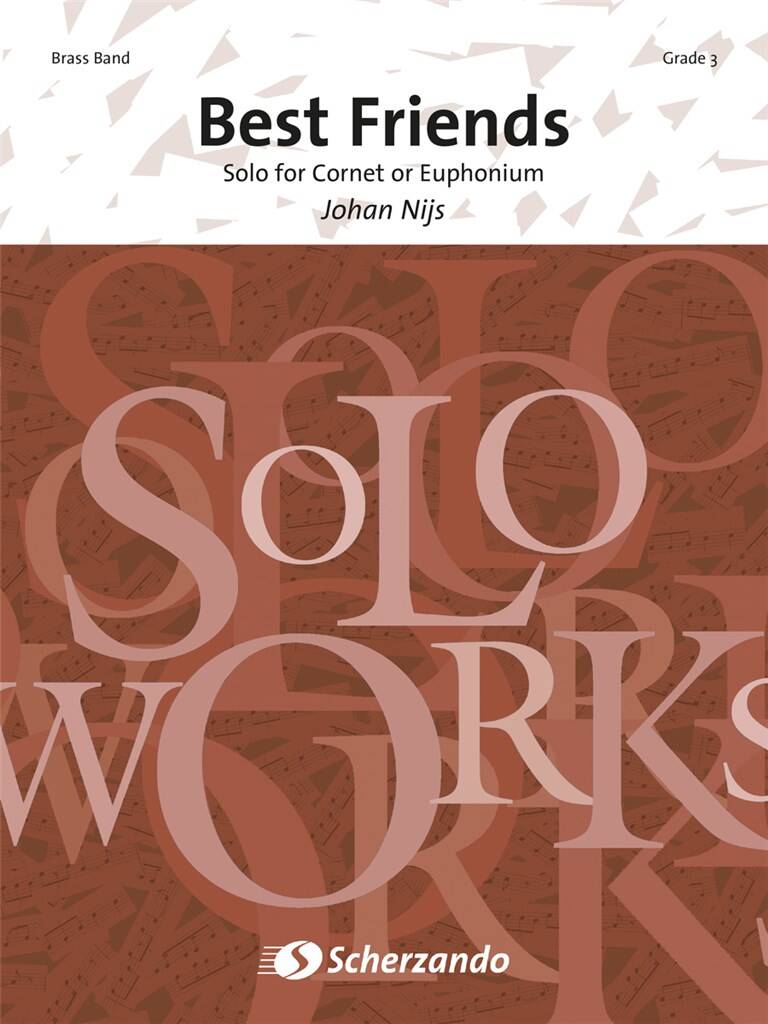 £60.99
Best Friends - Johan Nijs
With Best Friends, Belgian composer Johan Nijs portrays friendship in a wonderful ballad that can be played on the cornet, euphonium or trombone. A great chance to put one of your players in the spotlight! In this version for Brass Band theeuphonium plays the solo.
Estimated dispatch 5-14 working days
 View Music