
Results
-
 £30.00
Eriskay Love Lilt (with brass band) - Trad
Eriskay Love Lilt is a traditional Gaelic melody from the Western Isles of Scotland, sensitively arranged here by Andrew Duncan as a cornet solo with brass band accompaniment.This arrangement was written in 2001 for Phillip McCann and was first played by him with the Hepworth Band at the 2002 Leek Music Festival in Derbyshire, England. It has also since been recorded by Eleanor Ferguson with the Whitburn Band on Reflections of Freedom.Andrew Duncan comments: The Isle of Eriskay (Eirisgeigh) lies forty miles off the North West coast of Scotland in the North Atlantic. It is a small island, only two kilometres square and lies between the larger islands of South Uist and Barra. Eriskay is one of the islands which form the archipelago known as the Western Isles or Na h-Eileanan an Air. The Eriskay Love Lilt is a hauntingly beautiful tune which is typical of the greater number of traditional Gaelic melodies in that it is largely based on the Aeolian mode, the black notes on the piano.Also available with piano accompanimentor as a solo with brass ensemble (10-piece).
In Stock: Estimated dispatch 3-5 working days
-
 £39.95
When Thunder Calls (Brass Band - Score and Parts)
When Thunder Calls was commissioned by Dr Nicholas Childs and the Black Dyke Band for their performance at the Gala Concert of the Swiss Open Championships in September 2011. When composing this piece, I decided to focus on both the music and the stage presentation. The way the piece has been composed and designed makes it a very effective way of starting a concert or a second half of a concert.At the start of the piece, the percussion enter the stage and take their positions in their usual place behind the band. They begin playing the piece without a conductor. They keep repeating the opening section while the Basses, Horns, Baritones and Euphoniums march onto the stage.This group of musicians take their seats with the Horns, Baritones and Euphoniums sitting where they usually sit in the band but the Basses sit where the solo cornets usually sit, forming an inner semi-circle of lower brass. When seated and when the music gets to the end of bar 4 the piece continues onto section A. All performers keep repeating this next 4-bar phrase until the trombones march onto stage and stand at the front of the stage with the Bass Trombone standing in between the other two trombones.All performers then play from figure B to C with the trombones taking the lead at the front. When the performers get to rehearsal figure C they repeat this section (the same as section A) while the trombones move from the front of the stage and take their positions where the Basses would normally sit (between the horns and the percussion) and remain standing. Meanwhile, the flugel enters the stage and stands at the front of the stage (standing where the trombones did). When in position the flugel soloist picks up into rehearsal figure D.When the flugel soloist finishes playing, just before rehearsal figure F they then move to their normal seat in the band. At figure F the cornets march onto the stage from either side, they turn and stand side by side each other facing outward towards the audience forming two 'fanfare' lines either side of the lower brass. The conductor follows the cornets on stage and on cue they lift their instruments at the same time and perform when the piece gets to figure G.There is no more moving around from this point on other than the solo cornet to move forward with the solo euphonium and perform their duet at letter H. Also the horns are required to stand and play at letter I and then sit just before J.When performed with all the choreography, this piece makes for an exciting addition to any concert repertoire both for the performer and the audience.Suitable for 3rd Section Bands and Above
Estimated dispatch 7-14 working days
-
 £30.00
Bandamonium 2024 (Neil Lock) - Brass Band Sheet Music Full Score & Parts - LM541
COMPOSER: Neil LockThis march was submitted to the march composers' competition for "Bandamonium 3"in Hatherleigh, Devon in July 2024. The winning march was played by massed bands at the conclusion of the celebrations on Saturday 27th July 2024. Unfortunately, this march took second place in the competition, behind the march of Paul Pennicotte-Henrie, conductor of Okehampton Silver Band.The march can be played with or without the singing. (Even at the Whit Friday marches, begad!) I suggest that it should be introduced by 3-beat rolls.When played with singing, the "Bandamonium" lyrics (bars 10-13 and 56-57) are to be sung by all players, keeping to their own parts, with appropriate octave adjustment for their individual singing voices. Conductor and percussionists should sing with the main theme (Db and C at bars 10-13, F at 56-57). Listen to the 3rd cornet players!There is an additional part for Singers, in which the trio melody (bars 58 onwards) can be sung by Soprano and Tenor singers at a moderate choir standard. An octave-down option is also provided in the higher bars. This part can be given to "spare" singers within the band, or to singers external to the band if opportunity permits. The lyrics are:We are in Devon,We're in Hatherleigh,Whit Friday heaven,But we're marching free!Now it's past seven,Time to party,At BandamoniumIn Hatherleigh!LM541 - ISMN : 9790570005413
In Stock: Estimated dispatch 3-5 working days
-
 £39.95
Swing into Christmas (Brass Band - Score and Parts)
Written during Colonel Robert Redhead's tenure as Bandmaster of The International Staff Band, this bright and good-humoured selection - originally titled Sounds of the forties - was composed for the UK Territory's annual Christmas event at the Westminster Central Hall in 1993. It features lively treatments of Good King Wenceslas, Carol of the drum, Silent Night! and Deck the hall and brings fresh sparkle to these familiar carols. With the permission of the Redhead family, the work has been readied for publication. Colonel Redhead lives in retirement in Canada, and this release stands as a welcome addition to the journals.The secret to a successful presentation of this piece (and any swing number) is for the band to have a clear grasp of basic swing principles. Players should aim for a relaxed, buoyant feel built on back'beat emphasis (2 and 4), light articulation, and a sense of forward motion without rushing. Note that, apart from the intentionally straight quavers on the drum kit in sections D and E, quavers elsewhere should be swung.A drum kit will be essential as it provides the stylistic anchor throughout, setting up the tempo, supporting the back'beat, and giving the band confidence to embrace the swing style.The Glenn Miller-inspired opening cornet feature sets the tone for the whole piece and should be played with strength, clarity, and stylistic assurance. The outer movements share this brighter, punchier swing character, with crisp rhythmic definition and confident ensemble playing.In contrast, the central setting of Silent Night! adopts a slow 'shuffle' feel. This section should feel spacious and unhurried, with warm phrasing, gentle back'beat, and a laid'back rhythmic pulse. In the melody line, think breadth, and in the accompaniment, think subtlety rather than weight.
Estimated dispatch 7-14 working days
-
 £69.95
Horn Concerto (Horn Solo with Brass Band)
Horn in F/E flat with Brass BandComposed in 1971 for Ifor James, the Concerto for French Horn and Band revealed some of those elements that have made Gregson's music so popular with audiences (and not just brass band audiences) worldwide: the boldness of his melodies, with the interval of the fourth revealing his admiration for the music of Paul Hindemith; his incisive rhythms, betraying the influence of another favourite composer, Bla Bartk; an admirable economy of means; and the clarity of his scoring.Each of the Concerto's three movements displays a different facet of the French Horn's character. The first is serious, symphonic in impulse, the rising fourths of the opening gesture giving the music an almost Germanic weight. In the slow movement, the soloist becomes the first among equals, sharing with the cornet soloist some typically haunting melodies. The lyrical flow is interrupted at the mid-point by mysterious, fleet-of-foot cadenzas. A rondo finale brings the concerto to a lighthearted conclusion. The rising fourths here are the impulse for a jaunty theme which reveals another of Gregson's early influences - William Walton, and in particular that composer's Partita for orchestra.
Estimated dispatch 7-14 working days
-
 £44.83
Boreas: The North Wind (Brass Band) Derek Jenkins
Boreas was an ancient Greek deity personifying the north wind. He was a winged god of ruthless disposition, which was rivaled only by the harsh wintry winds at his command. Boreas fell in love with Orithyia, the King's daughter. Contrary to his genuine nature, he attempted to woo her with sweet words of devotion. His efforts were in vain, and Orithyia failed to yield to his advances. With this rejection, Boreas's temper flared and he, once again, was overcome by his icy and merciless nature. Like Boreas, this work begins with slow, lyrical lines that quickly fade into an unrelenting fury of anger. Moments reminiscent of Boreas's words of affection appear, but they are quickly washed away as the piece escalates. This arrangement was written for Joseph Parisi and the Fountain City Brass Band as a small token of thanks. The original version for wind ensemble was commissioned by and written for Timothy Shade and the Bethel College Wind Ensemble. To view a video of Diamond Brass Band performing the work please visit: www.youtube.com/watch?v=Co4oreV7Hm4 Sheet music available from: UK - www.brassband.co.uk USA - www.solidbrassmusic.com Difficulty Level: 2nd Section + Instrumentation: 1 Soprano Cornet (Eb) 9 Cornets (Bb) 1 Flugelhorn 3 Tenor Horns (Eb) 2 Baritones (Bb) 2 Trombones (Bb) 1 Bass Trombone 2 Euphoniums (Bb) 2 Basses (Eb) 2 Basses (Bb) 4 Percussion
In Stock: Estimated dispatch 1-3 working days
-
 £33.62
Song of Peace (Cornet Duet or Bb Instrument Solo with Brass Band) Rob Wiffin
A reflective piece featuring two cornets and band, but also playable as a solo for cornet, trombone or euphonium. Song of Peace was written just after a close friend of the composer died suddenly - a cathartic piece, reflecting the release from pain to peace. It fits the expressive style and power of the solo brass instruments. Audio demo: https://soundcloud.com/user-565396545/song-of-peace-cornet-duet-or Duration: Approx. 3.40 minutes Difficulty Level (Band): Easy Soloist(s): Medium This PDF download includes the full score and parts. Sheet music available at www.brassband.co.uk (UK) or https://satradecentral.org (USA)
In Stock: Estimated dispatch 1-3 working days
-
 £70.00
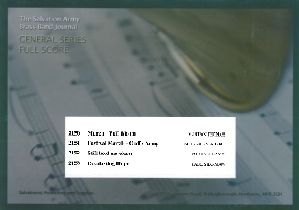
General Series Band Journal April 2016 Numbers 2154-2157
No. 2154 Cornet Solo - The victory cry! (Andrew Blyth)This solo features the popular song by Stuart Townend and Keith Getty entitled 'Power of the Cross', along with an original song by the composer, 'The Cross of hope'. It was originally written at the request of Staff Bandsman Gerry Todd and the Melbourne Staff Band.No.2155 Mission Force (Stephen Bulla)This is programmatic music, portraying the determination and forward vision of the modern church's mission. It includes two well-known hymns, 'Trentham' (T.B.159) and 'Slane' (T.B.831), using their words as metaphors that describe this quest into a spiritual future.No.2156 Prelude on 'Lavenham' (Geoffrey Nobes)An arrangement of a hymn, written by the composer with words by Reverend Nick Fawcett. The three statements of the melody correspond to three verses of the hymn and seek to reflect their meaning.No. 2157 On we march (Kevin Larsson)This piece was written for the Pasadena Tabernacle Band for their 120th anniversary. It includes a number of tunes closely connected with the Corps including 'Everything's coming up roses' from Gypsy, a song closely associated with the Rose Parade, and 'Hooray for Hollywood' as the Corps was previously called Hollywood Tabernacle. Continuing on the Rose Parade theme, 'On we march' (T.B.788) and the well-known hymn tune, 'Rachie' (T.B.190), are also featured.
Estimated dispatch 7-14 working days
-
 £54.95
Road to Run (Brass Band - Score and Parts)
The piece starts with a simple rhythmic pulse which is the basis of the entire work. This cell provides a platform for the piece to grow and develop starting with the first theme played by the euphoniums, all the way through to the conclusion performed in full gusto by the whole ensemble. The various motifs introduced throughout the opening of the piece are passed between the ensemble before the introduction of the three soloists.The central section of the piece features the Solo Trombone, Cornet and Euphonium as they take turns to play a jazz fusion solo whilst having some musical interplay with each other at the front of the stage. After this solo passage, the music then features the various sections within the ensemble, which pays homage to Weather Reports' famous "Birdland". In a jazz fused cannon, each new independent musical phrase is performed by the various sections standing. Starting with the Horns then Solo Cornets, Back Row and Flugal and finally the Baritones and Trombones.Once the different sections of the ensemble are featured, the piece then moves into the final stages. This section sees a reprieve of the opening material heard at the beginning, but further developed with the various melodic motifs passed around the ensemble. The ending builds on this material towards a rousing conclusion."Road to Run" is an up tempo, high energy concert work that has that 'feel-good factor' from start to finish. The idea behind the title is based on the feel and structure of the piece which takes the listener on a musical journey. And at 150 beats per minute - you could put it in your headphones and find your own 'Road to Run'.
Estimated dispatch 7-14 working days
-
 £89.95
Orion (Brass Band - Score and Parts)
Orion was named after the giant huntsman in Greek mythology and is a prominent constellation located on the celestial equator and visible throughout the world. It is one of the most conspicuous and recognisable constellations in the night sky. This piece and its inspiration were composed as a tone poem creating a musical picture of this amazing phenomenon.The opening introduces the constellation. Starting mysteriously with the percussion and basses this section develops a series of rhythmic and harmonic interludes from the upper brass. As this introduction develops, the melodic line lead by the Solo Cornet and Euphonium builds as the accompanying instruments increase in their rhythmic complexity. This section climaxes with a short fanfare motif which will be a prominent theme throughout this piece.The fast rhythmic section that follows serves as a technical test for the players. The thematic device introduced by the Solo Cornets is passed around various soloists and sections within the ensemble. This part of the tone poem gives the opportunity for the ensemble to highlight their technical prowess. The fanfare motif returns to conclude this section and takes the piece into the slow middle movement.Motifs heard earlier are mixed with new ideas in this slow section which give an opportunity for a variety of soloists to demonstrate their musical prowess. After the various solo passages and cadenzas, the mood shifts dramatically to a more ominous section that builds in texture and dynamic. Concluding with our returning fanfare motif the piece then builds in momentum towards our finale section.This finale is a technical showcase which will further test the playing ability and stamina of soloists, small groups and the full ensemble. Using prominent musical themes heard throughout this piece the music builds to a glorious conclusion fitting with wonderful constellation.
Estimated dispatch 7-14 working days
