
Results
-
 £56.00
January (Flugel Horn Solo with Brass Band - Score and Parts) - Fernie, Alan
Flugelhorn or Bb Cornet Solo with Brass Band
Estimated dispatch 7-14 working days
-
 £32.95
JOKER, The (Trombone solo with Brass Band) - Moss, Harold
Brass Band Set (inc. Solo Cornet Conductor)
Estimated dispatch 7-14 working days
-
 £20.00
Dance of the Blessed Spirits (Soprano Cornet/Brass Band) - Street, Allan
Soprano Cornet solo.
Estimated dispatch 7-14 working days
-
£49.95
HEJRE KATI (Wiffin) (Cornet/Brass Band) - Hubay, Jeno - Wiffin, Rob
A challenging cornet solo.
Estimated dispatch 7-14 working days
-
£33.00
Miss Marple Theme (Soprano Cornet/Brass Band)
Soprano Cornet Solo
Estimated dispatch 7-14 working days
-
£137.95
CABARET CONCERTO (Piano Solo with Brass Band - Score and Parts) - Ellerby, Martin
Includes: Harmony in Green and Rose; Variations in Pink and Grey; Nocturne in Blue and Silver; An Orange Note; Arrangement in White and Black (Cornet Solo); Caprice in Purple and Gold; symphony in White; Harmony in Blue. Duration: 20:00. Recorded on Polyphonic QPRL231D TERRA AUSTRALIS
Estimated dispatch 7-14 working days
-
 £79.95
The Plantagenets (Brass Band - Score and Parts) - Gregson, Edward
A Symphonic Study for Brass BandThe Plantagenets was Gregson's first major test piece, written specially for the 1973 National Brass Band Championships.In this ambitious symphonic study he turned his attention to music which sets out to create a mood or atmosphere, in contrast to his earlier brass band works such as Essay and Partita where the underlying concerns are technical rather than expressive. However, Gregson is at pains to emphasise that The Plantagenets is not programme music. 'Symphonic' is the optimum word here. In its textural and harmonic complexity, its rhythmic and melodic variety, this was his most ambitious brass band piece so far. His language, with its roots in Hindemith and Bartok is further enriched here with the expressive language of Holst and Rachmaninov.As he says in his notes on the work: The Plantagenets attempts to portray the mood and feelings of an age - that of the House of Plantagenet which lasted from the middle of the twelfth century to the end of the fourteenth. To many it conjures up an age of chivalry and this is represented by fanfare motifs which occur throughout the work in varied form.Characteristically, the composer then goes on to describe not the atmosphere or mood he is trying to convey, but the means by which the music has been composed: the opening fanfares, based on the interval of the third, generating the musical material for the whole work; an exposition of two themes - one fanfare-like, one lyrical (on horns); a slow episode introducing a new melody on solo horn (answered by cornet and euphonium in canon); a little scherzo, fugal in character; and a recapitulation leading to a maestoso statement of the slow movement theme with a final reference to the fanfares as a triumphant conclusion.Duration: 11.30
Estimated dispatch 7-14 working days
-
£39.95
The Plantagenets (Brass Band - Score only) - Gregson, Edward
A Symphonic Study for Brass BandThe Plantagenets was Gregson's first major test piece, written specially for the 1973 National Brass Band Championships.In this ambitious symphonic study he turned his attention to music which sets out to create a mood or atmosphere, in contrast to his earlier brass band works such as Essay and Partita where the underlying concerns are technical rather than expressive. However, Gregson is at pains to emphasise that The Plantagenets is not programme music. 'Symphonic' is the optimum word here. In its textural and harmonic complexity, its rhythmic and melodic variety, this was his most ambitious brass band piece so far. His language, with its roots in Hindemith and Bartok is further enriched here with the expressive language of Holst and Rachmaninov.As he says in his notes on the work: The Plantagenets attempts to portray the mood and feelings of an age - that of the House of Plantagenet which lasted from the middle of the twelfth century to the end of the fourteenth. To many it conjures up an age of chivalry and this is represented by fanfare motifs which occur throughout the work in varied form.Characteristically, the composer then goes on to describe not the atmosphere or mood he is trying to convey, but the means by which the music has been composed: the opening fanfares, based on the interval of the third, generating the musical material for the whole work; an exposition of two themes - one fanfare-like, one lyrical (on horns); a slow episode introducing a new melody on solo horn (answered by cornet and euphonium in canon); a little scherzo, fugal in character; and a recapitulation leading to a maestoso statement of the slow movement theme with a final reference to the fanfares as a triumphant conclusion.Duration: 11.30
Estimated dispatch 7-14 working days
-
 £59.99
Sanctuary (Brass Band - Score and Parts) - Sparke, Philip
Sanctuary was commissioned by Eastern Bay of Plenty Brass from New Zealand and was performed as an own choice piece at the 2018 New Zealand National Brass Band Championships. It opens with an expressive cornet solo, hymn-like in mood. A slightly faster central section builds to a change of key and an expansive return of the opening melody, this time scored for full band. After an emotional climax the mood subsides, leading to a quiet close.Duration: 3.30
Estimated dispatch 7-14 working days
-
 £59.99
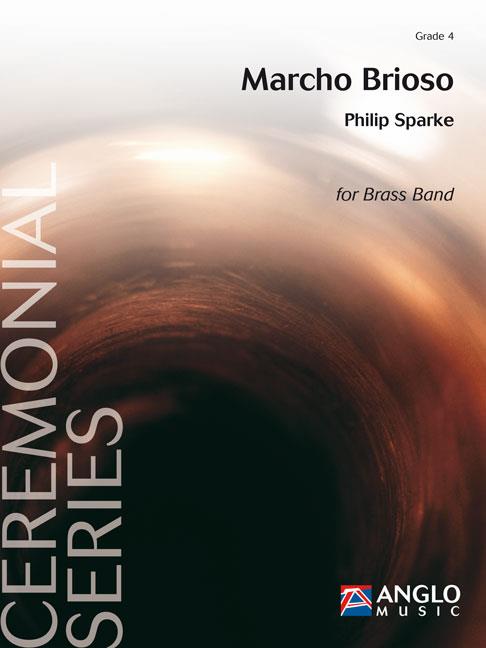
Marcho Brioso (Brass Band - Score and Parts) - Sparke, Philip
Marcho Brioso was commissioned by The Brioso Brass, a British-style brass band from Hokkaido, Japan. They gave the first performance in January 2012.The commission was for a bright and breezy march that the band could use as their theme tune, so Marcho Brioso falls into the composer's series of Broadway-style marches, which includes Slipstream, The Bandwagon and Jubiloso. After a short introduction a solo cornet plays the main theme, accompanied by a euphonium counter-melody. A secondary phrase from the horns and baritones leads to a tutti version of the main theme which is followed by the traditional 'bass' strain. A change of key heralds the trio section, which features a cantabile melody on euphonium; this is then taken up by the full band after a short bridge passage and further change of key. This takes us back to the home key which sees a quiet staccato version of the main theme lead to a recapitulation and a short coda which brings the march to a close.Duration: 3:45
Estimated dispatch 7-14 working days
 View Music