
Results
-
 £22.50
Edward Gregson: Concertante for Piano and Brass Band
DescriptionProgramme NoteThe Concertante for Piano and Brass Band was written in 1966, when the composer was an undergraduate student at the Royal Academy of Music in London. It received its first public concert performance in 1967 at the Royal Festival Hall, London, when the composer was the soloist with the International Band of the Salvation Army, conducted by Bernard Adams. It was one of the first major works to be written for this particular combination.The Concertante is unashamedly romantic in idiom and is in three movements: Prelude, Nocturne and Rondo. The Prelude is cast in sonata form and opens with a short cadenza-like flourish from the soloist, followed by two main ideas - the first sweepingly dramatic, the second highly lyrical. The interplay between these two themes forms the main focus of the movement, and after a return to the opening theme, an exuberant codetta brings the music to a close, albeit a quiet one. https://morthanveld.com/wp-content/uploads/2017/09/Gregson-Concertante-1st-movt-clip.mp3The tender Nocturne opens with an introduction from the band that contains precursors of the two main ideas to follow. The solo piano announces the main theme, which has a slightly 'bluesy' character with its flattened third and seventh notes of the scale, and is a love song dedicated to the composer's wife-to-be. The band enters with phrases of a chorale already hinted at in the introduction - Ray Steadman-Allen's hymn tune 'Esher' - but never quite presented in its complete state. Both ideas are developed alongside each other, with eventually the first theme returning, this time with piano and band together, and building to a majestic climax, before subsiding to a peaceful coda - a return to the very opening of the movement. https://morthanveld.com/wp-content/uploads/2017/09/Gregson-Concertante-movt-2-clip.mp3The final Rondo is full of energetic rhythms and changing time patterns. The main theme is playful in character, with much interplay between soloist and band, whilst the middle section presents a new theme, and one that has more than a hint of the hymn tune 'Onward Christian Soldiers', in what amounts to a good humoured parody. The opening Rondo theme returns, this time leading to a powerful and dissonant climax from the band. This is followed by an extended piano cadenza, underlying the virtuoso aspect of the work, and leading to an energetic and life-affirming coda, which brings the work to a triumphant conclusion. https://morthanveld.com/wp-content/uploads/2017/09/Gregson-Concertante-movt-3-clip.mp3Duration: 18 minutesInstrumentation:Please note that there is no 1st/Repiano Cornet part in this work. The 1st/Repiano Cornet player should join the Solo Cornet bench. As such an extra Solo Cornet part is provided in the set of parts.Version for two pianosA version of the Concertante for two pianos is available for rehearsal purposes. Piano 1 is the solo part and Piano 2 the band reduction. However, for those pianists not needing to rehearse the work in this way, a solo piano part is also provided with the main set of band parts.To view a preview of the solo part for the first movement click here.The youthful Gregson (his work was written as a third year undergraduate) was seemingly a bit of a musical magpie - but one heck of a skilful one at that.These were shiny baubles of poise, panache and pastiche, with affectionate, remarkably mature nods of appreciation towards Gershwin, Rachmaninov, Ireland and even Elmer as well as Leonard Bernstein.The rich colour palette and flowing lines (with the tenderest of central Nocturnes) were a joy - as were the little buds of motifs that dotted the score like seeds ready to be planted on a future fertile brass band compositional field. - Iwan Fox, 4Barsrest.com, June 2019For more information on Edward Gregson's music please visit the composer's website: www.edwardgregson.com
Estimated dispatch 7-14 working days
-
£59.95
MY STRENGTH, MY TOWER Rhapsodic Variations (Brass Band Set) - Dean Goffin
This music consists of a theme followed by five extensive variations. The theme is the composer's own tune set to the words, 'Thee will I love, my strength, my tower', a hymn by Johann Scheffler translated by John Wesley. A strong modal flavour is characteristic of the theme. Variation 1: This is a light and graceful variation with a good deal of imitative writing. It leads, without a break, into the next variation. Variation 2: Fire and ferocity are asked for in the course of this variation. Variation 3: This variation demonstrates the original approach of the composer. Solo lines for cornet and euphonium are included with their arabesques and arpeggii. Variation 4: Taking the form of a passacaglia, the 'ground' is given out at once by the basses. Fragments of the 'ground', plain or decorated, are combined and used in a number of ways, revealing the composer's mastery of counterpoint. Variation 5: The briskly moving and scintillating final variation abounds in sudden variations of dynamic. The tempo remains constant until an increase is called for in the coda. This 'contest' version has been prepared by Brian Bowen who was asked to re-work the percussion part and introduce a repiano cornet part (Salvation Army band publications do not, in general, have a part for repiano cornet).
Estimated dispatch 7-14 working days
-
 £59.95
Judd: My Strength My Tower - Contest Version
This music consists of a theme followed by five extensive variations. The theme is the composer's own tune set to the words, 'Thee will I love, my strength, my tower', a hymn by Johann Scheffler translated by John Wesley. A strong modal flavour is characteristic of the theme. Variation 1 This is a light and graceful variation with a good deal of imitative writing. It leads, without a break, into the next variation. Variation 2 Fire and ferocity are asked for in the course of this variation. Variation 3 This variation demonstrates the original approach of the composer. Solo lines for cornet and euphonium are included with their arabesques and arpeggii. Variation 4 Taking the form of a passacaglia, the 'ground' is given out at once by the basses. Fragments of the 'ground', plain or decorated, are combined and used in a number of ways, revealing the composer's mastery of counterpoint. Variation 5 The briskly moving and scintillating final variation abounds in sudden variations of dynamic. The tempo remains constant until an increase is called for in the coda. This 'contest' version has been prepared by Brian Bowen who was asked to re-work the percussion part and introduce a repiano cornet part (Salvation Army band publications do not, in general, have a part for repiano cornet).
Estimated dispatch 7-14 working days
-
Trumpet Tune and Air - Clarke, Purcell - Len Jenkins
Wobbleco Music is pleased to offer a new arrangement of the famous 'Trumpet Tune in D' for full brass band featuring a soprano cornet solo. The tune is often attributed to Henry Purcell, but in fact was the result of a joint musical production by Jeremiah Clarke and Daniel Purcell (Henry Purcell's younger brother), hence the confusion. For bands that do not have a soprano cornet player, we also include an alternative solo part written for Bb cornet. To complement this, we also include a soprano cornet part in Eb, for use when the band has a soprano player but who is not the featured soloist. Recognising its popularity for weddings and special occasions, where a full band may be impractical for space or availability reasons, we have also produced a quintet edition, which is available as a separate publication from Wobbleco Music.
-
 £35.00
Edward Gregson: Fanfare for a New Era (for Brass Band)
DescriptionComposer's NoteThe Fanfare has been designed to be partly antiphonal, with four separate brass 'choirs' initially playing their own music, and so some spatial separation is desirable. Soprano and solo cornets should be placed centrally, standing behind the rest of the band - or in some venues could even be placed off-stage in a side balcony, but still close to the band. If the Fanfare is played by a contesting size band, one of the solo cornets should play the 1st cornet part together with the usual player ie the number of players on the 1st, 2nd, and 3rd cornet parts should be equal. Otherwise the number of players in each of the two cornet 'choirs' is at the discretion of the conductor. The Tubular Bells accompanying the cornets 1-3 group should be placed close to that group. See inside back cover for suggested band formation.The style of playing should replicate that of symphonic brass, with a minimum of vibrato and with long notes being sustained without decaying.Programme NoteCommissioned in 2020 by Youth Brass 2000, Fanfare for a New Era was designed to be partly antiphonal - thus the separation of the band into four brass 'choirs', each with their own percussion accompaniment. First, soprano and solo cornets, rather like heraldic trumpeters, announce the main idea, majestic in character. Then horns, baritones, and euphoniums, with timpani, enter with stately figurations. Next, the heraldic trumpeters usher in trombones and tubas, to the accompaniment of tom-toms and snare drum, presenting a faster and rhythmic dance-like theme. Finally, the remaining cornets amplify the pealing of bells. All four elements then come together, surrounding the audience with a 'joyful noise' of festive brass and percussion.The original symphonic brass version of this fanfare can be purchased as part of a set of Three Fanfares HERE.For more information on Edward Gregson's music please visit the composer's website: www.edwardgregson.com
Estimated dispatch 7-14 working days
-
 £39.95
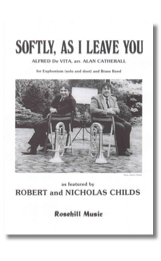
Softly, As I Leave You - Alfred de Vita arr. Alan Catherall
Made popular by many singers over the years, this lovely song was first arranged for the Childs brothers as a solo, and later a duet, by Alan Catherall. It was first performed in the duet version at the Royal Albert Hall, London, in October 1985, conducted by their late father, John Childs. Also available with piano Brass Band Set comprises: Detailed condensed conductor score Solo B-flat Euphonium B-flat Euphonium Duet (2) E-flat Soprano Cornet Solo B-flat Cornet (4) 2nd B-flat Cornet (2) 3rd B-flat Cornet (2) B-flat Flugelhorn* Solo E-flat Horn* 1st E-flat Horn* 2nd E-flat Horn 1st B-flat Baritone 2nd B-flat Baritone 1st B-flat Trombone 2nd B-flat Trombone Bass Trombone B-flat Euphonium (2) E-flat Bass (2) B-flat Bass (2) 1st Percussion 2nd Percussion 3rd Percussion (Drum Kit) * Alternative parts for use as solo or duet provided. There is no Repiano Cornet part.
Estimated dispatch 7-9 working days
-
 £150.00
Brass Quintet Collection - Various - Lawrence Killian
20 Titles for Brass Quintet with Optional AugmentationFeaturing stylish arrangements using a flexible format for a minimum of five brass players, this set of music for small ensemble covers a wide range of composers and styles. The collection includes music by Purcell, Bach, Verdi, Gounod, Sousa, Joplin, Botsford, Elgar, Gershwin, and others.Using a unique approach to the scoring, the basic setup is for five players: two cornets/ trumpets, one horn, one trombone, and one bass tuba. Two optional "augment" players can be added using the "flugelhorn", and/ or the "Euphonium" parts. Further expansion of the ensemble is possible by adding multiple players to each part.Twelve parts are provided in total: 1st Bb Cornet, 2nd Bb Cornet, Eb Tenor Horn, French Horn in F, Bb Trombone or Baritone in treble clef, C Trombone in bass clef, EEb Bass, BBb Bass, C Tuba in bass clef, Bb Flugelhorn or Cornet (augment part 1), Bb Euphonium or Baritone (augment part 2), C Euphonium or Trombone in bass clef (augment part 2).A Full score is available seperately at a cost of �35.00. Please contact [email protected] to order. NOTE: Individual books are priced at �20.00 each. Please email [email protected] to order individual books. Videos of these works being performed are available below:- Asturias (Leyenda) from Suite Espanola No.1, Isaac AlbenizBerceuse from "Jocelyn", Benjamin Godard TITLES INCLUDED:- 1. Asturias (Leyenda) from Suite Espanola No.1, Isaac Albeniz 2. Bist du bei mir (Be Thou with Me), J. S. Bach3. Chatterbox Rag, George Botsford4. Grizzly Bear Rag, George Botsford5. Jubilee Fantasy on God Save the King, Bernhard Brahmig 6. Chanson de Matin, Sir Edward Elgar 7. Pomp and Circumstance March No. 4, Sir Edward Elgar 8. But Not For Me, George Gershwin 9. By Strauss, George Gershwin10. They All Laughed, George Gershwin11. Berceuse from "Jocelyn", Benjamin Godard12. JUDEX - from "Mors et Vita", Charles Gounod 13. The Entertainer (Rag), Scott Joplin14. Intermezzo No.2, Vasily Sergeyevich Kalinnikov 15. Berliner Luft, Paul Lincke 16. Sound the Trumpet, from "Come Ye Sons of Art", Henry Purcell 17. Gymnopedie No.1, Erik Satie 18. The Liberty Bell March, John Philip Sousa 19. Tritsch-Tratsch Polka, Johann Strauss II 20. Grand March from the opera Aida, Giuseppe Verdi
In Stock: Estimated dispatch 1-3 working days
-
 £29.50
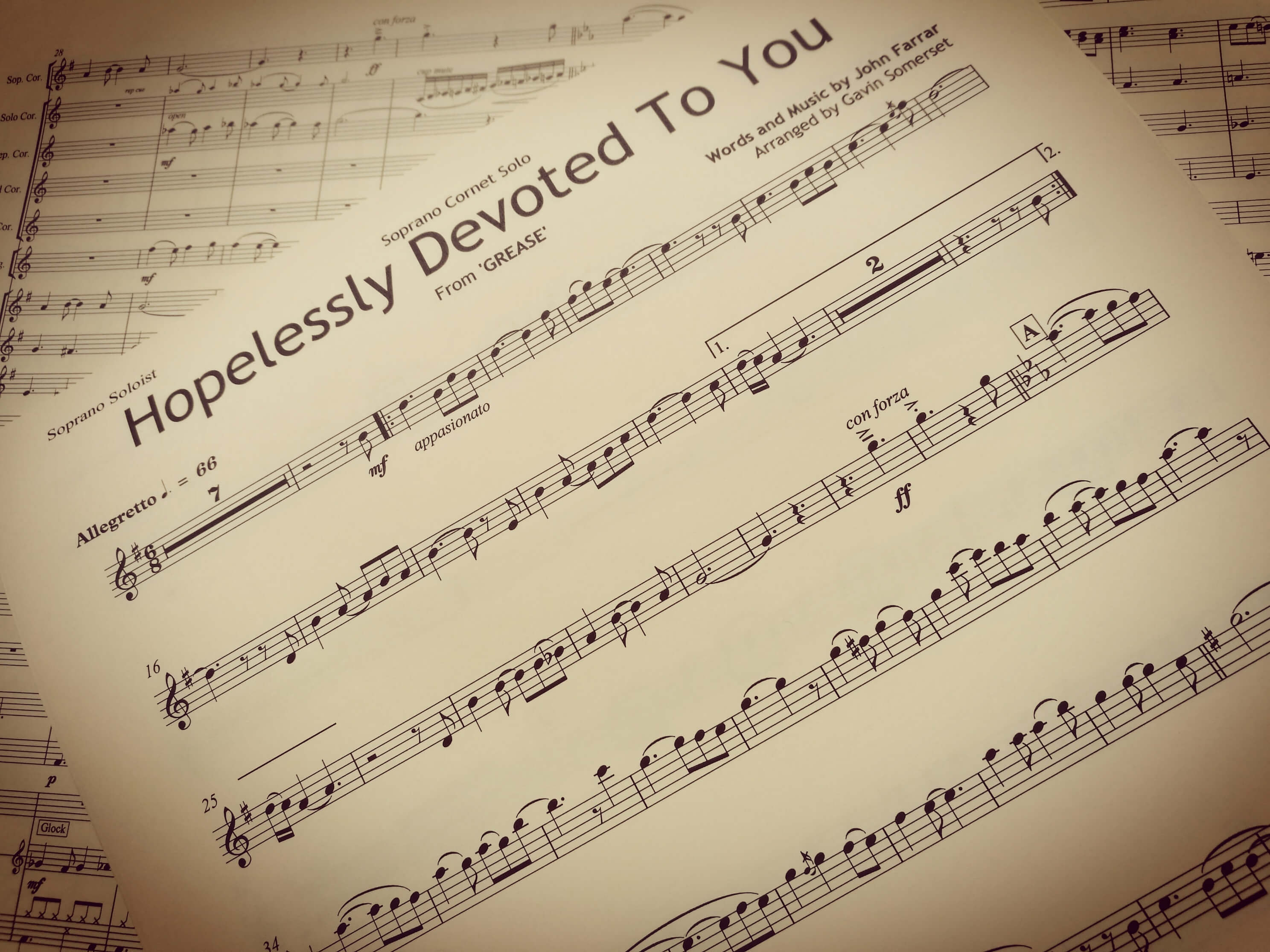
Hopelessly Devoted To You - John Farrar - Gavin Somerset
With Grease celebrating its 40th anniversary this year, this new Soprano Solo comes at the perfect time. The song was written by John Farrar, as the contractually agreed vocal solo for Olivia Newton-John to perform in the film. With simple accompaniments and a song well-known by audiences of all ages, this title is the perfect choice for Soprano players looking to combine their lyrical playing with power in the top register (highest note top C). A must have in the repertoire for soprano cornet soloists. **An alternate lower soloist part is also provided with this publication. FREE SOLOIST PART: CLICK HEREFREE ALTERNATE SOLOST PART: CLICK HERE To download the playback audio to play along to, please RIGHT CLICK HERE & Save As .
In Stock: Estimated dispatch 1-3 working days
-
 £44.50
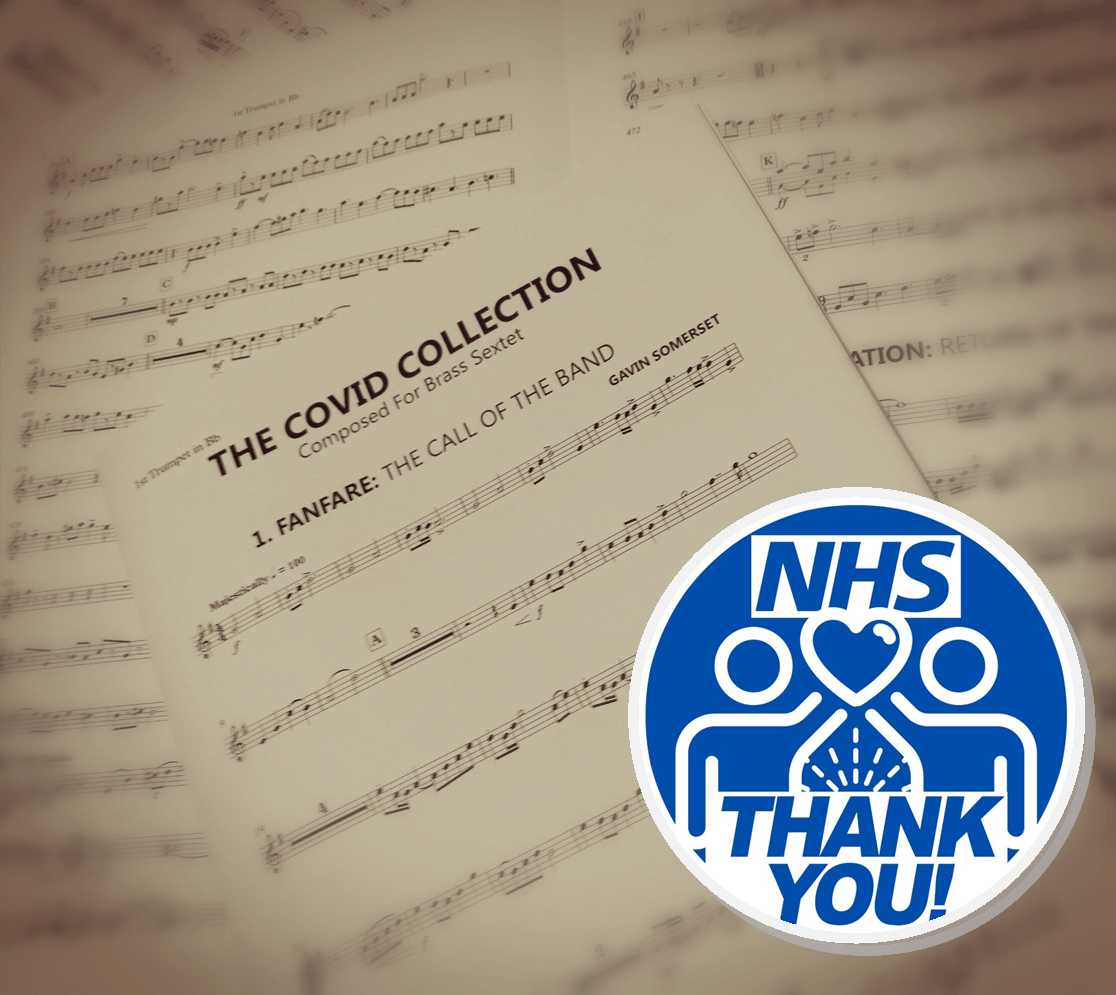
The Covid Collection - Gavin Somerset
This exciting new 22-minute concert suite for Brass Sextet has been composed during the months of lockdown charting the feelings of a nation, with seven movements playable by 6 (or more) players. The music was composed with the intention for players to perform either together live in a small group, in isolation by way of a virtual performance (downloadable backing tracks are available to play along to) and ultimately, to give players something to enjoy as we all miss our brass band families. This concert suite is the perfect addition to all bands' libraries at a time when rehearsals are limited. Several of the movements are already in preparation for a full band edition to be released at a later date: (also available as a digital download worldwide - purchase now & print to play). Bands purchasing this sextet edition will be eligible for a discount on the upcoming full brass band edition of the concert suite. ------------------------------------------------------------------------------------- Movement 1: FANFARE: The Call of the Band - CLICK HERE TO DOWNLOAD PLAYBACK TRACK This opening fanfare gives way to a full of life and energy. With catchy melodies and harmonies, it is an effective opening to any concert programme and the perfect way to begin the Suite. Movement 2: March of the Antibodies - CLICK HERE TO DOWNLOAD PLAYBACK TRACK A cheeky little number that keeps on fighting though. Whilst not a March in the traditional brass band sense, players should aim to give a 'happy' performance of this movement ensuring smiles all around for both performers and the audience.Movement 3: Solidarity - CLICK HERE TO DOWNLOAD PLAYBACK TRACK The first slow movement of the concert suite aims to reflect on the isolation many of us felt during the time of lockdown. However, during these times, walks out with loved ones allowed many to connect and enjoy downtime, not often afforded to many. Movement 4: Lazy Days - CLICK HERE TO DOWNLOAD PLAYBACK TRACK A movement whose title really does say it all. A laid back swing number that should be played in an as relaxed manner, as possible!Movement 5: Hymn for Carers (Dedicated to the NHS & Care Workers) - CLICK HERE TO DOWNLOAD PLAYBACK TRACK Dedicated to the NHS & Care Workers, this hymn tune is filled with emotional highs and lows, felt by many of the hospital and care staff who worked tirelessly to keep our people safe, with a timely nod at the end to Vera Lynn & our missed VE day commemorations. Movement 6: Army of the Keyworkers - CLICK HERE TO DOWNLOAD PLAYBACK TRACK A stirring work in 12/8 which rightfully, depicts our heroes who kept the country moving through the most difficult of times. An heroic number for players to enjoy.Movement 7: CELEBRATION: Return of the Band - CLICK HERE TO DOWNLOAD PLAYBACK TRACK Little needs to be said about this movement, as at this time of release, we cannot yet celebrate the return of all players to the band rooms across the country. However, when that time comes, this movement is to be played with the joy of normality we shall all feel. CLICK HERE TO DOWNLOAD THE FULL SUITE BACKING TRACK ------------------------------------------------------------------------------------- Each movement can be performed as a standalone item, or form part of the full 22-minute concert suite. Sextet scored for: x1 Cornet I in Bbx1 Cornet 2 in Bb1x Flugelhorn1x Tenor Horn in Eb1x Euphonium/Baritone in Bb1x Eb Bass*extra parts included are, Cornet parts in Eb & C, Horn in F, Euphonium/Baritone in BC, Trombone (TC and BC), BBb Bass in TC & Tuba in BC.
In Stock: Estimated dispatch 1-3 working days
-
£24.50
Farondole - Bizet - Alan Beaumont
This famous movement from Bizet's highly popular suite has long been a favorite with brass bands and their audiences alike. This new arrangement now includes better percussion parts (including timpani) and some lovely grace notes for Baritone and Repiano. The Cornet section is also arranged unusually as it is written for 3 players to play the Repiano part and 2 players to play the Solo Cornet line. A wonderful effect.
In Stock: Estimated dispatch 1-3 working days
 View Music