
Results
-
 £59.77
We Seven (Brass Band) Derek Jenkins
We Seven, the title of this work, comes from a book by the same name written by the United States's first astronauts. The composer writes: 'In 1959, the United States entered the space race by starting a programme whose main aims included sending a solo astronaut into space and recovering him safely. Project Mercury, as this programme was so called, recruited the first seven American astronauts and successfully sent six of them into space. These men were Scott Carpenter, Gordon Cooper, John Glenn, Gus Grissom, Wally Schirra, Alan Shepard, and Deke Slayton, and collectively they became known as the 'Mercury Seven.' Through their efforts and those of countless others, the United States Space Program accomplished much with these six flights, including successfully sending an astronaut into space, putting a man in orbit, and keeping him up there for more than 24 hours. In 1962, shortly after Glenn and Carpenter's orbital flights, the 'Mercury Seven' co-wrote the book We Seven and throughout it, the astronauts discuss the events leading from their selection into the programme up through Carpenter's flight in May of 1962. The primary material for the work comes from two sources: the use of musical cryptograms to encode the astronauts names and initials into pitches and the aria 'Un bel di vedremo' from Giacomo Puccini's opera, Madame Butterfly. The inclusion of the latter comes directly from one of Glenn's chapters in the book. Together with a couple of the other astronauts, he would often listen to the opera to unwind from a long day of training. I would like to think that as he was orbiting the Earth that this opera, particularly this aria, would be running through his mind.' This work commemorates the Project Mercury on the 50th anniversary of its conclusion and was written for Joseph Parisi and the University of Missouri-Kansas City Wind Ensemble. This version for brass band has been prepared by the composer for the Fountain City Brass Band. To view a video of Fountain City Brass Band performing the work please visit: www.youtube.com/watch?v=yD3sBWhGkOo Sheet music available from: UK - www.brassband.co.uk USA - www.solidbrassmusic.com Difficulty Level: 1st Section + Instrumentation: 1 Soprano Cornet (Eb) 9 Cornets (Bb) [Both 3rd Cornets double Crystal Glasses] 1 Flugelhorn 3 Tenor Horns (Eb) [2nd Horn doubles Crystal Glasses] 2 Baritones (Bb) 2 Trombones (Bb) 1 Bass Trombone 2 Euphoniums (Bb) 2 Basses (Eb) 2 Basses (Bb) 4 Percussion
In Stock: Estimated dispatch 1-3 working days
-
 £34.95
Behold the Power of God - Christopher Bond
Behold the Power of God (2010) was written for and premiered by the Cornwall Youth Brass Band in dedication to their Musical Advisor at the time; the late Cornish composer Goff Richards who later described the work as 'a remarkable piece of writing'. The work's title, while implying a religious meaning, actually references Goff's name, with his full name Godfrey translating as 'God-peace' and Richards meaning 'Power'. Two energetic outer sections fall either side of a more lyrical middle section featuring the solo cornet. The perfect opening item at any concert.
Estimated dispatch 10-14 working days
-
 £79.95
Grieg Variations - Jonathan Bates
DURATION: 12'30". DIFFICULTY: 2nd+. . 'Grieg Variations' is a through-composed work in the traditional style of a 'theme & variations'. The work opens with the main melodic fragment featured throughout Grieg Variations which comes from Grieg's Peer Gynt Suite No.2; the final movement - 'Solveig's Song'. . This theme is followed by a set of 9 variations, each taking inspiration from various melodies and styles found within the Peer Gynt Suite. The first variation, a light-footed scherzo based upon the tonal line of Solveig's Song is followed by an 'Alla marcia' variation - in which the music is inspired by the 2nd movement - 'Arab Dance' - of the original suite. The 3rd variation takes a far darker and more aggressive turn in a variation set around the music of the 1st movement of the Peer Gynt Suite before a relaxation into a solemne revisiting of the original theme. Opening with a sombre and longing solo for Flugel horn, the focal point of this 4th variation is an extended solo for the Solo Euphonium, marked 'molto espressivo'. The new material here is used as a theme throughout this variation, being reprised by the full band immediately after as the music builds to a climax point at the top of the musical line. . Following this, there are 2 cadenzas for the Solo Horn and Solo Cornet respectively; the former inspired by the thematic material of Solveig's Song, and the latter from the Oboe cadenza at the beginning of Grieg's '2 Lyric Pieces, Op.68'. These cadenzas lead swiftly into the 7th variation, a bustling rhyhm-driven movement set in complex time. The 3rd movement of the Peer Gynt Suite No.2 - 'Peer Gynt's Homecoming' - makes it's first appearance in variation 8 in a triumphant battle-like setting before a combination of both this material and the Solveig's Song combine to bring Grieg Variations to it's close -not without a little nod to potentially Grieg's most famous work - In The Hall of the Mountain King. . .
In Stock: Estimated dispatch 1-3 working days
-
£60.00
Manchester Concertino - Peter Meechan
Manchester Concertino is a concertino in three movements for trumpet or cornet. It was written in late summer/early autumn in, as the title suggests, Manchester, UK.The first movement, Fanfare, was written for Belgian cornetist Harmen Vanhoorne, and explores the main musical idea behind the piece, a minor third. The loud fanfare gives way to a cadenza over a timpani roll, before a reprise of the opening fanfare.The second movement, Dream, was commissioned by Keith Johnson and is dedicated to Jess Tredrea. It is a slow, lilting, movement - almost as if the listener was hearing the piece through a summer haze.The final movement is simply titled Finale and is dedicated to Roger Webster. New material is fused with the fanfare from the opening movement leading to a climatic finish to the work.
Estimated dispatch 12-14 working days
-
£70.00
Milestone - Peter Meechan
Milestone is a concerto commissioned by Mark Wilkinson (with funds provided by the Arts Council England) to celebrate 21 years as Principal Cornet with Fodens Band. In three movements, the work is intended to not only demonstrate the soloistas virtuosic skills, but also his ability to communicate to the audience.The first movement, titled Milestone, combines sections of driving rhythms (intended to represent Markas years of continuing hard work), in the accompaniment with long legato phrases from the soloist interspersed with dexterous, virtuosic, passages.The second movement, Song, features a simple chord sequence, over which the soloist asingsa a melody, each time varying and each time becoming more expressive, leading to an emotional climax.The final movement, Twenty One, is a quasi-celebratory dance. Opening with the band clapping, the soloist weaves their way through the various textures in the band. Occasionally making both a musical and metaphorical nod to the industrious nature of the first movement, the chord sequence of the second movement also re-appears, before a brief coda takes us to the conclusion of the work.
Estimated dispatch 12-14 working days
-
 £15.00
Anvil Chorus from Il Trovatore - Verdi
Programme Notes from Andrew Duncan:Like many of the arrangements in the Flexi-Collection - Popular Classics Series I have simplified the rhythms and time signature, etc. I have also omitted trills for ease of playing.Dynamics form a very important aspect of this arrangement and it is important to observe these, especially the p markings. Every dynamic from p through to ff is used as well as some crescendos.The 1st Cornet/Trumpet part is perhaps more difficult than in some of the other arrangements in the series, but the other parts are fairly simple in comparison.The Percussion part (which is optional) is unusual in that it calls for two 'Anvils' to be played. However if these are not available then a good effect can be obtained by hitting two pieces of metal with metal hammers.The Flexi-Collection ApproachFlexible scoring tailored to your needs - A perfect solution for expanding the repertoire of training and junior brass bands. The Flexi-Collection currently offers two series - Popular Classics and World Tour. Based on four-part harmony, these collections provide groups with the advantage of complete flexibility when they may not be balanced. If players or instruments are missing, the show can still go on!The Flexi-Collection - Popular Classics Series, encapsulates all that is great about the wonderful range of musical styles produced by Holst, Elgar, Handel, Verdi, Tchaikovsky, Grieg, Bizet and Parry.The thoughtful scoring and arranging by Andrew Duncan now means that groups of all abilities have access to a truly flexible set of music for their needs. With world parts, rudimentary theory, terminology translations and large format typesetting, The Flexi-Collection ticks all the boxes when it comes to bringing interesting music to the training and junior band/brass group environment.Available for Brass Band - The Flexi-Collection offers flexibility in every sense of the word.(Available individually or as part of the money-saving Flexi-Collection Popular Classics Album)
In Stock: Estimated dispatch 3-5 working days
-
 £30.00
Dance, Dance - Lucy Pankhurst
Lucy Pankhurst skillfully demonstrates her talent for developing a simple melody into a great fully-fledged concert item.This fun piece starts as a single cornet line, the melody builds throughout the band, harmonically developing and holds fantastic interest with musical surprises around every corner.
In Stock: Estimated dispatch 3-5 working days
-
 £15.00
Jerusalem - Parry
Programme Notes from Andrew Duncan:This is one of the more difficult arrangements in the Flexi-Collection Popular Classics Series, and as such will be best attempted after the easier ones have been mastered.The arrangement can be played all the way through as a solo piece or with a number of players playing the 1st Cornet/Trumpet part.The percussion part is very minimal in this arrangement (only 3 notes forthe suspended cymbal) and is an optional part.The Flexi-Collection ApproachFlexible scoring tailored to your needs - A perfect solution for expanding the repertoire of training and junior brass bands. The Flexi-Collection currently offers two series - Popular Classics and World Tour. Based on four-part harmony, these collections provide groups with the advantage of complete flexibility when they may not be balanced. If players or instruments are missing, the show can still go on!The Flexi-Collection - Popular Classics Series, encapsulates all that is great about the wonderful range of musical styles produced by Holst, Elgar, Handel, Verdi, Tchaikovsky, Grieg, Bizet and Parry.The thoughtful scoring and arranging by Andrew Duncan now means that groups of all abilities have access to a truly flexible set of music for their needs. With world parts, rudimentary theory, terminology translations and large format typesetting, The Flexi-Collection ticks all the boxes when it comes to bringing interesting music to the training and junior band/brass group environment.Available individually or as part of the money-saving Flexi-Collection Popular ClassicsAlbum.Scored for Brass Band and supplied with additional Easy Bb, Easy Eb and world parts - The Flexi-Collection offers flexibility in every sense of the word.
In Stock: Estimated dispatch 3-5 working days
-
 £77.00
General Series Brass Band Journal, Numbers 2250 - 2253, December 2024
2250: Prelude on 'Rhosymedre' (Ralph Vaughan Williams trs. Douglas Engle)The English composer Ralph Vaughan Williams' work Three Preludes (founded on Welsh Hymn Tunes) was published for the organ in 1920. This is a transcription of the second movement of that work. The words associated with the hymn tune are by Samuel Crossman, My song is love unknown (S.A.S.B. 149), and vividly depict the events of Holy Week. The music is gentle and solemn and would be appropriate for a Good Friday service or as a moment of repose in a concert. 2251: Hosanna Shuffle (Sam Creamer)The half-time shuffle groove is a popular feel developed by alternative rock/pop bands of the 1980s. It marries elements of rock and swing styles together to form a new and infectious feel - Hosannah Shuffle being written as a tribute to this fusion of musical styles. Contrary to a swing style, shuffle brings the pulse back onto the beat while maintaining the swung quaver rhythms to create a rock-type rhythmic drive. 2252: Everlasting Love (Keith Manners)This piece was written for the London North East Music School in 2004. The theme of the week was 'Making a stand for Christ', reminding the school that it only takes one person to make such a stand before others follow. The music starts with a lone Solo Cornet playing the melody of Graham Kendrick's song Such Love (S.A.S.B. 199). One by one, other parts join in with the theme.2253: Festival March (Michael Cooper)This piece represents the first published brass composition of Bandmaster Michael Cooper, who is the Bandmaster at Brisbane City Temple Corps. This imposing festival march features the tunes I want to be a soldier (T.B. 683), Lift up the banner (T.B. 90) and My Jesus, I love thee (T.B. 506). These tunes depict the idea that spiritual warfare is an essential component of one's faith, success of which is articulated in the final verse of My Jesus, I love thee (S.A.S.B. 878).
Estimated dispatch 7-14 working days
-
 £60.00
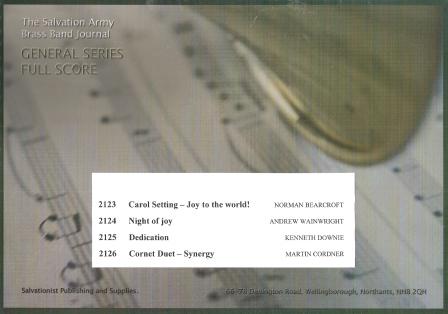
General Series Band Journal August 2013 Numbers 2123-2126
No. 2123 Carol Setting - Joy to the world! (Lieut. Colonel Norman Bearcroft)'Joy to the world' is a melody often attributed to Handel, but it is a bringing together of a couple of brief snippets of themes from his oratorio, 'Messiah'. These were put together by Lowell Mason to form the tune, 'Antioch', which we use for this carol. The carol has been arranged in majestic style by Lieut-Colonel Norman Bearcroft.No. 2124 Night of Joy (Andrew Wainwright)'Night of Joy' is based on a traditional Spanish Christmas song entitled 'Cantemos a Maria' ('Let's sing to Mary').No. 2125 Dedication (Dr Kenneth Downie)A setting of Colonel Brindley Boon's beautiful song of dedication, 'I dedicate myself to thee' (Musical Salvationist, November 1950).No. 2126 Cornet Duet - Synergy (Captain Martin Cordner)This piece celebrates the Biblical principle of believers working together in the Body of Christ and incorporates the song with words by Catherine Baird 'We're in Gods Army and we fight together with the composers own melody to Philip Paul Bliss's words 'Whosoever heareth! shout, shout the sound.
Estimated dispatch 7-14 working days
 View Music