
Results
-
 £10.00
HYMN TO BAROSSA (Brass Band Score) - Scott, Andy
Brass Band score only. Scored for brass band (without percussion), 'Hymn to Barossa' is a re-scoring by the composer of the hymn section from 'Battle of Barossa'. This new arrangement is a melancholy and melodic hymn that mid-piece features a poignant cornet solo. 'Hymn to Barossa' gradually builds, but deliberately only so far, and is a statement of controlled emotions. Dur: 2:30
Estimated dispatch 7-14 working days
-
 £59.95
Concerto Grosso (Brass Quartet with Brass Band - Score and Parts) - Gregson, Edward
Concerto Grosso was commissioned in 1972 by the Scottish Amateur Music Association for the National Youth Brass Band of Scotland.I took as my starting point the 18th century concerto grosso form with its element of contrast between small and large instrumental forces. The concertino (solo) group consists of cornet, horn, trombone and euphonium. The work is cast in one continuous movement (the old concerto grosso was often in three or more). The single movement is cast in the arch-like version of the ritornello form which was the mainstay of the baroque concerto. There are three main episodes which alternate with the ritornello and these exploit slow lyrical melodies as well as more rhythmically charged music. The final coda contrasts the ritornello material with the concertino group's own material, bringing the work to a resounding conclusion.- Edward GregsonDuration: 8.00
Estimated dispatch 7-14 working days
-
 £79.95
The Plantagenets (Brass Band - Score and Parts) - Gregson, Edward
A Symphonic Study for Brass BandThe Plantagenets was Gregson's first major test piece, written specially for the 1973 National Brass Band Championships.In this ambitious symphonic study he turned his attention to music which sets out to create a mood or atmosphere, in contrast to his earlier brass band works such as Essay and Partita where the underlying concerns are technical rather than expressive. However, Gregson is at pains to emphasise that The Plantagenets is not programme music. 'Symphonic' is the optimum word here. In its textural and harmonic complexity, its rhythmic and melodic variety, this was his most ambitious brass band piece so far. His language, with its roots in Hindemith and Bartok is further enriched here with the expressive language of Holst and Rachmaninov.As he says in his notes on the work: The Plantagenets attempts to portray the mood and feelings of an age - that of the House of Plantagenet which lasted from the middle of the twelfth century to the end of the fourteenth. To many it conjures up an age of chivalry and this is represented by fanfare motifs which occur throughout the work in varied form.Characteristically, the composer then goes on to describe not the atmosphere or mood he is trying to convey, but the means by which the music has been composed: the opening fanfares, based on the interval of the third, generating the musical material for the whole work; an exposition of two themes - one fanfare-like, one lyrical (on horns); a slow episode introducing a new melody on solo horn (answered by cornet and euphonium in canon); a little scherzo, fugal in character; and a recapitulation leading to a maestoso statement of the slow movement theme with a final reference to the fanfares as a triumphant conclusion.Duration: 11.30
Estimated dispatch 7-14 working days
-
£39.95
The Plantagenets (Brass Band - Score only) - Gregson, Edward
A Symphonic Study for Brass BandThe Plantagenets was Gregson's first major test piece, written specially for the 1973 National Brass Band Championships.In this ambitious symphonic study he turned his attention to music which sets out to create a mood or atmosphere, in contrast to his earlier brass band works such as Essay and Partita where the underlying concerns are technical rather than expressive. However, Gregson is at pains to emphasise that The Plantagenets is not programme music. 'Symphonic' is the optimum word here. In its textural and harmonic complexity, its rhythmic and melodic variety, this was his most ambitious brass band piece so far. His language, with its roots in Hindemith and Bartok is further enriched here with the expressive language of Holst and Rachmaninov.As he says in his notes on the work: The Plantagenets attempts to portray the mood and feelings of an age - that of the House of Plantagenet which lasted from the middle of the twelfth century to the end of the fourteenth. To many it conjures up an age of chivalry and this is represented by fanfare motifs which occur throughout the work in varied form.Characteristically, the composer then goes on to describe not the atmosphere or mood he is trying to convey, but the means by which the music has been composed: the opening fanfares, based on the interval of the third, generating the musical material for the whole work; an exposition of two themes - one fanfare-like, one lyrical (on horns); a slow episode introducing a new melody on solo horn (answered by cornet and euphonium in canon); a little scherzo, fugal in character; and a recapitulation leading to a maestoso statement of the slow movement theme with a final reference to the fanfares as a triumphant conclusion.Duration: 11.30
Estimated dispatch 7-14 working days
-
 £69.95
Concerto for Horn (Horn Solo with Brass Band - Score and Parts) - Gregson, Edward
Horn in F with Brass BandComposed in 1971 for Ifor James, the Concerto for French Horn and Band revealed some of those elements that have made Gregson's music so popular with audiences (and not just brass band audiences) worldwide: the boldness of his melodies, with the interval of the fourth revealing his admiration for the music of Paul Hindemith; his incisive rhythms, betraying the influence of another favourite composer, Bla Bartk; an admirable economy of means; and the clarity of his scoring.Each of the Concerto's three movements displays a different facet of the French Horn's character. The first is serious, symphonic in impulse, the rising fourths of the opening gesture giving the music an almost Germanic weight. In the slow movement, the soloist becomes the first among equals, sharing with the cornet soloist some typically haunting melodies. The lyrical flow is interrupted at the mid-point by mysterious, fleet-of-foot cadenzas. A rondo finale brings the concerto to a light-hearted conclusion. The rising fourths here are the impulse for a jaunty theme which reveals another of Gregson's early influences - William Walton, and in particular that composer's Partita for orchestra.Duration: 18.00
Estimated dispatch 7-14 working days
-
 £37.95
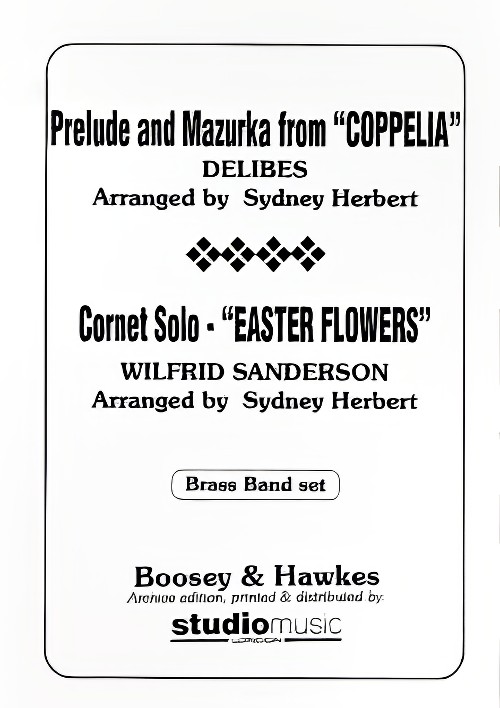
Prelude and Mazurka (from Coppelia)/Easter Flowers (Brass Band Set) - Delibes & Sanderson - Herbert, Sydney
This work is a Double Number. Prelude and Mazurka is a Brass Band Classical Transcription and Easter Flowers is a Cornet Solo with Brass Band.
Estimated dispatch 7-14 working days
-
 £29.95
Laudate Dominum (Cornet Solo with Brass Band - Score and Parts) - Mozart, Wolfgang Amadeus - Norbury, Kevin
Originally composed by Mozart in 1780 from the Vesperae ples de Confessore, this setting of the shortest of the psalms, Psalm 117, has an ethereal quality. It seems to express something of the beauty of God and of his love in creation. This work has been beautifully transcribed for brass and soloist by Kevin Norbury. Duration: 5.00
Estimated dispatch 7-14 working days
-
 £29.95
Love Song (Cornet Solo with Brass Band - Score and Parts) - Downie, Kenneth
Kenneth Downie is not only a fine brass band composer but has a noted catalogue of excellent choral works. Love Song was originally written as a vocal piece, and this arrangement was especially written for Philip Cobb. Duration: 5.15
Estimated dispatch 7-14 working days
-
 £29.95
Prayer of Childhood (Cornet Solo with Brass Band - Score and Parts) - Condon, Leslie
Leslie Condon made a huge impact on the lives of many he encountered. His compositions ranged from extended brass works to simple choral songs. Prayer of Childhood, originally composed for children to sing, is based on the verses which commence 'Gentle Jesus, meek and mild'. The simplicity of the melodic line is its strength and compliments the text so beautifully. Duration: 2.30
Estimated dispatch 7-14 working days
-
 £56.00
Take Me Back (Eb Bass Solo with Brass Band - Score and Parts) - Scott, Bennett - Fernie, Alan
Take Me Back to Dear Old BlightySlightly reduced Brass Band instrumentation (no rep cornet, no 2nd horn, no 2nd trombone part)
Estimated dispatch 7-14 working days
 View Music