
Results
-
 £45.00
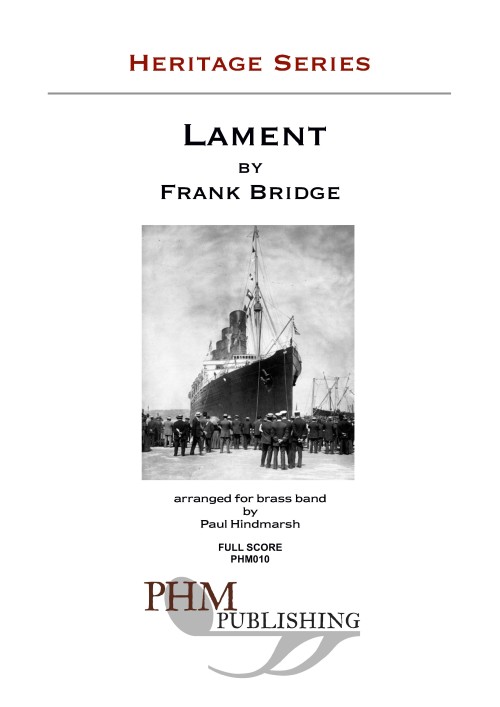
Lament (Brass Band - Score and Parts) - Bridge, Frank - Hindmarsh, Paul
The English composer Frank Bridge (1879 - 1941) did not take an active part in the First World War. However, he was devastated by the slaughter on the western and the eastern fronts, especially the loss of so many of his musicians friends and colleagues. Writing in 1963, his former pupil Benjamin Britten confessed that 'a lot of my feelings about the First World War which people seemed to see in the War Requiem came from Bridge. He had written a piano sonata in memory of a friend killed in France and though he didn't encourage me to take a stand for the sake of a stand, he did make me argue and argue and argue. His own pacifism was not aggressive, but typically gentle'.Bridge composed this Lament for string orchestra on 14 June 1915, in memory of Catherine Crompton, who drowned when the Cunard liner Lusitania was torpedoed by a German submarine on 7 May, 1915. According to figures researched by Liverpool historian Kevin Roach (www.lusitania.net), 1201 men, women and children lost their lives out of the 1962 people aboard. Ninety-four children died, including Catherine, her twin brother Paul and four other siblings. Paul Crompton, Snr. (44), a British businessman working in Philadelphia, his wife Gladys (40) and the family nanny were also drowned. How Bridge's dedication came about is uncertain. The music critic Edwin Evans, who knew Bridge well, has written that the Catherine was a young friend. It is also possible that he came across the family photograph which was published in many newspapers in the wake of the tragedy. By that time, Bridge was greatly distressed by the war as a whole. It seems perfectly in keeping with his pacifist leanings and the strength of his reaction, that this poignant and deeply touching 'war memorial' should mourn a child who he did not know, rather than one of the thousands of young men who fell in battle.Through the musical tears of this melancholy lullaby, Bridge may have regarded the death of young Catherine Crompton as symbolic of the loss of so many innocent lives in wartime. His response to this personal tragedy was characteristically spontaneous and utterly sincere. It is one of his most effective miniatures, poignant yet restrained in its lyrical beauty, with a compelling directness and simplicity of construction.This brass band transcription is pitched one tone lower than the original for string orchestra.- Paul HindmarshDuration: 5.00
Estimated dispatch 7-14 working days
-
 £64.99
Lord of the Lake (Brass Band - Score and Parts) - Deleruyelle, Thierry
Lord of the Lake is a work in three separate movements which tells the legend of the "Sea of Flines". Stphane Coquet, the conductor of the Flines-lez-Rches concert band, wanted to celebrate the 140th anniversary of his band by commissioning this work. The piece can be performed either on its own, or with a narrator who intervenes between each movement, telling this legend where children and their parents thwart the cruelty of a lord holed up in his castle.Duration: 7.45
Estimated dispatch 7-14 working days
-
 £29.95
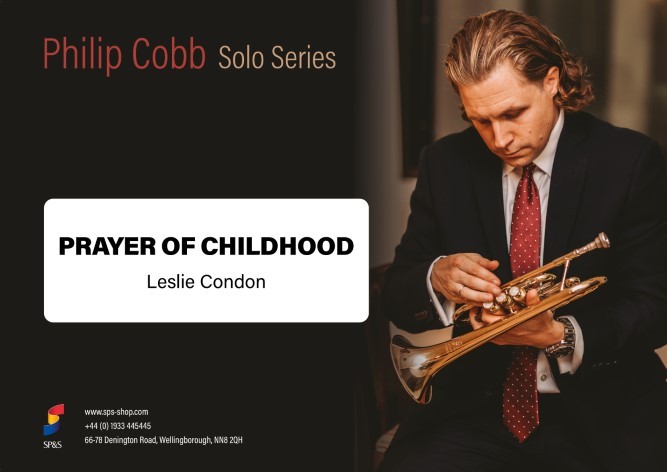
Prayer of Childhood (Cornet Solo with Brass Band - Score and Parts) - Condon, Leslie
Leslie Condon made a huge impact on the lives of many he encountered. His compositions ranged from extended brass works to simple choral songs. Prayer of Childhood, originally composed for children to sing, is based on the verses which commence 'Gentle Jesus, meek and mild'. The simplicity of the melodic line is its strength and compliments the text so beautifully. Duration: 2.30
Estimated dispatch 7-14 working days
-
 £69.95
Strange New Worlds (Brass Band - Score and Parts) - Graham, Peter
Strange New Worlds was commissioned by Nicholas Childs for the National Children's Brass Band of Great Britain with funds provided by Arts Council England.The COVID-19 pandemic made it necessary for the 2020 course to transition from residential to virtual and the work was designed to accommodate this change. The participants individually filmed themselves to a click track and the videos were collated to create a "virtual" performance. The premiere was streamed live on YouTube on August 7, 2020.The work is in 5 movements with a narrative dictated by the individual movement titles. Although to me this narrative is clearly defined, multiple scenarios present themselves. Some may interpret the story as being one from the ancients while others might identify with the science-fiction of H.G. Wells. Others still will relate to the recent surge of interest in 1980s culture and the Netflix series Stranger Things (to which the title of my work pays homage). Nor would it be unreasonable to consider the piece an analogy reflecting events in 2020. Listeners will decide the story (or message) for themselves.The five movements are: I. Things to Come; II. Descent to Darkness (featuring Cornets, Trombones and Percussion); III. Resistance (featuring Horns, Baritones, Euphoniums, Basses and Percussion); IV/V. Aftermath/A New HopeDuration: 8.00
Estimated dispatch 7-14 working days
-
 £13.95
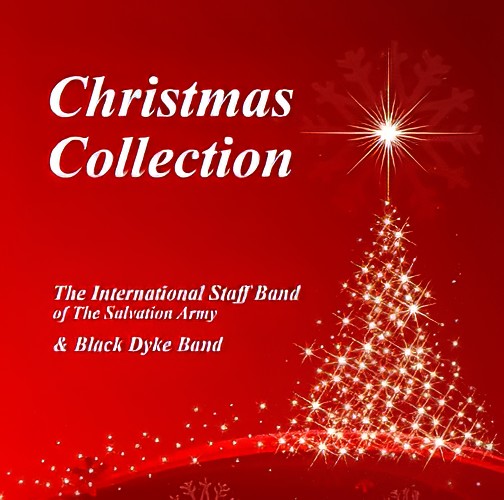
Christmas Collection - CD
1Ring the bellsThe ISB2It's the most wonderful time of the yearBlack Dyke Band3The candle songThe ISB4While shepherds watchedThe ISB5Calypso CarolThe ISB6A winter's taleBlack Dyke Band7Still, still, stillThe ISB8Carol of the bellsBlack Dyke Band9O holy night!The ISB10White ChristmasBlack Dyke Band11I wish it could be Christmas everydayBlack Dyke Band12GaudeteThe ISB13O Christmas treeBlack Dyke Band14Love came down at ChristmasThe ISB15Let it snow!Black Dyke Band16Saviour's DayThe ISB17So here it is, merry ChristmasBlack Dyke Band18Jingle bell rockBlack Dyke Band19Mary's ChildThe ISB20Rockin' around the Christmas treeBlack Dyke Band21In the bleak midwinterThe ISB22Huron CarolThe ISB23Walking in the airBlack Dyke Band24Mary's boy childThe ISB25Stop the cavalryBlack Dyke Band26It's beginning to look a lot like ChristmasBlack Dyke Band27Christ is born (il est ne)The ISB28Little children, wake and listenThe ISB29All I want for Christmas is youBlack Dyke Band30Come and join the celebrationThe ISB31Worldwide Christmas messageBlack Dyke Band32The virgin Mary had a baby boyThe ISB33Merry Christmas everyoneBlack Dyke Band34We wish you a merry ChristmasBlack Dyke Band
Estimated dispatch 7-14 working days
-
 £32.95
Nurserytime (Brass Band - Score and Parts) - Wiffin, Rob
This selection of well-known nursery rhymes and children's songs was made for the 2006 Party at the Palace. It includes Here we go round the Mulberry Bush, Incy Wincy Spider, Half a Pound of Tuppenny Rice, Three Blind Mice, Singing Polly Wolly Doodle, Old MacDonald had a Farm, One Man Went to Mow a Meadow, and Oh Dear What Can the Matter Be amongst others (Ring-a-ring a-roses, Hickory-dickory dock, Row, row, row your boat, Skip to my Lou)Duration: 5.00
Estimated dispatch 7-14 working days
-
 £154.99
A Brussels Requiem (Brass Band - Score and Parts) - Appermont, Bert
The attacks in Brussels on 22 March 2016 created a shockwave throughout Belgium and the rest of the world. Equally, the attacks in Paris and Nice led to great public indignation, fear and disbelief. What has happened to the western world? Have our cultures grown apart to such an extent that we do not understand each other anymore? Bert Appermont's intention was to voice certain emotions that these acts of terror have caused: particularly fear, grief, anger, and helplessness. He uses the French children's song Au Claire de la Lune as a connecting thread throughout the work. This piece is also about hope and faith in another world, and is meant to pay homage to all victims, resulting in a dignified remembrance. The musical development is presented in four through-composed parts, titled Innocence, In Cold Blood, In Memoriam - We Shall Rise Again and A New Day. This work was commissioned by the Brassband Oberosterreich (Brass Band Upper Austria) to be played at the European Brass Band Championships 2017.Duration: 16.30
Estimated dispatch 7-14 working days
-
 £119.99
The Essence of Youth (Brass Band - Score and Parts) - Roels, Stijn
In The Essence of Youth the composer gives an insight into childhood and youth -- inspired by his own daughter. The opening of sparking rhythms, dynamic contrasts and changes of time signature paint a vivid picture of the unpredictability of children. The first and second movements recount the love -- and also tension and the worries -- in the adult-child bond, through dissonant harmonies but also pretty melodies. The fugue-like ending leads to a final splendid chorale: a picture of proud parents with their child! Duration: 9.45
Estimated dispatch 7-14 working days
-
 £24.95
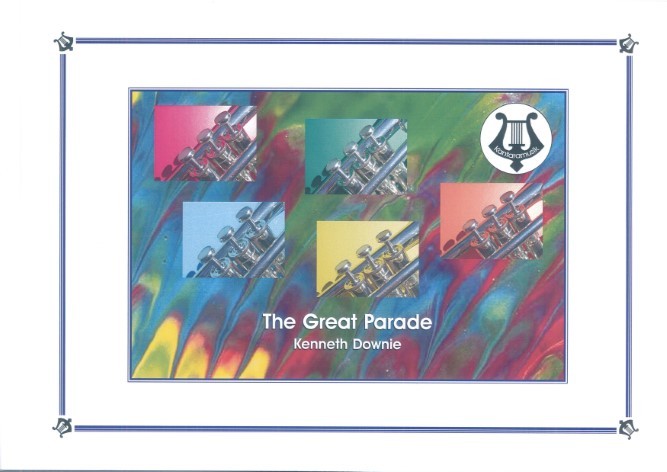
The Great Parade (Brass Band - Score and Parts) - Downie, Kenneth
This piece is intended to be a bright, sparkling concert march and features the spiritual 'I got a robe'. The quick tempo is to encourage a performance of sparkle and wit and, at the same time, to reflect the mood of celebration in the spiritual. The song was sung by slaves to encourage them to remember that, although they might be deprived of even basic items like robes in their present plight, one day, when they get to heaven, 'all God's children got a robe'.
Estimated dispatch 7-14 working days
-
£12.50
The Great Parade (Brass Band - Score Only) - Downie, Kenneth
This piece is intended to be a bright, sparkling concert march and features the spiritual 'I got a robe'. The quick tempo is to encourage a performance of sparkle and wit and, at the same time, to reflect the mood of celebration in the spiritual. The song was sung by slaves to encourage them to remember that, although they might be deprived of even basic items like robes in their present plight, one day, when they get to heaven, 'all God's children got a robe'.
Estimated dispatch 7-14 working days
 View Music