
Results
-
 £25.00
Zephyrus. March for Brass Band
Recommended - Suitable for all bands The Big Blow, was a formal record attempt to create the largest brass band in the world. It took place at Butlin's Resort, Skegness on 20 January 2007, and it's main goal was to raise money in support of the work of Brass Band Aid, and specifically to provide long-term sponsorship for two children in the village of Adet in Ethiopia. The Music Company (UK) Ltd were one of the Official Partners of The Big Blow, providing the performance piece for the record attempt. Andrew Duncan wrote 'Zephyrus' to mark the occasion. The title takes its name from the Greek God of the West Winds - Zephyrus. Zephyrus is a traditional British brass band march with an interesting African-feel lilt to the trio. This is enhanced by optional percussion instruments including djembi and bongos, which can alternatively be covered by standard drum kit. The Music Company are pleased to continue their support of Brass Band Aid by offering a donation to this worthy charity for every set of this music sold. Includes score & parts
-
 £55.00
Triumph Series Brass Band Journal, Numbers 1355 - 1358, November 2023
1355: March Medley - Pardoned Forever (Keith Manners)This collection of Easter-themed melodies should be played with enthusiasm and vigour. Featuring the songs He lives (S.A.S.B. 229), Chris is alive! Let Christians sing (S.A.S.B. 217) and No more! No more! He remembers sins no more (S.A.S.B. 460), the positive message of Easter Sunday is reflected in this bright march style.1356: Selection - I love the sweetest name (Noel Jones)This devotional selection includes three songs that feature the name of Jesus and derives its title from the following lines of those songs; 'How sweet the name of Jesus sounds' (S.A.S.B. 78), 'O, how I love the Saviour's name! The sweetest name on earth' (S.A.S.B. 94) and 'Sweetest name on mortal tongue' (S.A.S.B. 93).1357: Renewal (Harold Burgmayer)Will J. Brand penned the song Renewal (S.A.S.B. 634), with music by Bramwell Coles, for 'Day of Renewal' meetings conducted by General Albert Orsborn in October 1949. It was published in that form in The Musical Salvationist in 1951. Over time these meaningful words of consecration became wedded to an alternative tune, a lovely melody by Oscar Ahnfelt known as Trust in God (T.B. 903). This setting for band is based on a male-voice arrangement, conceived for a time of renewed consecration, sung by massed bands at the Canadian Staff Band's 50th Anniversary Festival in 2019.1358: Groove Hosanna! (Munashe Chikwezvero)This is a funk setting of three well-known melodies associated with Jesus' triumphal entry into Jerusalem. Today, such celebratory processions, and indeed most large gatherings, usually feature rich forms of music-making. Music provides atmosphere and generates excitement, and it is hoped that a funk inspired arrangement of these songs will inspire listeners to 'move to the groove'. The first two songs, Children of Jerusalem (S.A.S.B. 356) and Give me joy in my heart, keep me praising (S.A.S.B. 362) encourage us to sing 'Loud hosannas to our King!'. The words of the third song, When his salvation bringing, remind us that he "smiled to hear their song".
Estimated dispatch 7-14 working days
-
 £154.99
A Brussels Requiem (Brass Band - Score and Parts)
The attacks in Brussels on 22 March 2016 created a shockwave throughout Belgium and the rest of the world. Equally, the attacks in Paris and Nice led to great public indignation, fear and disbelief. What has happened to the western world? Have our cultures grown apart to such an extent that we do not understand each other anymore? Bert Appermont's intention was to voice certain emotions that these acts of terror have caused: particularly fear, grief, anger, and helplessness. He uses the French children's song Au Claire de la Lune as a connecting thread throughout the work. This piece is also about hope and faith in another world, and is meant to pay homage to all victims, resulting in a dignified remembrance. The musical development is presented in four through-composed parts, titled Innocence, In Cold Blood, In Memoriam - We Shall Rise Again and A New Day. This work was commissioned by the Brassband Oberosterreich (Brass Band Upper Austria) to be played at the European Brass Band Championships 2017.Duration: 16.30
Estimated dispatch 7-14 working days
-
 £69.99
Fanfares and Love Songs (Brass Band - Score and Parts)
Fanfares and Love Songs was commissioned by the National Children's Brass Band of Great Britain for performance on 25th July 2009. Its three movements contrast the extrovert and lyrical qualities of the traditional brass band. The fanfare with which the work opens involves the whole cornet section. The second movement is reflective in mood, beginning somewhat pensively on muted brass, and building to an emotional climax before subsiding back to a distant pianissimo chord. The finale is a fast dance, which with a final recapitulation of the opening fanfare drives on to a breathless close.Suitable for Advanced Youth/3rd Section Bands and aboveDuration: 12.00
Estimated dispatch 7-14 working days
-
 £95.00
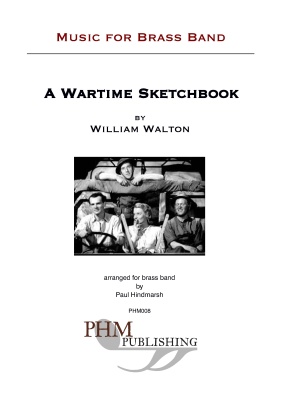
A Wartime Sketchbook (Brass Band - Score and Parts)
Early in 1941 William Walton, 39, received his call-up papers. He was by then one of the most eminent of British composers and was exempted from military service on condition that he provided music for films deemed to be of 'national importance'. Scoring Lawrence Olivier's Shakespeare epic Henry V in 1943 was the most substantial of these wartime projects. His role in patriotic films from 1941 and 42 like The Foreman went to France, Next of Kin, Went the day Well and The First of the Few was to provide appropriate title music and some underscoring at key moments. Walton extracted the most substantial portions of the latter as the popular Spitfire Prelude and Fugue for orchestra. The remaining music remained unpublished until 1990, when Christopher Palmer assembled the highlights into A Wartime Sketchbook. I was intrigued to hear these examples of Walton's wartime music and having discovered that they would fit naturally and idiomatically onto the brass band, I arranged six of the numbers into a suite for Besses o' th' Barn Band, which I was conducting at the time.In 1995 the brass band suite was recorded by the famous Black Dyke Mills Band as part of an all Walton album which I produced for the ASV label (ASV CD WHL 2093). This award- winning CD also included Walton's First Shoot, in the edition by Elgar Howarth, my transcription of movements from Music for Children and two substantial brass versions by Edward Watson of the suite from Henry V (with narrator) and the March and Siegfried Music from The Battle of Britain music.Prologue: This is the stirring title music from Went the day Well, a screen play by Graham Greene about a German airborne invasion of an English village. The main theme leads toBicycle Chase: Characteristic musical high-jinks for J.B.Priestley's The Foreman went to France.Refugees: From the same film, this is a poignant accompaniment to the long march of refugees. As Ernest Irving, the film's musical director, put it, "this really makes your feet sore and your knees sag."Young Siegfrieds: This lively movement comes from the music that Walton composed for The Battle of Britain in 1968, with the assistance of Malcolm Arnold, but which the film's producer rejected. It portrays first the Berliners, cheerfully ignoring the black-out and then, in the trio, the Young Siegfrieds of the Luftwaffe, courtesy of a parody of Siegfried's horn call from Wagner's opera.Romance: A soldier and a Dutch refugee snatch a few tender moments together in Next of Kin.Epilogue: At the end of The Foreman went to France, the French look forward with hope and optimism to eventual liberation.- Paul HindmarshDuration: 14.00
Estimated dispatch 7-14 working days
-
£40.00
A Wartime Sketchbook (Brass Band - Score only)
Early in 1941 William Walton, 39, received his call-up papers. He was by then one of the most eminent of British composers and was exempted from military service on condition that he provided music for films deemed to be of 'national importance'. Scoring Lawrence Olivier's Shakespeare epic Henry V in 1943 was the most substantial of these wartime projects. His role in patriotic films from 1941 and 42 like The Foreman went to France, Next of Kin, Went the day Well and The First of the Few was to provide appropriate title music and some underscoring at key moments. Walton extracted the most substantial portions of the latter as the popular Spitfire Prelude and Fugue for orchestra. The remaining music remained unpublished until 1990, when Christopher Palmer assembled the highlights into A Wartime Sketchbook. I was intrigued to hear these examples of Walton's wartime music and having discovered that they would fit naturally and idiomatically onto the brass band, I arranged six of the numbers into a suite for Besses o' th' Barn Band, which I was conducting at the time.In 1995 the brass band suite was recorded by the famous Black Dyke Mills Band as part of an all Walton album which I produced for the ASV label (ASV CD WHL 2093). This award- winning CD also included Walton's First Shoot, in the edition by Elgar Howarth, my transcription of movements from Music for Children and two substantial brass versions by Edward Watson of the suite from Henry V (with narrator) and the March and Siegfried Music from The Battle of Britain music.Prologue: This is the stirring title music from Went the day Well, a screen play by Graham Greene about a German airborne invasion of an English village. The main theme leads toBicycle Chase: Characteristic musical high-jinks for J.B.Priestley's The Foreman went to France.Refugees: From the same film, this is a poignant accompaniment to the long march of refugees. As Ernest Irving, the film's musical director, put it, "this really makes your feet sore and your knees sag."Young Siegfrieds: This lively movement comes from the music that Walton composed for The Battle of Britain in 1968, with the assistance of Malcolm Arnold, but which the film's producer rejected. It portrays first the Berliners, cheerfully ignoring the black-out and then, in the trio, the Young Siegfrieds of the Luftwaffe, courtesy of a parody of Siegfried's horn call from Wagner's opera.Romance: A soldier and a Dutch refugee snatch a few tender moments together in Next of Kin.Epilogue: At the end of The Foreman went to France, the French look forward with hope and optimism to eventual liberation.- Paul HindmarshDuration: 14.00
Estimated dispatch 7-14 working days
-
 £11.21
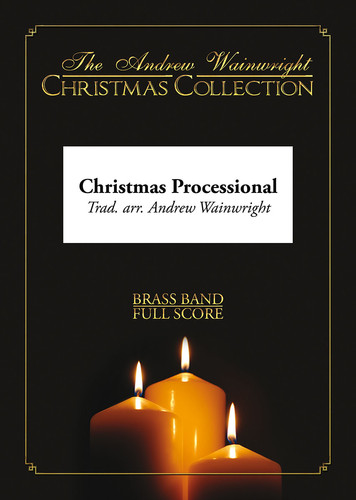
Christmas Processional (Brass Band Additional Parts) Trad. arr. Wainwright)
An effective opener to any Christmas concert, based on the French carol, 'Bring a torch, Jeanette, Isabella'. It tells the story of a group of children in medieval Provence, dressed up as shepherds and milkmaids, carrying torches and candles as they proceed to the stable. As they draw closer and their excitement increases, they are constantly reminded by their parents to keep the noise down so that they don't wake up the baby Jesus. The music begins quietly and builds to a majestic conclusion. "If I were still conducting bands regularly, this would certainly be on my list as a Christmas concert opener - it sets the energy and mood most effectively. The scoring is terrific." Paul Hindmarsh, British Bandsman magazine This arrangement also includes optional Organ and Hand bells parts. For a follow-the-score video of Virtuosi GUS Band performing the work, please visit: https://www.youtube.com/watch?v=2GasDfecnyY Sheet music available exclusively from World of Brass - www.worldofbrass.com Includes score and full set of parts. Difficulty Level: 2nd Section + Instrumentation: Solo Horn F 1st Horn F 2nd Horn F 1st Baritone B.C. 2nd Baritone B.C. 1st Trombone B.C. 2nd Trombone B.C. Euphonium B.C. Bass B.C. (Bass Eb Part) Bass B.C. (Bass Bb Part)
In Stock: Estimated dispatch 1-3 working days
-
 £37.37
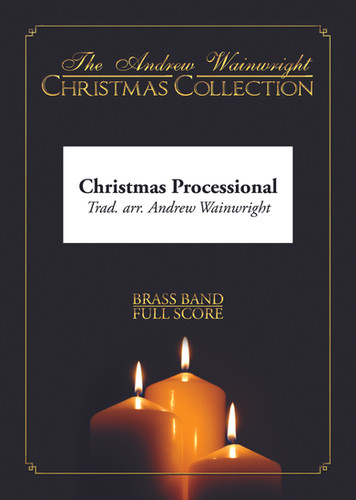
Christmas Processional - Brass Band & opt. Organ (Trad. arr. Andrew Wainwright)
An effective opener to any Christmas concert, based on the French carol, 'Bring a torch, Jeanette, Isabella'. It tells the story of a group of children in medieval Provence, dressed up as shepherds and milkmaids, carrying torches and candles as they proceed to the stable. As they draw closer and their excitement increases, they are constantly reminded by their parents to keep the noise down so that they don't wake up the baby Jesus. The music begins quietly and builds to a majestic conclusion. "If I were still conducting bands regularly, this would certainly be on my list as a Christmas concert opener - it sets the energy and mood most effectively. The scoring is terrific." Paul Hindmarsh, British Bandsman magazine This arrangement also includes optional Organ and Hand bells parts. For a follow-the-score video of Virtuosi GUS Band performing the work, please visit: https://www.youtube.com/watch?v=2GasDfecnyY Sheet music available exclusively from World of Brass - www.worldofbrass.com Includes score and full set of parts. Alternative parts for Horns in F, and Baritones, Trombones, Euphonium and Tubas in Bass Clef are available here. Difficulty Level: 2nd Section + Instrumentation: Soprano Cornet Eb Solo Cornet Bb Repiano Cornet Bb 2nd Cornet Bb 3rd Cornet Bb Flugel Horn Bb Solo Horn Eb 1st Horn Eb 2nd Horn Eb 1st Baritone Bb 2nd Baritone Bb 1st Trombone Bb 2nd Trombone Bb Bass Trombone Euphonium Bb Bass Eb Bass Bb Timpani Percussion 1-3 Organ (optional) Hand bells (optional)
In Stock: Estimated dispatch 1-3 working days
-
 £65.00
Music for Jock Tamson (Brass Band - Score and Parts)
Scottish Dances Set 2An original suite in three movements:Nyah Fearties!InchkeithWha's Like Us?This work was one of twelve works commissioned by the Scottish Brass Band Association and Funded by Creative Scotland Targeted Fund - 2021 to aid Covid Recovery and support composers in Scotland.Jock Tamson - a Scottish name explained... The phrase more often occurs in an extended form: We're a' Jock Tamson's bairns. This is interpreted in a metaphorical sense as a statement of egalitarian sentiments equivalent to "we're all the same under the skin" or "we are all God's children". i.e. This is music for everyone!
Estimated dispatch 7-14 working days
-
 £70.00
General Series Band Journal August 2016 Numbers 2158 - 2161
No. 2158 Prelude - My God and King! (Paul Sharman)Based on the hymn tune 'Luckington', this music is a paean of praise to the Lord of all creation.No. 2159 A Christmas overture (Kevin Larsson)An exciting collection of well-known Christmas carols, originally written as a concert opener.No. 2160 March - A voice from above (Eiliv Herikstad)This march refers to a number of Christmas carols. It starts with four bars of 'Hark! the herald angels sing' followed by fragments of 'Joy to the world!' before James R. Murray's 'Den himmelske lovsang' is presented in full. 'Come children, come quickly' requires legato playing from the lower band.No. 2161 In God we trust (Ralph Pearce)Although the title derives from the United States of America's much-neglected motto, the music is a journey through to total trust in God and our Lord Jesus Christ. The tunes featured are 'In thee, O Lord, do I put my trust' leading to 'Trust in God'. Increasingly calm music leads to the more recent song 'In Christ alone, I placed my trust'. The music ends with a brief reference to 'In Thee, O Lord, do I put my trust' now in a mood of calm assurance.
Estimated dispatch 7-14 working days