
Results
-
 £30.00
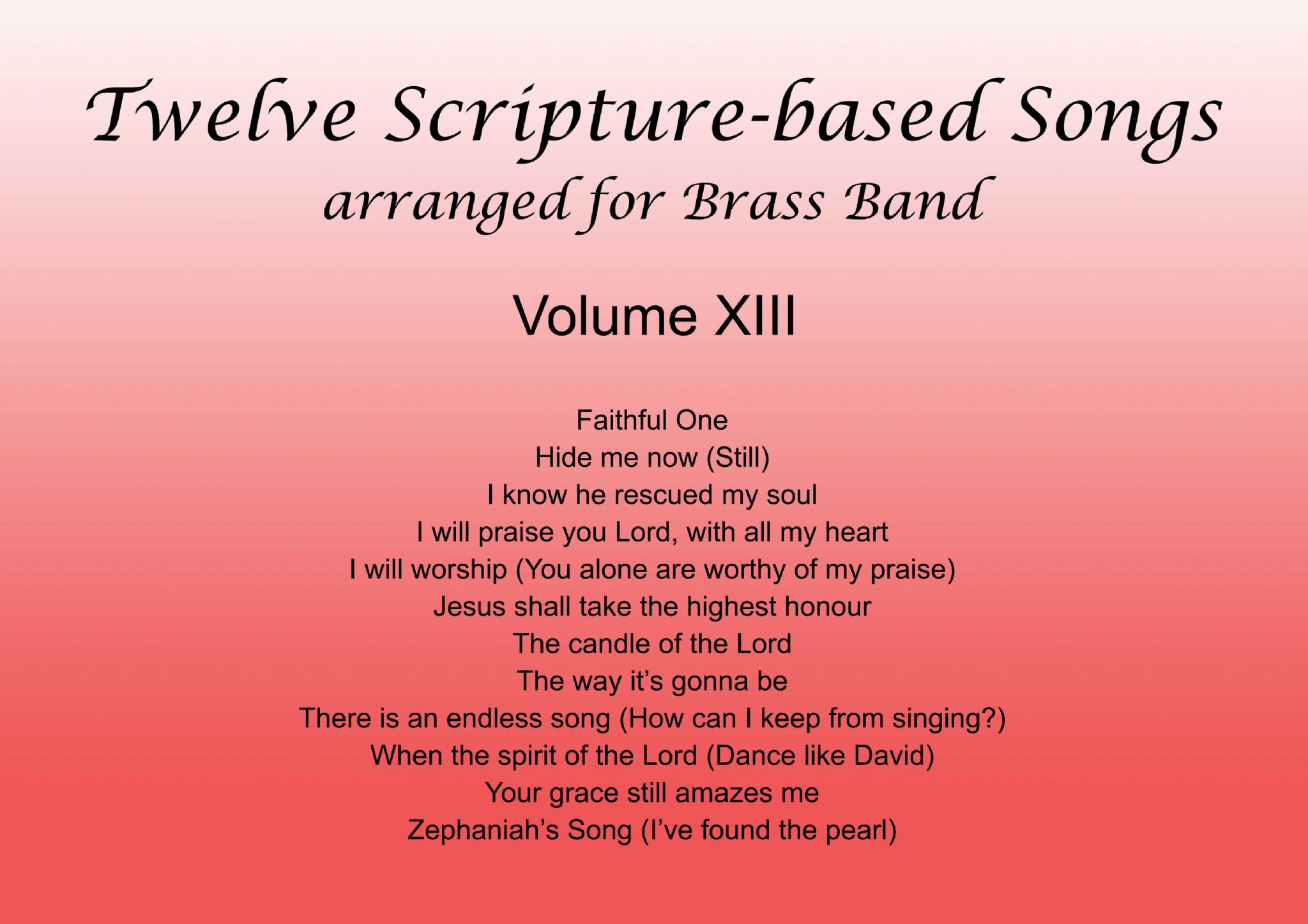
Twelve Scripture-Based Songs Volume XIII
Twelve scripture-Based Songs arranged for Brass Band (Volume XIII) are packaged and marketed in complete sets which include a full score and a set of master parts. It is intended that these parts be used as 'masters', for the purpose of photocopying a quantity of parts to accommodate the precise instrumentation needs of the band for which this has been purchased.Faithful One Brian Doerksen arr. Mervyn ClarkeHide me now (Still) Reuben Morgan arr. Paul SharmanI know he rescued my soul (My redeemer lives) Reuben Morgan arr. Dean JonesI will praise you Lord, with all my heart Dick KrommenhoekI will worship (You alone are worthy of my praise) David Ruiss arr .Dean JonesJesus shall take the highest honour Chris Bowater arr. Steven PonsfordThe candle of the Lord Joy Webb arr. Michael KenyonThe way it's gonna be Doug Horley arr. Dean JonesThere is an endless song (How can I keep from singing?) Chris Tomlin, Matt Redman and Ed Cash arr. Brian HoggWhen the spirit of the Lord (Dance like David) Anon arr. Andrew MackerethYour grace still amazes me Craig Phillips and Dean Phillips arr. David E JonesZephaniah's Song (I've found the pearl) arr. William Himes
Estimated dispatch 7-14 working days
-
 £44.95
Deus Invictus - God Unconquered (Brass Band - Score and Parts)
Deus Invictus draws its inspiration from well-known words from Romans 8: 38-39; 'For I am convinced that neither death nor life, neither angels nor demons, neither the present nor the future, nor any owers, neither height nor depth, nor anything else in all creation, can separate us from the love of God'. The music reflects the confidence and certainty of the scripture text while, as in everyday life, trials and tests come along which are reflected in a sequence of musical skirmishes. The work introduces the 19th century hymn 'St Albinus' to a wider audience and also includes references to the tunes 'St Margaret' and 'Rachie'. A setting of the Easter Hymn, 'Christ the Lord is risen today!', is heard followed by a final reprise of 'St Albinus'.
Estimated dispatch 7-14 working days
-
 £34.95
Song for the Skies (Eb Bass Solo with Brass Band - Score and Parts)
Song for the Skies was commissioned by Tuba virtuoso Les Neish and was given its world premier on the December 9th 2010 with the James Madison University Brass Band in Harrisonburg, Virginia, USA.Les asked me to compose a slow melody that highlights the wonderful sonorous sound of the Tuba. I am a big fan of Les and of the instrument and knowing the capabilities of Les as a soloist I wanted to experiment with the range and colour of the instrument in this solo.After a warm introduction from the ensemble the soloist enters almost timeless over the muted cornets. The melody when it is first heard has a somewhat haunting Celtic feel to it. It is intentionally marked as con rubato so that the soloist can really put their own musical stamp on the music. As the haunting melody repeats again this time in a change of key the accompaniment takes more of a role within the piece of music performing counter melodies within this second section.The middle of the piece introduces a new secondary melodic device that serves as an introduction to the original melody played in all its glory by the ensemble. This dies away to leave the second half of the melody in the euphoniums and baritones as the soloist plays a soaring counter melody in the highest register of the instrument.The piece starts to return home with a recapitulation of the introduction followed by the second part of the original melody by the soloist. After a momentary reflective solo from the soloist the introduction is used for a final time before the tuba guides us home to conclude.For the soloist, there are a number of occasions where the opportunity to play in the upper register of the instrument arises. However, I have also given the opportunity for the soloist to play various passages down the octave so it suits the performers playing style and range.Song for the Skies is very simple yet beautiful and I feel it suits the playing of the Eb Tuba perfectly. I hope you enjoy performing it.Paul Lovatt-Cooper
Estimated dispatch 7-14 working days
-
 £14.95
Crugybar (Cornet and Piano)
The traditional Welsh tune of Crugybar is most commonly associated with words by Howell Elvet Lewis which appear in the Baptist Hymn Book of 1962; 'The light of the morning is breaking, the shadows are passing away'. The Salvation Army Song Book of 1986 lists two further hymns that can be sung to the tune; 'I stand all bewildered with wonder and gaze on the ocean of love' ( W F Crafts) and 'When Jesus from Calvary called me, unfolding its meaning to me' (Will J Brand). This arrangement was made for Martyn Bryant, the long-serving principal cornetist of Bristol Easton Band of The Salvation Army.
Estimated dispatch 7-14 working days
-
 £24.95
Crugybar (Cornet Solo with Brass Band - Score and Parts)
The traditional Welsh tune of Crugybar is most commonly associated with words by Howell Elvet Lewis which appear in the Baptist Hymn Book of 1962; 'The light of the morning is breaking, the shadows are passing away'. The Salvation Army Song Book of 1986 lists two further hymns that can be sung to the tune; 'I stand all bewildered with wonder and gaze on the ocean of love' ( W F Crafts) and 'When Jesus from Calvary called me, unfolding its meaning to me' (Will J Brand). This arrangement was made for Martyn Bryant, the long-serving principal cornetist of Bristol Easton Band of The Salvation Army.
Estimated dispatch 7-14 working days
-
 £59.95
Swedish Festival Music (Brass Band - Score and Parts)
This three-movement suite was commissioned by the Swedish Brass Band Association as the test piece for the Championship Section of their 2008 National Contest. The first movement is inspired by the magnificent Swedish hymn 'How Great Thou Art'. Indeed the influence of that hymn can be traced in all three movements. The declamatory style of the opening gives way to other, more reflective expressions of awe and wonder. A more animated section develops before a final, triumphant statement of the 'How Great' idea returns to finish the movement. The slow second movement features another much-loved Swedish hymn. The music provides plenty of scope for expressive playing, and a feeling of intimacy should be created by the use of several short solo passages. The third movement Allegro brings a totally different, dance-like mood with frequent references to a reel from the region of Uppland. This eventually brings a return to the opening subject and a final, triumphant reference to 'How Great Thou Art'.
Estimated dispatch 7-14 working days
-
 £49.95
Bestowal of a Century (Tenor Horn Solo)
Tenor Horn Solo with Brass BandBestowal of a Century (2014) was commissioned by Lowenna Taylor, and funded through her Harry Mortimer Trust award which she was presented with at the 2013 British Open Championship following the completion of her studies at the Royal Welsh College of Music in Cardiff. The 15-minute work received its world premiere at the Cornwall Youth Brass Band Christmas concert in 2014 with solosit, Lowenna, working alongside the band under the baton of Les Neish.The Bestowal refers to the presentation of the Royal Trophy by the then Prince of Wales to the famous West of England Bandsman's Festival in Bugle in 1913. Over the years it has been won by some of the greatest names in brass banding, including Black Dyke and Munn & Feltons - although more recently it has become a wonderful open festival that includes sections for local bands as well as visitors from all over the banding globe. 2014 marked the one-hundredth anniversary of the presentation of the trophy, which is the only brass band trophy to have the official seal of royal patronage.The work, in three distinct sections, opens in a mysterious way, building progressively with interjections from the horn. The composer notes its as though one can imagine different part of the trophy being put together, piece by piece, until the trophy is complete and a climax is reached. Following this, a playful theme is presented which is developed throughout the first section and interacting between soloist and band.The second movement, in complete contrast, is a lyrical melody; heart-wrenching throughout, and sits well both as part of the concerto and also as a stand-alone solo item. The third movement is light-hearted and virtuosic, demonstrating the technical capabilities of the instrument with fast and virtuosic playing, and a cadenza towards the end of the work.
Estimated dispatch 7-14 working days
-
 £29.50
Lovely Jubilee
2012 marked a year of celebration for the Queen's Diamond Jubilee. Now with this special patriotic release, your band can to pay tribute to all that is great about Great Britain. There's fun to be had with suggested choreography featured during "The British Grenadiers" and a salute to the "Men Of Harlech" (along with some other surprises!) before the gorgeous tune 'Suo Gan' takes the limelight. Of course, your audience will most likely join in the fun too, with music such as 'Land Of Hope & Glory' & 'Rule Britannia!' to finish, this item will surely leave your audiences on a patriotic high. This is the perfect item for concerts and contests, a must have in this years concert program.
Estimated dispatch 7-14 working days
-
 £10.00
Swedish Festival Music (Study Score)
This three-movement suite was commissioned by the Swedish Brass Band Association as the test piece for the Championship Section of their 2008 National Contest. The first movement is inspired by the magnificent Swedish hymn 'How Great Thou Art'. Indeed the influence of that hymn can be traced in all three movements. The declamatory style of the opening gives way to other, more reflective expressions of awe and wonder. A more animated section develops before a final, triumphant statement of the 'How Great' idea returns to finish the movement. The slow second movement features another much-loved Swedish hymn. The music provides plenty of scope for expressive playing, and a feeling of intimacy should be created by the use of several short solo passages. The third movement Allegro brings a totally different, dance-like mood with frequent references to a reel from the region of Uppland. This eventually brings a return to the opening subject and a final, triumphant reference to 'How Great Thou Art'.
Estimated dispatch 7-14 working days
-
 £76.99
The Universal Band Collection (Brass Band - Score and Parts) - De Haan, Jacob
A collection of 5 short works in pop style which can be performed by any kind of compilation. The titles can be presented on the programme as separate works but the Universal Band Collection can also be performed as a complete suite. From a didactic point of view it is a suitable work to teach musicians something about the structure in music. For this purpose not only the big structure but also the small structure was kept very clear.Western Girl: A girl from the west of the USA rides her horse across the prairie, dreaming of her future. The rough structure: introduction - theme in a blues scale - the same thing in a different instrumentation - finale.Just a ballad: A ballad in pop style with a rough A-B-A form. First there is the introduction of the main theme (A), then follows a tenor melody in minor with a rhythmical reference to the main theme (B). Finally there is the main melody, performed tutti with a different rhythm in the drums (A').Play the Game: An English saying meaning: play fairly. Playful music in up-tempo with a wink to China, where almost all games are manufactured nowadays. Once again an A-B-A structure here.San Diego: A Mexican fugitive enjoys his freedom in America but also remembers his place of birth with melancholy. A sad minor melody with a straight trendy beat appears twice. The second time it has a slightly different instrumentation, in which the muted trumpets represent the Mexican feeling.Final Dance: Eventually there is a dance with an introduction in renaissance style, followed by a fast dance in rock style. All this composed in a classical song structure: introduction, verse, bridge, chorus, shortened verse, bridge, chorus, chorus.Duration: 10:30
Estimated dispatch 7-14 working days
 View Music