
Results
-
 £70.00
Masque. - Kenneth Hesketh
A Masque (short for Masquerade) has been defined by Historians as 'A revel in which Mummers or masked folk come with torches blazing into the festive hall and call upon the company to dance and dice'. The chaos of this dramaticdance is depicted in this 'Masque' by Hesketh. The main theme is bravura and is often present, in the background. The form of the piece is a simple scherzo-trio-scherzo. Colourful scoring (upper wind solos, trumpet and horn solosalternating with full bodied tuttis) with a dash of wildness may tease both player and listener to let their hair down a little! 'Masque' has been transcribed for wind band by Kenneth Hesketh from his 'Scherzo forOrchestra',commissioned by the National Children's Orchestra in 1987.
Estimated dispatch 5-14 working days
-
 £96.60
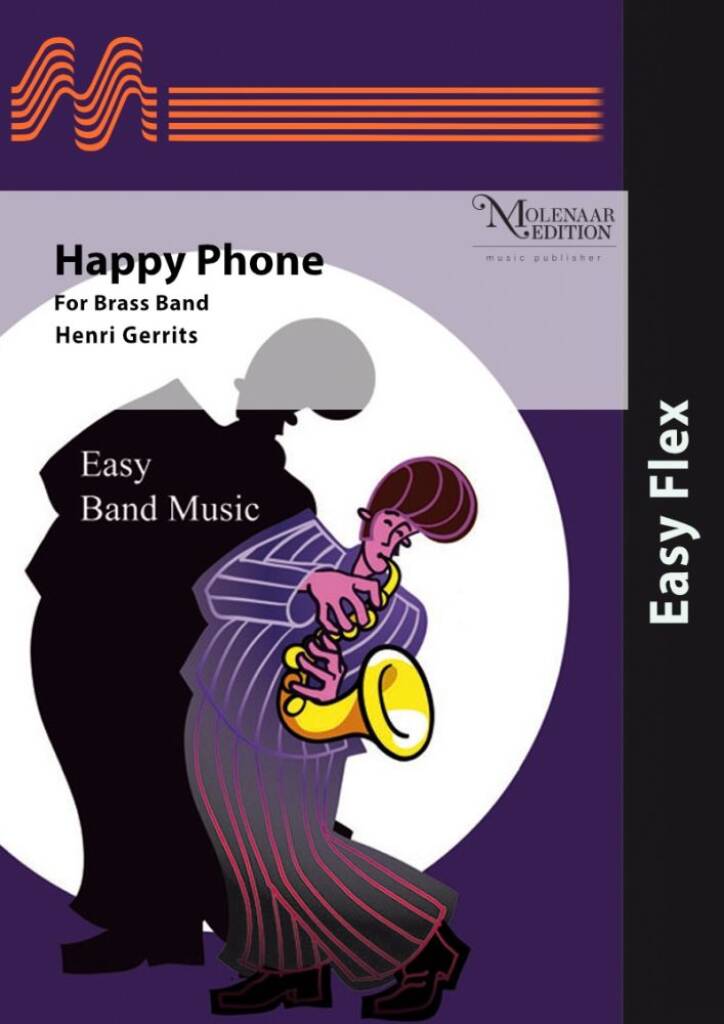
Happy Phone - Henri Gerrits
In this sparkling work, the conductor is interrupted in the middle of a musical adventure by a spontaneous phone call from a member of the orchestra. This unexpected moment adds an extra layer of liveliness and humour to the performance, creating a unique experience every time. This piece is perfect for training orchestras looking for a challenging and inspiring addition to their epertoire. A masterpiece that breaks the boundaries of traditional orchestral music and leaves unforgettable impression at every performance.
Estimated dispatch 5-14 working days
-
£44.95
TRAILBLAZERS (Brass Band Set) - Andrew Mackereth
This overture draws its inspiration from the story of the first Household Troops Band. It tells the story of the 1887 band, the subsequent lull of nearly a hundred years and the re-awakening of the Troops phenomenon in 1985. It was originally written in 1995 and featured prominently by the band on its North American tour of 2002. Given the history of the Household Troops Band, it is fitting that this composition is preoccupied with marching. It begins with a marching song played by a solitary muted cornet, symbolic not only of the call to bandsmen to join the evangelical effort but also a muso-dramatic device to indicate the steady increase in members and technical ability! The music quickly develops into stirring versions of 'A robe of white' and 'Storm the forts of darkness' with two early day Salvation Army tunes crucially adding to the narrative; 'Marching on in the light of God' and 'Soldiers of our God, arise!' The second section is a reflective setting of the Herbert Booth song, 'The penitent's plea'. This song serves to represent the many people who were 'saved' during those early day campaigns. The expressive music transports the listener through a period of uncertainty and angst until finally reaching the song, 'There is a message, a simple message, and it's a message for us all'. The final section deals first with the emergence from the annals of history with the muted cornet figure again before, symbolically, the present day band bursts forth with an emphatic statement of 'Would you be free from your burden of sin? There's power in the blood'. The stirring climax represents a fitting tribute to those gallant pioneering musicians and their equally impressive and dedicated contemporaries.
Estimated dispatch 7-14 working days
-
£132.00
Celebration for Band - John Brakstad
Many Norwegian bands have grown up around factories; but Norwegian factories are often located in the countrysides - by a fjord or lake, by a river or waterfall that provided power for the factory.The factory was the foundation for the existence of the community, but it was also essential for the community's cultural life; choirs, bands etc. (cp. British brass bands and mining)."Celebration for band" tries to give a picture of the environment and life around a band like this, with both factory noise and the natural world (Pastorale), as well as the challenges and development of the band itself.The composition is built up of five connected episodes:- Fanfare and Prologue (concludes with a feeling of the untamed power of the river) - Pastorale I: " At the river"- Intermezzo: " The Factory" (starts with the opening of water for the turbines: snare drum. Factory whistle and bell call to work, and the spinning and weaving machinery starts up.)- Pastorale II: " Summer evening on the fjord." - Finale: " Challenge and Progress"
Publisher Closed for Holidays. Est Delivery 13-14th Aug
-
 £33.66
Extinction:2100! (Brass Band) Joe Galuszka
Extinction:2100!, by Joe Galuszka, takes us on a journey to the present day and shows us the devastating impacts of climate change. With the world reaching crisis, we open with a reminder that the world has suffered in recent years from some of the most raging destruction of our plants and animal life, from wildfires. With the time left becoming smaller and smaller with each day passing, the piece reminds us next of the 'Tolling Bell of Extinction' before the conclusion takes us to a place all too familiar - the present - where with action and with a 'Call for Change', we can hopefully make a difference to our future, our children's future, and save our planet from devastation, from decimation, from extinction! To listen to an audio demo of the work please visit https://on.soundcloud.com/SjxKbnM1Q55hVXck7 Duration: approx. 4.30 mins Difficulty Level: 1st Section + PDF download includes parts and score. Sheet music available from www.brassband.co.uk (UK) or www.cimarronmusic.com (USA) Instrumentation: Soprano Cornet Eb Solo Cornet Bb Repiano Cornet Bb 2nd Cornet Bb 3rd Cornet Bb Flugel Horn Bb Solo Horn Eb 1st Horn Eb 2nd Horn Eb 1st Baritone Bb 2nd Baritone Bb 1st Trombone Bb 2nd Trombone Bb Bass Trombone Euphonium Bb Bass Eb Bass Bb Timpani Percussion 1-3
In Stock: Estimated dispatch 1-3 working days
-
£76.00
Jonny Makes Waves (Bra) - Max Stannard
Jonny Makes Waves is an exciting cornet solo with jazzy influences which is based around traditional sea songs. The main melody, A Life on the Ocean Wave, is the regimental march of the Royal Marines, while Heart of Oak , the official march of the Royal Navy, is quoted in the middle of the piece. These two melodies are given new harmonies and extensive quasi improvised sections by the soloists, in addition to call and response sections allowing all the band to join in. This fun filled piece is guaranteed to get your feet tapping.
Estimated dispatch 7-14 working days
-
£96.00
Celtic Warriors (Bra) - Jim Paterson - Mike Kilmartin
Imagine those epic movies set in historical times or films like The Lord of the Rings and Conan the Barbarian. The piece is about a band of Legendry Mystical Celtic Warriors answering an ancient cry for help the "Call to Arms" coming of a town whom are being attack from an Evil Sorcerer King. The whole idea behind this is to show that there are people willing sacrifice everything even their own life in the protections of others. Arranged by Mike Kilmartin on original themes by Jim Paterson.
Estimated dispatch 7-14 working days
-
£34.95
COME AND GET SAVED (Brass Band Set) - Bruce Broughton
This fantasia is based on the old Salvation Army song, 'Never can tell' which includes the words, 'You never can tell when the Lord will call you...Come and get saved and happy be'. The piece has many different and contrasting moods but is generally light-hearted and amiable like the straightforward message of the song and its genial melody.
Estimated dispatch 7-14 working days
-
 £42.00
Prisms (Score only) - Peter Graham
Dating from 1986 Prisms (Symphonic Study No. 2 for Brass band) was extensively revised in 1988 to form the preent work. Though not programmatic as such, the work has its roots in traditional brass band music, being strongly melodic and adopting a broad ternary form. The main themes call all be traced to the fourth-based first subject, these offshoots drawing a parallel with light refraction - Prisms. As well as the lyrical sections, much of the music is highly rhythmic, with a busy percussion section, and accesible and enjoyable to all. Duration: 13:00
Estimated dispatch 7-9 working days
-
 £52.00
Prisms (Parts only) - Peter Graham
Dating from 1986 Prisms (Symphonic Study No. 2 for Brass band) was extensively revised in 1988 to form the preent work. Though not programmatic as such, the work has its roots in traditional brass band music, being strongly melodic and adopting a broad ternary form. The main themes call all be traced to the fourth-based first subject, these offshoots drawing a parallel with light refraction - Prisms. As well as the lyrical sections, much of the music is highly rhythmic, with a busy percussion section, and accesible and enjoyable to all. Duration: 13:00
Estimated dispatch 7-9 working days
 View Music
