
Results
-
 £76.99
Oregon - Jacob de Haan
This fantasy tells the story of Oregon, one of Americas north-western states. Traveling by train on the Northern Pacific Railroad, the listener is taken through the fascinating Oregon landscape. Indians, cowboys, golddiggers and hooded wagons will file past on this adventurous journey. The piece has some similarities with a soundtrack of a movie. Various melodies, which could be the main themes of a movie, pass the review.The piece begins in a slow movement, introducing the first theme in minor. Then we hear in the following fast movement the trombones imitate the train, whistling the steam-flute. We hear the characteristic minor theme again, but now in differentvariants(also in major). The rythmic structure of 'western' stile and rock succeed each other. This is leading to the slow movement, where the signals of horns and trumpets introduce a wonderful vocal melody. After this characteristic melody, the fast movement appears shortly again, the trombones whistling the steam-flute again (now in major). We hear also some musical elements, that plays a part in the following Presto. Barchanges, jazzy chords, interesting rhytmic patterns (with bongo) and an original theme are the characteristics of this Presto. After this, the horns announce the last section of the piece. Interesting is the fact that we hear in this Allegro section a variant of the vocal melody in the slow movement. Also the Presto theme returns shortly, followed by the Allargando, which is a grand characteristic end of a soundtrack. The movie of our travelling fantasy has come to an end.
Estimated dispatch 5-14 working days
-
£42.50
The Lights of Europe - Harm Evers
The inspiration for The Lights of Europe was the continuous growth in unity throughout Europe. The march begins in the minor key (all beginnings are difficult) but unity is found and is clearly audible in the melodious trio of the march.
Estimated dispatch 5-14 working days
-
£60.99
The New Covenant - James Curnow
Throughout The New Covenant the composer seeks to portray through programmatic music the sensitivity, love and understanding of a compassionate Christ and the strength and wisdom of the Son of God who gave Himself to become the new covenant between God and man. This descriptive work creates a word painting by use of fragments from John Newton's beautiful hymn 'How Sweet The Name of Jesus'. An ideal work for any concert but especially for those taking place in Churches or Cathedrals.
Estimated dispatch 5-14 working days
-
 £60.99
Holy, Holy, Holy - John Bacchus Dykes - James Curnow
The music for the beloved hymn Holy, Holy, Holy (also known as Nicaea) was composed by the English composer John Bacchus Dyke in 1861 and was first published that year in the book Hymns Ancient and Modern. The beautiful melody is not only suitable for use in church services but also makes an ideal reflective concert work.
Estimated dispatch 5-14 working days
-
 £104.99
Slavia - Jan Van der Roost
Jan Van der Roost originally composed each and every note of 'Slavia' (as in case in 'Puszta', 'Rikudim' and 'A Highland Rhapsody'). Consequently, 'Slavia' does not contain any arrangement of existing tunes, but is an original composition 'in the style of...'. The introduction has an ABA structure and exposes a broad melodic line. Following a short cadenza, there is a second movement in a fast and fiery tempo. The tempi increase, gradually culminating in an exciting final climax, making this 'Slavonic Rhapsody' a spell-binding experience to the very last note.
Estimated dispatch 5-14 working days
-
£60.99
Nocturne - Ron Sebregts
Rolf Lovland, the leader of the pop group Secret Garden, is a successful songwriter in the world of pop music. With the romantic melody Nocturne his group convinced not only millions of fans but also the 1995 jury of the Eurovision song Contest, that this song was a winner.
Estimated dispatch 5-14 working days
-
£60.99
Es ist ein Ros Entsprungen - Michael Praetorius - Otto M. Schwarz
The many sided and productive Michael Praetorius (1571-1621) is knwon as a composer of dance music, sacred music and music for the advent and Christmas time. He worked as Kapelmeister to the court at Wolffenbuttel, but he was also asked to serve in other places, includin Dresden. Praetorius was valued for the new impulses he gave to music by means of his use of instrumental accompaniment. His main contribution is his theoretical work "Syntagma Musicum", one of the most important musical refernce books, in connection with instruments and instrumentation in the early 17th Century. "Es ist ein ros entsprungen" is a well known ancient melody which has inspired numerous composers andarrangers througout the Centuries. Otto M. Schwarz has made a choral arrangement.
Estimated dispatch 5-14 working days
-
 £89.99
Ross Roy - Jacob de Haan
In this composition, Jacob de Haan sees the "Ross Roy" as a metaphor for the years spent at school (a monument in time), where one's personality is formed. So, the opening theme the artist calls the Ross Roy theme initially has monumental characteristics.The rhythmic motion, which strides along in the lower register and percussion at the beginning of the next section is typical of "Tempo di Marcia". This movement, accompanied by repetitions of sound, is a metaphor for the structure and discipline in school. This is the introduction to a march theme, symbolic of "passing through" the classes up to the final examinations.Then, the Ross Roy theme is dealt with again, now in aplayful, humorous variation. As if the composer is saying there should also be time for a smile in school. The same theme can be heard in major key and a slower tempo in the following section, expressing pride and self-confidence. This is also the introduction to the expressive middle section that represents love, friendship and understanding.We then return to the march theme in a slightly altered construction. The oriental sounds, constituting the modulation to the final theme, are symbols of the diversity of cultures in the school. The characteristic final theme first sounds solemn, but turns into a festive apotheosis. It is no coincidence that the final cadence is reminiscent of the close to a traditional overture, for the school years can be considered the "overture" to the rest of one's life.
Estimated dispatch 5-14 working days
-
 £54.99
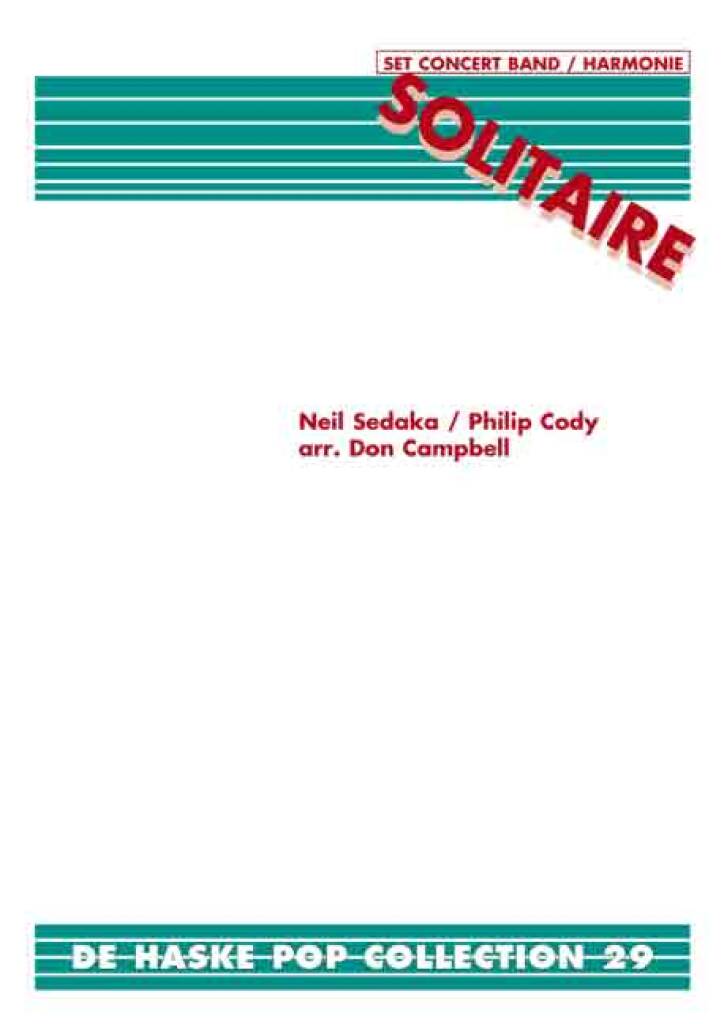
Solitaire - Neil Sedaka - Don Campbell
Many artists have performed solitaire over the years, but it is probably Neil Sedaka's interpretation that makes this song a true classic. This classic arrangement for brass band gives every player something of interest to play.
Estimated dispatch 5-14 working days
-
 £84.99
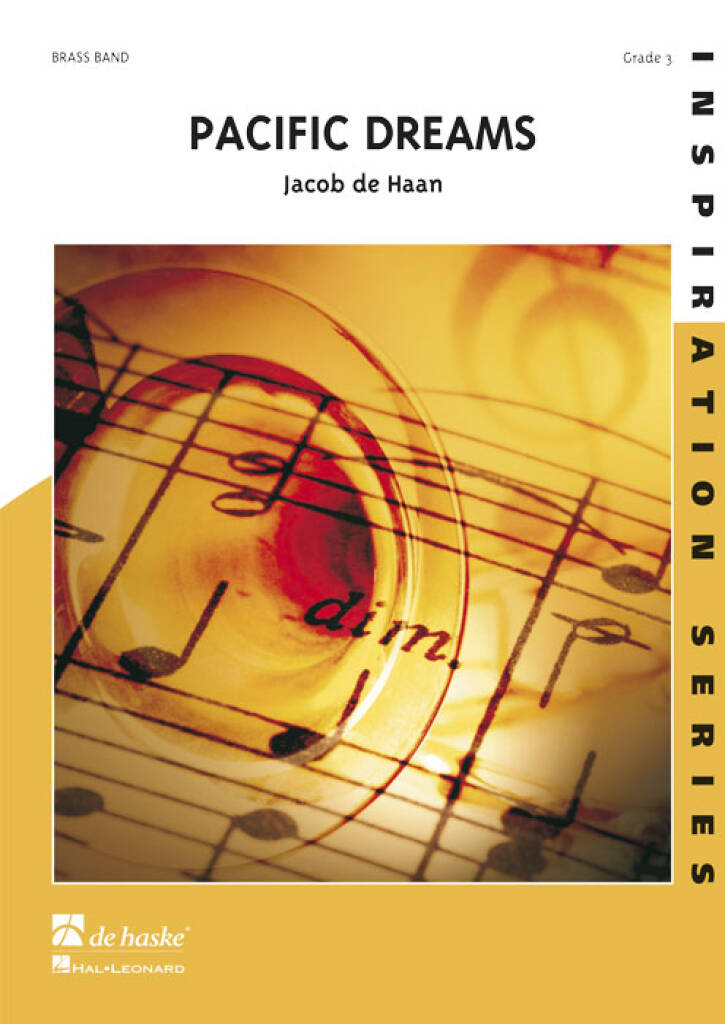
Pacific Dreams - Jacob de Haan
Pacific Dreams describes the experience of Miguel, a traveling composer from Spain who, feeling somewhat alienated from his homeland, is wandering through an area of Sydney known as The Rocks. At a small outdoor market in a typical street of this oldcolonial neighbourhood, he discovers a print of William DeShazos painting "Pacific Dreams" Portrayed in the painting is the surf of one of the exotic islands in the Pacific. Next, with the impressive Sydney Harbour Bridge looming over the narrowstreets of The Rocks, he envisions sultry Pacific beaches. Suddenly a theme he once composed about the lakes in Japan comes to him. Is it the Asian influences present in cosmopolitan Sydney that bring this theme to mind? Or perhaps the waters aroundSydney, over which he could sail to Tahiti? He is uncertain. Could this same theme be used to create a new composition about his feelings for the metropolis Sydney? How then to work his Pacific Dreams into the mix? Miguel is certainly no fan ofHawaiian music. Mayby he could use the vocabularies of islands like Hawaii and Tahiti, their beautiful vowel combinations being sung ad libitum by a mixed choir.With these ideas and his newly purchased print of "Pacific Dreams", he boards the Metroat Circular Quay. He has a final glimpse of the harbour and the Sydney Opera House as the train races into the ground. On to the hotel! To work! He must compose!Maestoso : Miguel is impressed as he gazes upon the Sydney Harbour Bridge. And yet, hewants to go away from this city. Away, to an exotic island in the Pacific.Steady Rock : In the Rocks, musicians are playing at a square. Miguel basks in the atmosphere but at the same time he is fantasizing about Hawaii and Tahiti.Andante Lamentoso :In his hotel room, Miguel is feeling sad and lonely in this big city. He takes comfort in his "Pacific Dreams".Allegro : Miguel boards the boat that takes him from Darling Harbour to Circular Quay. In his mind he is traveling on to Hawaii. Or is ithome, where the bolero is playing? He is pulled back to reality by the skyline of Sydney.
Estimated dispatch 5-14 working days
 View Music