
Results
-
 £54.99
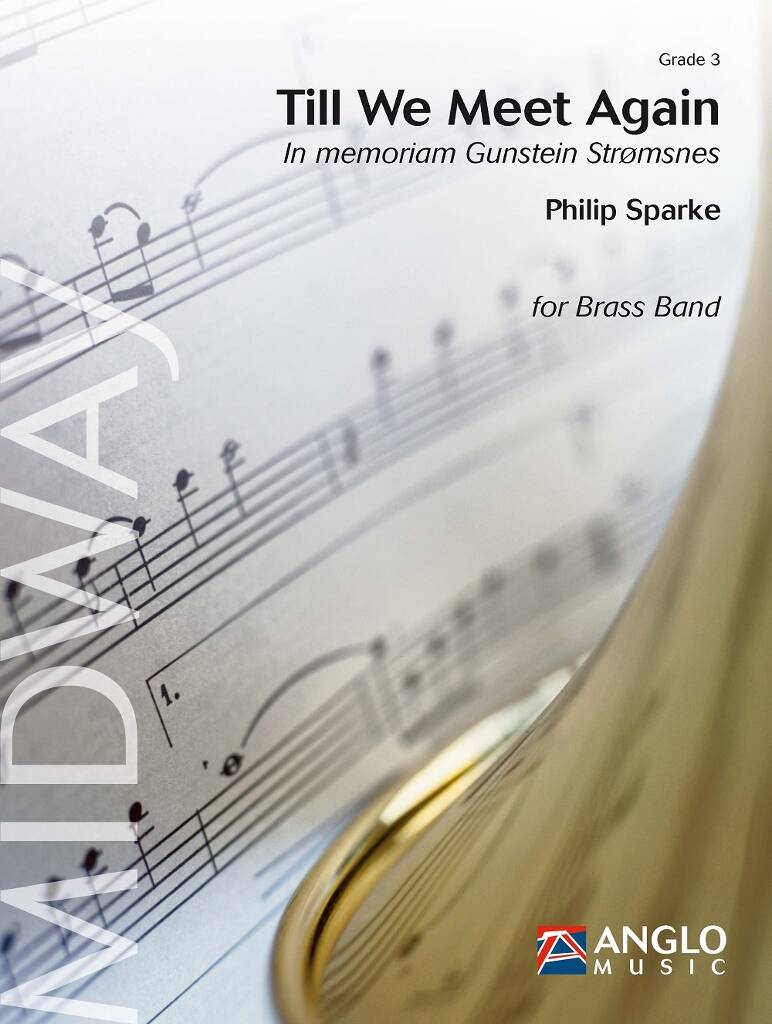
Till We Meet Again - Philip Sparke
Till We Meet Again was commissioned by Floraskulen Brassband, Floro, Norway, as a tribute to their former tuba player, Gunstein Stromsnes, who died tragically young in a traffic accident in 2017. They gave the premiere in December 2018. After a short introduction, a solo euphonium intones a modal, folk-like melody. This is taken up by the flugel horn and leads to a series of short solos which build to a majestic chorale for the full band. The mood subsides to reintroduce the modal melody before hints of the introduction and a short euphonium cadenza bring the work peacefully to a close.
Estimated dispatch 5-14 working days
-
£110.00
Legend - Geert Jan Kroon
Other than the title, there is no real story that connects this piece to eyeballs or werewolves. There is no real legend that precedes this work. The legend will evolve in the listener's mind while listening to this piece. For me, it started with the title. It was dreamed up by my son. He also suggested a musical gesture, which I then used to build all the musical materials in this piece. I have sought to capture a dark atmosphere with a sense of excitement. Although, there are some not so dark moments in the piece which serve as a musical contrast. I would like to invite every listener to imagine a world where there exists a legend of a bleeding eyeball and a blind werewolf. And if you do dream up a great story, please let me know and share it with each other!
-
 £10.00
Endurance
DescriptionMen wanted for hazardous journey. Small wages, bitter cold, long months of complete darkness, constant danger, safe return doubtful. Honour and recognition in case of success. - Ernest Shackleton, 4 Burlington StreetEndurance takes its title from the ship used by Sir Ernest Shackleton's Imperial Trans-Antarctic Expedition in 1914-15. After many months of fundraising (and reputedly running the above advert in The Times) the Endurance set sail from Plymouth on 6 August 1914. Whilst at sea news of the outbreak of war led Shackleton to put his ship and crew at the disposal of the Admiralty, but their services were not required and they were encouraged to continue. On October 26 1914 they left Grytviken on South Georgia for the Antarctic continent, hoping to find the pack ice shrinking in the Antarctic spring. Two days later, however, they encountered unseasonable ice which slowed their progress considerably. On 15 January 1915, when Endurance was only 200 miles from her intended landfall at Vahsel Bay, the ship became beset by ice which had been compressed against the land to the south by gale force winds. Trapped in the ice of the Weddell Sea, the ship spent the Antarctic winter driven by the weather further from her intended destination until, on 21 November 1915 Endurance broke up forcing the crew to abandon ship and set up camp on the ice at a site they named "Patience Camp".The crew spent several weeks on the ice. As the southern spring started to reduce the extent of the ice shelf they took to their three lifeboats, sailing across the open ocean to reach the desolate and uninhabited Elephant Island. There they used two of the boats to build a makeshift shelter while Shackleton and five others took the largest boat, an open lifeboat named the 'James Caird' and sailed it for 800 terrifyingly dangerous miles across the vast and lonely Southern Atlantic to South Georgia - a journey now widely regarded as one of the greatest and most heroic small-boat journeys ever undertaken. After landing on the wrong side of the island and having to climb over a mountain range in the dark with no map, Shackleton and his companions finally stumbled back into the Grytviken whaling station on 19 May 1916.After resting very briefly to recover his strength, Shackleton then began a relentless campaign to beg or borrow a ship to rescue the rest of his crew from Elephant Island; whaling ships were not strong enough to enter polar ice, but on 30 August 1916, over two years after their departure from Plymouth, Shackleton finally returned to Elephant Island aboard a steam tug borrowed from the Chilean government. Although some were in poor health, every member of the Endurance crew was rescued and returned home alive.Endurance is dedicated to the memory of my mum, who passed away in September 2017.Listen to a computer generated preview and follow the score below:
Estimated dispatch 7-14 working days
-
 £89.95
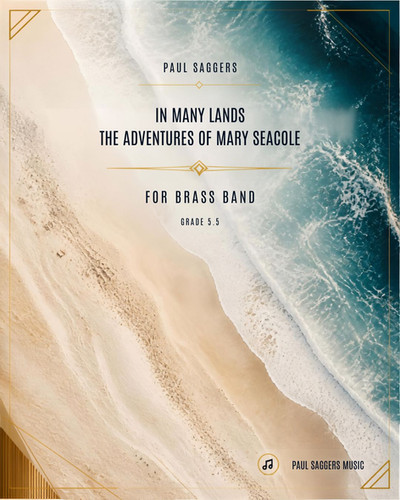
In Many Lands - The Adventures of Mary Seacole - Paul Saggers
In Many Lands - The Adventures of Mary Seacole was commissioned by The Royal Marines Band Service for The National Youth Brass Band of Great Britain. The first performance of the piece was on 16 April 2022 in Huddersfield Town Hall to celebrate the 70th anniversary of the NYBBGB. It was next performed in Birmingham Town Hall (on 28 April 2022) at a joint charity concert of the NYBBGB and The Band of Her Majesty's Royal Marines, Collingwood, for the European Brass Band Association Prelude Concert. The work is a musical account of the life of Mary Seacole who was a British-Jamaican nurse and businesswoman who set up the "British Hotel" behind the lines during the Crimean War. The work takes inspiration from Seacole's biography Wonderful Adventures of Mrs. Seacole in Many Lands. The work is divided into three movements:I Leave Kingston for Isthmus of PanamaIn 1851, Seacole travelled to Cruces to visit her brother. Shortly after her arrival, the town was struck by cholera, a disease which had reached Panama in 1849. Seacole was on hand to treat the first victim, who survived, which established Seacole's reputation and brought her a succession of patients as the infection spread. The rich paid, but she treated the poor for free. She avoided opium, preferring mustard rubs and poultices, the laxative calomel (mercuric chloride), sugars of lead, and rehydration with water boiled with cinnamon. While her preparations had moderate success, she faced little competition, the only other treatments coming from a "timid little dentist", who was an inexperienced doctor sent by the Panamanian government, and the Roman Catholic Church.The Predatory Tribes of BalaclavaSeacole was in London in 1854 when reports of the lack of necessities and breakdown of nursing care for soldiers in the Crimean War began to be made public. Despite her experience, her offers to serve as an army nurse were refused, and she attributed her rejection to racial prejudice. In 1855, with the help of a relative of her husband, she went to Crimea as a sutler, setting up the British Hotel to sell food, supplies, and medicines to the troops. After transferring most of her stores to the transport ship Albatross, with the remainder following on the Nonpareil, she set out on the four-day voyage to the British bridgehead into Crimea at Balaclava. Lacking proper building materials, Seacole gathered abandoned metal and wood in her spare moments, with a view to using the debris to build her hotel. The hotel was completed in July 1855 at a total cost of �800. Seacole's hotel was constantly targeted by thieves, she lost many resources and livestock.NYBBGB YOUTUBE PERFORMANCEhttps://www.youtube.com/watch?v=aCGzYWiKsqY
-
 £59.95
Aftershock (Brass Band - Score and Parts)
In this piece, the term "aftershock" serves as a metaphor for the Christian Church: commissioned by Jesus to carry forward the impact of his ministry and message. The Church is the spiritual aftershock of Christ's life, death, and resurrection - reverberating through history and into the present.Musically, the piece is constructed in three movements and built around motifs that pulse, echo, and resonate, symbolising the ongoing influence of Christ through his Church. Several well-known Christian songs are woven into its fabric, each contributing to the narrative of mission and worship. Build your Kingdom here (Rend Collective) affirms the Church's identity as "the hope on earth," while Major Leonard Ballantine's And you will be my witnesses (M.S. 1992-10) recalls Jesus' call to spread the gospel.The reflective central section features Matt Redman's I will offer up my life in spirit and truth, expressing personal devotion of a believer seeking to serive within the global Church.The finale draws on a traditional Salvation Army song by William Drake Pennick (S.A.S.B. 937), urging believers to proclaim the gospel far and wide: Tell the world, O tell the world!Make salvation's story heard;In the highways, in the byways,And in lands beyond the sea,do some witnessing for JesusWheresoever you may be.
Estimated dispatch 7-14 working days
-
 £54.99
Till We Meet Again (Brass Band - Score and Parts) - Sparke, Philip
Till We Meet Again was commissioned by Floraskulen Brassband, Floro, Norway, as a tribute to their former tuba player, Gunstein Stromsnes, who died tragically young in a traffic accident in 2017. They gave the premiere in December 2018. After a short introduction, a solo euphonium intones a modal, folk-like melody. This is taken up by the flugel horn and leads to a series of short solos which build to a majestic chorale for the full band. The mood subsides to reintroduce the modal melody before hints of the introduction and a short euphonium cadenza bring the work peacefully to a close.Duration: 4.00
Estimated dispatch 7-14 working days
 View Music