Results
-
 £125.00
Titan's Progress - Hermann Pallhuber
Commissioned by Austria's leading brass band, Brass Band Oberoesterreich, Titan's Progress is a series of descriptive, virtuoso episodes based on the principal character of the novel by Jean Paul. This was also theoriginal subject of Mahler's Symphony No. 1, from which Hermann Pallhuber derives much of his material. The work has proved an exceptionally popular test piece all over the world. Titan's Progress wasthe selected test piece for the British Open Brass Band Championship, held at Symphony Hall, Birmingham on Saturday 12th September 2009. Brass Band Grade 6: Championship Duration: 17 minutes Thescoreprovided with this set is a larger format, B4 size.
Estimated dispatch 5-14 working days
-
 £94.95
Whitsun Wakes (Score and Parts)
Whitsun Wakes was commissioned by the BBC and first performed by Black Dyke Band, conducted by James Watson, in Manchester's Bridgewater Hall on 26th May, 1997 as part of the BBC's 'Music Live' Festival. It was subsequently selected as a test piece for the British Open Championship which was scheduled to be held on 6th September 1997 at Birmingham's Symphony Hall. Unfortunately this was the day of the funeral of Diana, Princess of Wales and so the British Open was postponed until 17th January, 1998. However the greatest irony is the fact that although this piece takes its inspiration from the Manchester area it was destined to be played at the first British Open Championship to take place outside Manchester.
Estimated dispatch 7-14 working days
-
 £44.95
Whitsun Wakes (Score Only)
Whitsun Wakes was commissioned by the BBC and first performed by Black Dyke Band, conducted by James Watson, in Manchester's Bridgewater Hall on 26th May, 1997 as part of the BBC's 'Music Live' Festival. It was subsequently selected as a test piece for the British Open Championship which was scheduled to be held on 6th September 1997 at Birmingham's Symphony Hall. Unfortunately this was the day of the funeral of Diana, Princess of Wales and so the British Open was postponed until 17th January, 1998. However the greatest irony is the fact that although this piece takes its inspiration from the Manchester area it was destined to be played at the first British Open Championship to take place outside Manchester.
Estimated dispatch 7-14 working days
-
£29.95
Rhapsody in Brass (Score Only)
Rhapsody in Brass is in three movements and was written for the British Open Championships in 1949, held at Belle Vue in Manchester. The contest winners were Fairey Aviation Works Band under the baton of Harry Mortimer. Eric Ball came second with Ransome & Marles and Stanley Boddington 3rd with Munn and Felton Band. Rhapsody in Brass had the unusual distinction of being written as a test piece by a Salvation Army composer. Eric Ball's Resurgam was the only other piece to achieve that dual personality in that era.Dean Goffin was born in 1916 in Wellington, New Zealand, son of Henry Goffin, a Salvation Army officer and composer. At 19 he was appointed Bandmaster of the Wellington South Band and when World War II started, he enlisted in the New Zealand Armed Forces where he became Bandmaster of the 20th Infantry Battalion and later the 4th Brigade Band. During the time he served with them in the Middle East and Europe, he composed and arranged numerous pieces among which Rhapsody in Brass and the march Bel Hamid, later adapted for Salvation Army use and renamed Anthem of the Free.After the war, Dean kept on composing and his work was featured by the Wellington South Band. Later he transferred to Timaru for another job and became Bandmaster there. He was studying music at the time and as he wanted to take part in a competition for devotional selections for Salvation Army use, he sent some of his compositions to the International Headquarters. When Rhapsody for Brass was chosen as the test-piece for the British Open Championships, people at the Salvation Army started asking questions about the lack of publications of his work. It was discovered that the pieces submitted for the competition didn't meet the exact criteria. Among these pieces was one of his most appealing works The Light of the World which was published a year later, in 1950, the same year as he completed his Bachelor of Music studies at Otagu University.After entering the Salvation Army Training College in Wellington with his wife, Marjorie, Dean was in 1956 appointed National Bandmaster in the British Territory. Later he became National Secretary for Bands and Songster Brigades and in this period he organised the yearly festival in the Royal Albert Hall and was responsible for the national music schools in the UK. Dean returned to his home country in 1966 and to mark the centenary of the Salvation Army in New Zealand he was knighted by the Queen in 1983. Sir Dean Goffin died on 23 January 1984.
Estimated dispatch 7-14 working days
-
 £49.95
Bestowal of a Century - Christopher Bond
Bestowal of a Century (2014) was commissioned by Lowenna Taylor, and funded through her Harry Mortimer Trust award which she was presented with at the 2013 British Open Championship following the completion of her studies at the Royal Welsh College of Music in Cardiff. The 15-minute work received its world premiere at the Cornwall Youth Brass Band Christmas concert in 2014 with solosit, Lowenna, working alongside the band under the baton of Les Neish. The 'Bestowal' refers to the presentation of the Royal Trophy by the then Prince of Wales to the famous West of England Bandsman's Festival in Bugle in 1913. Over the years it has been won by some of the greatest names in brass banding, including Black Dyke and Munn & Feltons - although more recently it has become a wonderful open festival that includes sections for local bands as well as visitors from all over the banding globe. 2014 marked the one-hundredth anniversary of the presentation of the trophy, which is the only brass band trophy to have the official seal of royal patronage. The work, in three distinct sections, opens in a mysterious way, building progressively with interjections from the horn. The composer notes its as though one can imagine different part of the trophy being put together, piece by piece, until the trophy is complete and a climax is reached. Following this, a playful theme is presented which is developed throughout the first section and interacting between soloist and band. The second movement, in complete contrast, is a lyrical melody; heart-wrenching throughout, and sits well both as part of the concerto and also as a stand-alone solo item. The third movement is light-hearted and virtuosic, demonstrating the technical capabilities of the instrument with fast and virtuosic playing, and a cadenza towards the end of the work.
Estimated dispatch 10-14 working days
-
 £49.95
Bestowal of a Century (Tenor Horn Solo)
Tenor Horn Solo with Brass BandBestowal of a Century (2014) was commissioned by Lowenna Taylor, and funded through her Harry Mortimer Trust award which she was presented with at the 2013 British Open Championship following the completion of her studies at the Royal Welsh College of Music in Cardiff. The 15-minute work received its world premiere at the Cornwall Youth Brass Band Christmas concert in 2014 with solosit, Lowenna, working alongside the band under the baton of Les Neish.The Bestowal refers to the presentation of the Royal Trophy by the then Prince of Wales to the famous West of England Bandsman's Festival in Bugle in 1913. Over the years it has been won by some of the greatest names in brass banding, including Black Dyke and Munn & Feltons - although more recently it has become a wonderful open festival that includes sections for local bands as well as visitors from all over the banding globe. 2014 marked the one-hundredth anniversary of the presentation of the trophy, which is the only brass band trophy to have the official seal of royal patronage.The work, in three distinct sections, opens in a mysterious way, building progressively with interjections from the horn. The composer notes its as though one can imagine different part of the trophy being put together, piece by piece, until the trophy is complete and a climax is reached. Following this, a playful theme is presented which is developed throughout the first section and interacting between soloist and band.The second movement, in complete contrast, is a lyrical melody; heart-wrenching throughout, and sits well both as part of the concerto and also as a stand-alone solo item. The third movement is light-hearted and virtuosic, demonstrating the technical capabilities of the instrument with fast and virtuosic playing, and a cadenza towards the end of the work.
Estimated dispatch 7-14 working days
-
 £38.00
Monteverdi Three Miniatures
ABOUT THIS PIECE: Monteverdi - Three Miniatures, is an engaging and educational brass band arrangement by Adam Taylor, originally composed for the British Open Youth Brass Band Contest at the Guild 2015. This piece masterfully reimagines themes from the works of Claudio Monteverdi, presenting them in a contemporary style that's both accessible and inspiring for modern brass ensembles. Ideal for youth bands and ensembles looking to explore early music in a fresh format, Monteverdi - Three Miniatures offers flexibility and creativity. The arrangement includes adaptable tempos to match your interpretation, a featured duet with parts available in both Bb and Eb, and written percussion parts that can be expanded with additional instruments or streamlined for smaller sections. Players are encouraged to add their own ornamentation, allowing for personal expression and an authentic touch to the music. With its nod to the grandeur of the late Renaissance and early Baroque periods, this piece serves not only as an excellent concert addition but also as a valuable educational tool, introducing young musicians to Monteverdi's timeless work. Dive into this vibrant arrangement and bring the essence of Monteverdi's genius to your next performance. ENSEMBLE: Standard British Brass Band (with adaptations) WHEN YOU BUY THIS PRODUCT, YOU GET: High-quality printed score and parts LEVEL: 1 LISTEN: Click here DURATION: 5-minutes, 30-secondsEXAMPLE SCORE: Click here LEVEL GUIDE: Level 1- Accessible to all Level 2 - c. UK third section and higher Level 3 - c. UK second section and higher Level 4 - c. UK first section and higher Level 5 - c. UK championship section level
Estimated dispatch 5-7 working days
-
 £124.95
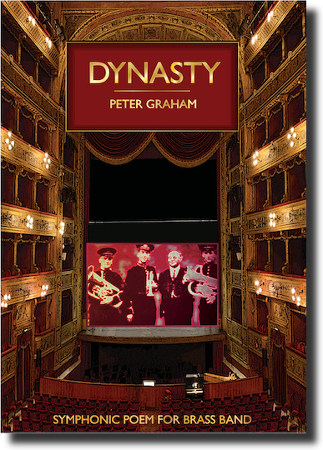
Dynasty - Peter Graham
'Dynasty' was a joint commission for the 2019 British Open and Belgium Championships, and pays homage to the iconic figure of Harry Mortimer through a series of linked narrative passages using his autobiography as a musical point of reference.First heard to widespread acclaim at Symphony Hall, the work will make its European contest premiere at the Belgian National Championships later this year.
Estimated dispatch 3-7 working days
-
 £33.62
A Century of Art (Brass Band) Robbert Vos
A Century of Art was composed for Brass Band Kunst naar Kracht from the town of De Goorn (The Netherlands) for its 100th anniversary in 2022. A version for Fanfare Orchestra was commissioned by the Fanfare Project Orchestra in 2023. The title of the work refers to Brass Band Kunst naar Kracht's 100-year existence and the array of art that has been created in that time. A Century of is a flashy and virtuosic opening work where melodic lines are combined with other surprising compositional elements. You can hear, among some references to some famous brass band test pieces, a quote from Lohengrin by Richard Strauss. A transcription of Lohengrin was used at the 1922 British Open in England, one of the most famous brass band competitions in the world, the same year as Brass Band Kunst naar Kracht was founded. To view a performance by Fanfare 'Project Orkest' of the work please visit www.youtube.com/watch?v=D6zuoaxf_kg (please note this is the Fanfare Band version, although it is essentially the same). Duration: 4.00 minutes Difficulty Level: 2nd Section + PDF download includes parts and score. Sheet music available from www.brassband.co.uk Instrumentation: Soprano Cornet Eb Solo Cornet Bb Repiano Cornet Bb 2nd Cornet Bb 3rd Cornet Bb Flugel Horn Bb Solo Horn Eb 1st Horn Eb 2nd Horn Eb 1st Baritone Bb 2nd Baritone Bb 1st Trombone Bb 2nd Trombone Bb Bass Trombone Euphonium Bb Bass Eb Bass BbTimpani Percussion 1-4
In Stock: Estimated dispatch 1-3 working days
-
£125.00
Titan's Progress (Score & Parts) - Hermann Pallhuber
Commissioned by Austria's leading brass band, Brass Band Oberoesterreich, Titan's Progress is a series of descriptive, virtuoso episodes based on the principal character of the novel by Jean Paul. This was also the original subject of Mahler's Symphony No. 1, from which Hermann Pallhuber derives much of his material. The work has proved an exceptionally popular test piece all over the world. Titan's Progress was the selected test piece for the British Open Brass Band Championship, held at Symphony Hall, Birmingham on Saturday 12th September 2009. Brass Band Grade 6: Championship Duration: 17 minutes The score provided with this set is a larger format, B4 size.
In Stock: Estimated dispatch 1-3 working days