
Results
-
 £12.50
Of Distant Memories (Music in an Olden Style) (Brass Band - Study Score) - Gregson, Edward
2013 Finals of the National Brass Band Championships of Great Britain - Championship Section.Of Distant Memories pays homage to the brass band composers that form the backbone of the brass band repertoire, and their music, and in the process summons up a kind of subconscious memory bank of the musical languages, styles and forms used by them. The music is conceived in the form of a 'traditional' tone poem, reflecting certain aspects (e.g. melodic, harmonic, textural) of those early test pieces. Although fairly traditional concepts have been kept in planning the architecture of the work, certain aspects of the instrumentation, or scoring, are more contemporary in colouristic terms, as befits a composer writing in the 21st century. However, the percussion requirements are fairly modest, similar to those used in the works of that period. The brass band tradition owes much to the composers of that period, for through their music they established a truly homogenous 'British' brass band sound which has spread throughout many parts of the world. That tradition flourishes today and remains important for today's composers, even if their musical language is far removed from that of their predecessors. Of Distant Memories is the composers own way of repaying that gratitude.Duration: 15.00
Estimated dispatch 7-14 working days
-
 £89.95
Of Distant Memories (Music in an Olden Style) (Brass Band - Score and Parts) - Gregson, Edward
Of Distant Memories pays homage to the brass band composers that form the backbone of the brass band repertoire and their music, and in the process summons up a kind of subconscious memory bank of the musical languages, styles and forms used by them. The music is conceived in the form of a 'traditional' tone poem, reflecting certain aspects (e.g. melodic, harmonic, textural) of those early test pieces. Although fairly traditional concepts have been kept in planning the architecture of the work, certain aspects of the instrumentation, or scoring, are more contemporary in colouristic terms, as befits a composer writing in the 21st century. However, the percussion requirements are fairly modest, similar to those used in the works of that period. The brass band tradition owes much to the composers of that period, for through their music they established a truly homogenous 'British' brass band sound which has spread throughout many parts of the world. That tradition flourishes today and remains important for today's composers, even if their musical language is far removed from that of their predecessors. Of Distant Memories is the composers own way of repaying that gratitude.Duration: 15.00
Estimated dispatch 7-14 working days
-
 £44.95
Of Distant Memories (Music in an Olden Style) (Brass Band - Score only) - Gregson, Edward
Of Distant Memories pays homage to the brass band composers that form the backbone of the brass band repertoire, and their music, and in the process summons up a kind of subconscious memory bank of the musical languages, styles and forms used by them. The music is conceived in the form of a 'traditional' tone poem, reflecting certain aspects (e.g. melodic, harmonic, textural) of those early test pieces. Although fairly traditional concepts have been kept in planning the architecture of the work, certain aspects of the instrumentation, or scoring, are more contemporary in colouristic terms, as befits a composer writing in the 21st century. However, the percussion requirements are fairly modest, similar to those used in the works of that period. The brass band tradition owes much to the composers of that period, for through their music they established a truly homogenous 'British' brass band sound which has spread throughout many parts of the world. That tradition flourishes today and remains important for today's composers, even if their musical language is far removed from that of their predecessors. Of Distant Memories is the composers own way of repaying that gratitude.Duration: 15.00
Estimated dispatch 7-14 working days
-
 £55.00
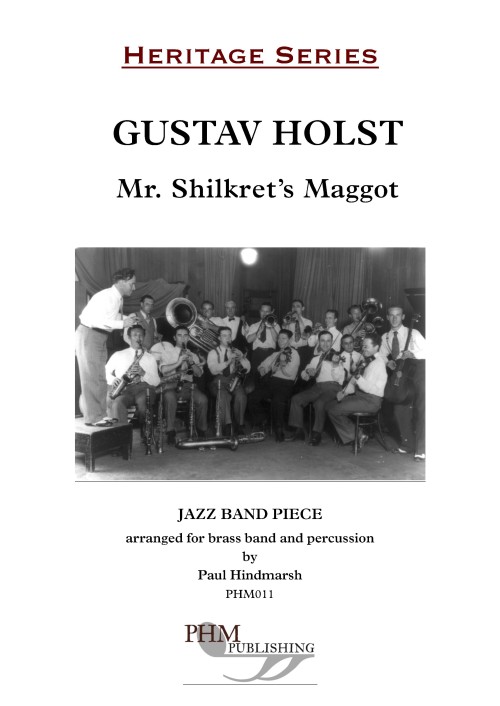
Mr Shilkret's Maggot (Brass Band - Score and Parts) - Holst, Gustav - Hindmarsh, Paul
This short piece was composed in 1932 during a visit Gustav Holst was making to the USA. He was invited by the band leader Nathaniel Shilkret to contribute to a series of piece for concert jazz band based on a folk song. Rather than using a traditional tune, Holst invented one of his own in folk song style and therefore the piece was not performed. Holst considered various titles for the piece including Mr. Shilkret's Dump, Folly and Maggot. On the manuscript he described it as a Jazz Band Piece. When the composer's daughter Imogen re-scored the piece for the English Chamber Orchestra to record under her direction in 1967, she changed decided to use the title Capriccio.Her re-orchestration involved removing the saxophone quartet, adding cor anglais and a second bassoon and changing cornet parts to trumpets. She retained the harp, extensive percussion, piano and celesta. My brass band version is based on the composer's manuscript, held at the British Library. It retains the composer's cornet parts, re-voices the woodwinds and strings, and places keyboards and harp onto glockenspiel, marimba, vibraphone and xylophone.I have selected the title Mr. Shilkret's Maggot for my scoring of Jazz Band Piece, which was first performed by The Cory Band, conducted by Philip Harper, at the Royal Northern College of Music Brass Band Festival, 29 January 2017.- Paul HindmarshDuration: 5.30
Estimated dispatch 7-14 working days
-
 £50.00
Solemn Procession (Brass Band - Score and Parts) - Strauss, Richard - Hindmarsh, Paul
Richard Strauss (1864 - 1949) was a famous conductor and composer when he wrote Feierlicher Einzug der Ritter des Johanniter-Ordens (Solemn Entrance of the Knights of the Order of Saint John) in 1909. One of only a handful of his works written exclusively for winds, Strauss composed Feierlicher Einzug for the investiture ceremonies of the Order of St. John, a Christian military order that was founded in Jerusalem in 1023 to care for poor, sick, or injured pilgrims journeying to the Holy Land.Strauss scored Feierlicher Einzug (TrV 224) for a large ensemble of fifteen trumpets, four horns, four trombones, two tubas and timpani. He saw enough potential in its stately character and majestic conclusion to produce a version for symphony orchestra with organ and it has been arranged for a variety of brass ensembles with or without organ since then.This version for British style brass band was adapted from the original in 1990 by Paul Hindmarsh for the exclusive use of Besses o' th' Barn Band, of which he was then the musical director. Now that the music of Richard Strauss published in his lifetime is in the public domain, Solemn Procession, as it has been rendered in English, can be enjoyed by all brass bands and their audiences.- Paul HindmarshDuration: 6.00
Estimated dispatch 7-14 working days
-
 £50.00
Greetings to a City (Brass Band - Score and Parts) - Bliss, Arthur - Hindmarsh, Paul
Sir Arthur Bliss (1891 - 1975) was a significant composer and pillar of the British musical establishment. Although Born in London, his father was from the United States and both countries were important in his life and career. A pupil of Stanford at the Royal College of Music, Bliss travelled to the United States with his father in 1923, taking a prominent part in Elizabeth Sprague Coolidge's Pittsfield Music Festival, as well as undertaking some teaching and conducting. In 1925 he married Trudy Hoffman and they returned to the UK early in 1926. Bliss's most influential scores were his ballets and film scores. In 1953 Sir Arthur was appointed Master of the Queen's Music, after which he added a steady stream of fanfares and ceremonial works to his list of works. In 1960 he was commissioned by the American Wind Symphony of Pittsburgh, which requested for festive work to feature on an extensive European tour, including a performance in London.Bliss scored Greetings to a City for antiphonal brass, a choir each of 2 trumpets, 2 horns and three trombones, with tuba and percussion. This adaptation for brass band instruments retains an element of antiphony, emphasing the contrast between the fanfare instruments (cornets and trombones) and the horns and tubas. Greetings to a City is cast in three connected sections, with extended fanfare episodes separated by a short lyrical interlude.- Paul HindmarshDuration: 6.00
Estimated dispatch 7-14 working days
-
 £43.00
Blue Bombazine (Eb Bass Solo with Brass Band - Score and Parts) - Johns, Terry
The word Bombazine is derived from the obsolete French word Bombasin. Largely made in the Norwich area, Bombazine is a twilled fabric made of silk used mainly in dress making and popular in England in the reign of Elizabeth I. The image and feel of warm, smooth, opulent silk is aptly suited to a solo feature for tuba. Wing Commander Duncan Stubbs and the RAF Music Service commissioned Blue Bombazine for solo tuba and brass in 2014, for Senior Aircraftman Jonathan Gawn and the RAF Central Band. It was first performed at The Royal Northern College of Music in Manchester, on the 11th April 2015 at the British Festival of Wind Bands. The music is written in the jazz idiom with a testing solo part. It is available with brass band accompaniment or for ten brass with tuba solo. Duration: 5.00. Suitable for 1st Section Bands and above
Estimated dispatch 7-14 working days
-
 £95.00
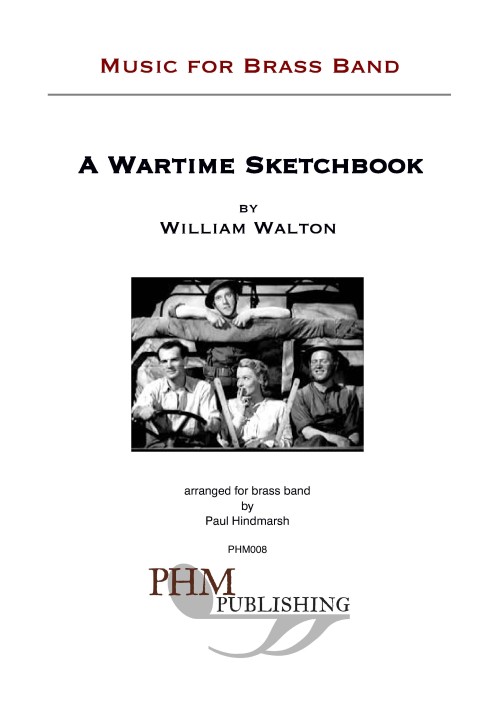
A Wartime Sketchbook (Brass Band - Score and Parts) - Walton, William - Hindmarsh, Paul
Early in 1941 William Walton, 39, received his call-up papers. He was by then one of the most eminent of British composers and was exempted from military service on condition that he provided music for films deemed to be of 'national importance'. Scoring Lawrence Olivier's Shakespeare epic Henry V in 1943 was the most substantial of these wartime projects. His role in patriotic films from 1941 and 42 like The Foreman went to France, Next of Kin, Went the day Well and The First of the Few was to provide appropriate title music and some underscoring at key moments. Walton extracted the most substantial portions of the latter as the popular Spitfire Prelude and Fugue for orchestra. The remaining music remained unpublished until 1990, when Christopher Palmer assembled the highlights into A Wartime Sketchbook. I was intrigued to hear these examples of Walton's wartime music and having discovered that they would fit naturally and idiomatically onto the brass band, I arranged six of the numbers into a suite for Besses o' th' Barn Band, which I was conducting at the time.In 1995 the brass band suite was recorded by the famous Black Dyke Mills Band as part of an all Walton album which I produced for the ASV label (ASV CD WHL 2093). This award- winning CD also included Walton's First Shoot, in the edition by Elgar Howarth, my transcription of movements from Music for Children and two substantial brass versions by Edward Watson of the suite from Henry V (with narrator) and the March and Siegfried Music from The Battle of Britain music.Prologue: This is the stirring title music from Went the day Well, a screen play by Graham Greene about a German airborne invasion of an English village. The main theme leads toBicycle Chase: Characteristic musical high-jinks for J.B.Priestley's The Foreman went to France.Refugees: From the same film, this is a poignant accompaniment to the long march of refugees. As Ernest Irving, the film's musical director, put it, "this really makes your feet sore and your knees sag."Young Siegfrieds: This lively movement comes from the music that Walton composed for The Battle of Britain in 1968, with the assistance of Malcolm Arnold, but which the film's producer rejected. It portrays first the Berliners, cheerfully ignoring the black-out and then, in the trio, the Young Siegfrieds of the Luftwaffe, courtesy of a parody of Siegfried's horn call from Wagner's opera.Romance: A soldier and a Dutch refugee snatch a few tender moments together in Next of Kin.Epilogue: At the end of The Foreman went to France, the French look forward with hope and optimism to eventual liberation.- Paul HindmarshDuration: 14.00
Estimated dispatch 7-14 working days
-
£40.00
A Wartime Sketchbook (Brass Band - Score only) - Walton, William - Hindmarsh, Paul
Early in 1941 William Walton, 39, received his call-up papers. He was by then one of the most eminent of British composers and was exempted from military service on condition that he provided music for films deemed to be of 'national importance'. Scoring Lawrence Olivier's Shakespeare epic Henry V in 1943 was the most substantial of these wartime projects. His role in patriotic films from 1941 and 42 like The Foreman went to France, Next of Kin, Went the day Well and The First of the Few was to provide appropriate title music and some underscoring at key moments. Walton extracted the most substantial portions of the latter as the popular Spitfire Prelude and Fugue for orchestra. The remaining music remained unpublished until 1990, when Christopher Palmer assembled the highlights into A Wartime Sketchbook. I was intrigued to hear these examples of Walton's wartime music and having discovered that they would fit naturally and idiomatically onto the brass band, I arranged six of the numbers into a suite for Besses o' th' Barn Band, which I was conducting at the time.In 1995 the brass band suite was recorded by the famous Black Dyke Mills Band as part of an all Walton album which I produced for the ASV label (ASV CD WHL 2093). This award- winning CD also included Walton's First Shoot, in the edition by Elgar Howarth, my transcription of movements from Music for Children and two substantial brass versions by Edward Watson of the suite from Henry V (with narrator) and the March and Siegfried Music from The Battle of Britain music.Prologue: This is the stirring title music from Went the day Well, a screen play by Graham Greene about a German airborne invasion of an English village. The main theme leads toBicycle Chase: Characteristic musical high-jinks for J.B.Priestley's The Foreman went to France.Refugees: From the same film, this is a poignant accompaniment to the long march of refugees. As Ernest Irving, the film's musical director, put it, "this really makes your feet sore and your knees sag."Young Siegfrieds: This lively movement comes from the music that Walton composed for The Battle of Britain in 1968, with the assistance of Malcolm Arnold, but which the film's producer rejected. It portrays first the Berliners, cheerfully ignoring the black-out and then, in the trio, the Young Siegfrieds of the Luftwaffe, courtesy of a parody of Siegfried's horn call from Wagner's opera.Romance: A soldier and a Dutch refugee snatch a few tender moments together in Next of Kin.Epilogue: At the end of The Foreman went to France, the French look forward with hope and optimism to eventual liberation.- Paul HindmarshDuration: 14.00
Estimated dispatch 7-14 working days
-
 £134.99
Dances and Alleluias (Brass Band - Score and Parts) - Sparke, Philip
Dances and Alleluias was commissioned by the British Federation of Brass Bands for the inaugural English National Brass Band Championships, held in the Lyric Theatre at The Lowry, Salford Quays, on July 1st 2006. In this fantastic work the composer mixes wonderful slow music, vocal in nature and ecstatic in mood, along with faster dances to create a challenging piece, which will bring out the best in any band.Duration: 14:30
Estimated dispatch 7-14 working days
 View Music