
Results
-
 £17.50
The Covenanters (Brass Band - Score only) - Downie, Kenneth
In 1638, many members of the Presbyterian Church of Scotland signed a document called the National Covenant. By doing so, they were declaring that they acknowledged only Jesus Christ as the spiritual head of their church, and not any king or queen. This had become necessary because the Stuart kings believed in the Divine Right of Monarchs and saw themselves as head of the church. In the previous year, Charles I had forcibly introduced the Book of Common Prayer, invoking the wrath of the common people who faced the threat of torture, transportation or execution if they did not use the new liturgy and worship at their local church. The net result of this was that many met illegally in the countryside or in barns and large houses. These meetings became known as 'conventides' and many took place in the south-west of the country. Anyone caught attending was at risk of execution by the muskets of the dragoons who were employed in the area for that specific purpose. This music was written to honour the bravery and loyalty of these Christians to their faith, in the face of extreme danger, in the hope that it will inspire us also to be faithful. There are overtones of military threat, secrecy and solidarity. An old pentatonic tune is used, which the composer heard as a boy being sung to the words The Lord's My Shepherd.
Estimated dispatch 7-14 working days
-
£22.50
Jubilance (Cornet Solo with Brass Band - Score only) - Himes, William
This exuberant fantasia for soloist and band requires double-tonguing for the quick and brilliant introduction. Not only the soloist will be extended with this work - the band accompaniment is also demanding and will need to be given full attention. The solo builds to a brilliant climax and is an ideal showcase for Cornet soloists.
Estimated dispatch 7-14 working days
-
£17.50
Sweet By And By (Brass Band - Score only) - Ballantine, Leonard
A newly departed saint (depicted by the flugel horn) has a lot of stories to tell as he joins up with former companions in this light-hearted look at an old gospel favourite. The music seeks to portray not only the sweet fellowship of that reunion but also the awesome majesty of Heavenly communion.
Estimated dispatch 7-14 working days
-
 £11.99
Burke and Wills Suite (Brass Band - Score only) - Sculthorpe, Peter
This suite is an arrangement of some of the music written for the film, Burke & Wills (Hoyts/Edgely), directed by Graeme Clifford. Duration: 13.00. The set is available for hire only.
Estimated dispatch 7-14 working days
-
 £53.99
For Your Eyes Only (Brass Band - Score and Parts) - Conti, Bill - Kraeydonck, Jan van
From the United Artists motion picture "For Your Eyes Only". Performed by Sheena Easton. Duration: 04:10
Estimated dispatch 7-14 working days
-
 £30.00
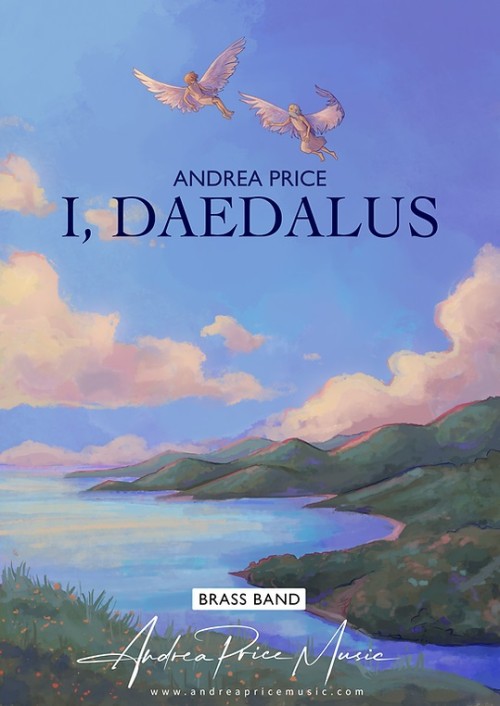
I, Daedalus (Brass Band - Score only) - Price, Andrea
This title is now digital download only - November 2025 Daedalus (pronounced day-da-luss) is a prominent figure in Greek mythology, renowned for his exceptional skills as an inventor, craftsman, and architect. The story of Daedalus symbolises human ingenuity, and epitomises the complex relationship between human creativity and its consequences. His myths explore themes of innovation, pride, and the perilous balance between human ambition and natural limits. After designing the labyrinth for King Minos, Daedalus and his son, Icarus, were imprisoned in a tower in Crete. Daedalus fashioned wings from feathers and wax, and father and son set out on their ill-fated escape. The music is through-composed, with a short introduction leading to five main sections:I - Inventor in the TowerII - Father and SonIII - Flight and FallIV - LamentV - Seeker of KnowledgeDuration: c. 10 minutes
Estimated dispatch 7-14 working days
-
 £54.99
Only Time (Brass Band - Score and Parts)
For many years Enya has been selling as many records as pop goddesses like Madonna and Britney Spears. But it was the events of September 11, 2001 that truly brought this Irish singer to the world stage with CNN broadcasting her ballad Only Time with the tragically dramatic images around the World Trade Center in New York. Ron has arranged this moving song in his own familiar creative way 03:00
Estimated dispatch 7-14 working days
-
 £28.00
PURCELL VARIATIONS (Brass Band extra score only) - Downie, Kenneth
Score only.
Estimated dispatch 7-14 working days
-
 £85.00
Three Haworth Impressions (Brass Band - Score and Parts) - Langford, Gordon
A wonderful three movement suite which conjures up fabulous musical imagery of the lands of northern England. Well worth including as a concert item in your next programme, but this great original composition should really should be set again as a test-piece soon - rewarding musically for audience and bandsmen alike.Includes:TOP WITHENS - A GENERAL EVOCATION OF THE ATMOSPHERE OF WUTHERING HEIGHTS The sinister opening motif symbolises the influence of the evil Heathcliffe, Soon this motif experiences several changes of character in order to portray emotions other than those of hatred and jealousy. The overall mood is, however, one of gloom and foreboding.THE THREE BELLS This is a reference to the pseudonyms adopted by Ann, Charlotte and Emily Bronte. The music begins with three "bell"-notes; Ab for Acton Bell, Cb for Currer Bell and Eb for Ellis Bell, and these three notes form the basis of a wistful waltz tune. Again the mood is rather sombre -- save for a brighter middle section -- and the opening motif from "Top Withens" is to be heard, again symbolising the frustrations and ill-fortune by which their lives were plagued.THE WORTH VALLEY RAILWAY The Brontes were not the only people in Haworth and not all is desperation and gloom. The third impression is a celebration of the victory of the people of Haworth in their fight to retain their railway. The nine-eight rhythm of a slow train is prominent, and our once-sombre motif is transformed into a triumphant fanfare.Duration: 12.00Please note that there are only 3 solo cornet parts included in this set
Estimated dispatch 7-14 working days
-
 £15.00
Symphony in Two Movements (Brass Band - Study Score) - Gregson, Edward
Selected as the Championship Section test piece for the National Brass Band Championships of Great Britain 2025This work was jointly commissioned by the National Youth Brass Band of Great Britain (NYBBGB) and the National Youth Brass Band of Wales (NYBBW), the latter with funding from T Cerdd (Music Centre Wales), to celebrate their 60th and 30th anniversaries respectively. The first performances were given at Cadogan Hall, London, in April 2012, by the NYBBGB, conducted by Bramwell Tovey; and at the Great Hall, Aberystwyth University, in July 2012, by the NYBBW, conducted by Nicholas Childs.When I was approached about a joint commission to write a new work to celebrate the anniversaries of these two outstanding youth bands I was delighted to accept, and decided to respond by writing a work apposite for the magnitude of these special occasions, namely a 'symphony for brass'.Through a long journey of writing music for brass band, which commenced with Connotations (1977), and continued with Dances and Arias (1984), Of Men and Mountains (1991), The Trumpets of the Angels (2000) and Rococo Variations (2008), I arrived at what I regard as the most important work of the cycle to date, combining as it does serious musical intent with considerable technical demands. It is perhaps my most abstract work for brass band, avoiding any programmatic content.The symphony lasts for some 19 minutes and is structured in two linked movements. The form is based on that used by Beethoven in his final piano sonata (Op.111), which is in two movements only: a compact sonata-form allegro, followed by a more expansive theme and four variations. Prokofiev also adopted this model in his 2nd Symphony of 1925.The opening Toccata of this Symphony is highly dramatic but compact, whilst still retaining the 'traditional' structural elements of exposition, development and recapitulation; indeed, it also has the 'traditional' element of a contrasting second subject - a gentle, lyrical modal melody first heard on solo cornets.In contrast, the longer and more substantial second movement Variations is built around a theme and four variations. The slowly unfolding chorale-like theme accumulates both added note harmony and increasing instrumentation, whilst the four variations which follow are by turn mercurial (fast, starting with all the instruments muted), march-like (menacing, with short rhythmic articulations underpinning an extended atonal melody), serene (a series of 'romances' for solo instruments alongside echoes of the chorale) with an emerging theme eventually bursting into a climax of passionate intent; whilst the final variation is a dynamic scherzo (concertante-like in its series of rapid-fire solos, duets, trios and quartets) with the music gradually incorporating elements of the main ideas from the first movement, thus acting as a recapitulation for the whole work. It reaches its peroration with a return to the very opening of the symphony, now in the 'home' tonality of F, and thus creating a truly symphonic dimension to the music.Most of the melodic material of the symphony is derived from the opening eleven-note 'row', which contains various intervallic sets, and although the work is not serially conceived it does use some typical quasi-serial procedures, such as canons, inversions, and retrogrades. The symphony uses somewhat limited percussion, in line with a 'classical' approach to the sound world of the brass band, alongside a use of multi-divisi instrumentation, whereby each player has an individual part rather than the traditional doubling within certain sections of the band.- Edward GregsonDuration: 19.00
Estimated dispatch 7-14 working days
 View Music