
Results
-
 £29.95
Tournament for Brass (Score Only)
This is not descriptive music: the tournament is within the band!In the first movement, small groups of instruments are featured - mainly in duets and trios - in a kind of "conversation piece".The second movement is in the form of a Theme with Variations, the band's main soloists being given a chance to show their paces.In the final Scherzo there is more general ensemble playing, although soloists again carry some of the responsibility.
Estimated dispatch 7-14 working days
-
£104.99
Brass Dynamics - Franco Cesarini
Composed for the 2nd section of the Swiss Brass Band Championships Brass Dynamics is perfect as a major work for any concert. It is centred on the form of an (A-B-A) overture with the initial dynamic theme setting the tone for the entire work and reoccurring in each movement. Composer Franco Cesarini has a masterful feel for brass band orchestration and brings out the best of all instruments and instrument combinations. Enrich your concert repertoire with this fascinating work.
Estimated dispatch 5-14 working days
-
 £69.99
Go for Brass! - Jacob de Haan
Subtitled "A Young Person's Guide to the Brass Band", Go for Brass! is a musical introduction to the sound, instrumental groups and the individual instruments of the brass band. Your players will love this work as they stand to highlight their particular section with snippets of the sparkling up-tempo dance style theme. An extremely entertaining concert item with a little fun educational content!
Estimated dispatch 5-14 working days
-
 £72.99
Fantastic Brass (Brass Band - Score and Parts) - Tinner, Gilbert
Composer and trombone player Gilbert Tinner wrote this original piece to reflect his passion for rhythm and brass instruments.
Estimated dispatch 7-14 working days
-
 £60.99
Centennial Prelude (Brass Band - Score and Parts) - Van der Roost, Jan
This short opening music was composed on commission of the symphonic band of Jan Van der Roost's village (= Kontich near Antwerp / Belgium). In 1991, this community band celebrated its 100th anniversary. After composing commissioned pieces from different countries (even from Japan), this was the most 'near' commission he ever received indeed! It is a short but varied piece, featuring all sections of the band. After a short introduction, played by the brass instruments, a crisp rhythm starts and boxes the main theme. After a second theme, played by brass and percussion, a short melodical passage brings some 'rest'. At the end, the fanfare of the introduction reoccurs. Although this "Centennial Prelude" isn't a really demanding piece, it sounds colourful and energetic. It has been recorded on CD by the band of the 'Royal Dutch Airforce' and the 'Desford Colliery Brass band'.Duration: 3:30
Estimated dispatch 7-14 working days
-
 £25.95
Song of Tranquillity (Cornet Duet or Bb Solo with Brass Band - Score and Parts) - Wiffin, Rob
A reflective piece featuring two cornets and band but also playable as a solo for cornet, trombone or euphonium.Song of Tranquillity was written just after a close friend of the composer died suddenly. It was cathartically written to reflect the release from pain to peace. It fits the expressive style and power of the solo brass instruments.Duration: 3.45
Estimated dispatch 7-14 working days
-
 £60.99
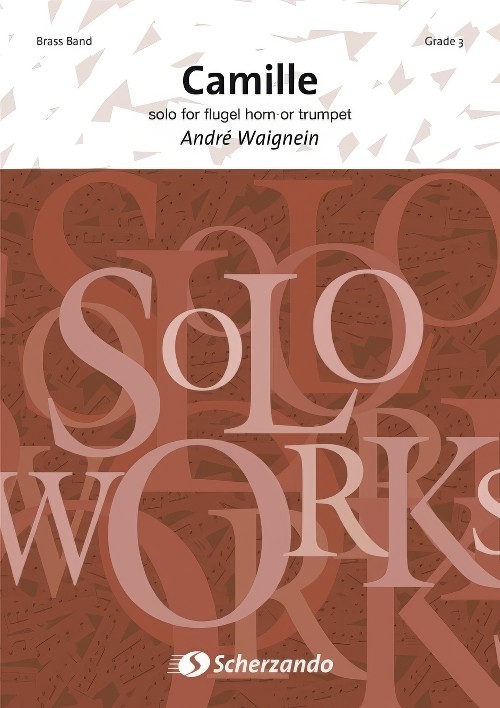
Camille (Flugel Horn or Trumpet Solo with Brass Band) - Waignein, Andre
The flugel horn has one of the most lush sounds of all brass instruments and this is used to full effect in this magnificent stately work featuring the flugel horn as a soloist.Duration: 6:00.
Estimated dispatch 7-14 working days
-
£24.50
Sang Til Juletraeet (Song to the Christmas Tree) - Edvard Grieg - Zillah Day-Smith
Sang Til Juletraeet (Song to the Christmas Tree)A short concert arrangement of Edvard Grieg's song no.2 from Seven Children's Songs, Op. 61. Its gentle lilting melody and expressive harmony suits brass instruments beautifully. This piece deserves its place as a Christmas time favourite!B flat and E flat bass parts included to suit the requirements of the individual ensemble.
In Stock: Estimated dispatch 1-3 working days
-
£24.50
The Angel Gabriel - Traditional Basque - Zillah Day-Smith
THE ANGEL GABRIELThis ancient hymn works beautifully for this combination of brass instruments. The harmony is sparse, while a drone is passed around the quartet emphasising the haunting qualities of the melody.
In Stock: Estimated dispatch 1-3 working days
-
 £25.00
Zephyrus. March for Brass Band
Recommended - Suitable for all bands The Big Blow, was a formal record attempt to create the largest brass band in the world. It took place at Butlin's Resort, Skegness on 20 January 2007, and it's main goal was to raise money in support of the work of Brass Band Aid, and specifically to provide long-term sponsorship for two children in the village of Adet in Ethiopia. The Music Company (UK) Ltd were one of the Official Partners of The Big Blow, providing the performance piece for the record attempt. Andrew Duncan wrote 'Zephyrus' to mark the occasion. The title takes its name from the Greek God of the West Winds - Zephyrus. Zephyrus is a traditional British brass band march with an interesting African-feel lilt to the trio. This is enhanced by optional percussion instruments including djembi and bongos, which can alternatively be covered by standard drum kit. The Music Company are pleased to continue their support of Brass Band Aid by offering a donation to this worthy charity for every set of this music sold. Includes score & parts
 View Music
 Listen to MP3