
Results
-
 £26.15
Trepak from The Nutcracker Suite - Brass Band (arr. Keith M. Wilkinson)
VIEW SCORE PDF Step into the enchanting world of Tchaikovsky's beloved The Nutcracker with this exciting brass band arrangement of Trepak from The Nutcracker Suite.. Expertly adapted for brass band by Keith M. Wilkinson, this suite captures the festive spirit and magical charm of the original score, while showcasing the full power and brilliance of brass and percussion. The second of three movements, The Nutcracker Suite includes March, Trepak and Waltz of the Flowers. To purchase the full suite, please visit www.brookwrightmusic.com/product-page/the-nutcracker-suite-brass-band-tchaikovsky-arr-keith-wilkinson To view a rolling score video featuring the Amsterdam Staff Band performing Trepak please visit www.youtube.com/watch?v=ur8p2d8nZ3A PDF download includes score and full set of parts. Sheet music available from: UK - www.brassband.co.uk USA - www.solidbrassmusic.com Difficulty Level: 2nd Section + Instrumentation: Soprano Cornet Eb Solo Cornet Bb Repiano Cornet Bb 2nd Cornet Bb 3rd Cornet Bb Flugel Horn Bb Solo Horn Eb 1st Horn Eb 2nd Horn Eb 1st Baritone Bb 2nd Baritone Bb 1st Trombone Bb 2nd Trombone Bb Bass Trombone Euphonium 1-2 Bb Bass Eb Bass Bb Timpani Percussion 1-2
In Stock: Estimated dispatch 1-3 working days
-
 £33.62
Waltz of the Flowers from The Nutcracker Suite - Brass Band (arr. Wilkinson)
VIEW SCORE PDF Step into the enchanting world of Tchaikovsky's beloved The Nutcracker with this delightful arrangement of Waltz of the Flowers from The Nutcracker Suite. Expertly adapted for brass band by Keith M. Wilkinson, this suite captures the festive spirit and magical charm of the original score, while showcasing the full power and brilliance of brass and percussion. The third of three movements, The Nutcracker Suite includes March, Trepak and Waltz of the Flowers. To purchase the full suite, please visit www.brookwrightmusic.com/product-page/the-nutcracker-suite-brass-band-tchaikovsky-arr-keith-wilkinson PDF download includes score and full set of parts. Sheet music available from: UK - www.brassband.co.uk USA - www.solidbrassmusic.com Difficulty Level: 2nd Section + Instrumentation: Soprano Cornet Eb Solo Cornet Bb Repiano Cornet Bb 2nd Cornet Bb 3rd Cornet Bb Flugel Horn Bb Solo Horn Eb 1st Horn Eb 2nd Horn Eb 1st Baritone Bb 2nd Baritone Bb 1st Trombone Bb 2nd Trombone Bb Bass Trombone Euphonium 1-2 Bb Bass Eb Bass Bb Timpani Percussion 1-2
In Stock: Estimated dispatch 1-3 working days
-
£34.95
MARCH OF THE HOURS (Brass Band Set) - Emil Soderstrom
March of the Hours was first performed at Star Lake Music Camp in 1962 with the composer supplying an informative listening guide which was printed in the published score; "The phrases are of 12 crotchets each (three bars) signifying the 12 hours. Up to the trio, the music describes the headlong search for pleasure by the thoughtless. Abruptly, the trio brings 'I need thee every hour', but an episode employing the original theme pushes it aside until it reappears, this time against a background of chimes of the full hour (Westminster chimes). While the hour strikes 12, a paraphrase of the opening strains of 'When the trumpet of the Lord shall sound and time shall be no more' is heard. Here the music stops, to be followed by the trumpet sounding (cornets and trombones) and the rest of the band responds with 'When the roll is called up yonder' with a final 'I'll be there'."
Estimated dispatch 7-14 working days
-
£44.95
GREAT SALVATION WAR, The (Brass Band Set) - James Curnow
James Curnow was inspired to compose this work after reading 'Marching to Glory', a history of The Salvation Army in the USA. The writer of the book, Dr. Edward H. McKinley, was a colleague of Curnow on the faculty of Asbury College and a member of The Salvation Army Student Fellowship Band. The work was written for this band and premiered by them at the Centennial National Congress in 1980 which was held at Asbury College. Curnow has endeavoured to capture the spirit of early day Salvationists as they gave themselves completely to the great salvation war. Three songs support the three-part structure; 1) Stand like the brave 2) In Thee, O Lord, do I put my trust 3) Rescue the perishing.
Estimated dispatch 7-14 working days
-
£34.95
SAINTS ON PARADE (Brass Band Set) - Kevin Norbury
Originally composed for the 2004 UK tour by the New York Staff Band, this American-style concert opener contains three well-known tunes which are subjected to a range of musical styles synonymous with the USA. 'Always cheerful', 'I've got the joy, joy, joy, down in my heart' and 'O, when the saints go marching in' are given the marching band, big band and Sousa-style march treatment.
Estimated dispatch 7-14 working days
-
£44.95
GAUDETE (Brass Band Set) - Kevin Norbury
A Christmas mini-overture featuring three medieval carols; 'Coventry Carol', 'Gaudete' and 'Unto us a boy is born'. A fun piece for player and listener alike.
Estimated dispatch 7-14 working days
-
 £85.00
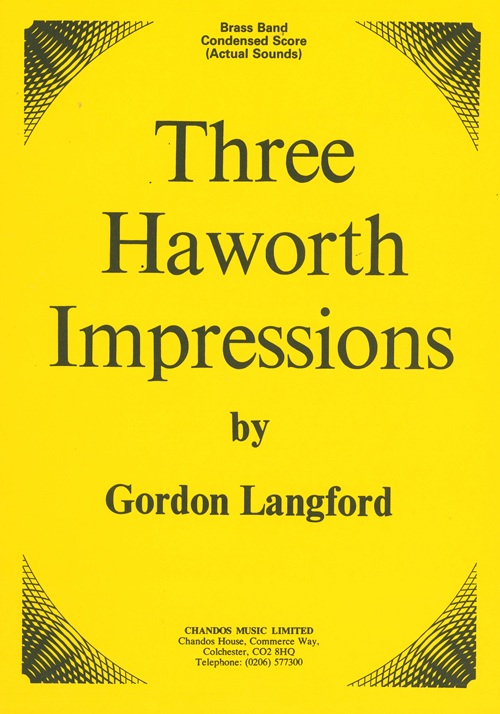
Three Haworth Impressions (Brass Band - Score and Parts) - Langford, Gordon
A wonderful three movement suite which conjures up fabulous musical imagery of the lands of northern England. Well worth including as a concert item in your next programme, but this great original composition should really should be set again as a test-piece soon - rewarding musically for audience and bandsmen alike.Includes:TOP WITHENS - A GENERAL EVOCATION OF THE ATMOSPHERE OF WUTHERING HEIGHTS The sinister opening motif symbolises the influence of the evil Heathcliffe, Soon this motif experiences several changes of character in order to portray emotions other than those of hatred and jealousy. The overall mood is, however, one of gloom and foreboding.THE THREE BELLS This is a reference to the pseudonyms adopted by Ann, Charlotte and Emily Bronte. The music begins with three "bell"-notes; Ab for Acton Bell, Cb for Currer Bell and Eb for Ellis Bell, and these three notes form the basis of a wistful waltz tune. Again the mood is rather sombre -- save for a brighter middle section -- and the opening motif from "Top Withens" is to be heard, again symbolising the frustrations and ill-fortune by which their lives were plagued.THE WORTH VALLEY RAILWAY The Brontes were not the only people in Haworth and not all is desperation and gloom. The third impression is a celebration of the victory of the people of Haworth in their fight to retain their railway. The nine-eight rhythm of a slow train is prominent, and our once-sombre motif is transformed into a triumphant fanfare.Duration: 12.00Please note that there are only 3 solo cornet parts included in this set
Estimated dispatch 7-14 working days
-
£16.00
Three Haworth Impressions (Brass Band - Score only) - Langford, Gordon
A wonderful three movement suite which conjures up fabulous musical imagery of the lands of northern England. Well worth including as a concert item in your next programme, but this great original composition should really should be set again as a test-piece soon - rewarding musically for audience and bandsmen alike.Includes:TOP WITHENS - A GENERAL EVOCATION OF THE ATMOSPHERE OF WUTHERING HEIGHTS The sinister opening motif symbolises the influence of the evil Heathcliffe, Soon this motif experiences several changes of character in order to portray emotions other than those of hatred and jealousy. The overall mood is, however, one of gloom and foreboding.THE THREE BELLS This is a reference to the pseudonyms adopted by Ann, Charlotte and Emily Bronte. The music begins with three "bell"-notes; Ab for Acton Bell, Cb for Currer Bell and Eb for Ellis Bell, and these three notes form the basis of a wistful waltz tune. Again the mood is rather sombre -- save for a brighter middle section -- and the opening motif from "Top Withens" is to be heard, again symbolising the frustrations and ill-fortune by which their lives were plagued.THE WORTH VALLEY RAILWAY The Brontes were not the only people in Haworth and not all is desperation and gloom. The third impression is a celebration of the victory of the people of Haworth in their fight to retain their railway. The nine-eight rhythm of a slow train is prominent, and our once-sombre motif is transformed into a triumphant fanfare.Duration: 12.00Please note that there are only 3 solo cornet parts included in this set
Estimated dispatch 7-14 working days
-
 £89.95
Four Etudes (Brass Band - Score and Parts) - Gregson, Edward
This work was written during August and September 2016. In it, I wanted primarily to explore the elements of timbre, rhythm, texture and colour. The first three tudes (or studies) are based on a set of piano pieces I composed in 1982, whilst the last, the longest of the set, was composed specially. My reference point was the Four tudes for orchestra of 1928 by Stravinsky, a work I have always admired, and of which the first three also happen to be based on a set of earlier pieces, in his case for string quartet, with the last being a re-arrangement of a work for pianola. I have also borrowed the titles he gave to the individual studies as they seemed to fit the mood of my pieces.However, the exception is the final study, where instead of the exuberant mood of his colourful portrayal of Madrid, mine was influenced by the terrible human tragedy that was unfolding in Aleppo at the time I was writing it, and thus reflects the violence and barbarism of those events; yet towards the end it does offer a glimmer of hope for humanity with a return to the Canticle (Song) of the first study, and concludes quietly with the chords and bells that began the work. The titles of the tudes are Canticle, Dance, Excentrique, and Aleppo. Like Stravinsky's, the set is relatively short, lasting around 8 minutes.The Four tudes were commissioned by Black Dyke Band and were written specially for the recording marking the conclusion of my year as Composer-in-Residence. The concert premiere will be given by Black Dyke Band, conducted by the composer, at the RNCM Festival of Brass in January 2017.- Edward GregsonDuration: 8.00
Estimated dispatch 7-14 working days
-
 £37.95
Four Etudes (Brass Band - Score only) - Gregson, Edward
This work was written during August and September 2016. In it, I wanted primarily to explore the elements of timbre, rhythm, texture and colour. The first three tudes (or studies) are based on a set of piano pieces I composed in 1982, whilst the last, the longest of the set, was composed specially. My reference point was the Four tudes for orchestra of 1928 by Stravinsky, a work I have always admired, and of which the first three also happen to be based on a set of earlier pieces, in his case for string quartet, with the last being a re-arrangement of a work for pianola. I have also borrowed the titles he gave to the individual studies as they seemed to fit the mood of my pieces.However, the exception is the final study, where instead of the exuberant mood of his colourful portrayal of Madrid, mine was influenced by the terrible human tragedy that was unfolding in Aleppo at the time I was writing it, and thus reflects the violence and barbarism of those events; yet towards the end it does offer a glimmer of hope for humanity with a return to the Canticle (Song) of the first study, and concludes quietly with the chords and bells that began the work. The titles of the tudes are Canticle, Dance, Excentrique, and Aleppo. Like Stravinsky's, the set is relatively short, lasting around 8 minutes.The Four tudes were commissioned by Black Dyke Band and were written specially for the recording marking the conclusion of my year as Composer-in-Residence. The concert premiere will be given by Black Dyke Band, conducted by the composer, at the RNCM Festival of Brass in January 2017.- Edward GregsonDuration: 8.00
Estimated dispatch 7-14 working days
 Watch video
 View Music