Results
-
£34.95I?ll Not Turn Back (Cornet and Euphonium Duet with Brass Band - Score and Parts) - Bosanko, Ivor
A setting of the challenging song with the words 'I'll not turn back, whatever it may cost'. Written as a duet for Cornet and Euphonium, but can be played by two Cornets or two Euphoniums.
Estimated dispatch 7-14 working days
-
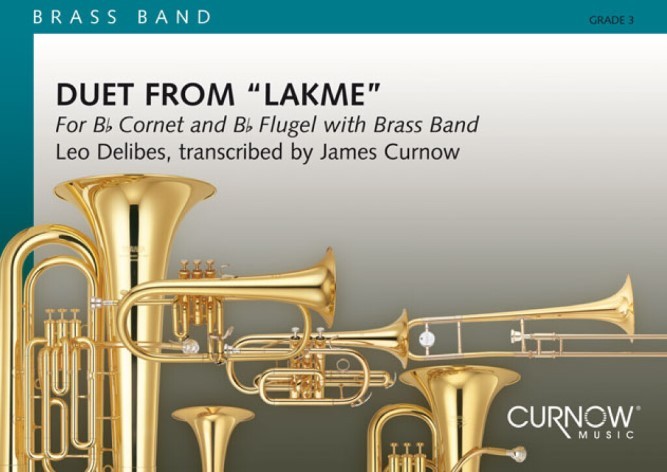
£17.50I?ll Not Turn Back (Cornet and Euphonium Duet with Brass Band - Score only) - Bosanko, Ivor
A setting of the challenging song with the words 'I'll not turn back, whatever it may cost'. Written as a duet for Cornet and Euphonium, but can be played by two Cornets or two Euphoniums.
Estimated dispatch 7-14 working days
-
£44.95Timepiece (Euphonium Duet with Brass Band - Score and Parts) - Bearcroft, Norman
This duet was heavily influenced by the famous euphonium solo, 'Grandfather's Clock' and references to that melody and clock sounds (tick-tock, cuckoo etc.) are plentiful!
Estimated dispatch 7-14 working days
-
£22.50Timepiece (Euphonium Duet with Brass Band - Score only) - Bearcroft, Norman
This duet was heavily influenced by the famous euphonium solo, 'Grandfather's Clock' and references to that melody and clock sounds (tick-tock, cuckoo etc.) are plentiful!
Estimated dispatch 7-14 working days
-
£65.00Second Suite in F - Brass Band Sheet Music Full Score & Parts - LM602 - Gustav Holst
COMPOSER: Gustav HolstTRANSCRIBED : Daniel S. AugustineA brand transcription from Holst's manuscript score for brass band.A very authentic version from the original for Military Band.Can be used as a testpiece in your next own choice contestSuitable for Section 3 bands upwardsSecond Suite in FOp. 28, No. 2 (1922)1. MarchThe "March" of the Second Suite begins with a simple five note motif between the low and high instruments of the band. The first folk tune is heard in the form of a traditional British brass band march using the morris-dance tune "Glorishears". After a brief climax, the second strain begins with a euphonium solo playing the second folk tune in the suite "Swansea Town". The theme is repeated by the full band before the trio. For the trio, Holst modulates to the unconventional subdominant minor of Bb minor and changes the time signature to 6/8, thereby changing the meter. Usually one would modulate to subdominant major in traditional march form. While Sousa, reputably the "king of marches", would sometimes change time signatures for the trio (most notably in "El Capitan"), it was not commonplace. The third theme, called "Claudy Banks",[2] is heard in a low woodwind soli, as is standard march orchestration. Then the first two tunes are repeated da capo.2. Song without Words "I'll Love My Love"Holst places the fourth folk song, "I'll Love My Love" in stark contrast to the first movement. The movement begins with a chord and moves into a solo over a flowing accompaniment. The solo is then repeated, forming an arc of intensity. The climax of the piece is a fermata, followed by a cornet pick-up into the final measures of the piece.3. Song of the BlacksmithAgain, Holst contrasts the slow second movement to the rather upbeat third movement which features the folk song "A Blacksmith Courted Me". There are many time signature changes (4/4 to 3/4) making the movement increasingly difficult because the accompaniment has a pick up on the up-beats of each measure. The band joins in on the melody around the body of the piece and are accompanied with the sound of a blacksmith forging metal with an anvil called for in the score. The final major chord has a glorious, heavenly sound, which opens way to the final movement.This chord works so effectively perhaps because it is unexpected.4. Fantasia on the "Dargason"This movement is not based on any folk songs, but rather has two tunes from Playford's Dancing Master of 1651. The finale of the suite opens with a solo based on the folk tune "Dargason", a 16th-century English dance tune included in the first edition of The Dancing Master. The fantasia continues through several variations encompassing the full capabilities of the band. The final folk tune, "Greensleeves", is cleverly woven into the fantasia by the use of hemiolas, with Dargason being in 6/8 and Greensleeves being in 3/4. At the climax of the movement, the two competing themes are placed in competing sections.As the movement dies down, a duet forms a call back to the beginning of the suite with the competition of low and high registers.The name 'dargason' may perhaps come from an Irish legend that tells of a monster resembling a large bear (although much of the description of the creature has been lost over time), the Dargason tormented the Irish countryside. During the Irish uprising of the late 18th century, the dargason is supposed to have attacked a British camp killing many soldiers. This tale aside, 'dargason' is more likely derived from an Old English word for dwarf or fairy, and the tune has been considered English (or Welsh) since at least the 16th century. It is also known as 'Sedony' (or Sedany) or 'Welsh Sedony'.
In Stock: Estimated dispatch 3-5 working days
-
£33.99Les Chasseresses from 'Sylvia' (Brass Band) Delibes arr. Rob Bushnell
Clement Philibert Leo Delibes was a French composer, best known for his ballets and operas, including works such as Lakme (with its famous "Flower Duet"), Coppelia and Sylvia (both key works in the development of modern ballet). The latter started as a play, Aminta, by the Italian poet Torquato Tasso, which Delibes set to music. It was then adapted for the Paris Opera with rehearsals starting in August 1875. The premiere took place on 14 June 1876 and was the first ballet to be shown at the newly-built Opera Garnier. Whilst the scenery and costumes were created by top artists and designers (Cheret and Lacoste), it was Delibes's music that shown thrown, being said to have saved the production, preventing the ballet from drifting into obscurity.Sylvia is said to be one of the first modern ballets, with Tchaikovsky remarking to composer Sergei Taneyev upon its ingenuity: "... the first ballet, where the music constitutes not only the main, but the only interest. What charm, what elegance, what richness of melody, rhythm, harmony." Although Swan Lake, a contemporary to Sylvia, is considered one of the best ballets there is, Tchaikovsky preferred Sylvia to his own work, saying Swan Lake was "poor stuff in comparison". Tchaikovsky said to Taneyev, "I was ashamed. If I had known this music early then, of course, I would not have written Swan Lake". The music to Sylvia, rather than setting only the mood, also sets the action and is noted for its use of leitmotifs - Delibes was an admirer of Wagner - and more dominant use of brass and wind. The most famous piece from this ballet is the Pizzicati in the third act.Act I of the ballet takes place in sacred wood, where creatures are worshipping before Eros when Sylvia arrives with her huntresses to mock the god of love. Aminta, a lowly shepherd and infatuated with Sylvia, protects the deity and Sylvia is wounded by Eros's arrow. The hunter Orion kidnaps Sylvia, whilst Eros revives Aminta. Act II takes place in Orion's Island cave, where Sylvia tries to bribe Orion with jewels and wine. Unsuccessful, she appeals to Eros for help, who arrives and takes her to the temple of Diana (where the final act takes place). Orion and Aminta fight, Sylvia and Orion cause the goddess of the hunt, Diana, to be outraged, smiting Orion and denying the love of Aminta and Sylvia. Eros shows Diana a vision, which changes her mind and the couple finally come together.This brilliant and lively fanfare that introduces the huntresses in the first act is arranged here for the UK-style brass band, with alternative parts for horns in F and bass-clef lower brass. The piece has been lowered by a tone compared to the original. A recording of the original composition can be found here https://youtu.be/6yoGrUH38PI?si=0L0bFa1qXnYNvkR3 Duration: Approx. 3.10 minutes Difficulty Level: 1st Section + This PDF download includes the full score and parts. Includes alternative parts for soloist in Eb, horns in F and lower brass in bass clef. Sheet music available at www.brassband.co.uk (UK) or www.cimarronmusic.com (USA) Instrumentation: Soprano Cornet Eb Solo Cornet Bb Repiano Cornet Bb 2nd Cornet Bb 3rd Cornet Bb Flugel Horn Bb Solo Horn Eb 1st Horn Eb 2nd Horn Eb 1st Baritone Bb 2nd Baritone Bb 1st Trombone Bb 2nd Trombone Bb Bass Trombone Euphonium Bb Bass Eb Bass Bb Timpani Percussion - Triangle, Cymbal & Bass Drum
In Stock: Estimated dispatch 1-3 working days
-
£35.00Barcelona - Vocal Duet or Cornet & Euphonium - Brass Band Sheet Music Full Score & Parts - LMAM054
Any purchases from this site cannot be made please click on the link (PURCHASE PDF - Sheet Music Direct or Sheet Music Plus) above. Do not click on "Add to cart" or buy with Shop button.Any purchases from this site cannot be made please click on the link (PURCHASE PDF - Sheet Music Direct or Sheet Music Plus) above. Do not click on "Add to cart" or buy with Shop button.COMPOSER: Mike Moran & Freddie MercuryARRANGER: David Beal"Barcelona" is a single released by Queen vocalist Freddie Mercury and operatic soprano Montserrat Caballe. A part of their collaborative album Barcelona, it also appeared on Queen's Greatest Hits III. The song reflects Mercury's love of opera with his high notes and Caballe's operatic vocals, backed by a full orchestra. Originally released in 1987, it was one of the biggest hits of Mercury's solo career, reaching number eight in the UK singles chart. After Mercury's death in 1991, it was featured at the 1992 Summer Olympics. The single was re-issued on 20 July 1992, after which the track climbed even higher, peaking at number two in the UK, the Netherlands and New Zealand. In 2004, BBC Radio 2 listed Barcelona at number 41 in its Sold On Song Top 100.Scored here for British Brass Band.Any purchases from this site cannot be made please click on the link above
In Stock: Estimated dispatch 3-5 working days
-
£30.00Eternal Source of Light Divine - Duet (Soprano Cornet & Bb Cornet) with Brass Band Full Score & Parts - LM548
COMPOSER: George Frideric HandelARRANGER: Peter BrayThe cantata celebratesQueen Anne'sbirthday, and the accomplishment of theTreaty of Utrecht(negotiated by theToryministry of Anne in 1712) to end theWar of the Spanish Succession. It was scored for 3 solo voices, choir and chamber orchestra.Queen Anne was said by the Duke of Manchester to be "too careless or too busy to listen to her own band, and had no thought of hearing and paying new players however great their genius or vast their skill."Nevertheless, and whether or not she ever heard this ode for her birthday, she granted Handel a "pension" (subsidy for living expenses) of two hundred pounds a year, for lifeHere is the delightful arrangement for Soprano Cornet and Bb Cornet with Brass Band Accompaniment
In Stock: Estimated dispatch 3-5 working days
-
£30.00Somethin' Stupid - Brass Band - Cornet & Euphonium Duet - LMAM002 - C. Carson Parks - David Beal
Any purchases of this Item cannot be made from this listing please click on the link above - Any purchase using this site will be refundedCOMPOSER: C. Carson ParksARRANGER: David BealThe famous hit from Robbie Williams & Nicole Kidman, A Number 1 Christmas hit in 2001And now available for Brass Band...Any purchases of this Item cannot be made from this listing please click on the link above - Any purchase using this site will be refundedAbout Digital DownloadsDigital Downloads are downloadable sheet music files that can be viewed directly on your computer, tablet or mobile device. Once you download your digital sheet music, you can view and print it at home, school, or anywhere you want to make music, and you don't have to be connected to the internet. Just purchase, download and play!PLEASE NOTE: Your Digital Download will have a watermark at the bottom of each page that will include your name, purchase date and number of copies purchased. You are only authorized to print the number of copies that you have purchased. You may not digitally distribute or print more copies than purchased for use (i.e., you may not print or digitally distribute individual copies to friends or students).
In Stock: Estimated dispatch 3-5 working days
-
£30.00Tell Him - Brass Band Sheet Music Full Score & Parts - LMAM007 - David Foster, Linda Thompson & Walter Afanasieff - David Beal
Any purchases of this Item cannot be made from this listing please click on the link above - Any purchase using this site will be refundedCOMPOSER: David Foster, Linda Thompson & Walter AfanasieffARRANGER: David Beal"Tell Him" is a song written by Linda Thompson and producers Walter Afanasieff and David Foster. It was recorded as a duet between American singer Barbra Streisand and Canadian singer Celine Dion for their 1997 albums, Higher Ground and Let's Talk About Love, and released as the lead single from these albums on November 3, 1997.And now available for Brass Band...Any purchases of this Item cannot be made from this listing please click on the link above - Any purchase using this site will be refundedAbout Digital DownloadsDigital Downloads are downloadable sheet music files that can be viewed directly on your computer, tablet or mobile device. Once you download your digital sheet music, you can view and print it at home, school, or anywhere you want to make music, and you don't have to be connected to the internet. Just purchase, download and play!PLEASE NOTE: Your Digital Download will have a watermark at the bottom of each page that will include your name, purchase date and number of copies purchased. You are only authorized to print the number of copies that you have purchased. You may not digitally distribute or print more copies than purchased for use (i.e., you may not print or digitally distribute individual copies to friends or students).
In Stock: Estimated dispatch 3-5 working days