
Results
-
 £54.99
Candyman (Brass Band - Score and Parts)
Candyman was the third worldwide hit from Cristina Aguilera?s albumBack to Basics. It's jazzy 1940s feel makes this an extremely catchymelody that works well in this arrangement for concert band. This is areal 'feel good' song and will bring a feeling of joy to any concert. 03:00
Estimated dispatch 7-14 working days
-
 £60.00
Capriol Suite (Brass Band - Score and Parts) - Warlock, Peter - Littlemore, Phillip
Peter Warlock's set of set of six dances in renaissance style, Capriol Suite, is by far his most famous work. The suite consists of Basse-Danse, a lively dance for older folk; a stately Pavane; a delicate, yet lively Tordion; Bransles (pronounced 'Brawl'), a fast country dance which works its way into a frenzy, continuously building in speed and excitement; Pieds-en-l'air, with its beautifully serene lines and Mattachins, an exhilarating sword dance with its driving rhythm, culminating in violent dissonances bringing the piece to a spirited close. This is a new arrangement suitable for any band, including those in the 4th Section that relish a challenge. Percussion has been added in all but one of the movements, and is for two players. Duration: 10:00
Estimated dispatch 7-14 working days
-
£42.95
CU CHULLAIN (Brass Band) - Jenkins, Karl - Small, Tony
from Adiemus iv - The Eternal Knot. Adiemus is an extended choral-type series of works based on European classical tradition, but where the vocal sound is more akin to 'ethnic' or 'world' music. Karl Jenkins ingeniously invented the language used in the entire Adiemus project. Cu Chullain is a movement from ADIEMS iv - The Eternal Knot. Cu Chullain (pronounced 'Koo Kullan') is the foremost hero of the Ulster Cycle, a collection of prose and verse romances which forms one of the major cycles of Irish literature. The epitome of Celtic valour, Cu Chullain is portrayed as the ideal chieftain and defender of his tribe. Possessing extraoridinary powers which he uses solely for the benefit of his people, he forms a bridge between the world of the gods and that of humas. Duration: 4:20 approx
Estimated dispatch 7-14 working days
-
 £118.99
Elegy I (Brass Band - Score and Parts)
Elegy I 'Jealousy' has been named after John Donne's poem of the same name. This English poet (1572-1631) wrote an entire series of elegies, each with its own theme. Jealousy can trigger various emotions, ranging from disappointment, grief, or regret, to madness and anger. All these emotions have been incorporated into this composition. Jacob de Haan was inspired by three different works of art: a poem (the aforementioned poem by John Donne), a painting by the Norwegian painter Edvard Munch (Jealousy in the Garden) and an old French chanson about jealousy (Je ne l'ose dire) by the sixteenth-century French composer Pierre Certon. The music refers repeatedly to this chanson - sometimes through key notes from the melody that serve as the starting point for new, isolated themes and sometimes through quotations of the original version
Estimated dispatch 7-14 working days
-
£54.99
GAILLARDE (Brass Band) - d'Attaignant, Pierre - Mellaerts, Manu
Galliarde by Pierre Attaignant (1494-1552) is an elegant opening item for those looking for something a little different. It can also be used as a filler or to link two works in a programme. Manu Mellaerts is an authority on the repertoire of this period and has arranged this short, stylish piece while keeping the original renaissance spirit in mind.
Estimated dispatch 7-14 working days
-
 £40.00
Great Gate of Kiev, The (from Pictures at an Exhibition) (Brass Band - Score and Parts) - Mussorgsky, Modest - Littlemore, Phillip
Modest Mussorgsky was a close friend of the young artist and architect Victor Hartmann, and his death in 1873 plunged Mossorgsky into a deep depression. The following year a memorial exhibition in St. Petersburg displayed Hartmann's paintings, costumes, architectural designs and sketches. Mussorgsky's visit to it, combined with his desire to write a piece in his friend's memory, inspired him to compose his?Pictures At An Exhibition?for piano. A suite of ten movements, with a recurring Promenade theme, it is one of the composer's most famous works and regarded as a showpiece for virtuoso pianists. It is perhaps the orchestral transcription made by Maurice Ravel in 1922 that is now the most famous version of it. This arrangement opens with a brief excerpt from?The Hut on Fowl's Legs, which was based on a painting of an elaborately carved clock depicting Baba Yaga, a horrible tiny witch that feasts on human bones. The tenth, and final picture in Mussorgsky's masterpiece is commonly referred to as?The Great Gate of Kiev, although it's literal translation is The Bogatyr Gates -- a Bogatyr being a hero figure in medieval East Slavic legend. It features a grand main theme that is interspersed with a more solemn hymn-like secondary theme. The work closes with a grand final rendition of the Promenade theme that almost grinds to a halt at what must be the foot of what were to be magnificent ceremonial gates (although they were never actually built!). Duration: 6:00
Estimated dispatch 7-14 working days
-
 £40.00
Hallelujah Chorus (from Messiah) (SATB Chorus with Brass Band - Score and Parts) - Handel, George Frideric - Littlemore, Phillip
Handel's?Messiah?was composed in 1741, receiving it's premiere in Dublin a year later. Written in three parts, the Hallelujah Chorus concludes the second part, and is often performed separately from the main oratorio, and especially around Christmas. There are no choral parts included with the set, however it works with all the major editions of vocal score. Duration: 3:30
Estimated dispatch 7-14 working days
-
£60.99
Let Me Weep (Brass Band - Score and Parts)
Let Me Weep ('Lascia ch'io pianga') is an aria from Handel's opera 'Rinaldo'. According to reports he composed the music for the complete opera in just 14 days, using many melodies from earlier works. The melody of this wonderful aria is known all over the world and this arrangement by Jacob de Haan retains all the passion of the original. 03:15
Estimated dispatch 7-14 working days
-
 £50.00
Liberty Fanfare (Brass Band - Score and Parts) - Williams, John - Sykes, Steve
The Liberty Fanfare is one of John Williams's lesser-known works, simply because it is not a film theme! In fact, the orchestral original was written for the re-opening of the Statue of Liberty following extensive repairs. This took place on the 4th of July (1986), hence the music's sense of celebration and national pride.Suitable for Advanced Youth/3rd Section Bands and aboveDuration: 5:00
Estimated dispatch 7-14 working days
-
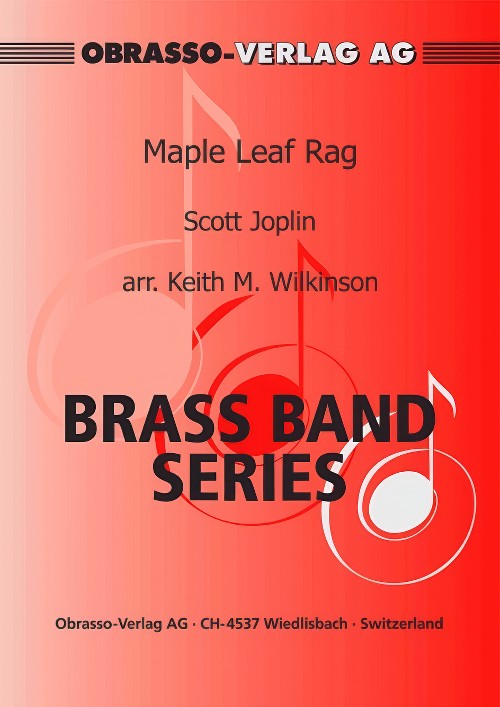 £56.00
Maple Leaf Rag (Brass Band - Score and Parts) - Joplin, Scott - Wilkinson, Keith M.
The Maple Leaf Rag is an early ragtime musical originally composed for piano by Scott Joplin. It was one of Joplin's early works, and became the model for ragtime compositions by subsequent composers. It is one of the most famous of all ragtime pieces. As a result Joplin was called the "King of Ragtime" and the work gave Joplin a steady, if unspectacular, income for the rest of his life.
Estimated dispatch 7-14 working days
 View Music