
Results
-
 £64.95
Canticle of the Sun (Percussion Solo with Brass Band - Score and Parts) - Ellerby, Martin
The Canticle of the Sun was commissioned by Birmingham Symphonic Winds conductor Keith Allen for Simone Rebello. The work is based on the canticle written by St. Francis of Assisi (1182-1226) whose ideas that nature and the material world were gifts from God and should be valued and appreciated. The brass band version was made especially for a studio recording by the Black Dyke Band conducted by Nicholas J. Childs with Simone Rebello on percussion. Duration: 13.00
Estimated dispatch 7-14 working days
-
 £34.95
How Can I Keep from Singing (Cornet Solo with Brass Band - Score and Parts) - Wainwright, Andrew
A beautiful arrangement of the traditional hymn for cornet soloist with brass band. Originally arranged for Virtuosi GUS Band & former Principal Cornet of Grimethorpe Colliery Band, James Fountain.
Estimated dispatch 7-14 working days
-
 £105.00
Tuba Concerto (Tuba Solo with Brass Band - Score and Parts) - Vaughan Williams, Ralph - Littlemore, Phillip
Ralph Vaughan Williams' Tuba Concerto was written in 1953/4 in response to an invitation to compose a work for the Golden Jubilee of the London Symphony Orchestra. Vaughan Williams was by then in his eighty-second year. The lively, outer movements both conclude with extended cadenzas, while the beautifully lyrical Romanza is Vaughan Williams at his best. Phillip Littlemore's brass band arrangement is a welcome addition to the brass band repertoire. Suitable for Championship Section Bands. Duration: 15.00
Estimated dispatch 7-14 working days
-
 £59.99
Carnival of Venice (Cornet Solo with Brass Band - Score and Parts) - Freeh, Mark
The jazz cornet legend Harry James was synonymous with taking classical works and crafting versions in his own inimitable style. Carnival of Venice was one of his most famous features and here you have a true-to-the-original arrangement to feature your cornet soloist created by one of the greatest arrangers of jazz for brass band, Mark Freeh. A brass band classic given the jazz treatment, will astound and amaze your audiences every time. Not to be missed.Duration: 3:00
Estimated dispatch 7-14 working days
-
 £50.00
CONCERTO FOR EUPHONIUM (Brass Band Parts) - Scott, Andy
Brass Band parts only, solo part not included - available separately. The 'Concerto for Euphonium' with Brass Band is scored in three movements: The Lure of the Red Jacket; Far Beyond the Stars; The Dragon's Den. The Lure of the Red Jacket responds musically to these ideas and attitudes; a non-relenting riff that signifies the hard slog of practice, scorings which find members of the band supporting the soloist, all the time the soloist putting together new riffs and ideas. Stylistically all this happens within a frame of minimalism and funk. Far Beyond the Stars is a simple folk-like melody that is stated by the soloist, which develops with different harmonic backdrops being introduced. The poignant words form the focus of the emotional intensity of this piece. The Dragon's Den is a fierce and fiery fusion of energy, virtuosic playing and intricate ensemble work, the finale of the Concerto for Euphonium draws upon the composers experience of big band and small group performance and writing. Dur: 15:00
Estimated dispatch 7-14 working days
-
 £45.00
Crown Imperial, March (Brass Band - Score and Parts) - Walton, William - Littlemore, Phillip
William Walton composed his Crown Imperial for performance at the coronation of King Edward VIII, which was scheduled for the 12th May 1937. However, due to the dramatic abdication of Edward, it was in fact performed at the Coronation of the new monarch, King George VI, which took place on the same scheduled date. The march became popular immediately, and arrangements for piano solo, organ, small orchestra and military band were all published within a year. It has been used at all Royal events since, most notably the Coronation of Queen Elizabeth II in 1953. This new brass band transcription?is in keeping with the shorter, 6-minute concert version that Walton created immediately following the Coronation of George VI. However, the scoring is more in keeping with contemporary brass band voicings, and provides an exciting version for brass band.?Duration: 7:00
Estimated dispatch 7-14 working days
-
 £39.95
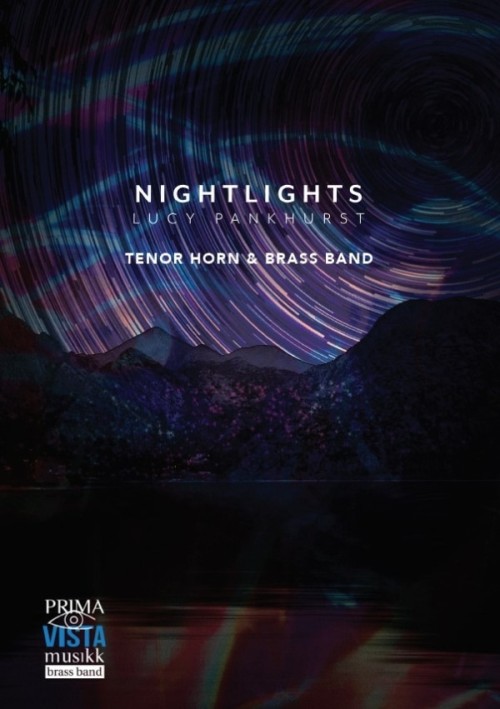
Nightlights (Tenor Horn Solo with Brass Band - Score and Parts) - Pankhurst, Lucy
Nightlights was commissioned by Chris Jeans and Don Collins for Youth Brass 2000, to be used as part of their programme at the 2019 European Championships. Written during January 2019, Nightlights received its world premiere by Youth Brass 2000, conducted by Chris Jeans with Siobhan Bates as soloist, at the 2019 European Brass Band Championships in Montreux, Switzerland.Nightlights is intended to illustrate a winter's evening looking out across Lake Geneva from Montreux. Tiny lights appear beneath the mountains from faraway homes and vehicles, flickering in the distance and shimmering in the reflections on the water. Tiny, blinking nightlights against the inky blue of the clear sky. Thousands of stars shine above, blurring the boundaries between land, water, and the heavens into a sparkling ether. Transfixed, the bustle of sounds and lights from Montreux seems a lot further away than it is in reality. Eventually, each little light blinks out, one at a time, leaving the chill of the cold night air and an empty sky.Duration: 4.30
Estimated dispatch 7-14 working days
-
 £72.99
Little Clover (Cornet Solo with Brass Band - Score and Parts) - Crausaz, Etienne
Irish Fantasy for Cornet and Brass Band. Due to its rarity, the four-leaf clover is considered lucky in western culture. But the common three-leaf shamrock, also known as Little Clover, is one of the symbols of Ireland, whose traditional music greatly influenced the general aesthetics of this piece. The work is in three parts: the first, in 6/8, is very lively and virtuosic. After a short cadenza, the second part introduces a theme tinged with melancholy, while the last part is a dance in 2/2 that reprises the theme of the second part to conclude the piece.Duration: 6.30
Estimated dispatch 7-14 working days
-
 £56.00
Bring Him Home (from Les Miserables) (Euphonium Solo with Brass Band - Score and Parts) - Fernie, Alan
This iconic song from Les Mis is now available for your Euphonium Soloist to feature with your Brass Band.
Estimated dispatch 7-14 working days
-
 £60.99
Lullaby of Birdland (Flugel Horn Solo with Brass Band - Score & Parts) - Tinner, Gilbert
"I've been arguably credited with having written some 300 songs, 299 of which enjoyed a rather bumpy ride from relative obscurity to total oblivion. Here's the other one." These are the words of the great Jazz pianist and composer George Shearing about his hit of the century Lullaby of Birdland. The list of famous artists who performed this Jazz standard runs from From Ella Fitzgerald to Amy Winehouse. Gilbert Tinner wrote this arrangement for Brass Band preserving the distinctive George Shearing Sound.Duration: 3.00
Estimated dispatch 7-14 working days
 View Music