
Results
-
 £60.99
Game of Thrones - Ramin Djawadi - Christopher Bond
The dark and dramatic theme from the popular HBO series Game of Thrones is one of the most distinctive and effective themes for TV or film to come along in several years. Arranged in a powerful setting for brass band, this is sure to be a hit with your musicians.
Estimated dispatch 5-14 working days
-
 £159.99
Other Lives - Oliver Waespi
Other Lives is works perfectly for a competition but can also be programmed as concert work. The dark chords at the beginning of the piece are derived from "Der Doppelganger", one of Franz Schubert's late songs. After a short development the music begins to accelerate and find its own shape, gradually moving away from the introduction. The entire first part, "Rage", has an intensely agitated character. The ensuing "Reflection" turns back to the initial chord progression, before a series of interspersing solos explore time and space at a slower pace. After another musical surge, the music is brought close to silence and then gives way to the third part, "Redemption".Here, a widely spaced sound field contains a remote allusion to another work by Schubert "Ruckblick". After this farewell, an abstract musical transformation triggers an emotional change, as the initial motifs are now presented in their inversed form in order to create a much brighter harmonic landscape. Moreover, in the last part of the piece, "Renewal", the grim, tense atmosphere of the first part is transformed into a great energy. Other Lives was commissioned by the Valaisia Brass Band.
Estimated dispatch 5-14 working days
-
 £60.99
Bring Me Sunshine - Christopher Bond
Bring Me Sunshine is a song written in 1966 by the composer Arthur Kent, with lyrics by Sylvia Dee. It was first recorded by The Mills Brothers in 1968, on their album My Shy Violet. In the UK, the song is synonymous with the popular comedy duo Morecambe & Wise, after it was adopted as their signature tune in their second series for the BBC in 1969. Christopher Bond provided a beautiful instrumental arrangement for brass band.
Estimated dispatch 5-14 working days
-
 £115.60
Klabb - Øyvind Moe
Klabb was written in 2010 for the brass band at Manger Folkehogskule and conductor Bjorn Sagstad. The piece consists of a series of short related episodes based on the whole-tone scale, but intermittently tending towards traditional "major" tonality. "Klabb" can refer to punching someone - and the piece is certainly meant to pack a punch - but the common meaning of the word comes from snow clumping to the undersides of skis, or more generally, something that makes for laborious progress. The whole-tone scale is directionless in that it has no implicit pull towards a tonal center, complicating the creation of meaningful and believable harmonic development. In thisrespect, the title can be seen as the composer's expression of frustration with his own choice of basic material (it seemed like a good idea at the time ...). For the performers, the unusual fingering combinations are what constitute the "klabb". Good luck, and don't forget to wax!
Estimated dispatch 5-14 working days
-
 £74.99
Fanfare for Fenway - John Williams
This spectacular tune from John Williams was originally written for the First Centennial Celebration of Fenway Park in Boston. It was transcribed for brass band by Stephen Bulla for the exclusive 'John Williams Signature Edition' series, approved by John Williams himself. A fancy opener for any occasion!
Estimated dispatch 5-14 working days
-
 £154.99
Hypercube - Oliver Waespi
Hypercube is a musical narrative partly inspired by the architecture of the Grande Arche de la Dfense in Paris whose shape has been compared to a hypercube.With this landmark building as a starting point, the piece explores the poetry and reality of urban landscapes. In the course of the piece, these contrasting elements are being torn into a dramatic and virtuosic development in extended sections named 'Le Vertige' (Vertigo).The Clouds theme returns later in a series of lyrical solos. In the final part of the piece, both the Vertigo and the Hypercube themes become the background for an ongoing acceleration, which conveys theimpression of some sort of musical Penrose stairs. Hypercube was commissioned by the Paris Brass Band and the association ADIAM 94 in 2015.
Estimated dispatch 5-14 working days
-
£54.99
Hard to Say I'm Sorry - Dan Foster - Thijs Oud
This classic pop song by Chicago is now avilable for brass band in the Pop classics series. The atmospheric ballad with it's swinging finale will bring a touch of emotion to any concert.
Estimated dispatch 5-14 working days
-
 £104.99
Beecher Variations - Stephen Bulla
In this beautiful composition, melodic fragments of the hymn tune Beecher are morphed into a series of variations, showing the melody in various moods from expressive, then quiet and soft, to bright and triumphant in the end. Written as a testpiece in the 4th division for the Dutch Brass Band Championships in 2015, the music features challenging solo parts for cornet, soprano cornet, flugelhorn and euphonium. A great work for the concert stage!
Estimated dispatch 5-14 working days
-
 £54.95
The Journal of Phileas Fogg - Peter Graham
Commissioned in 2012 by Dr Nicholas Childs for the National Childrens Brass Band of Great Britain, Peter Graham has taken elements of Jules Vernes epic work, Around the World in Eighty Days, as the outline for a series of adventures recorded inan imaginary diary by the hero of the story, Phileas Fogg. The ensuing journey takes Phileas by boat and train to Paris (where he passes the Moulin Rouge), Russia (where he is chased by Cossacks), Vienna (at night), Spain (where he is a spectator ata bull fight) and a final circumnavigation by sea (when foreign lands are evoked), before he arrives back in London with rich memories of his trip.
Estimated dispatch 5-14 working days
-
 £74.99
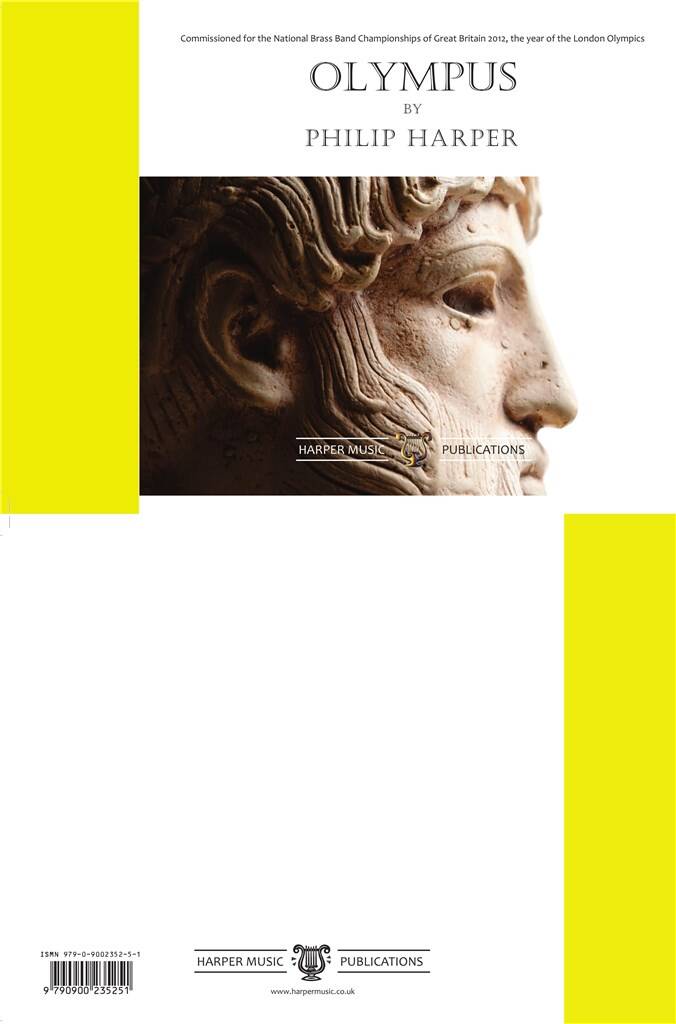
Olympus - Philip Harper
Selected as the test-piece for the 3rd Section Regional contests of the National Brass Band Championships 2012The music begins with a depiction of the exciting Opening Ceremony where noisy fanfares and sudden swells add to the cosmopolitan flag-waving clamour. Without a break the music leads to The Chariot Race, a fast compound-time gallop withthundering hooves in the basses and percussion, and a heroic melody introduced by the tenor horns. Chariot racing was the main equestrian event in the Ancient Greek Games, which were founded in memory of King Oenomaus. In the Greek legend he suffereddefeat in a chariot race to his son-in-law and Zeus' grandson, Pelops, but much of the music is bitter-sweet to symbolise the fact that Pelops had to cheat to win drawing parallels with some of the issues still facing modern-day athletics. A slow, mystical passage follows, describing The Temple of Zeus at Olympia. The statue of Zeus, who was honoured throughout the Ancient Games' history, was housed inside the temple and was one of the Seven Wonders of the Ancient World. Themusic depicts this period of the dawn of one of mankind's most ancient civilisations and there is a series of solo passages above a drone. The next section is called The Olympic Flame and a broad and lyrical anthem-like melody develops slowly in the euphoniums, which gradually ascends until the horns can take it over before passing upwards again to the cornets (Higher). The musicbursts into bright life at the lighting of the flame and the regular rhythmic pattern which has been established goes through an accelerando (Faster). The final section is called The Olympic Truce and aims to capture the cooperative spirit of the ancient practice of ending wars for the duration of the games. The anthem-like melody makes an affirmatory return (Stronger) and the work ends asit began with a blaze of colour and a real sense of optimism and global celebration. "Citius, Altius, Fortius" (Faster, Higher, Stonger)NOTES ON PERFORMANCEPercussion requirements: 1 to 3 players (3 Timpani, Snare Drum, Tenor Drum, Cymbals, Glockenspiel, Triangle)
Estimated dispatch 5-14 working days
 View Music