
Results
-
 £29.95
Quintessence (Brass Band - Score only) - Redhead, Robert
Originally written for the Melbourne Staff Band's tour of the UK in 1978 and, more specifically, their participation in The Salvation Army International Congress in London, the music expresses the quintessence of Australian Salvationism. The five sections are; 1. An original theme expressing the immensity of the Australian continent. 2. Australia's sons, let us rejoice representing the character of the people. 3. Glory, glory, glory hallelijah from the song The Christian Mission. 4. A meditative setting of At Thy feet I bow adoring, written by two Australian Salvationists. 5. A development of the previous themes bringing the work to its climactic conclusion.
Estimated dispatch 7-14 working days
-
 £72.99
Advents-Fantasie (Brass Band - Score and Parts) - Kernen, Roland
Roland Kernen has arranged the songs Macht hoch die Tur (Open Wide the Gates), Maria durch ein Dornwald ging (Maria Walks Amid the Thorns) and O Little Town of Bethlehem in his magical Advents-Fantasie. Within this work O Little Town of Bethlehem is skilfully used to connect the individual sections. A very varied and beautifully constructed composition to enrich any Christmas programme.Duration: 7.00
Estimated dispatch 7-14 working days
-
£50.00
A Festive Overture (Brass Band - Score and Parts) - Hesketh, Kenneth
This exuberant overture has busy, colourful outer sections which frame an expansive middle section, where Hesketh introduces a typically broad melody.Suitable for Championship Section BandsDuration: 7.00
Estimated dispatch 7-14 working days
-
 £29.95
ACADEMIC FESTIVAL OVERTURE (Brass Band Score only) - Brahms, Johannes - Wright, Denis
2012 National Championships Finals - Second Section. Brahms composed Academic Festival Overture during the summer of 1880 as a musical "thank you" to the University of Breslau which had awarded him an honorary doctorate the previous year. The overture consists of four continuous sections, all based on German student songs, the most famous of which is the last, 'Gaudeamus igitur'. Duration: 10'30".
Estimated dispatch 7-14 working days
-
£59.95
ACADEMIC FESTIVAL OVERTURE (Brass Band Set - Score and Parts) - Brahms, Johannes - Wright, Denis
2012 National Championships Finals - Second Section. Brahms composed Academic Festival Overture during the summer of 1880 as a musical "thank you" to the University of Breslau which had awarded him an honorary doctorate the previous year. The overture consists of four continuous sections, all based on German student songs, the most famous of which is the last, 'Gaudeamus igitur'. Duration: 10'30".
Estimated dispatch 7-14 working days
-
£112.95
EARTHRISE (Brass Band - Score and Parts) - Clarke, Nigel
Earthrise is the name of one of the most iconic photographs in history. The original NASA image numbered AS8-14-2383 was one of a series of photographes taken by William Anders and the Apollo 8 crew on 24 December 1968 during the first manned mission to the moon. Earthrise is written in one condinuous movement but divided into three sections.Duration: 16:15Suitable for Championship Section Bands
Estimated dispatch 7-14 working days
-
£44.95
EARTHRISE (Brass Band - Score only) - Clarke, Nigel
Championshipo Section. Earthrise is the name of one of the most iconic photographs in history. The original NASA image numbered AS8-14-2383 was one of a series of photographes taken by William Anders and the Apollo 8 crew on 24 December 1968 during the first manned mission to the moon. Earthrise is written in one condinuous movement but divided into three sections. Duration: 16:15
Estimated dispatch 7-14 working days
-
 £94.95
Facets of the Heart (Brass Band - Score and Parts) - Davoren, Tom
2015 Butlins Championship Section Testpiece.Facets of the Heart was created during a turbulent period of the composers life. The concept behind it changed between inception and completion. The result is a musical representation of three lesser considered but extremely important aspects of love, set against their natural opposites. Running in three continuous sections, the chosen aspects are Fear, Pain and Comfort, and Doubt and Courage.Duration: 14 mins.
Estimated dispatch 7-14 working days
-
 £49.95
Facets of the Heart (Brass Band - Score only) - Davoren, Tom
2015 Butlins Championship Section Testpiece.Facets of the Heart was created during a turbulent period of the composers life. The concept behind it changed between inception and completion. The result is a musical representation of three lesser considered but extremely important aspects of love, set against their natural opposites. Running in three continuous sections, the chosen aspects are Fear, Pain and Comfort, and Doubt and Courage.Duration: 14 mins.
Estimated dispatch 7-14 working days
-
 £30.00
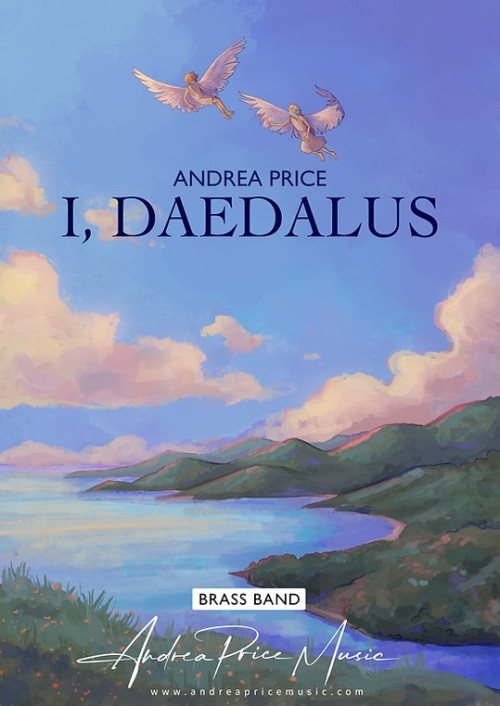
I, Daedalus (Brass Band - Score only) - Price, Andrea
This title is now digital download only - November 2025 Daedalus (pronounced day-da-luss) is a prominent figure in Greek mythology, renowned for his exceptional skills as an inventor, craftsman, and architect. The story of Daedalus symbolises human ingenuity, and epitomises the complex relationship between human creativity and its consequences. His myths explore themes of innovation, pride, and the perilous balance between human ambition and natural limits. After designing the labyrinth for King Minos, Daedalus and his son, Icarus, were imprisoned in a tower in Crete. Daedalus fashioned wings from feathers and wax, and father and son set out on their ill-fated escape. The music is through-composed, with a short introduction leading to five main sections:I - Inventor in the TowerII - Father and SonIII - Flight and FallIV - LamentV - Seeker of KnowledgeDuration: c. 10 minutes
Estimated dispatch 7-14 working days
 View Music