
Results
-
 £74.95
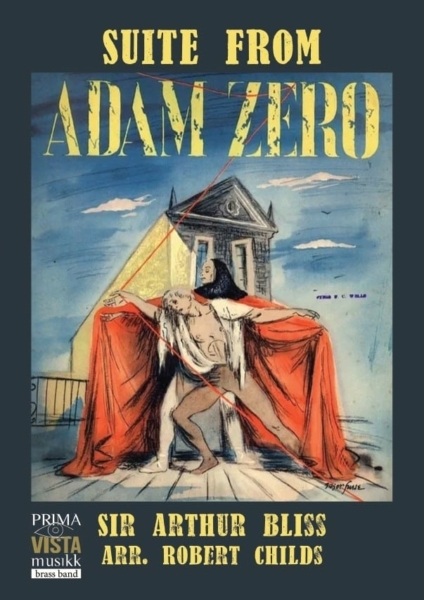
Adam Zero, Suite from (Brass Band - Score and Parts) - Bliss, Arthur - Childs, Robert
Selected as the Section 2 test piece for the National Brass Band Championships of Great Britain 2025Following his ballet Checkmate, Bliss composed another score for the, by then, Sadler's Wells Ballet, Miracle in the Gorbals, which was choreographed by Robert Helpmann, to a scenario by Michael Benthall. Premired in 1944, the ballet made a considerable impact and was a box-office success. It was followed in turn by a further collaboration with Helpmann and Benthall, Adam Zero. This would serve Helpmann, in the eponymous role, as a vehicle in two respects: demonstrating his gifts as a dancer-actor and as a choreographer. First performed at the Royal Opera House, Covent Garden, on 8 April 1946, Adam Zero was conducted by Constant Lambert, the work's dedicatee. Bliss considered it 'his most varied and exciting ballet score'. Benthall provided a synopsis for the programme:There is a philosophy that life moves in an endless series of timeless cycles. As Nature passes through Spring, Summer, Autumn and Winter, so man is born, makes a success in his own particular sphere, loses his position to a younger generation, sees his world crumble before his eyes and only finds peace in death. This age-old story is told in terms of a Company creating a ballet and calling on the resources of the theatre to do so. Lighting, stage mechanism, dance conventions, musical forms and costumes and scenery of all periods are used to symbolize the world of 'Adam Zero'.Apart from Adam, as the Principal Dancer, other main roles included the Stage Director (representing Omnipotence), and Adam's Fates (Designer, Wardrobe Mistress, and Dresser). 'The Woman in this allegory', wrote Bliss, 'under the symbol of the Choreographer, was both the creator and destroyer of Adam: his first love, his wife, his mistress, and finally the figure of beneficent Death.' When the curtain rose, the 'audience saw the Covent Garden stage right back to the wall, completely empty except for the protagonists, 'the Company poised, still and expectant, as they await the birth of... Adam Zero.'Unfortunately, soon after the premire, Helpmann injured himself and had to withdraw from the remaining performances. Despite generally positive reviews, the ballet did not capture the imagination of audiences and, to Bliss's considerable disappointment, was not revived. Seventy years would elapse before its first major return to the stage, in 2016, performed by the ballet company of Stadttheater Bremerhaven with choreography by Sergei Vanaev.Bliss extracted a concert suite from the ballet, conducting its first performance with the City of Birmingham Symphony Orchestra on 28 October 1948. For his own suite, arranged for brass band in 2023, Dr Robert Childs chose three dances linked to the seasons, book-ending them with the ebullient 'Fanfare Overture' and 'Fanfare Coda'. After Adam has grown to manhood, his Fates clothe him in a costume synonymous with confident youth, appropriate for the virile, ardent 'Dance of Spring'. In the 'Approach of Autumn', Adam, now wearing a sombre costume, has grown older: his Fates have streaked grey in his hair and put lines on his face. But they had earlier raised Adam to the zenith of his power, and the 'Dance of Summer' depicts him in the prime of life, in music of sweeping grandeur. The 'Fanfare Coda' signals that the next cycle of life is about to begin.Duration: 10.30
Estimated dispatch 7-14 working days
-
 £95.00
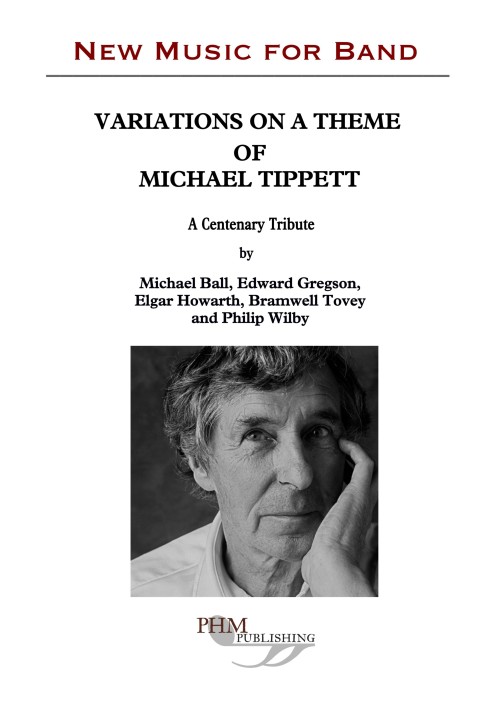
Variations on a Theme of Michael Tippett (Brass Band - Score and Parts) - Hindmarsh, Paul
A Centenary Tribute by Michael Ball, Edward Gregson, Elgar Howarth, Bramwell Tovey and Philip WilbyThis unique 'pice d'occasion' arose out of a telephone conversation in 2004 with Alan Wycherley, who was the soprano cornet player of the Foden's Richardson Band at the time. He indicated that the band would like to include an original birthday tribute for Edward Gregson (60) and Elgar Howarth (70) in its concert at the 2005 RNCM Festival of Brass in Manchester. I have been Artistic Director of Manchester's Festival of Brass since it was established in 1990 as a BBC Radio 3 series, As the centenary of the birth of Sir Michael Tippett fell on 5 January 2005, I devised this collective work as a way of embracing all three anniversaries in a novel way.The idea of joint compositions is not a new one in the classical music world. In the 1860s, Verdi was joined by a number of his contemporaries in a Requiem Mass for Rossini. In this country there have been a number of orchestral examples over the past fifty years, but never before for the brass band. Although Tippett composed only one work for brass band, Festal Brass with Blues, his orchestral works and operas are full of idiomatic brass writing. The theme I chose for this celebration is one of Tippet's most memorable miniatures featuring wind and brass. In the opera Midsummer Marriage it marks the entry of the Ancients. It is also included in the orchestral Suite in D (1948), for the Birthday of Prince Charles.I invited five of the leading contemporary voices in brass band music to add their own creative perspectives to the little Tippett theme, with it's characteristic rhythms, embellishments and modality - the Lydian mode. Each contribution was designed to fit into a tonal and formal template to give the whole work a flow and continuity. In Danse des Amis, Bramwell Tovey has composed a jazzy, humorous variation. Inspiration came from Tippett's love of jazz and, more personally, from the characteristically syncopated gait of the distinguished music critic John Amis, who Tovey once observed leaving a performance of Tippett's opera King Priam before the end. Incidentally, that performance was conducted by Elgar Howarth.We hear Edward Gregson in lyrical mode. His Midsummer Song is redolent of the sound world of Tippett's opera A Midsummer Marriage and it ends with a brief reference to a favourite of Gregson's, Tippett's Concerto for Orchestra. Michael Ball provides a brief moment of light, airy activity bringing to mind perhaps Tippett's love of Shakespearian fantasy, especially The Tempest. Elgar Howarth juxtaposes a slowed down version of the processional theme with distant recollections of fanfares from King Priam. Philip Wilby has rounded the tribute off with a spectacular fugue. During its inexorable progress Wilby ingeniously introduces the two other birthday references - the three-note musical signature that Elgar Howarth includes in much of his music and the characteristic theme which begins Edward Gregson's substantial work for brass an organ The Trumpets of the Angels. An elaborated reprise of Tippett's little theme is followed by a dynamic coda.- Paul HindmarshDuration: 13.00
Estimated dispatch 7-14 working days
-
£40.00
Variations on a Theme of Michael Tippett (Brass Band - Score only) - Hindmarsh, Paul
A Centenary Tribute by Michael Ball, Edward Gregson, Elgar Howarth, Bramwell Tovey and Philip WilbyThis unique 'pice d'occasion' arose out of a telephone conversation in 2004 with Alan Wycherley, who was the soprano cornet player of the Foden's Richardson Band at the time. He indicated that the band would like to include an original birthday tribute for Edward Gregson (60) and Elgar Howarth (70) in its concert at the 2005 RNCM Festival of Brass in Manchester. I have been Artistic Director of Manchester's Festival of Brass since it was established in 1990 as a BBC Radio 3 series, As the centenary of the birth of Sir Michael Tippett fell on 5 January 2005, I devised this collective work as a way of embracing all three anniversaries in a novel way.The idea of joint compositions is not a new one in the classical music world. In the 1860s, Verdi was joined by a number of his contemporaries in a Requiem Mass for Rossini. In this country there have been a number of orchestral examples over the past fifty years, but never before for the brass band. Although Tippett composed only one work for brass band, Festal Brass with Blues, his orchestral works and operas are full of idiomatic brass writing. The theme I chose for this celebration is one of Tippet's most memorable miniatures featuring wind and brass. In the opera Midsummer Marriage it marks the entry of the Ancients. It is also included in the orchestral Suite in D (1948), for the Birthday of Prince Charles.I invited five of the leading contemporary voices in brass band music to add their own creative perspectives to the little Tippett theme, with it's characteristic rhythms, embellishments and modality - the Lydian mode. Each contribution was designed to fit into a tonal and formal template to give the whole work a flow and continuity. In Danse des Amis, Bramwell Tovey has composed a jazzy, humorous variation. Inspiration came from Tippett's love of jazz and, more personally, from the characteristically syncopated gait of the distinguished music critic John Amis, who Tovey once observed leaving a performance of Tippett's opera King Priam before the end. Incidentally, that performance was conducted by Elgar Howarth.We hear Edward Gregson in lyrical mode. His Midsummer Song is redolent of the sound world of Tippett's opera A Midsummer Marriage and it ends with a brief reference to a favourite of Gregson's, Tippett's Concerto for Orchestra. Michael Ball provides a brief moment of light, airy activity bringing to mind perhaps Tippett's love of Shakespearian fantasy, especially The Tempest. Elgar Howarth juxtaposes a slowed down version of the processional theme with distant recollections of fanfares from King Priam. Philip Wilby has rounded the tribute off with a spectacular fugue. During its inexorable progress Wilby ingeniously introduces the two other birthday references - the three-note musical signature that Elgar Howarth includes in much of his music and the characteristic theme which begins Edward Gregson's substantial work for brass an organ The Trumpets of the Angels. An elaborated reprise of Tippett's little theme is followed by a dynamic coda.- Paul HindmarshDuration: 13.00
Estimated dispatch 7-14 working days
-
 £35.00
Carol of the Bells (Brass Band - Score and Parts) - Littlemore, Phillip
This popular Christmas piece was composed by Mykola Leontovych around 1916. It is based on a Ukrainian folk chant known as 'Shchedryk', a New Year's carol. However, it was not until after the composer's death in 1921 that it was first introduced to Western audiences, when the Ukrainian National Choir included it on their tour of Europe and the Americas that same year. The film composer John Williams incorporated it into the score for the 1990 film Home Alone and he is credited for bringing it to a wider audience still, although it had been released on Christmas albums by a number of popular artists before that. This transcription for brass band has been adapted from the arrangement by Robert Prizeman, who created it for Libera, the world famous boys choir that he both founded and directs. Their unique, enchanting and, some say, heavenly sound delights audiences throughout the world through extensive concerts, recording and TV broadcasts. This brass band transcription introduces this skilled choral arrangement to a new genre and a whole new audience as well. Duration: 3.00
Estimated dispatch 7-14 working days
-
 £50.00
CONCERTO FOR EUPHONIUM (Brass Band Parts) - Scott, Andy
Brass Band parts only, solo part not included - available separately. The 'Concerto for Euphonium' with Brass Band is scored in three movements: The Lure of the Red Jacket; Far Beyond the Stars; The Dragon's Den. The Lure of the Red Jacket responds musically to these ideas and attitudes; a non-relenting riff that signifies the hard slog of practice, scorings which find members of the band supporting the soloist, all the time the soloist putting together new riffs and ideas. Stylistically all this happens within a frame of minimalism and funk. Far Beyond the Stars is a simple folk-like melody that is stated by the soloist, which develops with different harmonic backdrops being introduced. The poignant words form the focus of the emotional intensity of this piece. The Dragon's Den is a fierce and fiery fusion of energy, virtuosic playing and intricate ensemble work, the finale of the Concerto for Euphonium draws upon the composers experience of big band and small group performance and writing. Dur: 15:00
Estimated dispatch 7-14 working days
-
 £20.00
SALT OF THE EARTH, GOSPEL (Euphonium Solo with Brass Band Parts) - Scott, Andy
Brass Band parts only, solo part not included - available separately. 'Salt of the Earth Gospel' is a new arrangment for Solo Euphonium and Brass Band of the second movement of the Concerto for Tuba 'Salt of the Earth'. It is a seven-bar melody that is passed around different soloists whilst the solo euphonium weaves in and out of the melody in an almost improvisatory way. Tension is created by a gradual dynamic build with an ensemble release before the soloist gently brings the piece to rest. Dur: 4:30
Estimated dispatch 7-14 working days
-
£37.50
Brass Monkeys Jazz Workout - Paul H Traves
This huge release brings together a selection of music composed by Paul H Traves that introduces your learners to the different style of Jazz that is available. Naturally, the rhythmic work required to play such styles means that this publication will push your learners on and will challenge them at a new level. Syncopation and swing are at the heart of the music in this collection and it is the perfect way to get your learners playing in new styles not always covered by training band music. This title offers excellent value for money with seven titles included. This publication features:SNAKES & LADDERS - (teaching dynamics and expressive playing)CHROMATICS - (As the title suggest, ensuring every valve us used!)ROCKIN' GERONIMO - (featuring triplets and accidentals)TRUMPET DRIFT - (introducing crotchet triplets & syncopation)J.B.'s 12 BAR BLUES - (a well-known style that feature sharp key signatures)J.B.'s CALYPSO (unison playing and tight rhythmic playing required)ZIG-ZAG (getting players into a lazy swing style)
In Stock: Estimated dispatch 1-3 working days
-
 £38.95
Unity Series Band Journal - Numbers 538 - 541, February 2025
538: For Christ alone (Morgan Juel Stavik)This gentle and delicate march takes its title from the chorus of Fred Fry's song (S.A.S.B. 960).539: Calling Today! (Noel Jones)The words for this three-verse arrangement were written by Fanny Crosby, with music composed by George Cole Stebbins. While the song doesn't feature in the current Salvation Army Song Book, it was included in both the 1955 and 1986 editions. This arrangement was prepared during the pandemic, where people were encouraged to make contact by telephone as much as possible, and certainly welcomed phone calls from so many friends. Thinking of the calls, led to the words of this song.540: When the saints go marching in (Thomas Mack)This arrangement was written for the service celebrating the life of Irma Long at the request of her daughter. Irma, a gentle and kind woman, was a soldier for 70 years, 40 of which were at Corry Corps, Pennsylvania, USA, where she was also a songster, a pre-school Sunday School teacher, and corps treasurer. She drove the country roads from her village to Corry five times a week, even during the hard snow and ice of winters, so that she and her three daughters could attend corps activities. 541: There is sunshine (Wilfried Weiland)This work introduces a new composer to our band journals. Wilfried Weiland was the Band master at Berlin Central Corps and a member of the German Staff Band for several years. Although this is Wilfried's first published contribution with The Salvation Army, he has had several brass pieces published in the United Kingdom and abroad. The arrangement was originally written in July 2022 for the 25th anniversary of the Naumburg Corps, Germany. The reggae genre, employed here, has not been featured within our journals before but suits the style of a brass band well.
Estimated dispatch 7-14 working days
-
 £66.00
Ballet for Band - Joseph Horovitz
Composer Joseph Horovitz will celebrate his 90th birthday in May, with 2016 already seeing a welcome retrospective of some his finest works at the RNCM Brass Band Festival in Manchester in January.It included Ballet for Band, written in 1983 at the set-work for the National Final at the Royal Albert Hall, and which has since become one his most popular major test-pieces - played on numerous occasions throughout the banding world. It is a wonderfully elegant, mischievous composition - a brass band ballet, not of programmatic intent but of fertile imagination; beautifully crafted with a delicacy of touch as light on its feet as any arabesque.The composer has admitted that he had a clear vision of the characters that inhabit his score, yet has never divulged any details - leaving the bands and listeners, as he says, "...to exercise their own imaginations rather than being influenced bymine!"
Estimated dispatch 5-14 working days
-
 £85.00
Three Haworth Impressions (Brass Band - Score and Parts) - Langford, Gordon
A wonderful three movement suite which conjures up fabulous musical imagery of the lands of northern England. Well worth including as a concert item in your next programme, but this great original composition should really should be set again as a test-piece soon - rewarding musically for audience and bandsmen alike.Includes:TOP WITHENS - A GENERAL EVOCATION OF THE ATMOSPHERE OF WUTHERING HEIGHTS The sinister opening motif symbolises the influence of the evil Heathcliffe, Soon this motif experiences several changes of character in order to portray emotions other than those of hatred and jealousy. The overall mood is, however, one of gloom and foreboding.THE THREE BELLS This is a reference to the pseudonyms adopted by Ann, Charlotte and Emily Bronte. The music begins with three "bell"-notes; Ab for Acton Bell, Cb for Currer Bell and Eb for Ellis Bell, and these three notes form the basis of a wistful waltz tune. Again the mood is rather sombre -- save for a brighter middle section -- and the opening motif from "Top Withens" is to be heard, again symbolising the frustrations and ill-fortune by which their lives were plagued.THE WORTH VALLEY RAILWAY The Brontes were not the only people in Haworth and not all is desperation and gloom. The third impression is a celebration of the victory of the people of Haworth in their fight to retain their railway. The nine-eight rhythm of a slow train is prominent, and our once-sombre motif is transformed into a triumphant fanfare.Duration: 12.00Please note that there are only 3 solo cornet parts included in this set
Estimated dispatch 7-14 working days
 View Music