
Results
-
 £34.00
(I've Had) The Time Of My Life - (Arr. by David Beal) - Brass Band Music Full Score & Parts - LMAM096
COMPOSER: Donald Markowitz, Franke Previte, John DenicolaARRANGER: David Beal"(I've Had) The Time of My Life" is a song composed by Franke Previte, John DeNicola, and Donald Markowitz. It was recorded by American singers Bill Medley and Jennifer Warnes and used as the theme song for the 1987 film Dirty Dancing. The song has won a number of awards, including the Academy Award for Best Original Song, the Golden Globe Award for Best Original Song, and the Grammy Award for Best Pop Performance by a Duo or Group with Vocals.
In Stock: Estimated dispatch 3-5 working days
-
 £34.00
Murder On The Dancefloor (Sophie Ellis-Bextor & Gregg Alexander arr. by David Beal) - Brass Band Music Full Score & Parts - LMAM085
COMPOSER: Gregg Alexander & Sophie Ellis-BextorARRANGER: David Beal"Murder on the Dancefloor" is a song written by Sophie Ellis-Bextor and Gregg Alexander, produced by Alexander and Matt Rowe for Ellis-Bextor's debut studio album, Read My Lips (2001). Released on 3 December 2001, the song peaked at number two on the UK Singles Chart and became a top-10 hit worldwide, charting within the top three in Australia, New Zealand, and four European countries. In the United States, the single reached number nine on the Billboard Maxi-Singles Sales chart. "Murder on the Dancefloor" is reported to have been the most played song in Europe in 2002. In January 2024, following its use in the film Saltburn and its subsequent popularity on TikTok, "Murder on the Dancefloor" again reached number two on the UK Singles Chart, becoming Ellis-Bextor's first top-10 appearance since 2007. It entered the US Billboard Hot 100 the same month, making it Ellis-Bextor's first appearance on that chart. It also peaked at number 10 on the Billboard Global 200, her first top-ten and overall first entry on the chart.Scored For :
In Stock: Estimated dispatch 3-5 working days
-
 £95.00
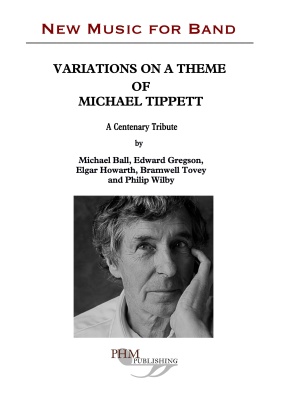
Variations on a Theme of Michael Tippett (Brass Band - Score and Parts)
A Centenary Tribute by Michael Ball, Edward Gregson, Elgar Howarth, Bramwell Tovey and Philip WilbyThis unique 'pice d'occasion' arose out of a telephone conversation in 2004 with Alan Wycherley, who was the soprano cornet player of the Foden's Richardson Band at the time. He indicated that the band would like to include an original birthday tribute for Edward Gregson (60) and Elgar Howarth (70) in its concert at the 2005 RNCM Festival of Brass in Manchester. I have been Artistic Director of Manchester's Festival of Brass since it was established in 1990 as a BBC Radio 3 series, As the centenary of the birth of Sir Michael Tippett fell on 5 January 2005, I devised this collective work as a way of embracing all three anniversaries in a novel way.The idea of joint compositions is not a new one in the classical music world. In the 1860s, Verdi was joined by a number of his contemporaries in a Requiem Mass for Rossini. In this country there have been a number of orchestral examples over the past fifty years, but never before for the brass band. Although Tippett composed only one work for brass band, Festal Brass with Blues, his orchestral works and operas are full of idiomatic brass writing. The theme I chose for this celebration is one of Tippet's most memorable miniatures featuring wind and brass. In the opera Midsummer Marriage it marks the entry of the Ancients. It is also included in the orchestral Suite in D (1948), for the Birthday of Prince Charles.I invited five of the leading contemporary voices in brass band music to add their own creative perspectives to the little Tippett theme, with it's characteristic rhythms, embellishments and modality - the Lydian mode. Each contribution was designed to fit into a tonal and formal template to give the whole work a flow and continuity. In Danse des Amis, Bramwell Tovey has composed a jazzy, humorous variation. Inspiration came from Tippett's love of jazz and, more personally, from the characteristically syncopated gait of the distinguished music critic John Amis, who Tovey once observed leaving a performance of Tippett's opera King Priam before the end. Incidentally, that performance was conducted by Elgar Howarth.We hear Edward Gregson in lyrical mode. His Midsummer Song is redolent of the sound world of Tippett's opera A Midsummer Marriage and it ends with a brief reference to a favourite of Gregson's, Tippett's Concerto for Orchestra. Michael Ball provides a brief moment of light, airy activity bringing to mind perhaps Tippett's love of Shakespearian fantasy, especially The Tempest. Elgar Howarth juxtaposes a slowed down version of the processional theme with distant recollections of fanfares from King Priam. Philip Wilby has rounded the tribute off with a spectacular fugue. During its inexorable progress Wilby ingeniously introduces the two other birthday references - the three-note musical signature that Elgar Howarth includes in much of his music and the characteristic theme which begins Edward Gregson's substantial work for brass an organ The Trumpets of the Angels. An elaborated reprise of Tippett's little theme is followed by a dynamic coda.- Paul HindmarshDuration: 13.00
Estimated dispatch 7-14 working days
-
£40.00
Variations on a Theme of Michael Tippett (Brass Band - Score only)
A Centenary Tribute by Michael Ball, Edward Gregson, Elgar Howarth, Bramwell Tovey and Philip WilbyThis unique 'pice d'occasion' arose out of a telephone conversation in 2004 with Alan Wycherley, who was the soprano cornet player of the Foden's Richardson Band at the time. He indicated that the band would like to include an original birthday tribute for Edward Gregson (60) and Elgar Howarth (70) in its concert at the 2005 RNCM Festival of Brass in Manchester. I have been Artistic Director of Manchester's Festival of Brass since it was established in 1990 as a BBC Radio 3 series, As the centenary of the birth of Sir Michael Tippett fell on 5 January 2005, I devised this collective work as a way of embracing all three anniversaries in a novel way.The idea of joint compositions is not a new one in the classical music world. In the 1860s, Verdi was joined by a number of his contemporaries in a Requiem Mass for Rossini. In this country there have been a number of orchestral examples over the past fifty years, but never before for the brass band. Although Tippett composed only one work for brass band, Festal Brass with Blues, his orchestral works and operas are full of idiomatic brass writing. The theme I chose for this celebration is one of Tippet's most memorable miniatures featuring wind and brass. In the opera Midsummer Marriage it marks the entry of the Ancients. It is also included in the orchestral Suite in D (1948), for the Birthday of Prince Charles.I invited five of the leading contemporary voices in brass band music to add their own creative perspectives to the little Tippett theme, with it's characteristic rhythms, embellishments and modality - the Lydian mode. Each contribution was designed to fit into a tonal and formal template to give the whole work a flow and continuity. In Danse des Amis, Bramwell Tovey has composed a jazzy, humorous variation. Inspiration came from Tippett's love of jazz and, more personally, from the characteristically syncopated gait of the distinguished music critic John Amis, who Tovey once observed leaving a performance of Tippett's opera King Priam before the end. Incidentally, that performance was conducted by Elgar Howarth.We hear Edward Gregson in lyrical mode. His Midsummer Song is redolent of the sound world of Tippett's opera A Midsummer Marriage and it ends with a brief reference to a favourite of Gregson's, Tippett's Concerto for Orchestra. Michael Ball provides a brief moment of light, airy activity bringing to mind perhaps Tippett's love of Shakespearian fantasy, especially The Tempest. Elgar Howarth juxtaposes a slowed down version of the processional theme with distant recollections of fanfares from King Priam. Philip Wilby has rounded the tribute off with a spectacular fugue. During its inexorable progress Wilby ingeniously introduces the two other birthday references - the three-note musical signature that Elgar Howarth includes in much of his music and the characteristic theme which begins Edward Gregson's substantial work for brass an organ The Trumpets of the Angels. An elaborated reprise of Tippett's little theme is followed by a dynamic coda.- Paul HindmarshDuration: 13.00
Estimated dispatch 7-14 working days
-
 £34.00
99 Red Balloons (Nena arr. by David Beal) - Brass Band Music Full Score & Parts - LMAM118 DOWNLOAD ONLY
COMPOSER: Carlo Karges, Kevin Mcalea, Joern Uwe Fahrenkrog-PetersonARRANGER: David Beal"99 Luftballons" (German: Neunundneunzig Luftballons, "99 balloons") is a song by the West German band Nena from their 1983 self-titled album. An English-language version titled "99 Red Balloons" (German: Neunundneunzig Rote Luftballons), with lyrics by Kevin McAlea, was also released by Nena on the album 99 Luftballons in 1984 after widespread success of the original in Europe and Japan. The English version is not a direct translation of the German original and contains lyrics with a somewhat different meaning. In the US, the English-language version did not chart, while the German-language recording became Nena's only US hit on the Billboard Hot 100.
In Stock: Estimated dispatch 3-5 working days
-
£34.95
SOUTHERN CROSS, The (Brass Band Set) - Brian Bowen
The Southern Cross is one of several excellent marches by Brian Bowen in which he carried on the more sophisticated pattern of British marches by Wilfred Heaton, Leslie Condon and Ray Steadman-Allen. It was written for the Box Hill (Australia) Corps jubilee celebrations in 1970 and formed part of the band's repertoire when it toured Great Britain in the same year. The first half of the march features part of the song, 'March on!' by Klaus Ostby, an early pioneer of Salvation Army music in Scandinavia. The contrapuntal layering of melodies in the trio, especially in the finale where 'March on!' sounds one more triumphant time, is notable, as is the shift to a slower, more stately tempo. The harmonic and rhythmic style also represents the more modern sounds of Salvation Army brass band music in the late 1960s and early 1970s. Right from the opening gestures, listeners at early performances knew that a page had turned in the evolution of the Salvation Army march.
Estimated dispatch 7-14 working days
-
 £29.50
Friends of the Band - Ron Glynn
This lively new Concert March, "Friends of the Band", was written in recognition of those friends and supporters of all Brass Bands whose help financially and in all other ways, are invaluable in the successful running of the organisations. There is a slight hint of the song, "Dear Old Pals, Jolly Old Pals" in the first section which again embeds the feelings all players and conductors have towards our band's supporters. The work was originally composed for the Hook Norton Brass Band, when the composer's wife gave so much of her time encouraging supporters to become friends. This is a great addition to all bands' libraries and a way to pay tribute and thanks.
In Stock: Estimated dispatch 1-3 working days
-
 £77.00
General Series Brass Band Journal, Numbers 2242 - 2245, April 2024
2242: Fanfare Prelude - Faithful in every way (Simon Gash)Lord, I come before your throne of grace (S.A.S.B. 378) has become a popular song for Sunday worship. These words of great assurance are married to a strong tune which, unlike many contemporary worship songs, suits the brass band idiom well. Although this piece will work without Percussion, the Snare Drum part, which underpins a lot of the piece, will help drive the music forward.2243: The wonders of thy grace (Norman Bearcroft)Herbert Booth's song Within my heart, O Lord, fulfil (S.A.S.B. 211) was the inspiration behind Lieut-Colonel Norman Bearcroft's three-verse setting of the hymn tune Wareham, with the title being taken from the lyrics of verse two.2244: Trombone Solo - I will wait (Andrew Mackereth)Major Leonard Ballantine has an astonishing gift for contemporary song writing. This song is a brilliant example of this, taking the idea of Jesus waiting patiently for us to accept the fullness of his offer of love.This arrangement was made at the request of Andrew Justice, former Principal Trombonist of The International Staff Band. For many years, Andrew has used this song with piano accompaniment. In making this arrangement, the composers aim was to capture the transparency you can create in piano playing.2245: The battle cry! (David Edmonds)Inspired by Lorne Barry's Trinity (F.S. 599), this piece would be well suited as a concert opener but would work in many settings as a contribution to worship. Its main feature is the driving rhythmic pattern in the Bass and Percussion sections. The music needs to be played with confidence and purpose. As the title suggests, it is a strong, inspiring battle cry, corralling the troops. This is a setting of the song by Stuart Townend and Keith Getty, O Church, arise (S.A.S.B. 819), which has become popular in recent years, not only within The Salvation Army, but also the wider Christian church.
Estimated dispatch 7-14 working days
-
 £65.00
Second Suite in F - Brass Band Sheet Music Full Score & Parts - LM602 - Gustav Holst
COMPOSER: Gustav HolstTRANSCRIBED : Daniel S. AugustineA brand transcription from Holst's manuscript score for brass band.A very authentic version from the original for Military Band.Can be used as a testpiece in your next own choice contestSuitable for Section 3 bands upwardsSecond Suite in FOp. 28, No. 2 (1922)1. MarchThe "March" of the Second Suite begins with a simple five note motif between the low and high instruments of the band. The first folk tune is heard in the form of a traditional British brass band march using the morris-dance tune "Glorishears". After a brief climax, the second strain begins with a euphonium solo playing the second folk tune in the suite "Swansea Town". The theme is repeated by the full band before the trio. For the trio, Holst modulates to the unconventional subdominant minor of Bb minor and changes the time signature to 6/8, thereby changing the meter. Usually one would modulate to subdominant major in traditional march form. While Sousa, reputably the "king of marches", would sometimes change time signatures for the trio (most notably in "El Capitan"), it was not commonplace. The third theme, called "Claudy Banks",[2] is heard in a low woodwind soli, as is standard march orchestration. Then the first two tunes are repeated da capo.2. Song without Words "I'll Love My Love"Holst places the fourth folk song, "I'll Love My Love" in stark contrast to the first movement. The movement begins with a chord and moves into a solo over a flowing accompaniment. The solo is then repeated, forming an arc of intensity. The climax of the piece is a fermata, followed by a cornet pick-up into the final measures of the piece.3. Song of the BlacksmithAgain, Holst contrasts the slow second movement to the rather upbeat third movement which features the folk song "A Blacksmith Courted Me". There are many time signature changes (4/4 to 3/4) making the movement increasingly difficult because the accompaniment has a pick up on the up-beats of each measure. The band joins in on the melody around the body of the piece and are accompanied with the sound of a blacksmith forging metal with an anvil called for in the score. The final major chord has a glorious, heavenly sound, which opens way to the final movement.This chord works so effectively perhaps because it is unexpected.4. Fantasia on the "Dargason"This movement is not based on any folk songs, but rather has two tunes from Playford's Dancing Master of 1651. The finale of the suite opens with a solo based on the folk tune "Dargason", a 16th-century English dance tune included in the first edition of The Dancing Master. The fantasia continues through several variations encompassing the full capabilities of the band. The final folk tune, "Greensleeves", is cleverly woven into the fantasia by the use of hemiolas, with Dargason being in 6/8 and Greensleeves being in 3/4. At the climax of the movement, the two competing themes are placed in competing sections.As the movement dies down, a duet forms a call back to the beginning of the suite with the competition of low and high registers.The name 'dargason' may perhaps come from an Irish legend that tells of a monster resembling a large bear (although much of the description of the creature has been lost over time), the Dargason tormented the Irish countryside. During the Irish uprising of the late 18th century, the dargason is supposed to have attacked a British camp killing many soldiers. This tale aside, 'dargason' is more likely derived from an Old English word for dwarf or fairy, and the tune has been considered English (or Welsh) since at least the 16th century. It is also known as 'Sedony' (or Sedany) or 'Welsh Sedony'.
In Stock: Estimated dispatch 3-5 working days
-
 £24.00
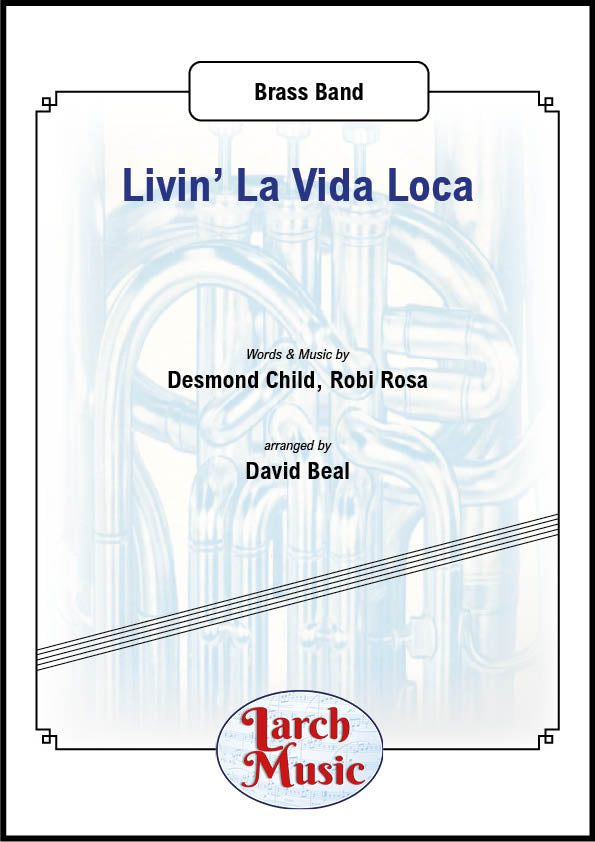
Livin' La Vida Loca - Brass Band Sheet Music Full Score & Parts - LMAM015 - Desmond Child & Robi Rosa - David Beal
COMPOSER: Desmond Child & Robi RosaARRANGER: David Beal"Livin' la Vida Loca" (transl. "Livin' the Crazy Life") is a song recorded by Puerto Rican singer Ricky Martin for his fifth studio album and English-language debut, Ricky Martin (1999). The song was written by Draco Rosa and Desmond Child, while the production was handled by the latter. It was released to radio stations by Columbia Records as the lead single from the album on March 27, 1999. A Latin pop and dance song with elements of salsa, surf, and ska, it is about an irresistible, particularly sinister, wild woman who lives on the edge, seducing others into her crazy world. The song received acclaim from music critics, who complimented its lyrics and danceable rhythm. It was ranked as the best 1990s pop song by Elle, and was listed among the Best Latin Songs of All Time by Billboard.Scored here for British Brass Band.About Digital DownloadsDigital Downloads are downloadable sheet music files that can be viewed directly on your computer, tablet or mobile device. Once you download your digital sheet music, you can view and print it at home, school, or anywhere you want to make music, and you don't have to be connected to the internet. Just purchase, download and play!PLEASE NOTE: Your Digital Download will have a watermark at the bottom of each page that will include your name, purchase date and number of copies purchased. You are only authorized to print the number of copies that you have purchased. You may not digitally distribute or print more copies than purchased for use (i.e., you may not print or digitally distribute individual copies to friends or students).
In Stock: Estimated dispatch 3-5 working days


 View Music
