
Results
-
 £31.95
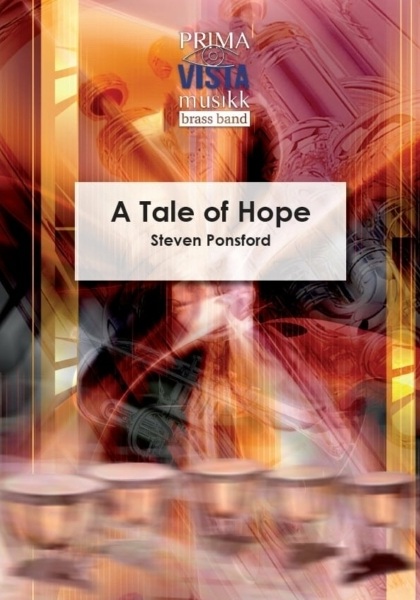
A Tale of Hope (Brass Band - Score only)
The piece tells the story of Chicago lawyer and Presbyterian church elder Horatio Gates Spafford. In 1873, the Spafford family planned a vacation to England, but last-minute business demands prevented Horatio from sailing with them. Tragedy struck when the ship collided with an iron sailing vessel while crossing the Atlantic, killing 226 people, including all four of Spafford's daughters. His wife, Anna, survived the tragedy, and upon arriving in Cardiff, Wales, she sent a telegram to Spafford that simply read "Saved alone." Shortly afterwards, as Spafford travelled to meet his grieving wife, he was inspired to write the hymn It Is Well with My Soul as his ship passed near where his daughters had died. The hymn was subsequently set to music by fellow American Philip Bliss, with the tune named after the ship on which Spafford's daughters died, Ville du Havre.Composer Steven Ponsford has chosen to portray this story in a substantial composition for brass band. Much of the early music is turbulent, reflecting the long voyage, and then the disaster that claimed Spafford's daughters. After a darker 'Grave' section, the hymn It Is Well With My Soul softly emerges, with the piece ending on a note of optimism and hope.Duration: 11.30
Estimated dispatch 7-14 working days
-
 £77.00
General Series Brass Band Journal, Numbers 2250 - 2253, December 2024
2250: Prelude on 'Rhosymedre' (Ralph Vaughan Williams trs. Douglas Engle)The English composer Ralph Vaughan Williams' work Three Preludes (founded on Welsh Hymn Tunes) was published for the organ in 1920. This is a transcription of the second movement of that work. The words associated with the hymn tune are by Samuel Crossman, My song is love unknown (S.A.S.B. 149), and vividly depict the events of Holy Week. The music is gentle and solemn and would be appropriate for a Good Friday service or as a moment of repose in a concert. 2251: Hosanna Shuffle (Sam Creamer)The half-time shuffle groove is a popular feel developed by alternative rock/pop bands of the 1980s. It marries elements of rock and swing styles together to form a new and infectious feel - Hosannah Shuffle being written as a tribute to this fusion of musical styles. Contrary to a swing style, shuffle brings the pulse back onto the beat while maintaining the swung quaver rhythms to create a rock-type rhythmic drive. 2252: Everlasting Love (Keith Manners)This piece was written for the London North East Music School in 2004. The theme of the week was 'Making a stand for Christ', reminding the school that it only takes one person to make such a stand before others follow. The music starts with a lone Solo Cornet playing the melody of Graham Kendrick's song Such Love (S.A.S.B. 199). One by one, other parts join in with the theme.2253: Festival March (Michael Cooper)This piece represents the first published brass composition of Bandmaster Michael Cooper, who is the Bandmaster at Brisbane City Temple Corps. This imposing festival march features the tunes I want to be a soldier (T.B. 683), Lift up the banner (T.B. 90) and My Jesus, I love thee (T.B. 506). These tunes depict the idea that spiritual warfare is an essential component of one's faith, success of which is articulated in the final verse of My Jesus, I love thee (S.A.S.B. 878).
Estimated dispatch 7-14 working days
-
 £77.00
General Series Brass Band Journal, Numbers 2246 - 2249, August 2024
2246: Christmas Prelude - David's City (Noel Jones)In 2 Samuel 5, we read of David's anointing as King of Israel at the age of thirty, a reign that lasted for forty years. Bethlehem was known as 'David's city' because he was born there and worked as a shepherd on the nearby hills. Verses 1, 2 and 5 of Once in Royal David's City (C.C. 68) are featured in this Christmas Prelude. There are also brief references to the carols O come, all ye faithful and O little town of Bethlehem between verses.2247: Cornet and Euphonium Duet - This Kingdom (Stephen Bulla)Geoff Bullock's song, This Kingdom, has been made well known by the American gospel singer Ron Kenoly. Stephen Bulla wrote this duet for a Brass Spectacular concert held in Basel, Switzerland, in May 2019.2248: Wonder (Stephen Gibson)When we stop to consider the mystery of God's love for each one of us, its enormity can only cause us to wonder. The opening bars of this music create an atmosphere, using a rolling accompaniment underneath sustained, music and chromatic Cornets, setting the style for the entire piece. Occasional references to Albert E. Webber's chorus Can you wonder? are heard throughout.2249: O to love thee! (Michael Davis)This piece takes its title from the first verse of Francis Bottome's words, Precious Jesus, O to love thee! The introduction establishes the baroque form of a prelude which leads into the tune Glory to the lamb (T.B. 327). Following a brief interlude, the melody is passed through several sections of the band, with delicate countermelodies in the Flugel and Horns. The majestic ending eventually comes to rest on the final tonic chord.
Estimated dispatch 7-14 working days
-
 £94.99
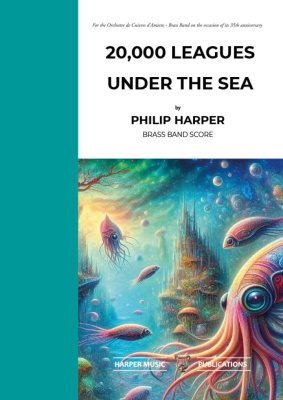
20,000 Leagues Under the Sea (Brass Band - Score and Parts)
Frenchman Jules Verne was a pioneer in science fiction during the late 19th Century, penning some classic stories such as Journey to the Centre of the Earth and Around the World in 80 Days - both of which have already been the subject of brass band test-pieces. It was therefore natural for me to choose Verne's 1869 watery magnum opus as the subject for this piece to which there are five sections, as well as an introduction and a finale.THE NAUTILUS. After a mysterious introduction we are introduced to The Nautilus - a fantastical submarine.THE CORAL KINGDOM. We visit awe-inspiring underwater coral formations.SQUID ATTACK. The Nautilus is attacked by a school of giant squid, or 'devilfish'.CAPTAIN NEMO. Captain Nemo is a loner and an eccentric. Some say he is a madman. Soloists of the band help to uncover the character of this enigmatic but powerful figure.MAELSTROM. The Nautilus is dragged into the ocean's deadliest whirlpool but Captain Nemo lives to fight another day.Duration: 12.30
Estimated dispatch 7-14 working days
-
£43.99
20,000 Leagues Under the Sea (Brass Band - Score only)
Frenchman Jules Verne was a pioneer in science fiction during the late 19th Century, penning some classic stories such as Journey to the Centre of the Earth and Around the World in 80 Days - both of which have already been the subject of brass band test-pieces. It was therefore natural for me to choose Verne's 1869 watery magnum opus as the subject for this piece to which there are five sections, as well as an introduction and a finale.THE NAUTILUS. After a mysterious introduction we are introduced to The Nautilus - a fantastical submarine.THE CORAL KINGDOM. We visit awe-inspiring underwater coral formations.SQUID ATTACK. The Nautilus is attacked by a school of giant squid, or 'devilfish'.CAPTAIN NEMO. Captain Nemo is a loner and an eccentric. Some say he is a madman. Soloists of the band help to uncover the character of this enigmatic but powerful figure.MAELSTROM. The Nautilus is dragged into the ocean's deadliest whirlpool but Captain Nemo lives to fight another day.Duration: 12.30
Estimated dispatch 7-14 working days
-
 £42.95
When You Believe (Euphonium Solo with Brass Band - Score and Parts)
Originally performed by Michelle Pfeiffer and Sally Dworsky in the DreamWorks movie, The Prince of Egypt, the more famous pop single version of this work was performed by Mariah Carey and the late great Whitney Houston.In this version arranged for Soloist and Brass Band, you can showcase your star Euphonium player.Duration: 4.30
Estimated dispatch 7-14 working days
-
 £77.00
General Series Brass Band Journal, Numbers 2242 - 2245, April 2024
2242: Fanfare Prelude - Faithful in every way (Simon Gash)Lord, I come before your throne of grace (S.A.S.B. 378) has become a popular song for Sunday worship. These words of great assurance are married to a strong tune which, unlike many contemporary worship songs, suits the brass band idiom well. Although this piece will work without Percussion, the Snare Drum part, which underpins a lot of the piece, will help drive the music forward.2243: The wonders of thy grace (Norman Bearcroft)Herbert Booth's song Within my heart, O Lord, fulfil (S.A.S.B. 211) was the inspiration behind Lieut-Colonel Norman Bearcroft's three-verse setting of the hymn tune Wareham, with the title being taken from the lyrics of verse two.2244: Trombone Solo - I will wait (Andrew Mackereth)Major Leonard Ballantine has an astonishing gift for contemporary song writing. This song is a brilliant example of this, taking the idea of Jesus waiting patiently for us to accept the fullness of his offer of love.This arrangement was made at the request of Andrew Justice, former Principal Trombonist of The International Staff Band. For many years, Andrew has used this song with piano accompaniment. In making this arrangement, the composers aim was to capture the transparency you can create in piano playing.2245: The battle cry! (David Edmonds)Inspired by Lorne Barry's Trinity (F.S. 599), this piece would be well suited as a concert opener but would work in many settings as a contribution to worship. Its main feature is the driving rhythmic pattern in the Bass and Percussion sections. The music needs to be played with confidence and purpose. As the title suggests, it is a strong, inspiring battle cry, corralling the troops. This is a setting of the song by Stuart Townend and Keith Getty, O Church, arise (S.A.S.B. 819), which has become popular in recent years, not only within The Salvation Army, but also the wider Christian church.
Estimated dispatch 7-14 working days
-
 £55.00
Triumph Series Brass Band Journal, Numbers 1359 - 1362, March 2024
1359: Festival March - Coastal Celebration (Sam Creamer)Coastal Celebration was commissioned in 2019 by Nambour Salvation Army Band for the Corps' 125th anniversary celebrations. Nambour was the birthplace of The Salvation Army's work on the Beautiful Sunshine Coast in Queensland, Australia. Firring with this theme are subtle tributes to iconic Sunshine Coast landmarks, referenced with small phrases of popular secular melodies intertwined with the main tunes What a faithful God (S.A.S.B. 378) and All through the years (S.A.S.B. 826).1360: He's always been faithful (Craig Woodland)This meditative selection is an arrangement of the song by American singer and record producer Sara, Groves, He's always been faithful. The words express the joy and thankfulness in having a relationship with Jesus and knowing his presence in life. The melody and motifs of the traditional hymn, Great is thy faithfulness (S.A.S.B. 26), are heard throughout.1361: Christ's living water (Dean Jones)Christ's sacrificial love has been beautifully portrayed through the imagery of water in many songs, none more so that the skilfully crafted words we find in the chorus of I know a fount (S.A.S.B. 197), written by Oliver Cooke. To enhance the sentiments expressed, the pure sounds derived from Handel's Water Music fit perfectly in terms of music and imagery.1362: March - Fear Not! (Avelan Ntsiete)The Salvation Army continues to proclaim its music ministry in all corners of the world and, with this item under review, we introduce a new composer, originally from Congo Brazzaville, Central Africa. Avelan Ntsiete is currently a Bandsman at the Lilas Corps in Paris but has previously served in the Congo Brazzaville Territorial Band. This march, in traditional format, was written for an evangelistic campaign in Kindamba, where civil war has brought upheaval to the area and uncertainty for the local Salvationists. The composer was part of a small brass group which travelled for over 24 hours by truck and on foot to reach Kindamba and bring encouragement to the Salvationists within that community.
Estimated dispatch 7-14 working days
-
 £12.00
Of Men and Mountains (Brass Band Study Score)
Of Men and Mountains was commissioned by the Netherlands Brass Band Championships for their 10th Anniversary Contest, held in Drachten in December 1990.The title of the work and its genesis came about as a result of a train journey the composer took in July 1989 across Canada from Toronto to Vancouver. The awe-inspiring journey through the Rocky Mountains, with its high peaks and shafts of sunlight breaking through the clouds, with its canyons and ferocious rapids, made the composer understand a little more about the majesty of nature and the fragility of humanity. The eternal struggle between man and nature was personified in the building of this incredible railway, hence the title (after Blake).The work is dedicated to the memory of Eric Ball, who died shortly before the writing of the work commenced.Of Men and Mountains is in one continuous movement and lasts about 17 mins. Its form is difficult to describe because of its motivic and accumulative nature, but it is essentially a symphonic tone poem in search of a theme, which eventually comes in its final and complete state in the majestic ending after an ever-increasing paced scherzo.Duration: 17.00
Estimated dispatch 7-14 working days
-
 £40.00
A Song for Bram (Brass Band - Score and Parts)
A Song for Bram is a short work, originally composed piano and brass band, and is dedicated to the memory of Bramwell Tovey, a close friend and colleague of the composer, and a conductor, composer, pianist and musician of huge talent, who sadly passed away before his time in the summer of 2022. In this short piece the composer has tried to imagine what kind of tune Bram would have improvised at the piano, something he frequently engaged in. No doubt it would have been a mixture of bluesy jazz, hymn tune, and love song, and this is how the solo piano takes off. In the middle section of a what is a simple tertiary structure, introduced are quotes from two hymn tunes Bram particularly loved, never having forgotten his Salvation Army roots. Bram's 'Song' returns, this time on a plaintive flugelhorn horn, and which reaches a climax with the full band before receding, literally, into the distance.....(to a new life beyond?).Duration: 6.00
Estimated dispatch 7-14 working days