
Results
-
 £34.95
Trusting Faith (Euphonium Solo with Brass Band - Score and Parts)
This piece is based on the melody Faith is the victory (T.B. 128) and throughout the solo we follow a person's journey of faith. In the first movement, the bold and confident opening depicts a seemingly strong and certain faith, although perhaps a little naive and immature. The music suggests that if we are certain enough, then we will see our prayers immediately answered and will witness miracles. But what happens when we don't see those miracles happen, or our prayers seem unanswered? Doubt creeps in and the music quickly becomes a full struggle continuing through to the end of the moment.What do you do when you faith amounts to something other than what you thought it to be? The beginning of the second movement reflects this questions and starts hesitantly and full of doubt. Soon, a new melody is introduced, Trusting as the moments fly (T.B. 263). The words of the chorus remind us that true faith should bot be affected by fears or disappointments, that our trust in God should remain. Realising that a faith that holds firm, though being tested over time, becoming deeper and stronger, is a liberating truth. We no longer need to struggle in our strength alone, but can lean on God instead.When we lean on God, reset in his care, and feel. safe in his hands, then faith has really become our victory. We will then become strong disciples who can meet life's various challenges without wavering or being afraid. This is depicted in the final movement of the solo when both melodies, whose messages complement each other, are woven together in an explosive finale.
Estimated dispatch 7-14 working days
-
 £110.00
Diversions After Benjamin Britten (Brass Band - Score and Parts)
Suite by Lucy Pankhurst, Simon Dobson, Paul McGhee and Gavin HigginsHaving devised a collective centenary tribute for Michael Tippett at the 2006 RNCM Festival of Brass (Variations on a Theme of Michael Tippett by five eminent composers of brass band music, PHM002), I commissioned this companion piece as a Benjamin Britten tribute for the 2013 festival. In the late 1970s, while researching a book about the English composer, and Britten's first teacher, Frank Bridge (1879 - 1941), I came across a copy of the printed score of Benjamin Britten's Variations on a Theme of Frank Bridge (Op.10) for string orchestra, in which Britten had written descriptive titles for each of the variations suggesting appropriate character traits of his much loved mentor and guide. The character variations are cast in march, song and dance forms.Taking inspiration from Britten's youthful tribute, I invited four award-winning composers, who have all made significant contributions to the brass band medium, to create their own personal reflections on four aspects of Britten's character and music, designed to form a suite of Diversions after Benjamin Britten, but which can also be played separately.Lucy Pankhurst's hauntingly lyrical Prelude: His Depth refers to the emotional and symbolic subtexts that underpin Britten's operas, taking its musical cue from Britten's many arrangements of folk songs. The flugel horn takes a prominent role throughout.Simon Dobson's breathless Scherzo: His Vitality reminds us with its rapid passage work and leaping bass 'groove' that Britten loved tennis and fast cars in his younger days.Paul McGhee's evocative interpretation of the March: His Sympathy represents Benjamin Britten's pacifism, as the composer writes: 'We view the music through the eyes of a pacifist. Whilst war and violence surround us, we do not engage in it and though it continues to happen around us. With the use of muted effects in most of the band throughout the piece, the flugel horn is the lone voice of reason, standing firm against the mechanical and destructive society in which it is forced to live. As the machine of war continues around the lone voice, the voice is gradually dismissed and mocked as the war machine rumbles on into the distance.'In an extended finale, entitled Toccata: His Skill, Gavin Higgins celebrates Benjamin Britten's consummate creativity. For the RNCM Festival of Brass premiere, the four contrasting movements were framed and connected by Britten's Fanfare for St. Edmundsbury for three trumpets, with the trumpet soloists spaced round the hall. I am grateful to the Britten Estate and publishers Boosey & Hawkes for giving permission for the elements of Britten's fanfare to be incorporated in the collective work.- Paul HindmarshDuration: 19.30
Estimated dispatch 7-14 working days
-
£45.00
Diversions After Benjamin Britten (Brass Band - Score only)
Suite by Lucy Pankhurst, Simon Dobson, Paul McGhee and Gavin HigginsHaving devised a collective centenary tribute for Michael Tippett at the 2006 RNCM Festival of Brass (Variations on a Theme of Michael Tippett by five eminent composers of brass band music, PHM002), I commissioned this companion piece as a Benjamin Britten tribute for the 2013 festival. In the late 1970s, while researching a book about the English composer, and Britten's first teacher, Frank Bridge (1879 - 1941), I came across a copy of the printed score of Benjamin Britten's Variations on a Theme of Frank Bridge (Op.10) for string orchestra, in which Britten had written descriptive titles for each of the variations suggesting appropriate character traits of his much loved mentor and guide. The character variations are cast in march, song and dance forms.Taking inspiration from Britten's youthful tribute, I invited four award-winning composers, who have all made significant contributions to the brass band medium, to create their own personal reflections on four aspects of Britten's character and music, designed to form a suite of Diversions after Benjamin Britten, but which can also be played separately.Lucy Pankhurst's hauntingly lyrical Prelude: His Depth refers to the emotional and symbolic subtexts that underpin Britten's operas, taking its musical cue from Britten's many arrangements of folk songs. The flugel horn takes a prominent role throughout.Simon Dobson's breathless Scherzo: His Vitality reminds us with its rapid passage work and leaping bass 'groove' that Britten loved tennis and fast cars in his younger days.Paul McGhee's evocative interpretation of the March: His Sympathy represents Benjamin Britten's pacifism, as the composer writes: 'We view the music through the eyes of a pacifist. Whilst war and violence surround us, we do not engage in it and though it continues to happen around us. With the use of muted effects in most of the band throughout the piece, the flugel horn is the lone voice of reason, standing firm against the mechanical and destructive society in which it is forced to live. As the machine of war continues around the lone voice, the voice is gradually dismissed and mocked as the war machine rumbles on into the distance.'In an extended finale, entitled Toccata: His Skill, Gavin Higgins celebrates Benjamin Britten's consummate creativity. For the RNCM Festival of Brass premiere, the four contrasting movements were framed and connected by Britten's Fanfare for St. Edmundsbury for three trumpets, with the trumpet soloists spaced round the hall. I am grateful to the Britten Estate and publishers Boosey & Hawkes for giving permission for the elements of Britten's fanfare to be incorporated in the collective work.- Paul HindmarshDuration: 19.30
Estimated dispatch 7-14 working days
-
 £30.00
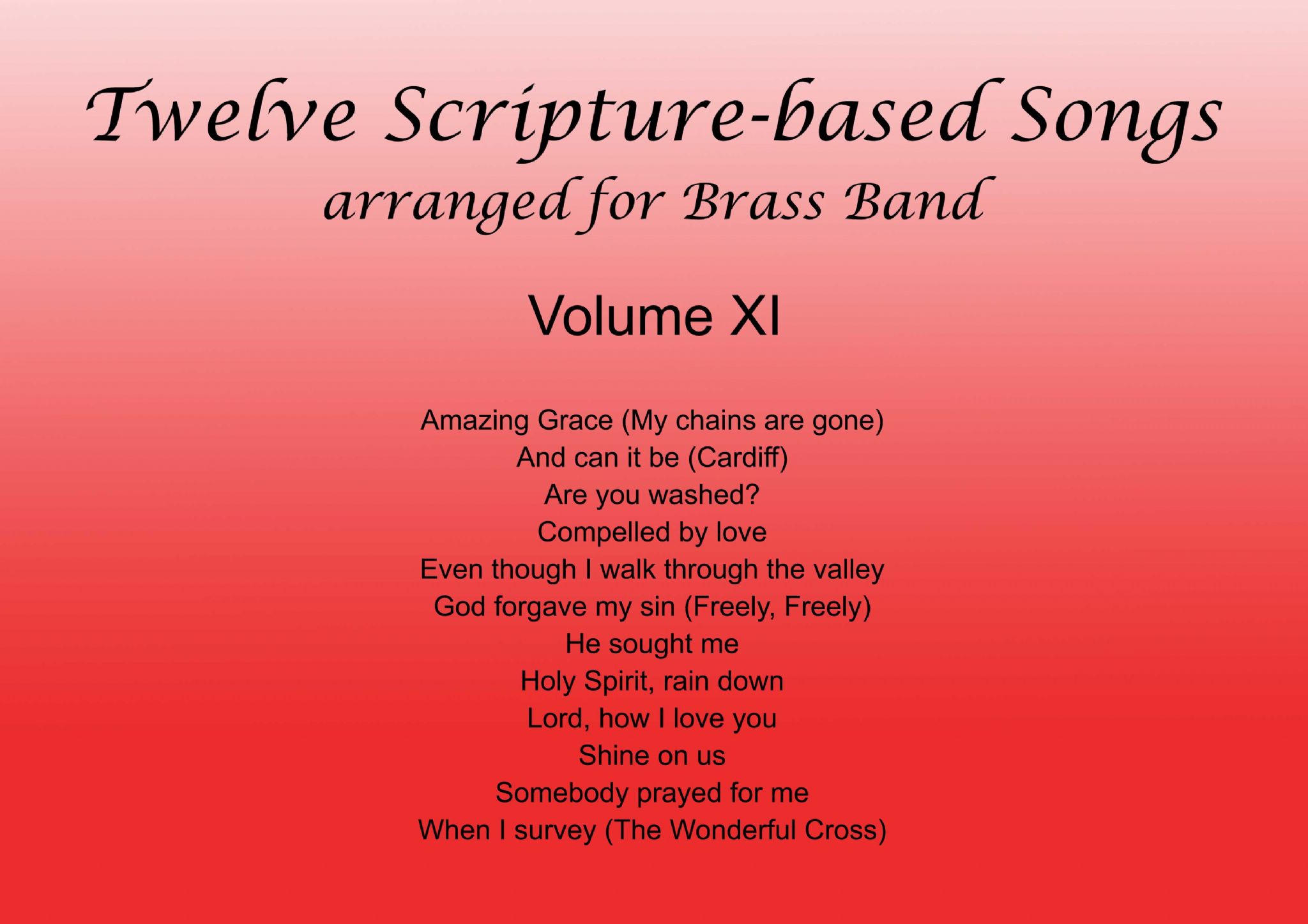
Twelve Scripture-Based Songs Volume XI
Twelve scripture-Based Songs arranged for Brass Band (Volume XI) are packaged and marketed in complete sets which include a full score and a set of master parts. It is intended that these parts be used as 'masters', for the purpose of photocopying a quantity of parts to accommodate the precise instrumentation needs of the band for which this has been purchased.Amazing Grace (My chains are gone)And can it be (Cardiff)Are you washed?Compelled by loveEven though I walk through the valleyGod forgave my sin (Freely, Freely)He sought meHoly Spirit, rain downLord, how I love youShine on usSomebody prayed for meWhen I survey (The Wonderful Cross)
Estimated dispatch 7-14 working days
-
 £45.00
Wellerman - Sea Shanty Medley
ABOUT THIS PIECE: We don't sell sugar, tea, or rum - nor do we condone the taking of whales in tow! We do sell some pretty exciting music though, and this latest arrangement from Adam D J Taylor is sure to be a right 'knees up' for ensemble, audience and parrots alike. Scored for brass band with optional choir, this is a fun and challenging arrangement of a few famous sea shanties with 'film music' undertones throughout. ENSEMBLE: Standard British Brass Band with optional SATB Choir* *SATB parts additional cost (minimum 4-copy order at �4.99 per copy, then �1 per copy thereafter). To order this piece with SATB parts, please contact us here. WHEN YOU BUY THIS PRODUCT, YOU GET: High-quality printed score and parts LEVEL: 2 LISTEN: Click here to hear a recording with choir (Black Dyke Mills Band & Huddersfield Choral Society) Click below to hear the piece played at the famous Changing of the Guard at Buckingham Palace: DURATION: 4-minutes 30-seconds EXAMPLE SCORE: Click here LEVEL GUIDE: Level 1- Accessible to all Level 2 - c. UK third section and higher Level 3 - c. UK second section and higher Level 4 - c. UK first section and higher Level 5 - c. UK championship section level
Estimated dispatch 5-7 working days
-
 £79.95
Amundsen - Jonathan Bates
DURATION: 14'00". DIFFICULTY: 1st+. 'Amundsen' was commissioned by rskog Brass, Norway for their winning performance at the 2020 Norwegian National Championships held at the Grieghallen in Bergen. In December 1911, Norwegian Roald Amundsen gained global fame by becoming the first explorer to lead a team to the geographic South Pole. Amundsen and 4 other members of his team arrived 5 weeks ahead of a rival team from the UK led by Robert Falcon Scott, all of which perished on their attempted return from the pole. Initially when Amundsen's team set out in 1910, they were under the impression that they would be making the far shorter journey to the arctic drift to attempt to reach the North Pole, but Amundsen had received news that American explorers Peary and Cook had beaten them to this goal, and so Amundsen's focus changed southward. 'Fram, Forward' - 'Fram' (translating to English as "forward") was the name of the ship Amundsen used for this particular polar expedition. Amundsen had only informed 2 people of his real intentions of conquering the South Pole when the ship first left port in Kristiansand before heading south to the Portuguese island of Madeira in the Atlantic Ocean. After weeks at sea - causing the uninformed members of the crew to raise a number of questions and produce a general feel of uncertainty and low spirits - it was here that Amundsen announced his true plans to the rest of his crew. They were asked whether they wished to continue with their expedition, to which all - some begrudgingly - agreed to sail on to the South Pole, through the great Ice Barrier before docking in the Bay of Whales on the Ross Ice Shelf. 'Ross Ice Shelf' - Upon Amundsen's arrival in the Bay of Whales, the team were greeted by the sight of the enormous ice plateau's and glaciers, towering into the Antarctic sky. In 1907, Ernest Shackleton had attempted - and failed - to reach the South Pole, but his route and mapping was by now well documented. Scott and the UK team were to follow this route, whereas Amundsen and his men forged their own way to the pole through unchartered territory and deadly terrain littered with deep crevasses and canyons. The music here though, is a picture of tranquility. The eerie silence of total emptiness with only the heavy snow falling around Amundsen as Fram and the Bay of Whales disappears into the distance, faced by the maginute of the expedition ahead. 'Advance to Polheim' - The first new challenge Amundsen discovered on this route was a rough, sharp and extremely steep glacier (which was later named the Axel heiberg Glacier after the Norwegian monarch who funded much of the expedition), which would take his team up from sea level to an altitude of over 9,000ft in just 20 miles, with most of this over just 7 miles. Once scaled, only the vast Antarctic Plateau stood between Amundsen and the pole. Here the race began, with only one aim - victory for himself, his team, and for the whole of Norway. .
In Stock: Estimated dispatch 1-3 working days
-
 £40.00
Last Night of the Proms Medley - Traditional
The quintessential most English of English classical music concerts and the self-styled world's largest and most democratic musical festival". The "Proms", originally known as The Henry Wood Promenade Concerts are an eight-week summer season of daily orchestral classical music concerts and other events held annually, predominantly in the Royal Albert Hall in London. Founded in 1895, each season now consists of more than 70 concerts in the Albert Hall, a series of chamber concerts at Cadogan Hall, additional Proms in the Park events across the United Kingdom on the last night, and associated educational and children's events. Often held as outdoor concerts in London's pleasure gardens, where the audience was free to stroll around while the orchestra was playing, this tradition has once again been revived in parks and stately homes not only in the UK, but across the world. The first series of promenade concerts were held indoors at the Queen's Hall in Langham Place. The idea was to encourage an audience for concert hall music who, though not normally attending classical concerts, would be attracted by the low-ticket prices and more informal atmosphere. In addition to "promenading" or "promming"; eating, drinking and smoking was all allowed. Many people's perception of the "Proms" is taken from the "Last Night", although this concert is very different from the others. The concert is traditionally of a lighter vein, with popular classics being followed by a series of British patriotic pieces in the second half of the concert. This second half sequence traditionally includes most of the works included in this medley. Many in the audience use the occasion for an exuberant display of Britishness. Union Jack Flags are carried and waved by the "Prommers", especially during "Rule, Britannia!". Balloons and party poppers are also in abundance.
-
 £70.00
The Four Temperaments (Score only) - Robert Simpson
The Four Temperaments was commissioned by the Yorkshire Imperial Band and first performed by them in 1983. The suite depicts the four traditional temperaments, as Nielsen had done in his second symphony: Sanguine, Phlegmatic, Melancholic, and Choleric, though each movement stands up as absolute music. The composer has said of The Four Temperaments: 'The Melancholic wants to be broad, warm and grand, without haste or hysteria. As for the rest, it should go like a bomb.' It does! Duration: 22:00
Estimated dispatch 7-9 working days
-
 £116.00
The Four Temperaments (Parts only) - Robert SImpson
The Four Temperaments was commissioned by the Yorkshire Imperial Band and first performed by them in 1983. The suite depicts the four traditional temperaments, as Nielsen had done in his second symphony: Sanguine, Phlegmatic, Melancholic, and Choleric, though each movement stands up as absolute music. The composer has said of The Four Temperaments: 'The Melancholic wants to be broad, warm and grand, without haste or hysteria. As for the rest, it should go like a bomb.' It does! Duration: 22:00
Estimated dispatch 7-9 working days
-
 £42.00
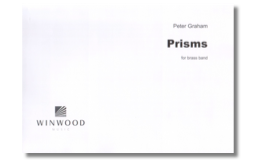
Prisms (Score only) - Peter Graham
Dating from 1986 Prisms (Symphonic Study No. 2 for Brass band) was extensively revised in 1988 to form the preent work. Though not programmatic as such, the work has its roots in traditional brass band music, being strongly melodic and adopting a broad ternary form. The main themes call all be traced to the fourth-based first subject, these offshoots drawing a parallel with light refraction - Prisms. As well as the lyrical sections, much of the music is highly rhythmic, with a busy percussion section, and accesible and enjoyable to all. Duration: 13:00
Estimated dispatch 7-9 working days