Results
-
 £27.00
Auld Lang Syne (Brass Band - Score and Parts)
It is a tradition in most English-speaking countries to sing this song at the stroke of midnight on New Year's Eve to usher in the New Year. The words are at least partially written by Robert Burns and the words "Auld Lang Syne" literally mean "old long ago" or "the good old days", providing a moment of reflection before moving forwards into the New Year.The tubular bells, although pitched, sound midnight when they enter at bar 10.This arrangement was prepared for Brass Band of the Western Reserve, musical director Keith M Wilkinson, to perform at First Night, Akron, Ohio, December 31st, 2007. The following choreography is suggested:Commence the performance with all the cornets scattered around the auditorium.At the end of bar 18 invite the audience to sing along with the band.At bar 27 the cornets move to stand in front of the other members of the band to lead to the stirring conclusion. Should auld acquaintance be forgot and never brought to mind?Should auld acquaintance be forgot and days of auld lang syne?For auld lang syne, my dear, for auld lang syne,We'll take a cup of kindness yet, for auld lang syne.
Estimated dispatch 7-14 working days
-
£60.00
Occasional Overture - Benjamin Britten
Benjamin Britten composed his Occasional Overture Op.38, for the opening of the BBC Third Programme on 29th September 1946, when it was performed by the BBC Symphony Orchestra under Sir Adrian Boult. It was not heard again until 1982, when the composer's Executors decided that it should be revived. Given the dominance of brass and woodwind in this concise but exciting work, versions for brass band and wind band have been prepared for Britten's centenary year.Brass Band Grade 6: Championship.Duration: 8 Minutes.
In Stock: Estimated dispatch 1-3 working days
-
 £59.77
We Seven (Brass Band) Derek Jenkins
We Seven, the title of this work, comes from a book by the same name written by the United States's first astronauts. The composer writes: 'In 1959, the United States entered the space race by starting a programme whose main aims included sending a solo astronaut into space and recovering him safely. Project Mercury, as this programme was so called, recruited the first seven American astronauts and successfully sent six of them into space. These men were Scott Carpenter, Gordon Cooper, John Glenn, Gus Grissom, Wally Schirra, Alan Shepard, and Deke Slayton, and collectively they became known as the 'Mercury Seven.' Through their efforts and those of countless others, the United States Space Program accomplished much with these six flights, including successfully sending an astronaut into space, putting a man in orbit, and keeping him up there for more than 24 hours. In 1962, shortly after Glenn and Carpenter's orbital flights, the 'Mercury Seven' co-wrote the book We Seven and throughout it, the astronauts discuss the events leading from their selection into the programme up through Carpenter's flight in May of 1962. The primary material for the work comes from two sources: the use of musical cryptograms to encode the astronauts names and initials into pitches and the aria 'Un bel di vedremo' from Giacomo Puccini's opera, Madame Butterfly. The inclusion of the latter comes directly from one of Glenn's chapters in the book. Together with a couple of the other astronauts, he would often listen to the opera to unwind from a long day of training. I would like to think that as he was orbiting the Earth that this opera, particularly this aria, would be running through his mind.' This work commemorates the Project Mercury on the 50th anniversary of its conclusion and was written for Joseph Parisi and the University of Missouri-Kansas City Wind Ensemble. This version for brass band has been prepared by the composer for the Fountain City Brass Band. To view a video of Fountain City Brass Band performing the work please visit: www.youtube.com/watch?v=yD3sBWhGkOo Sheet music available from: UK - www.brassband.co.uk USA - www.solidbrassmusic.com Difficulty Level: 1st Section + Instrumentation: 1 Soprano Cornet (Eb) 9 Cornets (Bb) [Both 3rd Cornets double Crystal Glasses] 1 Flugelhorn 3 Tenor Horns (Eb) [2nd Horn doubles Crystal Glasses] 2 Baritones (Bb) 2 Trombones (Bb) 1 Bass Trombone 2 Euphoniums (Bb) 2 Basses (Eb) 2 Basses (Bb) 4 Percussion
In Stock: Estimated dispatch 1-3 working days
-
 £45.00
The Thunderer (Brass Band - Score and Parts)
This march, one of Sousa's most popular compositions, was written in 1889 and was dedicated to the Knights Templar of Washington, D.C. Sousa had been knighted by that organization three years earlier. The origins of the name of the march are unclear and the march is noteworthy not only for Sousa's usual creative skills but also for the use, in two sections of the march, of military-style percussion and, in the last section, of featured fanfares.This arrangement was prepared for the 2009 Summer concerts of Brass Band of the Western Reserve, musical director Dr Keith M Wilkinson. The arrangement highlights the particular features mentioned above and performances will be enhanced by following the indicated staging directions.
Estimated dispatch 7-14 working days
-
 £79.99
The Alchymist's Journal (Brass Band - Score and Parts)
The Alchymist's Journal (Variants for Brass Band) was commissioned by Faber Music Band Consultant Paul Hindmarsh in 2001, with the support of the Brass Band Heritage Trust, as a substantial concert/contest challenge that would be within the compass of the country's most able youth and first section bands. It received its first performance in January 2002, by Black Dyke Band under Nicholas Childs, as part of the Royal Northern College of Music Festival of Brass.Since its original publication, composer Kenneth Hesketh has made a number of revisions to the work. Most of these were included in the recording made by Foden's Band conducted by Bramwell Tovey. This definitive new edition, including all the composer's revisions, has been specially prepared for the 2015 National Brass Band Championships of Great Britain and is the text that all bands performing were required to use.Suitable for 1st Section Bands and aboveDuration: 12 minutes
Estimated dispatch 7-14 working days
-
 £49.99
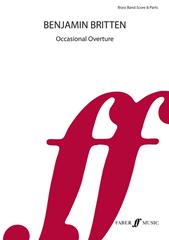
Occasional Overture (Brass Band - Score and Parts)
Benjamin Britten composed his Occasional Overture Op.38, for the opening of the BBC Third Programme on 29th September 1946, when it was performed by the BBC Symphony Orchestra under Sir Adrian Boult. It was not heard again until 1982, when the composers Executors decided that it should be revived. Given the dominance of brass and woodwind in this concise but exciting work, versions for brass band and wind band have been prepared for Brittens centenary year. Suitable for Championship Section Bands. Duration: 8.00
Estimated dispatch 7-14 working days
-
 £40.00
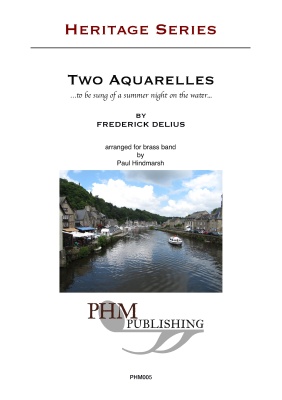
Two Aquarelles (Euphonium Feature with Brass Band - Score and Parts)
In the late spring of 1917, the Bradford born composer, Frederick Delius (1856 - 1934) composed two short part-songs at his home in Grez-sur-Loing. The river ran along the bottom of his garden and he called the two miniatures To be sung of a summer night on the water. The First World War was at its height, but one would never guess that from the languid and serene quality of these richly textured nocturnes. The songs were first heard in London on 28 June, sung by the Oriana Madrigal Society, conducted by Charles Kennedy Scott. In 1932 Delius's amanuensis, Eric Fenby, arranged them for string orchestra as Two Aquarelles. While I have taken Fenby's title, my arrangement is a note-for-note transcription of the choral original. It was prepared in early in 1993 for Besses o' th' Barn Band, of which I was Musical Director at the time. In the second song, the prominent tenor solo has been given to the solo euphonium, who should stand apart from the band in performance.- Paul HindmarshDuration: 5.00
Estimated dispatch 7-14 working days
-
 £5.00
£5.00O Mio Babbino Caro (Trombone or Horn Solo and Piano Accompaniment)
This famous aria is from the opera Gianni Schicchi. Lauretta, daughter of Gianni Schicchi, has fallen in love with Rinuccio but there are huge tensions between their two families which threaten to keep the young couple apart. The rather discordant music which opens portrays these tensions before giving way to Lauretta's tender appeal to her father to allow her to marry the man she loves. A brass band arrangement of this aria was prepared at the request of Brett Baker to be performed with Brass Band Of The Western Reserve, musical director Dr Keith M Wilkinson, during his visit in May, 2011. This piano accompaniment version will make this beautiful music accessible to more soloists.Parts included for Trombone BC, Trombone TC, Eb Horn, F Horn and Piano Accompaniment
Estimated dispatch 7-14 working days
-
 £112.00
Zampa (Brass Band - Score and Parts)
The opera, Zampa, was first performed in Paris in 1831 and over the next 50 or so years enjoyed frequent performances and remained extremely popular. Since the dawn of the 20th century the popularity of the opera has waned somewhat but the overture has continued to be one of the composer's most famous works and is a staple of the orchestral repertoire.This brass band transcription was prepared for Brass Band Of The Western Reserve and it has been extremely well-received on their concerts.
Estimated dispatch 7-14 working days
-
 £24.00
O Mio Babbino Caro (Trombone Solo with Brass Band - Score and Parts)
This famous aria is from the opera Gianni Schicchi. Lauretta, daughter of Gianni Schicchi, has fallen in love with Rinuccio but there are huge tensions between their two families which threaten to keep the young couple apart. The rather discordant music which opens portrays these tensions before giving way to Lauretta's tender appeal to her father to allow her to marry the man she loves. This arrangement was prepared at the request of Brett Baker to be performed with Brass Band Of The Western Reserve, musical director Dr Keith M Wilkinson, during his visit in May, 2011.
Estimated dispatch 7-14 working days