
Results
-
 £33.62
Abide with me (Brass Band) William H. Monk arr. Greg Jasperse trs. Espen Haukas
VIEW SCORE PDF Greg Jasperse's choral setting of the much-loved hymn Abide with me has become very popular with choirs and has here been arranged for brass band by Norwegian composer Espen Haukas. The scoring is for standard brass band although the Repiano Cornet part is set as a second Flugel part. Optional cues are written for some upper register notes meaning the piece is playable by bands of all levels. To view a follow-the-score video with Bjorsvik Brass performing the work please visit: www.youtube.com/watch?v=lVHlQW_8Pao Sheet music available from: UK - www.brassband.co.uk USA - www.solidbrassmusic.com Difficulty Level: 4th Section + Instrumentation: Soprano Cornet Eb Solo Cornet 1&2 Bb Solo Cornet 3&4 Bb 2nd Cornet Bb 3rd Cornet Bb Flugel Horn 1&2 Bb Solo Horn Eb 1st Horn Eb 2nd Horn Eb 1st Baritone Bb 2nd Baritone Bb 1st Trombone Bb 2nd Trombone Bb Bass Trombone Euphonium 1&2 Bb Bass Eb Bass Bb Percussion 1-3
In Stock: Estimated dispatch 1-3 working days
-
 £7.46
£7.46Adoration (Cornet Solo with Brass Band - Additional Parts) Price arr. Wainwright
Florence Price was an American classical composer, pianist, organist and music teacher. She is noted as the first African-American woman to be recognised as a symphonic composer, and the first to have a composition played by a major orchestra. Price composed over 300 works: four symphonies, four concertos, as well as choral works, art songs, chamber music and music for solo instruments. In 2009, a substantial collection of her works and papers that had been previously considered lost was found in her abandoned summer home. Amongst these was this delightful work, Adoration, which had been composed in the 1950s for organ. According to IMSLP.org, the piece "failed to meet notice or renewal requirements to secure statutory copyright with no 'restoration' under the GATT amendments" and therefore is in the public domain. A version for violin and piano by Elaine Fine has become popular. This setting for cornet soloist with brass band has been arranged by Andrew Wainwright. It is also available as a Bb solo with piano here. The additional parts included in this download are for low brass in bass clef. The full brass band set is available here. To view a video of Andrew Roe performing the work, please visit: www.youtube.com/watch?v=_7UYlz8Fzxo Difficulty Level: 4th Section + Length: 3.15 minutes Sheet music available from: UK - www.brassband.co.uk USA - https://satradecentral.org Included in download: 1st Baritone B.C. 2nd Baritone B.C. 1st Trombone B.C. 2nd Trombone B.C. Euphonium B.C. Tuba B.C. (Eb Bass Part) Tuba B.C. (Bb Bass Part)
In Stock: Estimated dispatch 1-3 working days
-
 £33.62
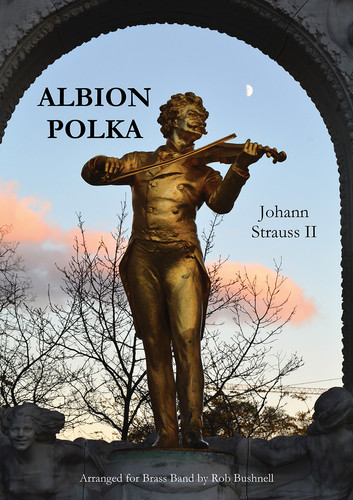
Albion Polka (Brass Band) Johann Strauss II arr. Rob Bushnell
Written in 1851, the Albion Polka was written by Johann Strauss II (or Strauss Junior) and dedicated to Count Albert of Saxe-Coburg-Gotha, husband of Queen Victoria of Great Britain. The work takes its title from the old Roman name for Britain. It is not an unfamiliar addition to the Vienna New Year's Concerts. This arrangement is for the UK-style brass band, with alternative parts for horns in F and bass-clef lower brass. A recording of the original composition can be found here: www.youtube.com/watch?v=KZIC-JhitHU Duration: Approx. 3.00 minutes (without rubato) Difficulty Level: 3rd Section + PDF download includes parts and score. Also includes alternative parts for horns in F and lower brass in bass clef. Instrumentation: Soprano Cornet Eb Solo Cornet Bb Repiano Cornet Bb 2nd Cornet Bb 3rd Cornet Bb Flugel Horn Bb Solo Horn Eb 1st Horn Eb 2nd Horn Eb 1st Baritone Bb 2nd Baritone Bb 1st Trombone Bb 2nd Trombone Bb Bass Trombone Euphonium Bb Bass Eb Bass Bb Timpani Glockenspiel Snare
In Stock: Estimated dispatch 1-3 working days
-
 £33.62
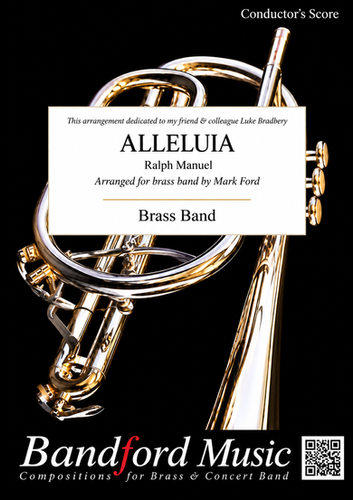
Alleluia (Brass Band) Ralph Manuel arr. Mark Ford
In composing Alleluia, Ralph Manuel created a masterwork for a capella choir. Through its melodic simplicity and warm harmonic textures, it beautifully expresses the sentiments of "Alleluia," its only word of text. The numerous timbral possibilities of brass and percussion provides an exciting palette of sound for this arrangement. This arrangement for brass band is from the pen of Mark Ford in a delightful setting sure to be popular with audiences. To view a rolling score video of the work please visit www.youtube.com/watch?v=Cg4MDGVBpns Duration: 5.00 minutes Difficulty Level: 3rd Section + This PDF download includes the full score and parts. Sheet music available at www.brassband.co.uk (UK) or https://satradecentral.org (USA) Instrumentation: Soprano Cornet Eb Solo Cornet 1&2 Bb Solo Cornet 3&4 Bb Repiano Cornet Bb 2nd Cornet Bb 3rd Cornet Bb Flugel Horn Bb Solo Horn Eb 1st Horn Eb 2nd Horn Eb 1st Baritone Bb 2nd Baritone Bb 1st Trombone Bb 2nd Trombone Bb Bass Trombone Euphonium Bb Bass Eb Bass Bb Timpani Percussion 1-2 Tuned Percussion
In Stock: Estimated dispatch 1-3 working days
-
 £11.20
Be Thou My Vision (Brass Band - Additional Parts) Trad. arr. Andrew Wainwright
A highly evocative arrangement of the popular hymn, also known as Slane. The arranger Andrew Wainwright responds to the ethereal quality of the tune with an exquisite layering of texture. The three-verse setting grows to a glorious climax on the final verse, before dying away to a serene ending. The arrangement was commissioned by the Nebraska Brass Band and its Musical Director Glenn Greet. To view a video of Dallas Brass Band performing the work please visit www.youtube.com/watch?v=mUyDYnOkXuE Sheet music available from: UK - www.brassband.co.uk USA - www.solidbrassmusic.com Difficulty Level: 4th Section + Parts included in this download: Solo Horn F 1st Horn F 2nd Horn F 1st Baritone Bass Clef 2nd Baritone Bass Clef 1st Trombone Bass Clef 2nd Trombone Bass Clef Euphonium Bass Clef Tuba Bass Clef (Bass Eb Part) Tuba Bass Clef (Bass Bb Part) The full brass band set with traditional instrumentation is available here.
In Stock: Estimated dispatch 1-3 working days
-
 £29.88
Beaufort Fanfare (Brass Band) Friedrich Gattermann
Beaufort Fanfare, by German composer Friedrich Gattermann, is a dynamic and vibrant musical work inspired by the Beaufort scale, a system for estimating wind speeds. Originally composed for brass ensemble and percussion, it was created to showcase Orchestral Tools' Beaufort Brass sample library, recorded at the iconic AIR Studios in London. Here it has been set for brass band. A central element of Beaufort Fanfare is its exploration of musical density. The piece begins with a single motif and gradually builds in complexity and richness, reflecting the increasing strength of the wind. As it progresses, the music intensifies, with the development of density playing a crucial role in conveying the evolving character of the elements. Through intricate brass harmonies and rhythmic drive, Beaufort Fanfare captures both the awe-inspiring beauty and raw power of nature. More than just an auditory experience, this composition takes the listener on a journey through the elements, celebrating the force of wind in all its forms. To view a rolling score video of the work please visit www.youtube.com/watch?v=vdiIIERMSDY Duration: 2.15 minutes approx. Difficulty Level: 1st Section + PDF download includes parts and score. Sheet music available from www.brassband.co.uk Instrumentation: Soprano Cornet Eb Solo Cornet 1-3 Bb Solo Cornet 2-4 Bb Repiano Cornet Bb 2nd Cornet Bb 3rd Cornet Bb Flugel Horn Bb Solo Horn Eb 1st Horn Eb 2nd Horn Eb 1st Baritone Bb 2nd Baritone Bb 1st Trombone Bb 2nd Trombone Bb Bass Trombone Euphonium Bb Bass Eb Bass BbTimpani Percussion 1-3
In Stock: Estimated dispatch 1-3 working days
-
 £29.88
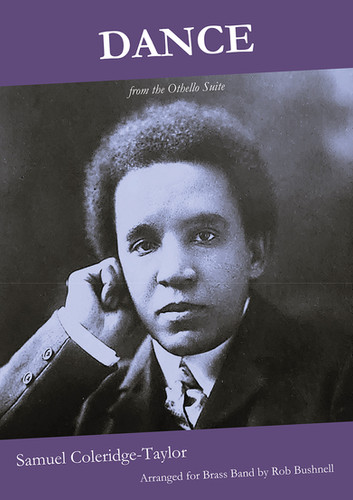
Dance from the Othello Suite (Brass Band) Coleridge-Taylor arr. Bushnell
Samuel Coleridge-Taylor is a British composer, who, from a young age, showed talent on the violin and entered the Royal College of Music, studying with Charles Villers Standford. His music become so popular that his Hiawatha trilogy was the second most performed choral piece (joint with Mendelssohn's Elijah, and only beaten by Handel's Messiah) with choral societies up and down the British Isles. In fact, Hiawatha was arranged by Charles Godfrey as a test-piece for the 1902 National Brass Band Championship of Great Britain, held at Crystal Palace.Commissioned by the theatre impresario Herbert Beerbohm, Coleridge-Taylor composed incidental music for His Majesty's Theatre London production of the Shakespeare play, Othello, in the West End, in 1909. In 1912, the play opened to the public, with a suite of five movements put together soon afterwards. The Dance, arranged here by Rob Bushnell, makes a great concert opener.This arrangement is for the British-style brass band, with alternative parts for horns in F and bass-clef lower brass. A recording of the original composition can be found at www.youtube.com/watch?v=OQeO_Ij9CV8 Duration: approx. 2.30 minutes Difficulty Level: 3rd Section + PDF download includes parts and score. Sheet music available at www.brassband.co.uk (UK) or https://satradecentral.org (USA) Instrumentation: Soprano Cornet Eb Solo Cornet Bb Repiano Cornet Bb 2nd Cornet Bb 3rd Cornet Bb Flugel Horn Bb Solo Horn Eb 1st Horn Eb 2nd Horn Eb 1st Baritone Bb 2nd Baritone Bb 1st Trombone Bb 2nd Trombone Bb Bass Trombone Euphonium Bb Bass Eb Bass Bb Timpani Percussion - Triangle, Cymbal & Bass Drum
In Stock: Estimated dispatch 1-3 working days
-
 £59.77
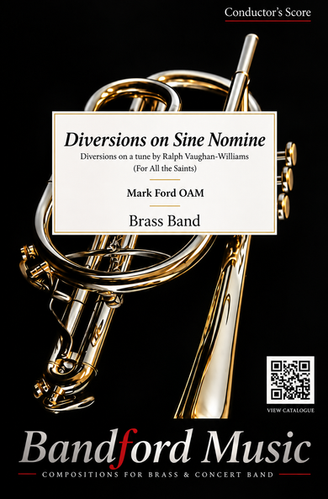
Diversions on Sine Nomine (Brass Band) Vaughan Williams arr. Mark Ford
Diversions on Sine Nomine is a substantial concert work for brass band, derived entirely from Ralph Vaughan Williams' celebrated hymn tune For All the Saints. Rather than a conventional set of variations, the work unfolds as a sequence of contrasting diversions, each reimagining aspects of the melody's character, harmony, and rhythmic potential. The opening establishes the noble and timeless quality of Sine Nomine before leading into episodes that explore a wide expressive range - from reflective and lyrical writing to passages of rhythmic energy and grandeur. Fragments of the hymn are continually transformed and re-contextualised, allowing the music to progress with clarity and purpose while maintaining a strong sense of structural coherence. Scored specifically with 3rd and 4th Section bands in mind, the work combines musical substance with practical playability. Idiomatic brass writing, transparent textures, and effective use of traditional band colours ensure musical impact without excessive technical demand. The final section brings the work to a broad and affirmative conclusion, reaffirming the dignity and enduring strength of Vaughan Williams' original melody. To view a rolling score video of the work please visit www.youtube.com/watch?v=Sth69ate-Cs Duration: 11.00 minutes Difficulty Level: 4th Section + This PDF download includes the full score and parts. Sheet music available at www.brassband.co.uk (UK) or https://satradecentral.org(USA) Instrumentation: Soprano Cornet Eb Solo Cornet 1&2 Bb Solo Cornet 3&4 Bb Repiano Cornet Bb 2nd Cornet Bb 3rd Cornet Bb Flugel Horn Bb Solo Horn Eb 1st Horn Eb 2nd Horn Eb 1st Baritone Bb 2nd Baritone Bb 1st Trombone Bb 2nd Trombone Bb Bass Trombone Euphonium Bb Bass Eb Bass Bb Timpani Percussion 1-2 Tuned Percussion
In Stock: Estimated dispatch 1-3 working days
-
 £37.35
Drink to me only (Flugel Solo with Brass Band) Trad. English Melody arr. Bowen
Enhance your solo repertoire with this evocative and timeless setting for flugel horn. Originally arranged for the New York Staff Band in 1991, this piece offers a lyrical and deeply expressive showcase for the soloist. This arrangement draws from a rich heritage, blending secular and sacred traditions. The melody, famously attributed to Colonel R. Mellish (1777-1817), is inspired by the classic 17th-century poem by Ben Johnson. Within The Salvation Army tradition, this beloved tune is paired with the sacred lyrics of William Drake Pennick, "There is a holy hill of God, its heights by faith I see" (The Salvation Army Song Book, No. 627), making it a versatile choice for both concert and worship settings. This setting is celebrated for its warm, melodic lines, perfectly suited to the mellow tonal qualities of the flugel horn. For those interested in studying the interpretation of this work, the New York Staff Band featured this arrangement on their 1992 recording, Under Three Flags (Triumphonic TRCD 1050). To view a rolling score video featuring Donald Spencer (Flugel Horn Soloist) with the New York Staff Band please visit: www.youtube.com/watch?v=ZRocgjTrli4 Sheet music available from: UK - www.brassband.co.uk USA - www.solidbrassmusic.com Difficulty Level: 4th Section + Instrumentation: Flugel Horn Soloist Bb Soprano Cornet Eb Solo Cornet Bb Repiano Cornet Bb 2nd Cornet Bb 3rd Cornet Bb Solo Horn Eb 1st Horn Eb 2nd Horn Eb 1st Baritone Bb 2nd Baritone Bb 1st Trombone Bb 2nd Trombone Bb Bass Trombone Euphonium Bb Bass Eb Bass Bb Timpani Glockenspiel
In Stock: Estimated dispatch 1-3 working days
-
 £37.35
Fallen Souls (Brass Band) Andrew Wainwright
Fallen Souls was the winner of Grimethorpe Colliery Band's 1st Annual Composition Competition in 2023. This depictive and impactful work explores the theme of human fallibility. The piece begins with a slow, yearnful introduction that depicts a fall from grace, represented by a horn solo that reflects the innate goodness of humanity. However, the music soon becomes more agitated and dissonant as it represents the temptations that can lead us astray. The opening reaches a climax of chaos and despair, as we are shown the devastating consequences of our choices. The following section depicts the temptations of humanity. The music is chaotic and seductive in this section, with regular time changes and rhythmic instability, representing the many temptations that surround us. The section ends with a sense of uncertainty, as we are left wondering whether we will succumb to these temptations. There is a reprise of the opening horn solo, and a return to the notion of human fallibility, but this time in extended form. Again there is a build toward chaos, and the music becomes more complex and textured, reflecting the complexity of the human journey. The work ends somewhat abruptly with a blaze, leaving the listener with a sense of both hope and uncertainty. To view a rolling score video featuring Grimethorpe Colliery Band please visit www.youtube.com/watch?v=rM-p8CjnYo0 Duration: 5.00 minutes approx. Difficulty Level: 1st Section + PDF download includes parts and score. Sheet music available from www.brassband.co.uk/sheet-music/fallen-souls-brass-band-andrew-wainwright-brookwright Instrumentation: Soprano Cornet Eb Solo Cornet Bb Repiano Cornet Bb 2nd Cornet Bb 3rd Cornet Bb Flugel Horn Bb Solo Horn Eb 1st Horn Eb 2nd Horn Eb 1st Baritone Bb 2nd Baritone Bb 1st Trombone Bb 2nd Trombone Bb Bass Trombone Euphonium Bb Bass Eb Bass BbTimpani Percussion 1-3
In Stock: Estimated dispatch 1-3 working days