
Results
-
 £99.95
Tribute to George Roberts - Bill Geldard
This publication includes Feelin' Low, Hall of the Mountain King and Stella by Starlight all for Bass Trombone with Brass Band.
Estimated dispatch 5-14 working days
-
 £112.08
All Tuned Up - 120 Famous Tunes for All Occasions (Full Set - A5) PDFs
This unique new resource from BrookWright Music will be an essential part of every band's library! All Tuned Up is designed to cater for ensembles for occasions throughout the year. Tunes are drawn from genres including Classical, Hymns, Folk and Patriotic amongst many others to form a comprehensive book that will cover a wide variety of events such as Weddings, Funerals, Graduation Ceremonies, Parties, Proms, Remembrance, Street Playing and Thanksgiving. Playable by as few as five players but also designed to work for full brass band or wind band, it features flexible parts in a wide variety of transpositions. These excellent arrangements have been expertly created by Andrew Wainwright, David E. Jones, Dean H. Jones and Steven Ponsford. The general harmonic format of All Tuned Up is in five parts, although additional notes have been included to thicken the harmony where more players are available. Therefore, the book will work equally well with larger groups, including full brass bands and wind bands. At the end of the Part 1 Bb book are four a capela tunes for Remembrance/Memorial occasions. To view a promotional video please visit https://www.youtube.com/watch?v=nmodRrXQRRs This PDF download is for International sizes: Full Score - A4 Size - 297mm x 210mm Band Parts - A5 Size - 210mm x 148mm Physical copies of the books available from: UK - Individual Books Full Set Brass Band Set USA - www.solidbrassmusic.com/product/all-tuned-up-ensemble-books The full set includes: Full Score Part 1 Eb (optional) - Soprano Cornet/Trumpet Eb, Clarinet Eb Part 1 Bb - Cornet/Trumpet Bb, Clarinet Bb, Flugel, Soprano Saxophone Part 1 C - Piccolo, Flute, Oboe, Part 2 Bb - Cornet/Trumpet, Clarinet Bb, Flugel Part 2 Eb - Tenor Horn, Alto Saxophone, Alto Clarinet Eb Part 2 F - Horn, Cor Anglais Part 3 Bb - Baritone, Trombone, Euphonium, Tenor Saxophone, Part 3 C (Bass clef) - Baritone, Trombone, Euphonium Part 3 Eb - Tenor Horn, Alto Saxophone, Alto Clarinet Eb Part 3 F - Horn, Cor Anglais Part 4 Bb - Euphonium, Baritone, Tenor Saxophone Part 4 C (Bass clef) - Euphonium, Baritone, Bassoon Part 5 Eb - Bass Eb, Baritone Saxophone Part 5 Bb - Bass Bb, Bass Clarinet Part 5 C (Bass clef) - Tuba, Bassoon, String Bass Percussion (optional) - Various
In Stock: Estimated dispatch 1-3 working days
-
£112.08
All Tuned Up - 120 Famous Tunes for All Occasions (Full Set - US Sizes) PDFs
This unique new resource from BrookWright Music will be an essential part of every band's library! All Tuned Up is designed to cater for ensembles for occasions throughout the year. Tunes are drawn from genres including Classical, Hymns, Folk and Patriotic amongst many others to form a comprehensive book that will cover a wide variety of events such as Weddings, Funerals, Graduation Ceremonies, Parties, Proms, Remembrance, Street Playing and Thanksgiving. Playable by as few as five players but also designed to work for full brass band or wind band, it features flexible parts in a wide variety of transpositions. These excellent arrangements have been expertly created by Andrew Wainwright, David E. Jones, Dean H. Jones and Steven Ponsford. The general harmonic format of All Tuned Up is in five parts, although additional notes have been included to thicken the harmony where more players are available. Therefore, the book will work equally well with larger groups, including full brass bands and wind bands. At the end of the Part 1 Bb book are four a capela tunes for Remembrance/Memorial occasions. To view a promotional video please visit https://www.youtube.com/watch?v=nmodRrXQRRs This PDF download is for US sizes: Full Score - Letter Size - 11" x 8.5" Band Parts - 7" x 5" Physical copies of the books available from: UK - Individual Books Full Set Brass Band Set USA - www.solidbrassmusic.com/product/all-tuned-up-ensemble-books The full set includes: Full Score Part 1 Eb (optional) - Soprano Cornet/Trumpet Eb, Clarinet Eb Part 1 Bb - Cornet/Trumpet Bb, Clarinet Bb, Flugel, Soprano Saxophone Part 1 C - Piccolo, Flute, Oboe, Part 2 Bb - Cornet/Trumpet, Clarinet Bb, Flugel Part 2 Eb - Tenor Horn, Alto Saxophone, Alto Clarinet Eb Part 2 F - Horn, Cor Anglais Part 3 Bb - Baritone, Trombone, Euphonium, Tenor Saxophone, Part 3 C (Bass clef) - Baritone, Trombone, Euphonium Part 3 Eb - Tenor Horn, Alto Saxophone, Alto Clarinet Eb Part 3 F - Horn, Cor Anglais Part 4 Bb - Euphonium, Baritone, Tenor Saxophone Part 4 C (Bass clef) - Euphonium, Baritone, Bassoon Part 5 Eb - Bass Eb, Baritone Saxophone Part 5 Bb - Bass Bb, Bass Clarinet Part 5 C (Bass clef) - Tuba, Bassoon, String Bass Percussion (optional) - Various
In Stock: Estimated dispatch 1-3 working days
-
£11.95
All Tuned Up - 120 Famous Tunes for All Occasions (International Size) Hard Copy
This unique new resource from BrookWright Music will be an essential part of every band's library! All Tuned Up is designed to cater for ensembles for occasions throughout the year. Tunes are drawn from genres including Classical, Hymns, Folk and Patriotic amongst many others to form a comprehensive book that will cover a wide variety of events such as Weddings, Funerals, Graduation Ceremonies, Parties, Proms, Remembrance, Street Playing and Thanksgiving. Playable by as few as five players but also designed to work for full brass band or wind band, it features flexible parts in a wide variety of transpositions. These excellent arrangements have been expertly created by Andrew Wainwright, David E. Jones, Dean H. Jones and Steven Ponsford. The general harmonic format of All Tuned Up is in five parts, although additional notes have been included to thicken the harmony where more players are available. Therefore, the book will work equally well with larger groups, including full brass bands and wind bands. At the end of the Part 1 Bb book are four a capela tunes for Remembrance/Memorial occasions. To view a promotional video please visit www.youtube.com/watch?v=nmodRrXQRRs This purchase is for International sizes: Full Score - A4 Size - 297mm x 210mm Band Parts - A5 Size - 210mm x 148mm The full set includes: Full Score Part 1 Eb (optional) - Soprano Cornet/Trumpet Eb, Clarinet Eb Part 1 Bb - Cornet/Trumpet Bb, Clarinet Bb, Flugel, Soprano Saxophone Part 1 C - Piccolo, Flute, Oboe, Part 2 Bb - Cornet/Trumpet, Clarinet Bb, Flugel Part 2 Eb - Tenor Horn, Alto Saxophone, Alto Clarinet Eb Part 2 F - Horn, Cor Anglais Part 3 Bb - Baritone, Trombone, Euphonium, Tenor Saxophone, Part 3 C (Bass clef) - Baritone, Trombone, Euphonium Part 3 Eb - Tenor Horn, Alto Saxophone, Alto Clarinet Eb Part 3 F - Horn, Cor Anglais Part 4 Bb - Euphonium, Baritone, Tenor Saxophone Part 4 C (Bass clef) - Euphonium, Baritone, Bassoon Part 5 Eb - Bass Eb, Baritone Saxophone Part 5 Bb - Bass Bb, Bass Clarinet Part 5 C (Bass clef) - Tuba, Bassoon, String Bass Percussion (optional) - Various
In Stock: Estimated dispatch 1-3 working days
-
 £15.00
My Love is Like a Red, Red Rose - Helen Douthwaite
Robert Burns' beautiful melody is brought to life as a euphonium solo with brass band accompaniment in this simple, yet highly effective, arrangement by Helen Douthwaite.Originally arranged by Helen for the Kirkintilloch Youth Band, the piece not only features the soloist with a carefully crafted, accessible solo line, but also enables the rest of the band to shine through the tutti elements.Set includes score and parts for:Solo CornetRepiano Cornet2nd Cornet3rd CornetFlugelhornSolo Eb Tenor Horn1st Eb Tenor Horn2nd Eb Tenor Horn1st Baritone2nd Baritone1st Trombone2nd TromboneBass TromboneEuphoniumEb BassBb Bass (optional)GlockenspielPercussionAdditional world parts also provided include F Horn 1/2/3, Baritone 1/2 in bass clef, Trombone 1/2 in bass clef, Euphonium in bass clef, Tuba.
In Stock: Estimated dispatch 3-5 working days
-
 £11.50
THE BIG WIG WAM (score) - Hazelgrove, Bernard (1945-2004)
score shows Bb, Bb, Eb, bass clef, bass clef, bass clef and percussion, but set contains transcribed parts for brass band brass and orchestral brass.
In Stock: Estimated dispatch 1-3 working days
-
 £37.50
THE BIG WIG WAM (score & parts) - Hazelgrove, Bernard (1945-2004)
score shows Bb, Bb, Eb, bass clef, bass clef, bass clef and percussion, but set contains transcribed parts for brass band brass and orchestral brass.
In Stock: Estimated dispatch 1-3 working days
-
 £30.00
Slavonic Basses - Tim Paton
A feature for the Bass Section with Brass Band. This is a chance for the bass section to display their talent!A short introduction for the four basses on their own. Then, after this humourous introduction, the piece immediately moves into the Cossack style music, where the bass section play a major part. Great fun for both band and audience!
In Stock: Estimated dispatch 3-5 working days
-
 £39.95
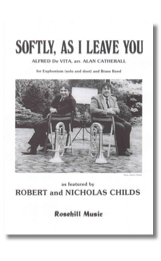
Softly, As I Leave You - Alfred de Vita arr. Alan Catherall
Made popular by many singers over the years, this lovely song was first arranged for the Childs brothers as a solo, and later a duet, by Alan Catherall. It was first performed in the duet version at the Royal Albert Hall, London, in October 1985, conducted by their late father, John Childs. Also available with piano Brass Band Set comprises: Detailed condensed conductor score Solo B-flat Euphonium B-flat Euphonium Duet (2) E-flat Soprano Cornet Solo B-flat Cornet (4) 2nd B-flat Cornet (2) 3rd B-flat Cornet (2) B-flat Flugelhorn* Solo E-flat Horn* 1st E-flat Horn* 2nd E-flat Horn 1st B-flat Baritone 2nd B-flat Baritone 1st B-flat Trombone 2nd B-flat Trombone Bass Trombone B-flat Euphonium (2) E-flat Bass (2) B-flat Bass (2) 1st Percussion 2nd Percussion 3rd Percussion (Drum Kit) * Alternative parts for use as solo or duet provided. There is no Repiano Cornet part.
Estimated dispatch 7-9 working days
-
 £29.95
Fanfare of a Nation - Christopher Bond
Fanfare of a Nation (2012) was commissioned by the Greater Gwent Youth Brass Ensemble as a short fanfare originally for ten players, and was performed in the presence of HM Queen Elizabeth II & The Duke of Edinburgh on the occasion of their visit to Wales to mark the Diamond Jubilee last year, under its original title The Royal Diamond Jubilee Fanfare. Since arranged for brass band and performed throughout the UK including by Black Dyke Band in Cardiff, this short work mesmerizes, dazzles and utilizes the fanfare effects so often associated with the brass family. Available to purchase for Brass Band or Brass Ensemble (10 players plus 1 percussion). The brass ensemble version is scored as follows: 4 x Trumpets, 1 x Horn in F, 3 x Tenor Trombones, 1 x Bass Trombone, 1 x Tuba, 1 x Percussion. Trumpet 1 is supplied in both E-flat & B-flat, Horn in F is supplied in E-flat, Tenor Trombone and Tuba parts are supplied in both bass and treble clef.
Estimated dispatch 10-14 working days