
Results
-
 £29.88
Fanfare from La Peri(Brass Band) Dukas arr. Rob Bushnell
La Peri is a one-act ballet by the French composer Paul Dukas, best known for The Sorcerer's Apprentice (L'apprenti sorcier) as in the 1940 Disney film Fantasia. Dukas was commissioned to write La Peri by the Ballets Russes, producing a Poeme danse en un tableau ('dance poem in one scene') in 1911; this become his last published work. With Natalia Trouhanova due to play the Peri and Vaslav Nijinsky to play Iskender (the name of Alexander the Great in Persian, who is scouting around Iran in search of the Flower of Immortality), the production was ultimately cancelled because Serge Diaghilev feel Trouhanova was not a skilled enough dancer to be partnered to Nijinsky. Trouhanova later hired Ivan Clustine to choreograph the music, with the ballet premiering at the Theatre du Chatelet in Paris on 22 April 1912.The brilliant fanfare that precedes the ballet is often performed separately and is the arrangement available here. Arranged for British-style brass band, it has optional percussion parts as well as alternative parts for horns in F and bass-clef lower brass. The piece has been lowered by a tone compared to the original. A recording of the original composition can be found here: www.youtube.com/watch?v=7EDekMos1ok. Duration: Approx. 2 minutes Difficulty Level: 2nd Section + Duration: 4 or 5 minutes (depending on tempo and without any cuts) PDF download includes parts and score. Sheet music available at www.brassband.co.uk (UK) or https://satradecentral.org (USA) Instrumentation: Soprano Cornet Eb Solo Cornet Bb Repiano Cornet Bb 2nd Cornet Bb 3rd Cornet Bb Flugel Horn Bb Solo Horn Eb 1st Horn Eb 2nd Horn Eb 1st Baritone Bb 2nd Baritone Bb 1st Trombone Bb 2nd Trombone Bb Bass Trombone Euphonium Bb Bass Eb Bass Bb Timpani Percussion 1 - Snare Drum Percussion 2 - Bass Drum & Cymbal
In Stock: Estimated dispatch 1-3 working days
-
 £33.62
Fanfare of Joy - Brass Band (Andrew Wainwright)
Fanfare of Joy was commissioned by the Burbage Band (Buxton) and its conductor Steven Critchlow in 2017. Based on Joy to the World and The First Nowell, this spectacular work opens with a majestic brass fanfare, before breaking in a Celtic-style dance which builds to a dramatic conclusion. The fanfare opening serves to announce the arrival of something special. In this case, the fanfare announces the arrival of Christmas, a time of joy and celebration. The Celtic-style dance is a lively and energetic movement that captures the spirit of Christmas. The music is full of syncopated rhythms and intricate melodies, driven by percussion. The final movement of the piece is a dramatic conclusion that brings the work to a rousing finish. The music is full of excitement and energy, and a fitting celebration of the Christmas season. To view a video of Dallas Brass Band performing the work please visit https://www.youtube.com/watch?v=CHl_oj1A-E8 PDF download includes score and full set of parts. Additional transposing parts for Horns in F, and Baritones, Trombones, Euphonium and Tubas in Bass Clef are available here. Sheet music available exclusively from World of Brass - www.worldofbrass.com Difficulty Level: 1st Section + Instrumentation: Soprano Cornet Eb Solo Cornet Bb Repiano Cornet Bb 2nd Cornet Bb 3rd Cornet Bb Flugel Horn Bb Solo Horn Eb 1st Horn Eb 2nd Horn Eb 1st Baritone Bb 2nd Baritone Bb 1st Trombone Bb 2nd Trombone Bb Bass Trombone Euphonium Bb Bass Eb Bass Bb Timpani Percussion 1-3
In Stock: Estimated dispatch 1-3 working days
-
 £33.62
Finale - Suite No.3 (Brass Band) Tchaikovsky arr. Ruben Schmidt
This arrangement by Ruben Schmidt is the exciting polonaise finale from the last movement of Tchaikovsky's thrilling Suite No.3 in G Major for Orchestra. This was first performed in Saint Petersburg on January 12th, 1885, at the fifth symphony concert of the Russian Musical Society, conducted by Hans von Bulow. The suite also was Tchaikovsky's first American success when it was performed by the New York Symphony Society at Carnegie Hall on May 7,1891. First intended as its own symphony, it became the most played and most successful of Tchaikovsky's four suites. The finale of the last movement is an invigorating polonaise dance to finish the suite. Tchaikovsky often enjoyed conducting this final movement as an independent work himself. To view a rolling score video of the work please visit www.youtube.com/watch?v=M-Ht80Lnk-c Duration: 4.00 minutes Difficulty Level: 1st Section + PDF download includes parts and score. Sheet music available here. Instrumentation: Soprano Cornet Eb Solo Cornet Bb Repiano Cornet Bb 2nd Cornet Bb 3rd Cornet Bb Flugel Horn Bb Solo Horn Eb 1st Horn Eb 2nd Horn Eb 1st Baritone Bb 2nd Baritone Bb 1st Trombone Bb 2nd Trombone Bb Bass Trombone Euphonium Bb Bass Eb Bass BbTimpani Percussion (Tambourine, Suspended Cymbal & Bass Drum)
In Stock: Estimated dispatch 1-3 working days
-
 £33.62
Jingle Bells Forever (Brass Band) Pierpont/Sousa/Smith arr. Lythaby
Jingle Bells Forever is a setting of two American favourites that weaves the melodic line from Pierpont's Jingle Bells with Sousa's umistakable march style. Drawn from The Stars and Stripes Forever, Sousa's immortal march that has become the official national march of the United States of America, the familiar strains provide the perfect accompaniment for the most festive of Christmas melodies. Sousa's famous grandioso with the piccolo descant (here scored for soprano cornet) and trombone countermelody draw this festive standard to a rousing conclusion. PDF download includes score and parts. Sheet music available from: UK - www.brassband.co.uk USA - www.solidbrassmusic.com Difficulty Level: 4th Section + Instrumentation: Soprano Cornet Eb Solo Cornet Bb Repiano Cornet Bb 2nd Cornet Bb 3rd Cornet Bb Flugel Horn Bb Solo Horn Eb 1st Horn Eb 2nd Horn Eb 1st Baritone Bb 2nd Baritone Bb 1st Trombone Bb 2nd Trombone Bb Bass Trombone Euphonium Bb Bass Eb Bass Bb Timpani Drum Set Cymbals Sleigh Bells Glockenspiel
In Stock: Estimated dispatch 1-3 working days
-
 £33.62
March - Helping Hands (Rob Bushnell) Brass Band
Helping Hands was written for the British Bandsman March Composition Contest, entered into category 2 (marches for 3rd/4th section bands). The piece is loosely programmatic in nature: The introductio is fanfare-like, announcing the date of the next Whit Friday Contests and the bands' anticipation of and preparation for the event. The first section is the march of the volunteers, as they descend upon the many venues, ready to run the contests. The second section (bars 35 to 52) sees the contests start. The bands strike up, march, finish and go from place to place, whilst the volunteers manage them, the audiences, and all manner of issues and problems thrown at them. The third section (bars 53 to 69) represents the bad weather which has, at times, presented itself on that particular Friday. But everyone carries on (possibly the sun comes out) and we enjoy the day. The trio uses the hymn St. Vincent by Sigismund Neukomm: St. Vincent de Paul is the patron saint of charities and volunteering, hence its use here. The piece is influenced by marches that are commonly heard during the Whit Friday March Contests, using motifs, rhythms and harmonic progressions (sparingly) throughout the piece. March-card sized parts included, with alternatives for horns in F and lower brass in bass clef. To view a rolling score video of the piece please visit www.youtube.com/watch?v=diqDoe0XpcA PDF download includes score and parts. Sheet music available from: UK - www.brassband.co.uk USA - https://satradecentral.org Difficulty Level: 3rd Section + Length: 3.50 minutes Instrumentation: Soprano Cornet Eb Solo Cornet Bb Repiano Cornet Bb 2nd Cornet Bb 3rd Cornet Bb Flugel Horn Bb Solo Horn Eb 1st Horn Eb 2nd Horn Eb 1st Baritone Bb 2nd Baritone Bb 1st Trombone Bb 2nd Trombone Bb Bass Trombone Euphonium Bb Bass Eb Bass Bb Drums
In Stock: Estimated dispatch 1-3 working days
-
 £33.62
O Little One Sweet (Brass Band) J.S Bach arr. Andrew Wainwright
This delightful German lullaby-carol first appeared in print in Samuel Scheidt's Tablaturbuch of 1650, though it may have been written before then, either by Scheidt himself or by an unknown author. J. S. Bach's version (in the form of a melody and figured bass) was included in Schemelli's Gesangbuch of 1736, and it is that which this arrangement for brass band by Andrew Wainwright is based on. This setting includes all four verses. To view a rolling score video of the work please visit https://www.youtube.com/watch?v=YryayLe_uJo Duration: Approx. 3.45 minutes Difficulty Level: 4th Section + PDF download includes parts and score. Sheet music available from www.brassband.co.uk (UK) or https://satradecentral.org (USA) Instrumentation: Soprano Cornet Eb Solo Cornet Bb Repiano Cornet Bb 2nd Cornet Bb 3rd Cornet Bb Flugel Horn Bb Solo Horn Eb 1st Horn Eb 2nd Horn Eb 1st Baritone Bb 2nd Baritone Bb 1st Trombone Bb 2nd Trombone Bb Bass Trombone Euphonium Bb Bass Eb Bass BbTimpani
In Stock: Estimated dispatch 1-3 working days
-
 £37.35
Polonaise from 'Scenes de Ballet' (Brass Band) Glazunov arr. Rob Bushnell
Alexander Glazunov was a Russian composer who was a gifted musician from childhood. He was seen as the natural heir to the nationalist revolution that had started with the Mighty Handful. Despite quickly turning from this to absolute forms of music, taking a keen interest in ballet music, his compositions still alludes to Russian folk tunes. He wrote four dance compositions, of which Scenes de Ballet was the first in 1894. The suite Scenes de Ballet, opus 52 has eight movements and was dedicated to the orchestra of the Russian Opera, St Petersburg. First performed in 1895 at a concert of the Imperial Music Society with Glazunov conducting. This arrangement of the final movement is for the British-style brass band, with alternative parts for horns in F and bass-clef lower brass. A recording of the original composition can be found here: https://www.youtube.com/watch?v=BS-Yx-bmxPg Duration: approx. 5.20 minutes Difficulty Level: 2nd Section + PDF download includes parts and score. Sheet music available at www.brassband.co.uk (UK) or https://satradecentral.org (USA) Instrumentation: Soprano Cornet Eb Solo Cornet Bb Repiano Cornet Bb 2nd Cornet Bb 3rd Cornet Bb Flugel Horn Bb Solo Horn Eb 1st Horn Eb 2nd Horn Eb 1st Baritone Bb 2nd Baritone Bb 1st Trombone Bb 2nd Trombone Bb Bass Trombone Euphonium Bb Bass Eb Bass Bb Timpani Percussion 1 - Snare Percussion 2 - Triangle, Cymbal & Bass Drum
In Stock: Estimated dispatch 1-3 working days
-
 £33.62
Prelude in C-sharp Minor (Brass Band) Rachmaninoff arr. Rob Bushnell
One of Sergei Rachmaninoff's most famous compositions, Prelude in C-sharp minor (Op. 3, No. 2) is part of a set of five pieces entitled Morceaux de fantaisie. It was written when Rachmaninoff was only 19 years old and was first performance by the composer on 26 September 1892 at a festival called the Moscow Electrical Exhibition. This arrangement is for the UK-style brass band, with alternative parts for horns in F and bass-clef lower brass. The piece has been transposed from the original (for piano) of C-sharp minor to A minor, which better suits a brass band. There is another arrangement of this piece by Sandy Smith (published by Obrasso) which is designed for more advanced ensembles. A recording of the original composition can be found here: www.youtube.com/watch?v=mXGSfJn3nKQ Duration: Approx. 3.40 minutes Difficulty Level: 3rd Section + PDF download includes parts and score. Also includes alternative parts for horns in F and lower brass in bass clef. Sheet music available from www.brassband.co.uk Instrumentation: Soprano Cornet Eb Solo Cornet Bb Repiano Cornet Bb 2nd Cornet Bb 3rd Cornet Bb Flugel Horn Bb Solo Horn Eb 1st Horn Eb 2nd Horn Eb 1st Baritone Bb 2nd Baritone Bb 1st Trombone Bb 2nd Trombone Bb Bass Trombone Euphonium Bb Bass Eb Bass Bb Percussion 1-3
In Stock: Estimated dispatch 1-3 working days
-
 £37.35
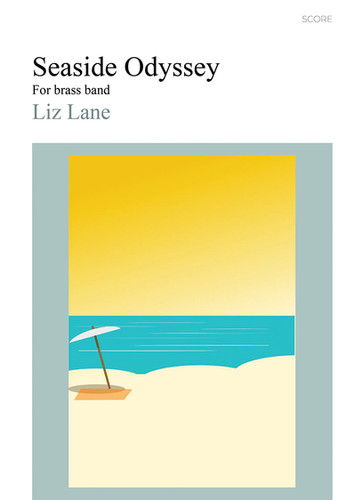
Seaside Odyssey (Brass Band) Liz Lane
Seaside Odyssey is a celebration of the British seaside! The music represents a juxtaposition between natural and manmade elements; there are two main musical themes - the reflective sea (a wordless setting of John Masefield's Sea Fever) and a more lively 'seaside' theme, heard separately in different ways and later together. From childhood memories, sand, beach and cliffs to cafes, ice creams, fish and chips, buckets and spades, boating trips, beach huts, bandstands, piers, theatres, gardens, mini golf, arcades and more, Seaside Odyssey is a journey from dawn to dusk with the sea at the heart of the music. This work was commissioned by Grimethorpe Colliery Band for its seaside tour, August 2023, where it performed at Paignton, Lyme Regis, Weymouth, Shanklin and Herne Bay. Includes optional poems and words specially curated from poets associated with the seaside towns, which can be read before a performance. Duration: approx. 5 minutes This PDF download includes parts and score. Sheet music available at www.brassband.co.uk (UK) or https://satradecentral.org (USA) Instrumentation: Eb Soprano Cornet Bb Solo Cornet Bb Repiano Cornet Bb Cornet 2 Bb Cornet 3 Bb Flugelhorn Eb Solo Tenor Horn Eb Tenor Horn 1 Eb Tenor Horn 2 Bb Baritone 1 Bb Baritone 2 Bb Trombone 1 Bb Trombone 2 Bass Trombone Bb Euphonium Eb Bass Bb Bass Percussion 1: timpani, triangle and optional 'arcade jackpot' effect (see score/part) Percussion 2: 3 suspended cymbals (2 ride, 1 crash) and hi-hat Percussion 3: snare, tom-toms and bass drum Percussion 4: glockenspiel
In Stock: Estimated dispatch 1-3 working days
-
 £33.62
The Piano Preludes (Brass Band) George Gershwin arr. Rob Bushnell
First performed by the composer at the Roosevelt Hotel in New York in 1926, The Piano Preludes (or Three Preludes) are a collection of short pieces by George Gershwin, show casing early-20th-century American classical music, as influenced by jazz. Gershwin originally planned to compose 24 preludes, wrote seven, performed only six publically and was further reduced to three when first published. The work was dedicated to friend and musical advisor Bill Daly. The first prelude begins with a five-note blues motif. It features syncopated rhythms based on the Brazilian baiao and minor-seventh chords throughout. The second prelude, which Gershwin said was "a sort of blues lullaby" consists of two sections: the first a "lazy" melody upon a steady beat of crotchets; the second the bass takes the melody, continuing with the steady beats. The third prelude was called "Spanish" by Gershwin, and features a question-and-answer type melody, starting in a minor tonality and ending in major one. This arrangement is for the British-style brass band, with alternative parts for horns in F and bass-clef lower brass. To view a follow-the-score video please visit www.youtube.com/watch?v=XqIQ0j1SWlc PDF download includes score and parts. Sheet music available from: UK - www.brassband.co.uk USA - www.solidbrassmusic.com Difficulty Level: 1st Section + Instrumentation: Soprano Cornet Eb Solo Cornet Bb Repiano Cornet Bb 2nd Cornet Bb 3rd Cornet Bb Flugel Horn Bb Solo Horn Eb 1st Horn Eb 2nd Horn Eb 1st Baritone Bb 2nd Baritone Bb 1st Trombone Bb 2nd Trombone Bb Bass Trombone Euphonium Bb Bass Eb Bass Bb Timpani Drum Kit Mallet Percussion
In Stock: Estimated dispatch 1-3 working days
 Watch video