
Results
-
 £74.72
Mind Dances (Brass Band) Fendall Hill
This highly descriptive and personal work for brass band is autobiographical, and based on a seven-year period of the composer Fendall Hill's life. He comments: "...external events had severe personal consequences, and my previously self assured self woke in the early mornings, way before my body wanted. My mind would fret, regret, and attempt to fix things beyond my control or powers, carving out an anxiety-shaped hole in my soul. This piece is an exploration of the sheer range of thought processes I went through, the mind dances I would perform to either calm myself back to sleep, or somehow come to terms with my situation. So often I would get to the point of mental exhaustion after phases of semi-calm, imagined alternate realities, and sheer panic. Your mind knows there is no benefit to worrying, but that doesn't stop the flow of emotions, the fear, and the anxiety." To view a performance video of the work please visit www.youtube.com/watch?v=pUhy33KKCKY&t=3s PDF download includes score and parts. Sheet music available from: UK - www.brassband.co.uk USA - https://satradecentral.org Difficulty Level: First Section + Length: 15.00 minutes Instrumentation: Soprano Cornet Eb Solo Cornet Bb Repiano Cornet Bb 2nd Cornet Bb 3rd Cornet Bb Flugel Horn Bb Solo Horn Eb 1st Horn Eb 2nd Horn Eb 1st Baritone Bb 2nd Baritone Bb 1st Trombone Bb 2nd Trombone Bb Bass Trombone Euphonium Bb Bass Eb Bass Bb Timpani Percussion Vibraphone Marimba
In Stock: Estimated dispatch 1-3 working days
-
 £33.62
O Holy Night (Flugel Solo with Brass Band) arr. Kevin Larsson
VIEW SCORE PDF O Holy Night, also known as Cantique de Noel, was originally based on a poem by Placide Cappeau before being set to music by Adople Adam. This carol has become a favourite to many, being performed all over the world in various styles and forms. This jazz-style arrangement for flugel horn and brass band was written for John Docter for The Salvation Army's Night of Wonder Carol Service in Los Angeles. To view a performance video please visit: www.youtube.com/watch?v=tMobVKBLmMY Sheet music available from: UK - www.brassband.co.uk USA - www.solidbrassmusic.com Difficulty Level: 3rd Section + Instrumentation: Flugel Horn Soloist Bb Soprano Cornet Eb Solo Cornet Bb 1st Cornet Bb 2nd Cornet Bb Solo Horn Eb 1st Horn Eb 2nd Horn Eb 1st Baritone Bb 2nd Baritone Bb 1st Trombone Bb 2nd Trombone Bb Bass Trombone Euphonium Bb Bass Eb Bass Bb Timpani Drum Kit Percussion Bongos
In Stock: Estimated dispatch 1-3 working days
-
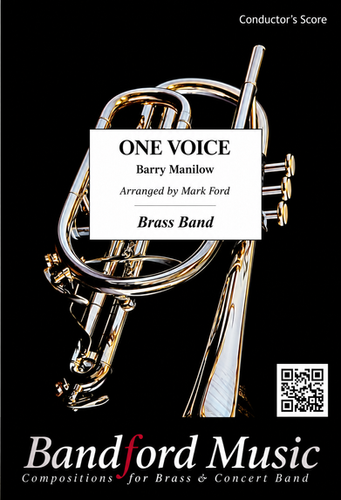 £33.62
One Voice (Brass Band) Barry Manilow arr. Mark Ford
Originally released in 1979 as the title track of Barry Manilow's sixth studio album, One Voice has become an enduring anthem for unity and social courage. It is a stirring ballad that reminds us how a single, brave voice can ignite a chorus of solidarity and lead the way toward positive change. Expertly crafted for brass band by Mark Ford, this setting captures the intimate, soaring spirit of the original while leveraging the unique textures of the brass band. The piece begins with a delicate, lyrical flugel horn solo, representing the 'single voice' of the title. As the arrangement progresses, the rest of the ensemble joins in, building from a gentle accompaniment into a magnificent, wall-of-sound finale that is sure to leave your audience inspired. To view a rolling score video of the work please visit https://youtu.be/RcQ5xbnyNjs Duration: Approx. 3.15 minutes Difficulty Level: 4th Section + This PDF download includes the full score and parts. Sheet music available at www.brassband.co.uk (UK) or https://satradecentral.org (USA) Instrumentation: Soprano Cornet Eb Solo Cornet Bb Repiano Cornet Bb 2nd Cornet Bb 3rd Cornet Bb Flugel Horn Bb Solo Horn Eb 1st Horn Eb 2nd Horn Eb 1st Baritone Bb 2nd Baritone Bb 1st Trombone Bb 2nd Trombone Bb Bass Trombone Euphonium Bb Bass Eb Bass Bb Timpani Glockenspiel Percussion
In Stock: Estimated dispatch 1-3 working days
-
 £67.24
Overture - The Flying Dutchman (Brass Band) Wagner arr. Keith M. Wilkinson
The opera The Flying Dutchman (Der Fliegende Hollander) was first performed in Dresden in 1843, conducted by the composer, who had also written the libretto, and 27 years later became Wagner's first opera to be performed in London. The opera describes the search of a Dutch sea-captain for a woman who will be faithful to him. The very popular overture encapsulates much of the story-line of the opera, including the wild swirling ocean, a strong motif depicting the hero and tender music associated with Senta, the lady he seeks. This brass band arrangement was initially prepared for the 50th anniversary in 1983 of the GUS Band, which the arranger was successfully directing at the time. Difficulty Level: 1st Section + Sheet music available from: UK - www.brassband.co.uk USA - www.solidbrassmusic.com Instrumentation: Soprano Cornet Eb Solo Cornet Bb Repiano Cornet Bb 2nd Cornet Bb 3rd Cornet Bb Flugel Horn Bb Solo Horn Eb 1st Horn Eb 2nd Horn Eb 1st Baritone Bb 2nd Baritone Bb 1st Trombone Bb 2nd Trombone Bb Bass Trombone Euphonium Bb Bass Eb Bass Bb Timpani Percussion 1-2
In Stock: Estimated dispatch 1-3 working days
-
 £33.62
Prelude in C-sharp Minor (Brass Band) Rachmaninoff arr. Rob Bushnell
One of Sergei Rachmaninoff's most famous compositions, Prelude in C-sharp minor (Op. 3, No. 2) is part of a set of five pieces entitled Morceaux de fantaisie. It was written when Rachmaninoff was only 19 years old and was first performance by the composer on 26 September 1892 at a festival called the Moscow Electrical Exhibition. This arrangement is for the UK-style brass band, with alternative parts for horns in F and bass-clef lower brass. The piece has been transposed from the original (for piano) of C-sharp minor to A minor, which better suits a brass band. There is another arrangement of this piece by Sandy Smith (published by Obrasso) which is designed for more advanced ensembles. A recording of the original composition can be found here: www.youtube.com/watch?v=mXGSfJn3nKQ Duration: Approx. 3.40 minutes Difficulty Level: 3rd Section + PDF download includes parts and score. Also includes alternative parts for horns in F and lower brass in bass clef. Sheet music available from www.brassband.co.uk Instrumentation: Soprano Cornet Eb Solo Cornet Bb Repiano Cornet Bb 2nd Cornet Bb 3rd Cornet Bb Flugel Horn Bb Solo Horn Eb 1st Horn Eb 2nd Horn Eb 1st Baritone Bb 2nd Baritone Bb 1st Trombone Bb 2nd Trombone Bb Bass Trombone Euphonium Bb Bass Eb Bass Bb Percussion 1-3
In Stock: Estimated dispatch 1-3 working days
-
 £37.35
Resilience (Brass Band) Andrew Wainwright
Resilience was composed by Andrew Wainwright for the River City Brass Band Composer Competition 2022, later being awarded first prize. The work celebrates the band's short but rich history, with a particular focus on the determination it has shown, like so many bands around the world, to continue its tradition of musical excellence despite the unprecedented challenges of the pandemic that led to an extended hiatus in music making. To view a video of River City Brass performing the work please visit www.youtube.com/watch?v=6y_MEm2eEeQ PDF download includes score and parts. Sheet music available from: UK - www.brassband.co.uk USA - www.solidbrassmusic.com Difficulty Level: 1st Section + Instrumentation: Soprano Cornet Eb Solo Cornet Bb Repiano Cornet Bb 2nd Cornet Bb 3rd Cornet Bb Flugel Horn Bb Solo Horn Eb 1st Horn Eb 2nd Horn Eb 1st Baritone Bb 2nd Baritone Bb 1st Trombone Bb 2nd Trombone Bb Bass Trombone Euphonium Bb Bass Eb Bass Bb Percussion 1-3
In Stock: Estimated dispatch 1-3 working days
-
 £33.62
Spanish Dance - Brass Band (Traditional arr. Andrew Wainwright)
Based on the traditional Spanish carol 'Riu Riu Chiu', this exciting foot-tapping item was premiered at Butlins Mineworkers Championships in 2010. Recorded on Virtuosi GUS Band's CD 'Christmas Fantasia - The Music of Andrew Wainwright', it has since proved to be a popular concert item. "Spanish Dance winds up to a whirlwind climax with a respectful nod in the direction of Morley Calvert's 'Canadian Folk Song Suite' - very clever." Paul Hindmarsh, British Bandsman magazine For a follow-the-score video of this work please visit: https://www.youtube.com/watch?v=jjskWuOH_YU Includes score and full set of parts. Sheet music available exclusively from World of Brass - www.worldofbrass.com Difficulty Level: 1st Section + Instrumentation: Soprano Cornet Eb Solo Cornet Bb Repiano Cornet Bb 2nd Cornet Bb 3rd Cornet Bb Flugel Horn Bb Solo Horn Eb 1st Horn Eb 2nd Horn Eb 1st Baritone Bb 2nd Baritone Bb 1st Trombone Bb 2nd Trombone Bb Bass Trombone Euphonium Bb Bass Eb Bass Bb Timpani Percussion 1-2
In Stock: Estimated dispatch 1-3 working days
-
 £33.62
The Music of Living - Brass Band (Dan Forrest arr. Andrew Wainwright)
The Music of Living is an exhilarating brass band arrangement by Andrew Wainwright of Dan Forrest's renowned choral masterpiece. Teeming with vibrant joy and an unshakeable optimism for life, this adaptation seamlessly translates the radiant energy and lush textures of the original vocal work into the rich, powerful sonic palette of the brass band. Characterized by driving rhythmic momentum, soaring melodic lines, and brilliant fanfare-like flourishes, this high-energy work serves as a spectacular showcase for every section of the ensemble. To view a rolling score video please visit https://youtu.be/6CCVRUJwhUA This PDF download includes score and full set of parts. Difficulty Level: 1st Section + Sheet music available exclusively from World of Brass - www.worldofbrass.com Instrumentation: Soprano Cornet Eb Solo Cornet Bb Repiano Cornet Bb 2nd Cornet Bb 3rd Cornet Bb Flugel Horn Bb Solo Horn Eb 1st Horn Eb 2nd Horn Eb 1st Baritone Bb 2nd Baritone Bb 1st Trombone Bb 2nd Trombone Bb Bass Trombone Euphonium Bb Bass Eb Bass Bb Timpani Percussion 1-2
In Stock: Estimated dispatch 1-3 working days
-
 £33.62
The Twelve Days of Christmas - Brass Band (Trad. arr. Andrew Wainwright)
This innovative arrangement by Andrew Wainwright of 'The Twelve Days of Christmas' features all 12 verses and will work well either as a standalone brass band piece, or with audience participation. To view a video of The Illinois Brass Band performing the work please visit www.youtube.com/watch?v=VPhk60_6E0U Includes score and full set of parts. Difficulty Level: 2nd Section + Length: 4.45 minutes Sheet music available from World of Brass - www.worldofbrass.com Instrumentation: Soprano Cornet Eb Solo Cornet Bb Repiano Cornet Bb 2nd Cornet Bb 3rd Cornet Bb Flugel Horn Bb Solo Horn Eb 1st Horn Eb 2nd Horn Eb 1st Baritone Bb 2nd Baritone Bb 1st Trombone Bb 2nd Trombone Bb Bass Trombone Euphonium Bb Bass Eb Bass Bb Timpani Percussion 1-2
In Stock: Estimated dispatch 1-3 working days
-
 £37.35
The Vow (Brass Band) Andrew Wainwright
VIEW SCORE PDF A majestic processional in the spirit of Elsa's Procession to the Cathedral, this powerful work blends the heartfelt beauty of William Himes' worship song All That I Am with an original theme by Andrew Wainwright. The piece was originally written for the composer's wedding. The piece features expressive interplay between solo lines and rich accompaniment, offering performers a dynamic canvas to shape and build the music. Gradually expanding in depth and intensity, it culminates in a stirring and triumphant conclusion - ideal for sacred ceremonies, concert halls, or moments of solemn celebration. PDF download includes score and full set of parts. Sheet music available from: UK - www.brassband.co.uk USA - www.solidbrassmusic.com To view a video of the Southern Territorial Band performing the work please visit: www.youtube.com/watch?v=h2VUSKHMbho Difficulty Level: Second Section + Instrumentation: Soprano Cornet Eb Solo Cornet Bb 1st Cornet Bb 2nd Cornet Bb Flugel Horn Bb Solo Horn Eb 1st Horn Eb 2nd Horn Eb 1st Baritone Bb 2nd Baritone Bb 1st Trombone Bb 2nd Trombone Bb Bass Trombone 1st Euphonium Bb 2nd Euphonium Bb Bass Eb Bass Bb Timpani Percussion 1-3
In Stock: Estimated dispatch 1-3 working days
 Watch video