
Results
-
 £8.50
£8.50BRASS ON THE RUN (score) - McKenzie, Jock
Grade 4-5 standard, with parts also included for Orchestral Brass and Flute. Full band scoring apart from 2 Horn parts & 2 Trombone/Baritone parts.
In Stock: Estimated dispatch 1-3 working days
-
 £27.50
BRASS ON THE RUN (score & parts) - McKenzie, Jock
Grade 4-5 standard, with parts also included for Orchestral Brass and Flute. Full band scoring apart from 2 Horn parts & 2 Trombone/Baritone parts.
In Stock: Estimated dispatch 1-3 working days
-
 £19.99
All Tuned Up - A4 Size Parts
120 Famous Tunes for All Occasions for Flexible Ensembles of Brass and WoodwindAll Tuned Up is designed to cater for ensembles for occasions throughout the year. Tunes are drawn from genres including Classical, Hymns, Folk and Patriotic amongst many others to form a comprehensive book that will cover a wide variety of events such as Weddings, Funerals, Graduation Ceremonies, Parties, Proms, Remembrance, Street Playing and Thanksgiving.Playable by as few as five players but also designed to work for full brass band or wind band, it features flexible parts in a wide variety of transpositions. These excellent arrangements have been expertly created by Andrew Wainwright, David E. Jones, Dean H. Jones and Steven Ponsford.The general harmonic format of All Tuned Up is in five parts, although additional notes have been included to thicken the harmony where more players are available. Therefore, the book will work equally well with larger groups, including full brass bands and wind bands.The following parts are available (in both A4 and Marchcard sizes):Part 1 in Bb: Cornet/Trumpet, Clarinet, Flugel Horn, Soprano SaxophonePart 1 in C: Piccolo, Flute, OboePart 1 in Eb (optional part): Soprano Cornet/Eb Trumpet, Eb ClarinetPart 2 in Bb: Cornet/Trumpet, Clarinet, Flugel HornPart 2 in Eb: Tenor Horn, Alto Saxophone, Alto ClarinetPart 2 in F: French Horn, Cor AnglaisPart 3 in Bb: Baritone TC, Trombone TC, Euphonium TC, Tenor SaxophonePart 3 in C BC: Baritone BC, Trombone BC, Euphonium BCPart 3 in Eb: Tenor Horn, Alto Saxophone, Alto ClarinetPart 3 in F: French Horn, Cor AnglaisPart 4 in Bb: Euphonium TC, Baritone TC, Tenor SaxophonePart 4 in C BC: Euphonium BC, Baritone BC, BassoonPart 5 in Bb: Bb Bass, Bass ClarinetPart 5 in C BC: Tuba, Bassoon, String BassPart 5 in Eb: Eb Bass, Baritone SaxophonePercussion (optional part)
Estimated dispatch 7-14 working days
-
 £39.99
All Tuned Up - Full Score
120 Famous Tunes for All Occasions for Flexible Ensembles of Brass and WoodwindAll Tuned Up is designed to cater for ensembles for occasions throughout the year. Tunes are drawn from genres including Classical, Hymns, Folk and Patriotic amongst many others to form a comprehensive book that will cover a wide variety of events such as Weddings, Funerals, Graduation Ceremonies, Parties, Proms, Remembrance, Street Playing and Thanksgiving.Playable by as few as five players but also designed to work for full brass band or wind band, it features flexible parts in a wide variety of transpositions. These excellent arrangements have been expertly created by Andrew Wainwright, David E. Jones, Dean H. Jones and Steven Ponsford.The general harmonic format of All Tuned Up is in five parts, although additional notes have been included to thicken the harmony where more players are available. Therefore, the book will work equally well with larger groups, including full brass bands and wind bands.The following parts are available (in both A4 and Marchcard sizes):Part 1 in Bb: Cornet/Trumpet, Clarinet, Flugel Horn, Soprano SaxophonePart 1 in C: Piccolo, Flute, OboePart 1 in Eb (optional part): Soprano Cornet/Eb Trumpet, Eb ClarinetPart 2 in Bb: Cornet/Trumpet, Clarinet, Flugel HornPart 2 in Eb: Tenor Horn, Alto Saxophone, Alto ClarinetPart 2 in F: French Horn, Cor AnglaisPart 3 in Bb: Baritone TC, Trombone TC, Euphonium TC, Tenor SaxophonePart 3 in C BC: Baritone BC, Trombone BC, Euphonium BCPart 3 in Eb: Tenor Horn, Alto Saxophone, Alto ClarinetPart 3 in F: French Horn, Cor AnglaisPart 4 in Bb: Euphonium TC, Baritone TC, Tenor SaxophonePart 4 in C BC: Euphonium BC, Baritone BC, BassoonPart 5 in Bb: Bb Bass, Bass ClarinetPart 5 in C BC: Tuba, Bassoon, String BassPart 5 in Eb: Eb Bass, Baritone SaxophonePercussion (optional part)
Estimated dispatch 7-14 working days
-
£14.99
All Tuned Up - Marchcard Size Parts
120 Famous Tunes for All Occasions for Flexible Ensembles of Brass and WoodwindAll Tuned Up is designed to cater for ensembles for occasions throughout the year. Tunes are drawn from genres including Classical, Hymns, Folk and Patriotic amongst many others to form a comprehensive book that will cover a wide variety of events such as Weddings, Funerals, Graduation Ceremonies, Parties, Proms, Remembrance, Street Playing and Thanksgiving.Playable by as few as five players but also designed to work for full brass band or wind band, it features flexible parts in a wide variety of transpositions. These excellent arrangements have been expertly created by Andrew Wainwright, David E. Jones, Dean H. Jones and Steven Ponsford.The general harmonic format of All Tuned Up is in five parts, although additional notes have been included to thicken the harmony where more players are available. Therefore, the book will work equally well with larger groups, including full brass bands and wind bands.The following parts are available (in both A4 and Marchcard sizes):Part 1 in Bb: Cornet/Trumpet, Clarinet, Flugel Horn, Soprano SaxophonePart 1 in C: Piccolo, Flute, OboePart 1 in Eb (optional part): Soprano Cornet/Eb Trumpet, Eb ClarinetPart 2 in Bb: Cornet/Trumpet, Clarinet, Flugel HornPart 2 in Eb: Tenor Horn, Alto Saxophone, Alto ClarinetPart 2 in F: French Horn, Cor AnglaisPart 3 in Bb: Baritone TC, Trombone TC, Euphonium TC, Tenor SaxophonePart 3 in C BC: Baritone BC, Trombone BC, Euphonium BCPart 3 in Eb: Tenor Horn, Alto Saxophone, Alto ClarinetPart 3 in F: French Horn, Cor AnglaisPart 4 in Bb: Euphonium TC, Baritone TC, Tenor SaxophonePart 4 in C BC: Euphonium BC, Baritone BC, BassoonPart 5 in Bb: Bb Bass, Bass ClarinetPart 5 in C BC: Tuba, Bassoon, String BassPart 5 in Eb: Eb Bass, Baritone SaxophonePercussion (optional part)
Estimated dispatch 7-14 working days
-
 £29.95
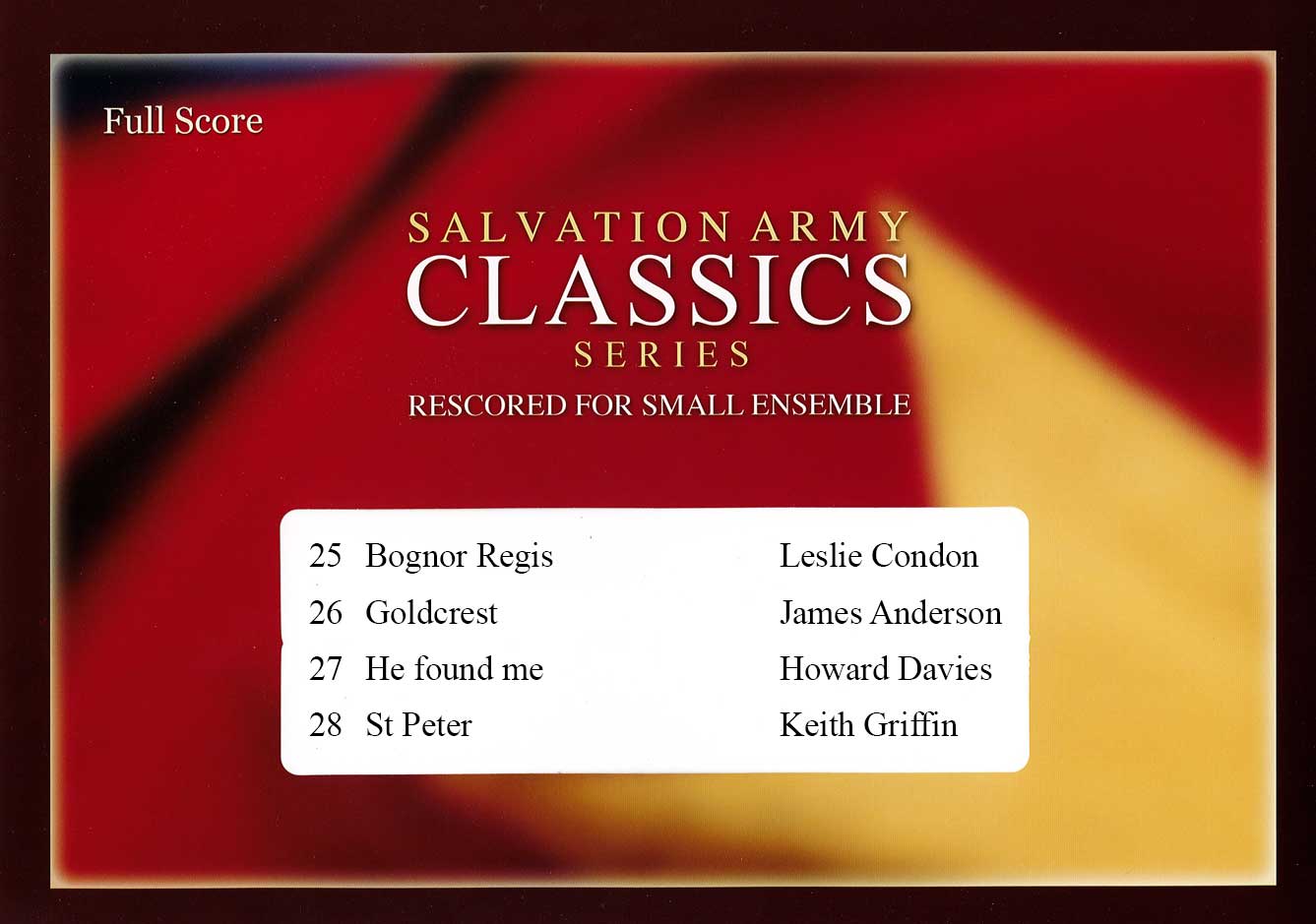
Salvation Army Classics 25-28 for Small Ensemble
Salvation Army Classics arranged for Flexible Brass Band Numbers 25-28Bognor Regis - Leslie CondonGoldcrest - James AndersonHe found me - Howard DaviesSt Peter - Keith Griffin This series features pieces that have been rescored for Unity Series (five-part) scoring.PART I 1st Cornet BbPART II 2nd Cornet Bb and 1st Horn EbPART III 2nd Horn Eb and Baritone or Trombone BbPART IV Euphonium BbPART V Bass Eb and Bass BbThese transcriptions have been carried out in such a way to facilitate the addition of any original parts that may be available.Where relevant, suggestions are made for a variation in tone colour (i.e. 2nd Cornet, Flugel, Baritone, Trombone) as well asthe occasional opportunity for rest.
Estimated dispatch 7-14 working days
-
 £74.95
Eden (Score and Parts)
This work was commissioned by the Brass Band Heritage Trust as the test piece for the final of the 2005 Besson National Brass Band Championship, held at the Royal Albert Hall, London.The score is prefaced by the final lines from Milton's epic poem Paradise Lost (completed in 1663), in which Adam and Eve, expelled from Paradise, make their uncertain way into the outside world:"...The world was all before them, where to chooseTheir place of rest, and providence their guide:They hand in hand with wandering steps and slow,Through Eden took their solitary way."My work is in three linked sections. In the first, the characters of Adam, Eve and the serpent guarding the Tree of Knowledge are respectively represented by solo euphonium, cornet and trombone. The music opens in an idyllic and tranquil mood and leads into a duet between euphonium and cornet. Throughout this passage the prevailing mood darkens, though the soloists seem to remain oblivious to the increasingly fraught atmosphere. A whip-crack announces the malevolent appearance of the solo trombone who proceeds to engage the solo cornet in a sinister dialogue.The second section interprets the Eden story as a modern metaphor for the havoc mankind has inflicted upon the world, exploiting and abusing its resources in the pursuit of wealth. Though certainly intended here as a comment on the present-day, it is by no means a new idea: Milton himself had an almost prescient awareness of it in Book I of his poem, where men, led on by Mammon:"...Ransacked the centre and with impious handsRifled the bowels of their mother earthFor treasures better hid. Soon had his crewOpened into the hill a spacious woundAnd digged out ribs of gold."So this section is fast and violent, at times almost manic in its destructive energy. At length a furious climax subsides and a tolling bell ushers in the third and final section.This final part is slow, beginning with an intense lament featuring solos for tenor-horn, flgel-horn and repiano cornet and joined later by solo baritone, soprano cornet, Eb-bass and Bb-bass.At one stage in the planning of the work it seemed likely that the music would end here - in despair. Then, mid-way through writing it, I visited the extraordinary Eden Project in Cornwall. Here, in a disused quarry - a huge man-made wound in the earth - immense biomes, containing an abundance of plant species from every region of the globe, together with an inspirational education programme, perhaps offer a small ray of hope for the future. This is the image behind the work's conclusion and the optimism it aims to express is real enough, though it is hard-won and challenged to the last.John Pickard 2005
Estimated dispatch 7-14 working days
-
 £29.50
Eden (Score Only)
This work was commissioned by the Brass Band Heritage Trust as the test piece for the final of the 2005 Besson National Brass Band Championship, held at the Royal Albert Hall, London.The score is prefaced by the final lines from Milton's epic poem Paradise Lost (completed in 1663), in which Adam and Eve, expelled from Paradise, make their uncertain way into the outside world:"...The world was all before them, where to chooseTheir place of rest, and providence their guide:They hand in hand with wandering steps and slow,Through Eden took their solitary way."My work is in three linked sections. In the first, the characters of Adam, Eve and the serpent guarding the Tree of Knowledge are respectively represented by solo euphonium, cornet and trombone. The music opens in an idyllic and tranquil mood and leads into a duet between euphonium and cornet. Throughout this passage the prevailing mood darkens, though the soloists seem to remain oblivious to the increasingly fraught atmosphere. A whip-crack announces the malevolent appearance of the solo trombone who proceeds to engage the solo cornet in a sinister dialogue.The second section interprets the Eden story as a modern metaphor for the havoc mankind has inflicted upon the world, exploiting and abusing its resources in the pursuit of wealth. Though certainly intended here as a comment on the present-day, it is by no means a new idea: Milton himself had an almost prescient awareness of it in Book I of his poem, where men, led on by Mammon:"...Ransacked the centre and with impious handsRifled the bowels of their mother earthFor treasures better hid. Soon had his crewOpened into the hill a spacious woundAnd digged out ribs of gold."So this section is fast and violent, at times almost manic in its destructive energy. At length a furious climax subsides and a tolling bell ushers in the third and final section.This final part is slow, beginning with an intense lament featuring solos for tenor-horn, flgel-horn and repiano cornet and joined later by solo baritone, soprano cornet, Eb-bass and Bb-bass.At one stage in the planning of the work it seemed likely that the music would end here - in despair. Then, mid-way through writing it, I visited the extraordinary Eden Project in Cornwall. Here, in a disused quarry - a huge man-made wound in the earth - immense biomes, containing an abundance of plant species from every region of the globe, together with an inspirational education programme, perhaps offer a small ray of hope for the future. This is the image behind the work's conclusion and the optimism it aims to express is real enough, though it is hard-won and challenged to the last.John Pickard 2005
Estimated dispatch 7-14 working days
-
 £45.00
English Counterpoint (Score and Parts)
The winner of the inaugural RWCMD Cory Composition Prize in 2015, debutant brass band composer Lewis Furber unlocks an original and evoactive soundworld, where the influence of composers such as Vaughan Williams is never far away. Features solos for flugel horn, euphonium and baritone.
Estimated dispatch 7-14 working days
-
 £40.00
A Hebridean Lullaby (Score and Parts)
Composed for World Solo Champion Katrina Marzella and the Cornwall Youth Brass Band, A Hebridean Lullaby is a beautiful and haunting melody from the pen of Philip Harper, taking its inspiration from the music and folksong of the Hebrides; a cluster of islands off the west coast of Scotland. Commissioned through a BBC Fame Academy Bursary, this piece is one which is enjoyed and admired by both performers and audiences the world over. The atmosphere created by the score is simply stunning. It's an outstanding addition to the baritone horn's concert repertoire.
Estimated dispatch 7-14 working days