
Results
-
 £67.50
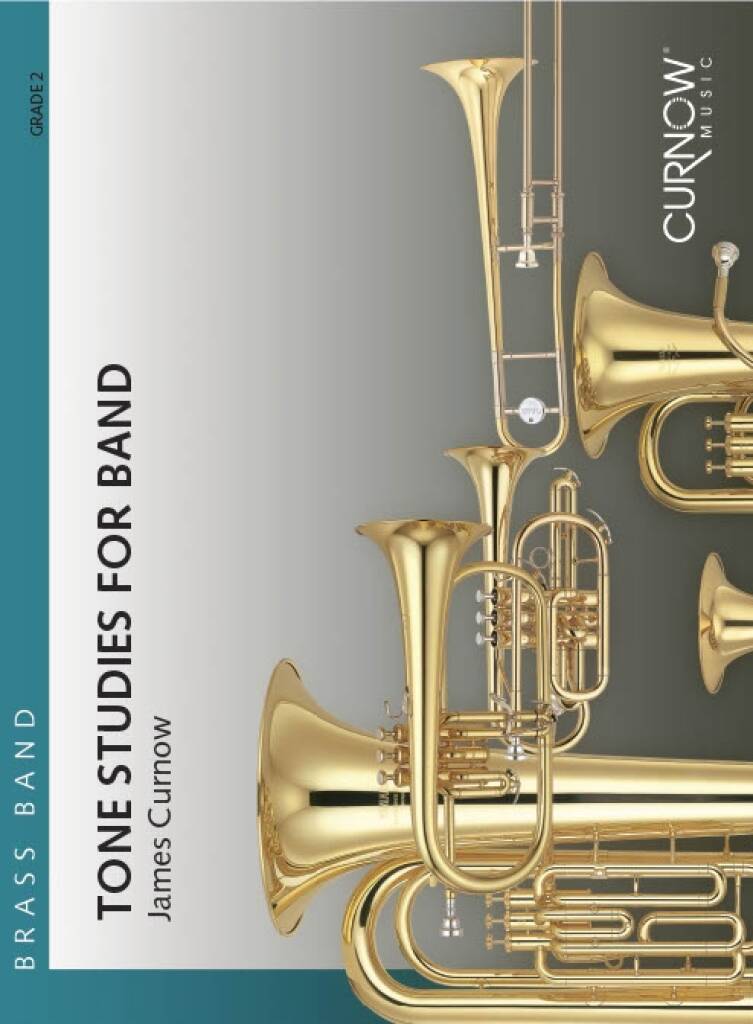
Tone Studies for Band - James Curnow
Tone Studies for brass band consists of nine studies designed to aid the development of good individual and ensemble tone production and intonation. Add Tone Studies to your library and you will find it quickly becomes an indispensible part of your band's rehearsal routine.
Estimated dispatch 5-14 working days
-
 £60.00
From the Shores of the Mighty Pacific (Cornet Solo with Brass Band - Score and Parts)
Cornet Solo with Brass BandHerbert L. Clarke (1867 - 1945) is regarded by many as one of the finest cornet players of all time, noted not only for his amazing technique but also for his warm, lyrical tone. He has left a multitude of cornet solos as well as collections of studies which are still very widely used. He was a member of The Sousa Band briefly in 1893 and then from 1898 to 1917 where he was not only the distinguished cornet soloist but also became assistant director.From The Shores Of The Mighty Pacific is an all-time favourite rondo-caprice cornet solo and was first published in 1912. A brass band arrangement was requested by Chris Lichtler, principal cornet of Brass Band of the Western Reserve, musical director Dr. Keith M. Wilkinson. Chris has performed it many times with BBWR and it was recorded by them on the CD, Without Reserve!.
Estimated dispatch 7-14 working days
-
 £94.95
Waiting for a Pain Hit!??!!? (Brass Band - Score and Parts)
Waiting For a Pain Hit!??!!? was written during November and December 2006 as an entry in the 2006/07 Swiss Brass Band Association Composers Competition. It was later chosen as the Championship Section set test piece for the 2010 Swiss National Brass Band Championships.The piece originates from sketches for a Brass Quintet which was written whilst I was in my second year of studies at the Royal Welsh College of Music and Drama. The piece, now being much more elaborate both musically and structurally than the original, aims to explore the many various textures available to a large brass ensemble. The aims of the piece, from its earliest stages, were mainly exploration of textures as well as dealing with issues of continuity and whilst the piece certainly contains challenging technical elements, they were not a driving force behind its inception and more organically grew from the primary aims of the piece. I was purposefully looking throughout the writing and editing process to create a piece of music with a seamless, ethereal quality to both the structure and the musical content.There are no 'performance directions' throughout the piece, the reasoning for this is explained below. However, I have spent much time and thought over the tempo markings throughout the piece and the tempos throughout the piece are the desired tempi and care should be taken with these. The tempo markings contained throughout the piece form a vital part of the structure and affect the continuity of the piece. Metronome marks contained within a box show the tempo of the new section in relation to the tempo that precedes it by use of metronome modulations. Any alterations to the tempo of the section that precedes it will alter the boxed metronome marks.The title of a piece of music, please forgive my generalisation, is to give an insight into 'what a piece is about'. I suppose that this piece is no different, but with the title being slightly abstract I shall resist the temptation to reveal what it means to me. The title, I feel, needs to be open to interpretation along with the music within. That's the way, with this piece especially, I like my music to be. Freedom to find our own meaning and a way to express it from within the score is vital. It is only then that the piece can take on its own identity and grow in ways that even I might not have imagined, revealing different sides to its personality with each performance.Before the music begins I have included some text. Do these words hold the key to the music?! Can they help??! I DON'T KNOW!!! I just like the rhythms, the pulse and the imagery. Hopefully, all of this can help to create a picture. But let it be your picture...- Paul McGhee, June 2010
Estimated dispatch 7-14 working days
-
£29.95
ROUSSEAU (Brass Band Set) - Ray Ogg
Rousseau takes its name from a melody turned hymn tune attributed to the 18th century philosopher and composer. The composer, during his one year tenure as Bandmaster of the Chicago Staff Band, studied harmony with Emil Soderstrom and the march was the ultimate result of these studies.
Estimated dispatch 7-14 working days
-
£59.95
ROMANS 8 Brass Celebration (Brass Band Set) - Ray Steadman-Allen
Based on the eighth chapter of Romans, this music was composed as a companion to a series of bible studies at the 1985 British National School of Music. The tunes of four songs are presented, each supporting the ideas of the chapter; 'This joyful Eastertide' 'We are born of the Spirit' 'Lord of all hopefulness' and 'In the Cross of Christ I glory'.
Estimated dispatch 7-14 working days
-
 £29.95
Soliloquy II (Euphonium Solo with Brass Band - Score and Parts)
A few years ago, I wrote a Soliloquy based on a Salvation Army song by George Marshall called Soliloquy (In the Stillness), since published in the General Series. This solo follows up the form of that previous work, though it is quite different in emotional content, and was a commission during Covid lockdown from Euphonium player Micah Dominic Parsons.The main inspiration is the tune Cross of Jesus by John Stainer as well as a motif from some older Euphonium Studies from the Royal Military School of Music, Kneller Hall, that Micah had discovered. The tune is used in a chorale form and, after an introduction, the very first section is a reversal of the chorale that appears in the second half of the work. The Euphonium exclamations are all derived from the main tune and the study motif. The work begins in quite a dark reflective manner, representing those aspects of the song, without being too specific. The second half reflects the more positive characteristics and finds a triumphal nature in its conclusion. The soloist lines throughout have a very declamatory style and can have a freedom in performance.There is one new element in the coda, where the triplet motif (bars 87-89) is a direct quotation from Romans 8 - A brass celebration by Ray Steadman-Allen. RSA was a good friend, mentor and encourager to me. The glorious climax of Romans 8 is his presentation of the same tune (Cross of Jesus) used in this work. And so the piece ends with a final and personal reference to RSA!- Howard Evans
Estimated dispatch 7-14 working days
-
 £67.50
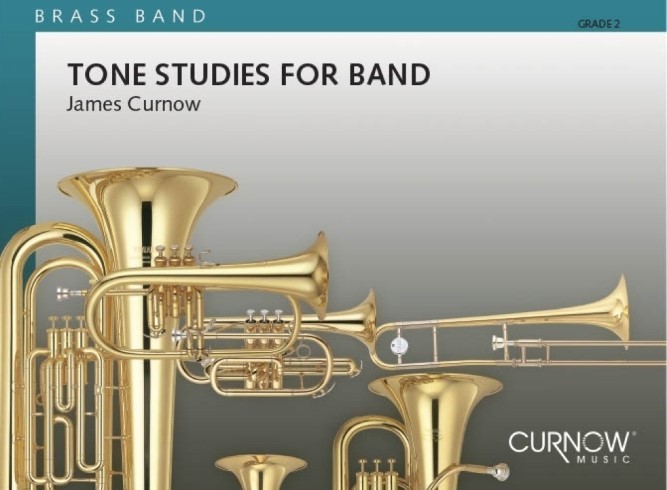
Tone Studies for Band (Brass Band - Score and Parts) - Curnow, James
Tone Studies for brass band consists of nine studies designed to aid the development of good individual and ensemble tone production and intonation. Add Tone Studies to your library and you will find it quickly becomes an indispensable part of your band's rehearsal routine.
Estimated dispatch 7-14 working days
-
 £89.95
Four Etudes (Brass Band - Score and Parts) - Gregson, Edward
This work was written during August and September 2016. In it, I wanted primarily to explore the elements of timbre, rhythm, texture and colour. The first three tudes (or studies) are based on a set of piano pieces I composed in 1982, whilst the last, the longest of the set, was composed specially. My reference point was the Four tudes for orchestra of 1928 by Stravinsky, a work I have always admired, and of which the first three also happen to be based on a set of earlier pieces, in his case for string quartet, with the last being a re-arrangement of a work for pianola. I have also borrowed the titles he gave to the individual studies as they seemed to fit the mood of my pieces.However, the exception is the final study, where instead of the exuberant mood of his colourful portrayal of Madrid, mine was influenced by the terrible human tragedy that was unfolding in Aleppo at the time I was writing it, and thus reflects the violence and barbarism of those events; yet towards the end it does offer a glimmer of hope for humanity with a return to the Canticle (Song) of the first study, and concludes quietly with the chords and bells that began the work. The titles of the tudes are Canticle, Dance, Excentrique, and Aleppo. Like Stravinsky's, the set is relatively short, lasting around 8 minutes.The Four tudes were commissioned by Black Dyke Band and were written specially for the recording marking the conclusion of my year as Composer-in-Residence. The concert premiere will be given by Black Dyke Band, conducted by the composer, at the RNCM Festival of Brass in January 2017.- Edward GregsonDuration: 8.00
Estimated dispatch 7-14 working days
-
 £37.95
Four Etudes (Brass Band - Score only) - Gregson, Edward
This work was written during August and September 2016. In it, I wanted primarily to explore the elements of timbre, rhythm, texture and colour. The first three tudes (or studies) are based on a set of piano pieces I composed in 1982, whilst the last, the longest of the set, was composed specially. My reference point was the Four tudes for orchestra of 1928 by Stravinsky, a work I have always admired, and of which the first three also happen to be based on a set of earlier pieces, in his case for string quartet, with the last being a re-arrangement of a work for pianola. I have also borrowed the titles he gave to the individual studies as they seemed to fit the mood of my pieces.However, the exception is the final study, where instead of the exuberant mood of his colourful portrayal of Madrid, mine was influenced by the terrible human tragedy that was unfolding in Aleppo at the time I was writing it, and thus reflects the violence and barbarism of those events; yet towards the end it does offer a glimmer of hope for humanity with a return to the Canticle (Song) of the first study, and concludes quietly with the chords and bells that began the work. The titles of the tudes are Canticle, Dance, Excentrique, and Aleppo. Like Stravinsky's, the set is relatively short, lasting around 8 minutes.The Four tudes were commissioned by Black Dyke Band and were written specially for the recording marking the conclusion of my year as Composer-in-Residence. The concert premiere will be given by Black Dyke Band, conducted by the composer, at the RNCM Festival of Brass in January 2017.- Edward GregsonDuration: 8.00
Estimated dispatch 7-14 working days
-
 £60.00
From the Shores of the Mighty Pacific (Cornet Solo with Brass Band - Score and Parts) - Clarke, Herbert L. - Wilkinson, Keith M.
Cornet Solo with Brass BandHerbert L. Clarke (1867 - 1945) is regarded by many as one of the finest cornet players of all time, noted not only for his amazing technique but also for his warm, lyrical tone. He has left a multitude of cornet solos as well as collections of studies which are still very widely used. He was a member of The Sousa Band briefly in 1893 and then from 1898 to 1917 where he was not only the distinguished cornet soloist but also became assistant director.From The Shores Of The Mighty Pacific is an all-time favourite rondo-caprice cornet solo and was first published in 1912. A brass band arrangement was requested by Chris Lichtler, principal cornet of Brass Band of the Western Reserve, musical director Dr. Keith M. Wilkinson. Chris has performed it many times with BBWR and it was recorded by them on the CD, Without Reserve!.
Estimated dispatch 7-14 working days
 View Music