
Results
-
 £104.99
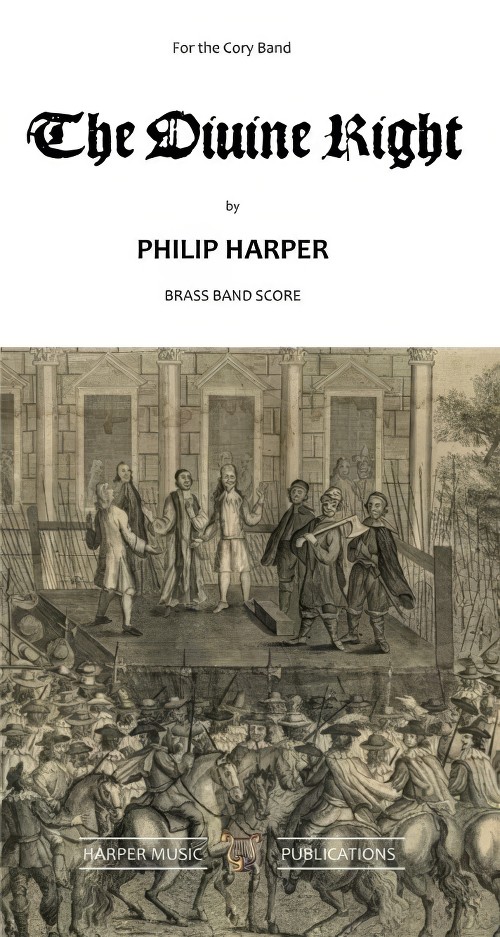
The Divine Right (Brass Band - Score and Parts) - Harper, Philip
At the time of composing this piece, the Arab Spring was sweeping through the Middle East. It seemed that almost every week a new country's people had risen up against the regimes and dictatorships which had prevailed for generations, leaving many nations at a defining crossroads in their history. There were so many possible ways ahead: so many hopes, yet so many uncertainties.This music is a depiction of these revolutionary times, and several musical themes are in turn presented, discussed, considered, fought over, altered, rejected or accepted.Most nations have had, or probably will have, their own Arab Spring, including the United Kingdom. Events of 17th Century Britain provide the context for this piece, particularly those following the execution of the tyrant King Charles I on 30 January 1649. The regicide was in part due to Charless steadfast belief in the Divine Right of Kings, and led to a tumultuous interregnum, where England stood at its own defining crossroads. The music begins turbulently, before King Charles appears and is led to the gallows outside Banqueting House in central London where he is brutally decapitated. From the assembled crowd rose, according to one observer,a moan as I never heard before and desire I may never hear again.The music descends to emptiness.The musical argument which follows is not strictly programmatic, but a number of musical themes are all thrown into the melting pot, representing ideas such as: religion; military force; reasoned Parliamentary debate; and the chattering, irrepressible voice of the people. Additionally, there are some quotations from the music of royalist composer Thomas Tomkins (1572-1656), who was often in tune with the feeling of the times.This defining episode in England's history was brought to a close with the Restoration of the monarchy in 1660, and as the exiled King Charles II rode back into London the diarist John Evelyn wrote:Never was so joyful a day seen in this nation. I stood in the Strand and beheld it, and blessed God.At the end of the piece the bells ring out, and the musical appearance of the King has transformed from turbulent to triumphant.Duration: 17.00
Estimated dispatch 7-14 working days
-
 £65.00
Royal Fireworks, Music from the (Brass Band - Score and Parts) - Handel, George Frideric - Blakeson, Don
Handel's Music For The Royal Fireworks was composed in 1749 to celebrate the signing of the Treaty of Aix-la-Chapelle and the end of the War of the Austrian Succession. The site chosen was the fashionable upper part of St. James Park, which was becoming known at that time as Green Park. The Green Park 'Machine', which housed the pyrotechnics was an elaborate affair adorned with "statues and other figures, festoons of flowers, and other lustres". It was announced that there would be some 10,000 rockets and other devices to be let off, all culminating in a grand, burning sun with 'Vivat Rex' at its centre. There were also rumours that the event was to be accompanied by an impressively large band of military music and mention was made of "40 trumpets, 20 french horns, 16 hautboys (oboes), 16 bassoons, 8 pairs of kettle drums, 12 side drums, a proper number of flutes and fifes; with 100 cannon to go off singly at intervals". It is unlikely that Handel had ever conceived such forces and it was merely the promoter's hyberbole, not least because it was unlikely that there were sufficient numbers of extra military musicians available that could read music, as most played from memory. It is also likely that Handel, and his publisher, were conscious that future performances would be hindered by such forces. The autographed score lists the instrumentation as 9 trumpets, 9 french horns, 24 hautboys, 12 bassoons, 3 pairs of kettle drums and up to 4 side drums. The work is in five movements, although Handel's original score did not indicate in which order they should be played. However, in this score they are arranged to be played as follows: Overture; Bour?e; La Paix; Minuets; La R?jouissance. Duration: 19:00
Estimated dispatch 7-14 working days
-
 £59.95
Voices of Youth (Brass Band - Score and Parts) - Gregson, Edward
The suite Voices of Youth is one of Gregson's earliest brass band compositions, written while he was still a student at the Royal Academy of Music in London. Voices of Youth was commissioned by the National Youth Brass Band of Great Britain and was premiered by them under the baton of Geoffrey Brand.The work has three movements:Nobility of Youth (Duration: 4.00)Sadness and Tenderness (Duration: 2.30)Gaiety (Duration: 2.45)In Nobility of Youth there are the rich sonorities beloved of Salvationist composers such as Eric Ball and, particularly, Ray Steadman Allen, whose music he admired. The modal contour of the melodies here and at the climax of the slow movement Sadness and Tenderness reveal lessons well learned from Holst and Vaughan Williams. Gaiety is probably the most interesting amalgam of all. Beginning in the harmonic world of Gilbert Vinter - whose influence Gregson readily acknowledges at this time - the music is transformed into a bravura waltz of which Percy Grainger might have been proud. It then veers off via a contrapuntal episode of academic correctness, into a coda that takes us into more adventurous harmonic realms.Duration: 10.00
Estimated dispatch 7-14 working days
-
 £89.95
Four Etudes (Brass Band - Score and Parts) - Gregson, Edward
This work was written during August and September 2016. In it, I wanted primarily to explore the elements of timbre, rhythm, texture and colour. The first three tudes (or studies) are based on a set of piano pieces I composed in 1982, whilst the last, the longest of the set, was composed specially. My reference point was the Four tudes for orchestra of 1928 by Stravinsky, a work I have always admired, and of which the first three also happen to be based on a set of earlier pieces, in his case for string quartet, with the last being a re-arrangement of a work for pianola. I have also borrowed the titles he gave to the individual studies as they seemed to fit the mood of my pieces.However, the exception is the final study, where instead of the exuberant mood of his colourful portrayal of Madrid, mine was influenced by the terrible human tragedy that was unfolding in Aleppo at the time I was writing it, and thus reflects the violence and barbarism of those events; yet towards the end it does offer a glimmer of hope for humanity with a return to the Canticle (Song) of the first study, and concludes quietly with the chords and bells that began the work. The titles of the tudes are Canticle, Dance, Excentrique, and Aleppo. Like Stravinsky's, the set is relatively short, lasting around 8 minutes.The Four tudes were commissioned by Black Dyke Band and were written specially for the recording marking the conclusion of my year as Composer-in-Residence. The concert premiere will be given by Black Dyke Band, conducted by the composer, at the RNCM Festival of Brass in January 2017.- Edward GregsonDuration: 8.00
Estimated dispatch 7-14 working days
-
 £37.95
Four Etudes (Brass Band - Score only) - Gregson, Edward
This work was written during August and September 2016. In it, I wanted primarily to explore the elements of timbre, rhythm, texture and colour. The first three tudes (or studies) are based on a set of piano pieces I composed in 1982, whilst the last, the longest of the set, was composed specially. My reference point was the Four tudes for orchestra of 1928 by Stravinsky, a work I have always admired, and of which the first three also happen to be based on a set of earlier pieces, in his case for string quartet, with the last being a re-arrangement of a work for pianola. I have also borrowed the titles he gave to the individual studies as they seemed to fit the mood of my pieces.However, the exception is the final study, where instead of the exuberant mood of his colourful portrayal of Madrid, mine was influenced by the terrible human tragedy that was unfolding in Aleppo at the time I was writing it, and thus reflects the violence and barbarism of those events; yet towards the end it does offer a glimmer of hope for humanity with a return to the Canticle (Song) of the first study, and concludes quietly with the chords and bells that began the work. The titles of the tudes are Canticle, Dance, Excentrique, and Aleppo. Like Stravinsky's, the set is relatively short, lasting around 8 minutes.The Four tudes were commissioned by Black Dyke Band and were written specially for the recording marking the conclusion of my year as Composer-in-Residence. The concert premiere will be given by Black Dyke Band, conducted by the composer, at the RNCM Festival of Brass in January 2017.- Edward GregsonDuration: 8.00
Estimated dispatch 7-14 working days
-
 £34.95
The High Council (Brass Band - Score and Parts) - Steadman-Allen, Ray
This march was written at the request of the then Chief of the Staff, Commissioner Arnold Brown for the welcome meeting of the 1974 High Council, a gathering of The Salvation Army's top leaders from around the world who meet to elect a new General. The scintillating music is filled with many wonderful and surprising shifts of key, rhythm and instrumental colour. Evangeline Booth's song 'The world for God' provides the international reference while at the trio's peak, the composer joins three tunes in impressive counterpoint; 'We're the Army' (cornets), 'A Robe of White' (horns and baritones) and 'Bound for Canaan's Shore' (trombones). The march ends with a dazzling shift into triple time and an impressive molto allargando codetta.
Estimated dispatch 7-14 working days
-
£17.50
The High Council (Brass Band - Score only) - Steadman-Allen, Ray
This march was written at the request of the then Chief of the Staff, Commissioner Arnold Brown for the welcome meeting of the 1974 High Council, a gathering of The Salvation Army's top leaders from around the world who meet to elect a new General. The scintillating music is filled with many wonderful and surprising shifts of key, rhythm and instrumental colour. Evangeline Booth's song 'The world for God' provides the international reference while at the trio's peak, the composer joins three tunes in impressive counterpoint; 'We're the Army' (cornets), 'A Robe of White' (horns and baritones) and 'Bound for Canaan's Shore' (trombones). The march ends with a dazzling shift into triple time and an impressive molto allargando codetta.
Estimated dispatch 7-14 working days
-
£24.50
Fakenham Fair - Traditional - A. Cook
The origins of the song Fakenham Fair are somewhat obscure. It was collected by Peter Bellamy, who performed it unaccompanied on his first solo LP, "Mainly Norfolk" in 1968, giving credit to a Peter Bullen of Norwich from whom he had learned it, Bullen in turn giving credit to his grandfather. But beyond that, other than it definitely being a Norfolk folk song, the rest is a mystery.Over the years, Fakenham Fair has become a firm favourite among folk audiences, probably the most famous version being the 2008 recording by folk supergroup 'Bellowhead' which this setting for brass band pays tribute to. A bright, quirky, and bouncy 5:4/10:8 waltz, the band parts dance back and forth from simple time to compound time and back again, giving a constant flow that somehow always feels natural despite the irregular rhythm... but which will also keep your audience guessing where the beat will land next! With solos and features for principal chairs around the band, nobody is left out of the fun. Engaging to listen to and even more so to play, Fakenham Fair is a perfect light concert item for the band that likes to show off their rhythmic and lyrical sides at the same time.
In Stock: Estimated dispatch 1-3 working days
-
 £65.50
Windsor Variations - Gavin Somerset
The first major Concert Work/Test Piece by Gavin Somerset for brass band takes the familiar tune, St. George's Windsor (Elvey) and gives us a highly enjoyable opus, full of music with which players & MDs can fully express themselves. Often sang to the harvest hymn, Come, Ye Thankful People Come, Its majesty and motifs make this an enjoyable piece to both play and listen to. The work's primary focus is on melody and music with all sections of the band involved in bringing this piece to life. At harvest time or any other, this is a great new feature work for the brass band repertoire. GET THE PARTS FREE TO REHEARSE AT HOME Whilst Brass Band rehearsals continue to be suspended, we are offering FREE downloads of any of the instrumental parts for this new work*. A downloadable playback of the work is also available for you to play along to with a click track included where deemed appropiate to aid your home practice. To download your free instrumental part, please send us a quick email to [email protected]. Once we have received your request, you shall be emailed your free music. Please allow up to 24hrs for this to arrive. Thank you. To download the playback audio to play along to, please RIGHT CLICK HERE & Save As . *A maximum of 2 parts per email address allowed
In Stock: Estimated dispatch 1-3 working days
-
 £29.50
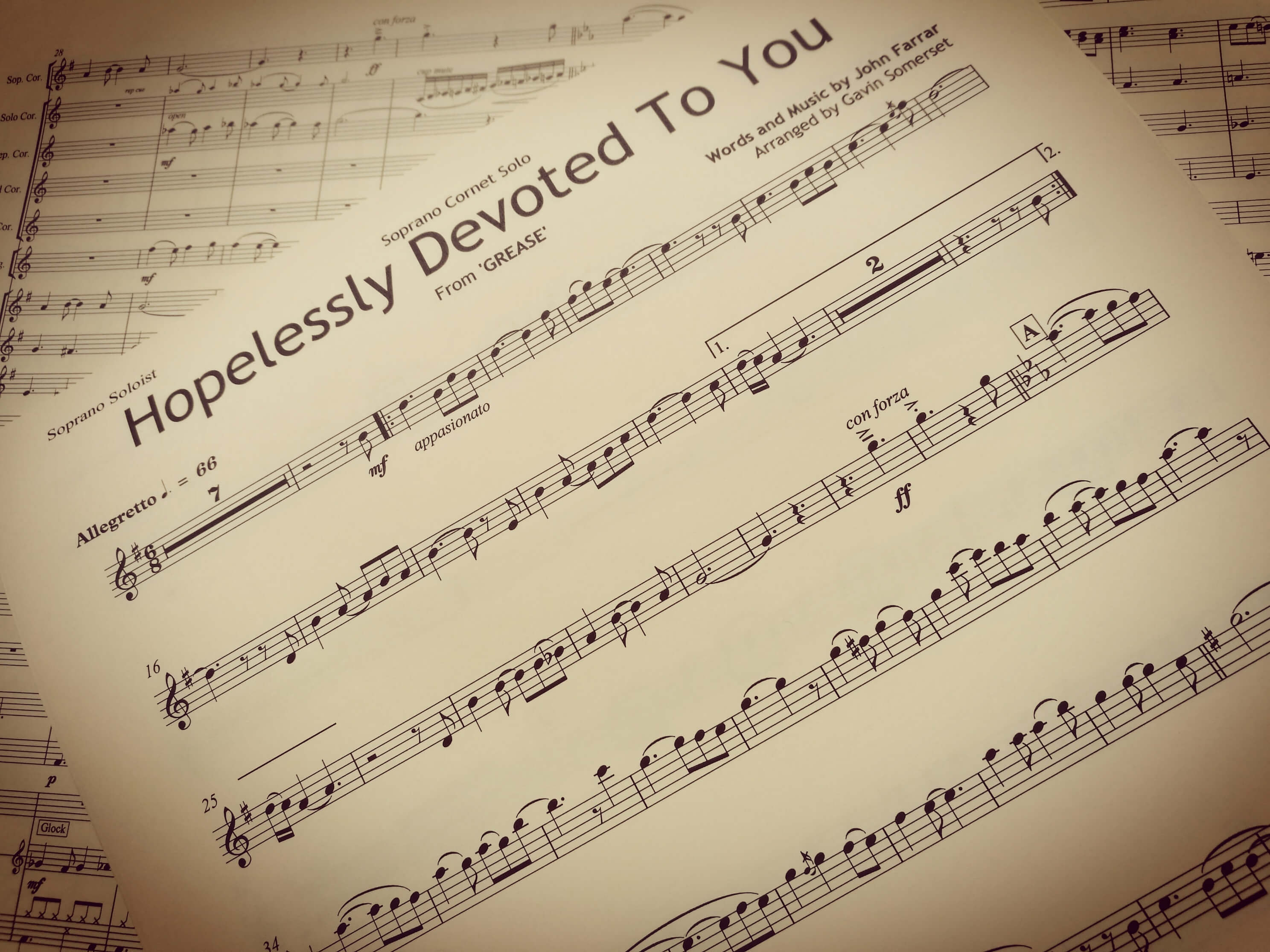
Hopelessly Devoted To You - John Farrar - Gavin Somerset
With Grease celebrating its 40th anniversary this year, this new Soprano Solo comes at the perfect time. The song was written by John Farrar, as the contractually agreed vocal solo for Olivia Newton-John to perform in the film. With simple accompaniments and a song well-known by audiences of all ages, this title is the perfect choice for Soprano players looking to combine their lyrical playing with power in the top register (highest note top C). A must have in the repertoire for soprano cornet soloists. **An alternate lower soloist part is also provided with this publication. FREE SOLOIST PART: CLICK HEREFREE ALTERNATE SOLOST PART: CLICK HERE To download the playback audio to play along to, please RIGHT CLICK HERE & Save As .
In Stock: Estimated dispatch 1-3 working days
 View Music
 Listen to MP3