
Results
-
 £127.30
Love? Magic With a Capital M - Frode Rydland
Imagine an extravagant magic show at Caesar's Palace in Las Vegas. All shows like this feature great superstars as guest artists. For instance, it can be Celine Dion and Josh Groban who enters the stage for a duet...Love... Magic with a capital M is a ballad for an imaginary magic show where the great stars are flugelhorn and trombone.A bit different stage setup, a bit of choreography, a bit of singing and a lot of sweet music!The Choir parts are intended to be sung by the band. But if your concert features a choir, you may add the choir to this performance.This music was written for Norwegian band Eikanger-Bjorsvik Musikklag for their winning program "MAGIC!", performed at the Norwegian equivalent to Brass in Concert, Siddis Brass in 2019.
Estimated dispatch 5-14 working days
-
 £59.99
A Stroll in the Park - Philip Sparke
A Stroll in the Park is a piece in the tradition of "walking" music (such as the Promenade from Mussorgsky's Pictures at an Exhibition or Gershwin's Walking the Dog from Shall we Dance). It strives to describe the joyful benefits of a relaxing walk in a city park on a summer Sunday afternoon and should be played in a relaxed, carefree and laidback manner.
Estimated dispatch 5-14 working days
-
 £72.99
Christmas Troika - James Curnow
Troika is a Russian word that means a group of three but it also means a light Russian sleigh pulled by three horses.Christmas Troika portrays the joy of Christmas via a musical sleigh-ride. One can almost see the frost on the treesand hear the wind blow and the sleigh-bells ring as the tune O Come, All Ye Faithful winds its way through the music.
Estimated dispatch 5-14 working days
-
£54.99
Gonna Fly Now - Bill Conti - Lorenzo Bocci
This is best known as the theme from Rocky, the 1997 smash hit for composer, conductor and Oscar winner Bill Conti. The Italian composer Lorenzo Bocci has taken this exciting piece and made it accessible for brass bands.
Estimated dispatch 5-14 working days
-
 £60.99
Nordic Fanfare and Hymn - Jacob de Haan
As the title suggests, this opening work consists of a fanfare and a hymn. It was written for the opening ceremony of the FIS Nordic World Ski Championships in Oberstdorf (Allgau, Germany) and can be played in four different versions depending on your needs or the players available. You can use a complete version, a short fanfare played just by cornets, trombones and timpani, a double fanfare (extended with tutti-band) or a fanfare version followed by the hymn. Fanfare and Hymn is an extremely practical and versatile ceremonial opening piece.
Estimated dispatch 5-14 working days
-
£54.95
Northern Landscapes - Peter Graham
The four movements of Northern Landscapes provide musical mood pictures of various aspects of Northern working life. 1) Industry opens the suite with the bustle of factory machinery, followed attacca by 2) Seascapes which evokes the calmness of local waters during a fishing expedition. 3) Earth Dance references the mining industry where the blackness of the environment is mirrored by the darkness of the music while 4) Flight evokes the path of an aircraft on its maiden journey in this tribute to the aircraft industry. Northern Landscapes has its origins in music written for the Ulster Orchestra Brass Quintet. This revised and updated version for brass band was commissioned by the Boarshurst (Greenfield) Silver Band, with National Lottery funds, supported by the Arts Council of England. It was set as the 2003 National Brass Band Championships Area Third Section Test-Piece.
Estimated dispatch 5-14 working days
-
 £59.99
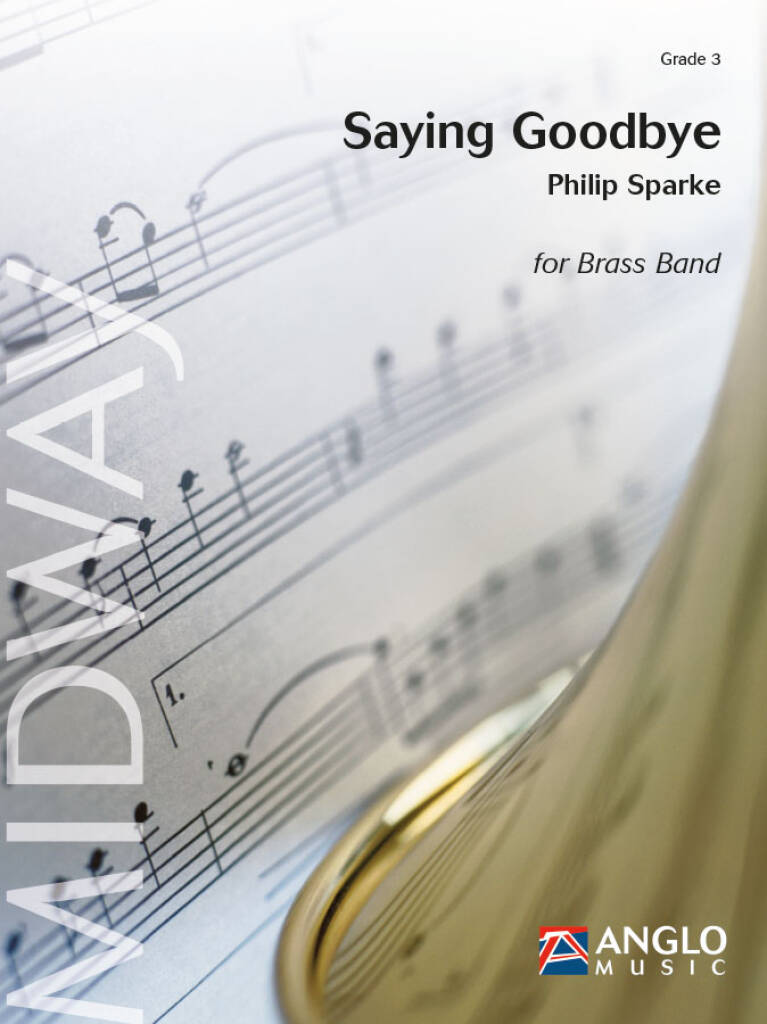
Saying Goodbye - Philip Sparke
Saying Goodbye is one of a series of original works in pop, rock and swing styles Philip Sparke has composed to try and give Brass Bands their own popular vocabulary and identity. It could be described as happy-sad in mood, a feature of much of Sparke's slower music. A perfect light addition for your concert.
Estimated dispatch 5-14 working days
-
 £129.99
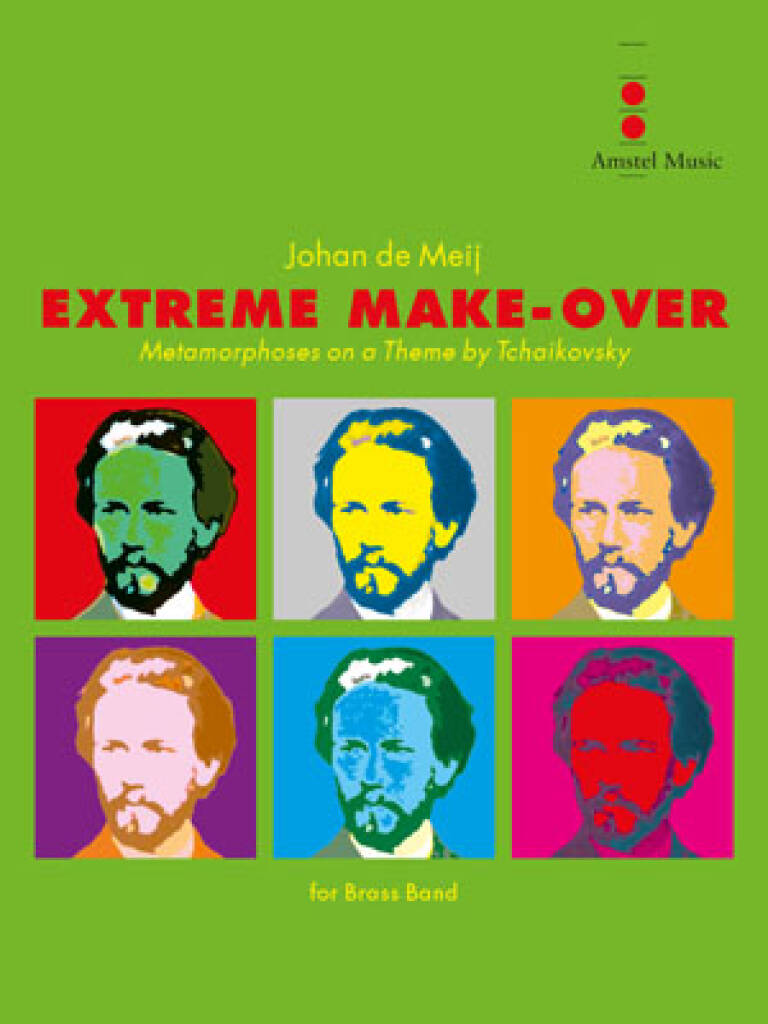
Extreme Make-Over - Johan de Meij
The work, set as the test-piece for the 2005 European Brass Band Championships was inspired by a theme from the second movement of Tchaikovsky's String Quartet No.1 (Andante Cantabile). It consists of a number of musical metamorphoses on the theme and includes several excerpts from Tchaikovsky's Fourth and Sixth Symphonies and Romeo and Juliet. The most unconventional element of the work is instrumentation for ten tuned bottles to be played by members of the Cornet section. This gives the piece an Indonesian Gamelan effect. Why not give your players something to get their teeth into with this impressive major new work.
Estimated dispatch 5-14 working days
-
 £74.95
Aspects of Adiemus (Brass Band - Score and Parts)
Aspects of Adiemus is a collection from one of the world's most popular composers, Karl Jenkins. Adiemus, literally translated, means 'we will draw near' and represents a musical language which can be heard on five award winning albums from the composer.Since Adiemus has risen in popularity around the world, it has become a growing entity meaning many different things to many different people. Vocally, the spread of influence grows wider all the time, taking in Arabic and African sounds as well as "Celtic" and ecclesiastical ones. The percussion too has expanded using Indian, Middle Eastern, Japanese, Chinese and even Australian instrumentation.The evolving nature of Adiemus has meant that it has been difficult to categorise. New age, classical crossover, world music, even pop. Karl sees this as a good sign: "To me, Adiemus transcends labels. The fact that it reaches people of different backgrounds, faiths and cultures gives it a universal appeal which is special. The compositions can be spiritual, religious, meditative - it's open to 'move' people in any away they choose to experience."Ironically, the Adiemus project 'got off the ground' initially due to a television commercial for an airline. Karl Jenkins explains, "I'd been toying with a new idea, completely separate to my work in advertising, but at this time, Jenkins Ratledge were commissioned to come up with the music for an airline commercial. We presented the client with a demonstration tape of one of my completed compositions and they loved it."That composition became known as Adiemus. The music for the airline commercial was aired and immediately drew interest from the public. Karl: "It's ironic that a piece of music not originally intended for a TV commercial should end up on a TV commercial, and that this music became the springboard for the success of the Adiemus project."Expertly arranged by Peter Graham, Aspects of Adiemus features the eponymous 'Adiemus', an uplifting and instantly recognisable opener. 'Chorale - Za Ma Ba' and 'Chorale - Vocalise' are songs of sanctuary, the latter featuring a chamber group from within the band. The vibrant 'Song of the Spirit' is a cornet feature, and the finale, 'Song of the Plains' combines intense rhythmic energy with tribal harmonies. Duration is variable depending on movement selection and optional cuts.Duration: 20.00
Estimated dispatch 7-14 working days
-
 £64.95
The Storm Cone (Brass Band - Score and Parts)
The Storm Cone was commissioned from Lucy Pankhurst as a central part of an immersive artwork by Laura Daly, which considers our intrinsic relationship with the past. The project itself takes the form of a downloadable app, featuring geolocated augmented reality technology and binaural recordings. The music was performed and recorded remotely by the students, staff and friends of the University of Salford during the UK lockdowns in 2021.At its centre, is a journey through music and sound that charts the fading away of a brass band during the interwar years (1918 - 1939). Using new technologies to trace lost bandstands in their final days of mass popularity, we first encounter the band performing as a full ensemble, in 360audio. Breath-taking detail can be heard from every instrument as you move amongst the absent musicians; proximity alters the perception of sounds as Pankhurst's score builds and then returns to a single note. From the powerful, collective sound of the band, the journey then follows the departed musicians into eight spatial sound works by Daly, where their fragile solo phrases merge and mutate in new environments. History, fiction, artifice, and reality combine within this sensory encounter to confront the present with its past.This absorbing work takes its name from the title of Rudyard Kipling's 1932 poem that forewarned of WWII. It considers key aspects of the interwar period and the ensuing break-up and reshaping of communities in different parts of the country. Brass bands, with their strong industrial, religious and militaristic associations, lost many musicians to both World Wars, and the intervening years of shellshock, unemployment, economic migrancy, and industrial action. Their survival and the survival of brass music tell a story of working-class life during this epoch of deindustrialisation. Life, music and creative legacy are all being sustained by breath. As the band's sound lingers in an absent-minded hum or whistle, it becomes both an imprint and portal to these past times.The Storm Cone commemorates the legacy of creativity, music and sound, the power of community and the importance of collective memory, history and storytelling. It highlights the emotive nature of the past and how it can also help foresee possible futures. Serving as a warning shot, The Storm Cone contemplates the residual impact of the interwar period and the cyclical nature of history in terms of current events, including the economic downturn and the rise of populism, extremism, racism and antisemitism; problems seemingly exacerbated by the current pandemic. The resulting experience is an artwork that underlines human strength and fragility and is imbued with a sense of both loss and celebration.Duration: 10.00
Estimated dispatch 7-14 working days
 View Music
 Listen to MP3