
Results
-
 £89.95
Orion (Brass Band - Score and Parts)
Orion was named after the giant huntsman in Greek mythology and is a prominent constellation located on the celestial equator and visible throughout the world. It is one of the most conspicuous and recognisable constellations in the night sky. This piece and its inspiration were composed as a tone poem creating a musical picture of this amazing phenomenon.The opening introduces the constellation. Starting mysteriously with the percussion and basses this section develops a series of rhythmic and harmonic interludes from the upper brass. As this introduction develops, the melodic line lead by the Solo Cornet and Euphonium builds as the accompanying instruments increase in their rhythmic complexity. This section climaxes with a short fanfare motif which will be a prominent theme throughout this piece.The fast rhythmic section that follows serves as a technical test for the players. The thematic device introduced by the Solo Cornets is passed around various soloists and sections within the ensemble. This part of the tone poem gives the opportunity for the ensemble to highlight their technical prowess. The fanfare motif returns to conclude this section and takes the piece into the slow middle movement.Motifs heard earlier are mixed with new ideas in this slow section which give an opportunity for a variety of soloists to demonstrate their musical prowess. After the various solo passages and cadenzas, the mood shifts dramatically to a more ominous section that builds in texture and dynamic. Concluding with our returning fanfare motif the piece then builds in momentum towards our finale section.This finale is a technical showcase which will further test the playing ability and stamina of soloists, small groups and the full ensemble. Using prominent musical themes heard throughout this piece the music builds to a glorious conclusion fitting with wonderful constellation.
Estimated dispatch 7-14 working days
-
 £110.00
Diversions After Benjamin Britten (Brass Band - Score and Parts)
Suite by Lucy Pankhurst, Simon Dobson, Paul McGhee and Gavin HigginsHaving devised a collective centenary tribute for Michael Tippett at the 2006 RNCM Festival of Brass (Variations on a Theme of Michael Tippett by five eminent composers of brass band music, PHM002), I commissioned this companion piece as a Benjamin Britten tribute for the 2013 festival. In the late 1970s, while researching a book about the English composer, and Britten's first teacher, Frank Bridge (1879 - 1941), I came across a copy of the printed score of Benjamin Britten's Variations on a Theme of Frank Bridge (Op.10) for string orchestra, in which Britten had written descriptive titles for each of the variations suggesting appropriate character traits of his much loved mentor and guide. The character variations are cast in march, song and dance forms.Taking inspiration from Britten's youthful tribute, I invited four award-winning composers, who have all made significant contributions to the brass band medium, to create their own personal reflections on four aspects of Britten's character and music, designed to form a suite of Diversions after Benjamin Britten, but which can also be played separately.Lucy Pankhurst's hauntingly lyrical Prelude: His Depth refers to the emotional and symbolic subtexts that underpin Britten's operas, taking its musical cue from Britten's many arrangements of folk songs. The flugel horn takes a prominent role throughout.Simon Dobson's breathless Scherzo: His Vitality reminds us with its rapid passage work and leaping bass 'groove' that Britten loved tennis and fast cars in his younger days.Paul McGhee's evocative interpretation of the March: His Sympathy represents Benjamin Britten's pacifism, as the composer writes: 'We view the music through the eyes of a pacifist. Whilst war and violence surround us, we do not engage in it and though it continues to happen around us. With the use of muted effects in most of the band throughout the piece, the flugel horn is the lone voice of reason, standing firm against the mechanical and destructive society in which it is forced to live. As the machine of war continues around the lone voice, the voice is gradually dismissed and mocked as the war machine rumbles on into the distance.'In an extended finale, entitled Toccata: His Skill, Gavin Higgins celebrates Benjamin Britten's consummate creativity. For the RNCM Festival of Brass premiere, the four contrasting movements were framed and connected by Britten's Fanfare for St. Edmundsbury for three trumpets, with the trumpet soloists spaced round the hall. I am grateful to the Britten Estate and publishers Boosey & Hawkes for giving permission for the elements of Britten's fanfare to be incorporated in the collective work.- Paul HindmarshDuration: 19.30
Estimated dispatch 7-14 working days
-
£45.00
Diversions After Benjamin Britten (Brass Band - Score only)
Suite by Lucy Pankhurst, Simon Dobson, Paul McGhee and Gavin HigginsHaving devised a collective centenary tribute for Michael Tippett at the 2006 RNCM Festival of Brass (Variations on a Theme of Michael Tippett by five eminent composers of brass band music, PHM002), I commissioned this companion piece as a Benjamin Britten tribute for the 2013 festival. In the late 1970s, while researching a book about the English composer, and Britten's first teacher, Frank Bridge (1879 - 1941), I came across a copy of the printed score of Benjamin Britten's Variations on a Theme of Frank Bridge (Op.10) for string orchestra, in which Britten had written descriptive titles for each of the variations suggesting appropriate character traits of his much loved mentor and guide. The character variations are cast in march, song and dance forms.Taking inspiration from Britten's youthful tribute, I invited four award-winning composers, who have all made significant contributions to the brass band medium, to create their own personal reflections on four aspects of Britten's character and music, designed to form a suite of Diversions after Benjamin Britten, but which can also be played separately.Lucy Pankhurst's hauntingly lyrical Prelude: His Depth refers to the emotional and symbolic subtexts that underpin Britten's operas, taking its musical cue from Britten's many arrangements of folk songs. The flugel horn takes a prominent role throughout.Simon Dobson's breathless Scherzo: His Vitality reminds us with its rapid passage work and leaping bass 'groove' that Britten loved tennis and fast cars in his younger days.Paul McGhee's evocative interpretation of the March: His Sympathy represents Benjamin Britten's pacifism, as the composer writes: 'We view the music through the eyes of a pacifist. Whilst war and violence surround us, we do not engage in it and though it continues to happen around us. With the use of muted effects in most of the band throughout the piece, the flugel horn is the lone voice of reason, standing firm against the mechanical and destructive society in which it is forced to live. As the machine of war continues around the lone voice, the voice is gradually dismissed and mocked as the war machine rumbles on into the distance.'In an extended finale, entitled Toccata: His Skill, Gavin Higgins celebrates Benjamin Britten's consummate creativity. For the RNCM Festival of Brass premiere, the four contrasting movements were framed and connected by Britten's Fanfare for St. Edmundsbury for three trumpets, with the trumpet soloists spaced round the hall. I am grateful to the Britten Estate and publishers Boosey & Hawkes for giving permission for the elements of Britten's fanfare to be incorporated in the collective work.- Paul HindmarshDuration: 19.30
Estimated dispatch 7-14 working days
-
 £79.99
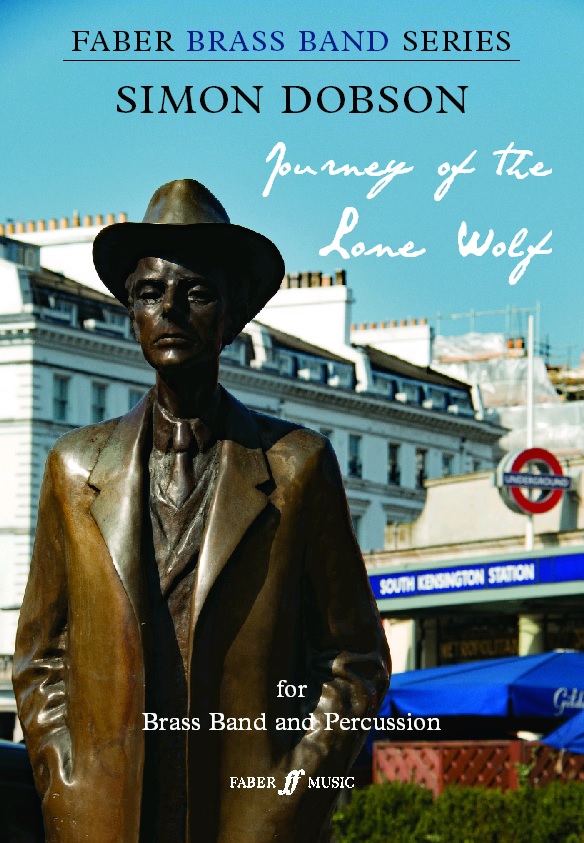
Journey of the Lone Wolf (Score and Parts)
Championship Section Finals Test Piece for National Brass Band Championships of Great Britain 2016Journey of the Lone Wolf tells the story of the hungarian composer Bla Bartk. It was commissioned by Dr. Nicholas Childs for Black Dyke Band, who gave the first performance on Sunday 26 January 2014 at the Bridgewater Hall, Manchester as part of the Royal Northern College of Music Festival of Brass.The composer's programme notes for each movement:1. Capturing the Peasants' SongAfter the upheaval of moving to Budapest the young Bla Bartk meets Zoltn Kodly and the pair embark on summertime adventures throughout the Hungarian countryside to collect and catalogue the astonishing variety (both harmonically and rhythmically) of gypsy and folk music heard in the Balkans. The arrival of WW1 plunges Bartk's beloved Hungary into chaos.2. Night MusicBartk was at times a cold man, aloof and lonely. The odd moments of tenderness he showed are portrayed here in a series of evocative solos. His brief but intense affairs speak of a love he could only long for. Jazz is my night music and here there are hints of what Bartk may have heard in the USA later in his life.3. Flight and FightHaving been forced by the world's evils to leave his homeland of Hungary for America, Bartk, the anti-fascist, felt isolated and angry. In this movement we hear his longing for a simpler time of gypsy folk dances as well as his maturity and depth as a composer finally exploring deeper colours and darker themes.
Estimated dispatch 7-14 working days
-
 £89.95
Revelation (Score and Parts)
Symphony for Double Brass on a theme of Purcell 1995 marked the tercentenary of Purcell's death, and my new score Revelation has been written as a tribute to his music and the ornate and confident spirit of his age. There are five major sections: 1 Prologue 2 Variations on a ground bass I 3 Fugue 4 Variations on a ground bass II 5 Epilogue and Resurrection The score uses many features of the Baroque Concerto Grosso, and arranges players in two equal groups from which soloists emerge to play in a variety ofvirtuoso ensembles. It quotes freely from Purcell's own piece Three Parts on a Ground in which he has composed a brilliant sequence of variations over a repeating six-note bass figure. This original motif can be heard most clearly beneath the duet for Cornet 5 and Soprano at the beginning of the 2nd section. There is, of course, a religious dimension to Revelation as the title suggests, and the score is prefaced by lines by the 17th century poet John Donne. His Holy Sonnet paraphrases the Book of Revelation in which the dead are raised at the sounds of the last trumpet. Donne's trumpets are themselves placed stereophonically ". . . At the round Earth's imagined corners" and it is this feature that today's players represent as they move around the performing area. Their final apocalyptic fanfares can be heard at the close of the score, as Purcell's music re-enters in a lasting tribute to England's first composer of genius. Philip Wilby September 1995 At the round Earth imagined corners, blow your trumpets, angels, and arise, arise from death, you numberless infinities Of souls, and to your scattered bodies go. All whom the flood did, and fire shall o 'erthrow All whom war, dearth, age, agues, tyrannies, Despair, law, chance hath slain, and you whose eyes Shall Behold God, and never taste death woe. John Donne after Revelation Ch. 11 v.15
Estimated dispatch 7-14 working days
-
 £44.95
Revelation (Score Only)
Symphony for Double Brass on a theme of Purcell 1995 marked the tercentenary of Purcell's death, and my new score Revelation has been written as a tribute to his music and the ornate and confident spirit of his age. There are five major sections: 1 Prologue 2 Variations on a ground bass I 3 Fugue 4 Variations on a ground bass II 5 Epilogue and Resurrection The score uses many features of the Baroque Concerto Grosso, and arranges players in two equal groups from which soloists emerge to play in a variety ofvirtuoso ensembles. It quotes freely from Purcell's own piece Three Parts on a Ground in which he has composed a brilliant sequence of variations over a repeating six-note bass figure. This original motif can be heard most clearly beneath the duet for Cornet 5 and Soprano at the beginning of the 2nd section. There is, of course, a religious dimension to Revelation as the title suggests, and the score is prefaced by lines by the 17th century poet John Donne. His Holy Sonnet paraphrases the Book of Revelation in which the dead are raised at the sounds of the last trumpet. Donne's trumpets are themselves placed stereophonically ". . . At the round Earth's imagined corners" and it is this feature that today's players represent as they move around the performing area. Their final apocalyptic fanfares can be heard at the close of the score, as Purcell's music re-enters in a lasting tribute to England's first composer of genius. Philip Wilby September 1995 At the round Earth imagined corners, blow your trumpets, angels, and arise, arise from death, you numberless infinities Of souls, and to your scattered bodies go. All whom the flood did, and fire shall o 'erthrow All whom war, dearth, age, agues, tyrannies, Despair, law, chance hath slain, and you whose eyes Shall Behold God, and never taste death woe. John Donne after Revelation Ch. 11 v.15
Estimated dispatch 7-14 working days
-
£29.95
Rhapsody in Brass (Score Only)
Rhapsody in Brass is in three movements and was written for the British Open Championships in 1949, held at Belle Vue in Manchester. The contest winners were Fairey Aviation Works Band under the baton of Harry Mortimer. Eric Ball came second with Ransome & Marles and Stanley Boddington 3rd with Munn and Felton Band. Rhapsody in Brass had the unusual distinction of being written as a test piece by a Salvation Army composer. Eric Ball's Resurgam was the only other piece to achieve that dual personality in that era.Dean Goffin was born in 1916 in Wellington, New Zealand, son of Henry Goffin, a Salvation Army officer and composer. At 19 he was appointed Bandmaster of the Wellington South Band and when World War II started, he enlisted in the New Zealand Armed Forces where he became Bandmaster of the 20th Infantry Battalion and later the 4th Brigade Band. During the time he served with them in the Middle East and Europe, he composed and arranged numerous pieces among which Rhapsody in Brass and the march Bel Hamid, later adapted for Salvation Army use and renamed Anthem of the Free.After the war, Dean kept on composing and his work was featured by the Wellington South Band. Later he transferred to Timaru for another job and became Bandmaster there. He was studying music at the time and as he wanted to take part in a competition for devotional selections for Salvation Army use, he sent some of his compositions to the International Headquarters. When Rhapsody for Brass was chosen as the test-piece for the British Open Championships, people at the Salvation Army started asking questions about the lack of publications of his work. It was discovered that the pieces submitted for the competition didn't meet the exact criteria. Among these pieces was one of his most appealing works The Light of the World which was published a year later, in 1950, the same year as he completed his Bachelor of Music studies at Otagu University.After entering the Salvation Army Training College in Wellington with his wife, Marjorie, Dean was in 1956 appointed National Bandmaster in the British Territory. Later he became National Secretary for Bands and Songster Brigades and in this period he organised the yearly festival in the Royal Albert Hall and was responsible for the national music schools in the UK. Dean returned to his home country in 1966 and to mark the centenary of the Salvation Army in New Zealand he was knighted by the Queen in 1983. Sir Dean Goffin died on 23 January 1984.
Estimated dispatch 7-14 working days
-
 £29.95
St. Andrew's Variations (Score Only)
This piece, written for the East Anglian Brass Band Festival in 1998, takes the form of eight variations and a finale, loosely based on the descending third motif heard in the initial theme. It was initially composed for junior band, and expanded and rescored for full band in 2006. There is no significance in the title, other than the fact it was written by a Scotsman to be played in the St Andrew's Hall, in Norwich!Alan Fernie was born and brought up in the Scots mining village of Newtongrange. From the age of 13 he learned to play the trombone both at school and with the local brass band, going on to study music in Glasgow and London. After a short period working as an orchestral musician, Alan moved into instrumental education, spending over 20 years teaching brass in schools all over the East of Scotland. It was during this time that he began to conduct and he has since directed bands at all levels, winning many awards. He first wrote for brass whilst still a student, and his music is now played, recorded and published throughout the world.In 2009, Alan was honoured with the "President's Award" from the Scottish Brass Band Association for services to banding. He is also proud to be associated as composer in residence with the acclaimed charity "Brass for Africa", with whom he spent two months recently teaching in Kampala, Uganda. Living in the Scottish Borders, Alan now works as a freelance musician, finding time to write, teach, conduct, judge, perform and act as compere throughout the UK and beyond.
Estimated dispatch 7-14 working days
-
 £64.95
The Dark Side Of The Moon (Score and Parts)
This piece was commissioned by Dr. Nicholas Childs and Black Dyke Band on behalf of Rotary International and received its world premire performance at St. David's Hall, Cardiff on Saturday 27th January 2007. It is dedicated to the composer's father, Harry Cooper.The music was selected by the National Contesting Council as the 3rd section test piece for the 2008 Regional Brass Band Championships of Great Britain. A Note from the Composer...Have you ever thought of a holiday destination, tourist attraction, event, place, site or period in history and thought 'I wonder what it would be like?' - somwhere you have never been and can only let your imagination run wild on. What would the place be like, and all the things surrounding it such as the mood, feelings you get experiencing it, the temperature? Who would be there and what you would see? This piece is my musical imagination of the dark side of the moon. I know from news reports, the internet and other footage that the moon is a very desolate place, very barren and rugged. So from the start the piece gives the listener a musical picture of the rugged landscape with little light and warmth.However, the one place that has had me thinking about is the side of the moon that we don't see in our night skies, the side of the moon with no sun and no light pollution from civilisation. I can only imagine the eeriness one would feel being stood in complete darkness on the moon's surface looking around.As you slowly explore the surroundings and your eyes drift up to the night sky, there is an awesome sight unfolding in front of you - countless stars and galaxies, planets and different solar systems and all right in front of you glistening from the light of the sun beaming from the other side of the moon. The Dark Side of the Moon portrays a musical picture of the whole experience as seen in my imagination taking the listener from the rugged landscape to the awesome beauty that sits endlessly in front of you.Paul Lovatt-Cooper, September 2007
Estimated dispatch 7-14 working days
-
 £31.95
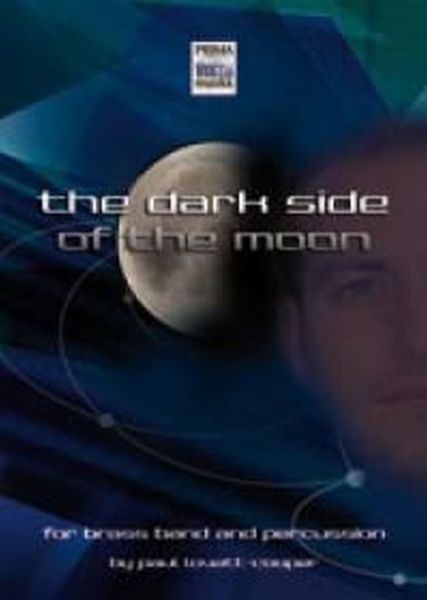
The Dark Side Of The Moon (Score Only)
This piece was commissioned by Dr. Nicholas Childs and Black Dyke Band on behalf of Rotary International and received its world premire performance at St. David's Hall, Cardiff on Saturday 27th January 2007. It is dedicated to the composer's father, Harry Cooper.The music was selected by the National Contesting Council as the 3rd section test piece for the 2008 Regional Brass Band Championships of Great Britain. A Note from the Composer...Have you ever thought of a holiday destination, tourist attraction, event, place, site or period in history and thought 'I wonder what it would be like?' - somwhere you have never been and can only let your imagination run wild on. What would the place be like, and all the things surrounding it such as the mood, feelings you get experiencing it, the temperature? Who would be there and what you would see? This piece is my musical imagination of the dark side of the moon. I know from news reports, the internet and other footage that the moon is a very desolate place, very barren and rugged. So from the start the piece gives the listener a musical picture of the rugged landscape with little light and warmth.However, the one place that has had me thinking about is the side of the moon that we don't see in our night skies, the side of the moon with no sun and no light pollution from civilisation. I can only imagine the eeriness one would feel being stood in complete darkness on the moon's surface looking around.As you slowly explore the surroundings and your eyes drift up to the night sky, there is an awesome sight unfolding in front of you - countless stars and galaxies, planets and different solar systems and all right in front of you glistening from the light of the sun beaming from the other side of the moon. The Dark Side of the Moon portrays a musical picture of the whole experience as seen in my imagination taking the listener from the rugged landscape to the awesome beauty that sits endlessly in front of you.Paul Lovatt-Cooper, September 2007
Estimated dispatch 7-14 working days