
Results
-
 £34.95
Of Wind and Weeping (Flugel Horn Solo)
Flugel Horn Solo with Brass BandThe relationship between Achilles and Patroclus is a key element of the myths associated with the Trojan war.. Its exact nature has been a subject of dispute in both the classical period and modern times. In the Iliad, the two heroes have a deep and meaningful friendship. Achilles is tender towards Patroclus, while he is callous and arrogant towards others.Of Wind & Weeping (2015) is a flugel solo, with the soloist representing Greek warrior Achilles and the pain he faces following the death of Patroclus. For a brief moment, Achilles' character shifts from a strong and unbreakable warrior to an emotional and vulnerable character. The solo should be played with expression and feeling, a character who is mourning a loved one with mixed feelings of sadness, shock and vengeance.The work was written in early 2015 for flugel soloist David James and Tongwynlais Temperance Band, with whom he is a member.
Estimated dispatch 7-14 working days
-
 £21.95
Red Priest (Brass Band - Study Score)
Concerto After VivaldiDuring his lifetime, Antonio Vivaldi was known as 'il Prete Rosso', the Red Priest, thanks to his youthful ordination and his flaming red hair. The son of a violinist at San Marco in Venice, Vivaldi's musical pedigree was impeccable and an excellent start to his career was coupled with astounding energy and productivity. His vast output of concerti grossi, using soloists in groups, inspired this composition and performers may choose appropriate stage positions for the various groupings of cornets and trombones, spaced around the performance area. The score quotes freely from some of Vivaldi's most popular compositions, including 'Winter' from The Four Seasons, the motet Nisi Dominus, the famous Gloria and the fugue from the Concerto grosso in D minor found in L'Estro Armonico.However, it is the musical spirit of Vivaldi, a close contemporary of both Handel and Casanova, that inspired this music, which should be played with a mixture of accuracy and abandoned virtuosity. The musical images in this piece have clear associations in the composer's mind with individual Venetian locations, ranging from bustling street scenes to vaulted interiors, and describing the famous journey down the Grand Canal, past the Doge's Palace, to the Ospedale della Pieta where Vivaldi worked for so many years.Duration: 14.00
Estimated dispatch 7-14 working days
-
 £33.62
Finale - Suite No.3 (Brass Band) Tchaikovsky arr. Ruben Schmidt
This arrangement by Ruben Schmidt is the exciting polonaise finale from the last movement of Tchaikovsky's thrilling Suite No.3 in G Major for Orchestra. This was first performed in Saint Petersburg on January 12th, 1885, at the fifth symphony concert of the Russian Musical Society, conducted by Hans von Bulow. The suite also was Tchaikovsky's first American success when it was performed by the New York Symphony Society at Carnegie Hall on May 7,1891. First intended as its own symphony, it became the most played and most successful of Tchaikovsky's four suites. The finale of the last movement is an invigorating polonaise dance to finish the suite. Tchaikovsky often enjoyed conducting this final movement as an independent work himself. To view a rolling score video of the work please visit www.youtube.com/watch?v=M-Ht80Lnk-c Duration: 4.00 minutes Difficulty Level: 1st Section + PDF download includes parts and score. Sheet music available here. Instrumentation: Soprano Cornet Eb Solo Cornet Bb Repiano Cornet Bb 2nd Cornet Bb 3rd Cornet Bb Flugel Horn Bb Solo Horn Eb 1st Horn Eb 2nd Horn Eb 1st Baritone Bb 2nd Baritone Bb 1st Trombone Bb 2nd Trombone Bb Bass Trombone Euphonium Bb Bass Eb Bass BbTimpani Percussion (Tambourine, Suspended Cymbal & Bass Drum)
In Stock: Estimated dispatch 1-3 working days
-
 £56.00
Rey's Theme from Star Wars Eposide VII: The Force Awakens - John Williams/Idar Torskangerpoll
The iconic soundtrack composed by John Williams continues with "The Force Awakens", the seventh Star Wars movie.This arrangement for Young Band tries to capture the rich timbre of the original orchestral music. It is very important to be aware of the balance in the band when performing this music. The horns should stand out dynamically when they plays the melody. Also make shure that the rhythmic are played as clear as possible, especially in the bass tubas and other low instruments. You may choose whether to play the upper or lower octave in the trumpet parts.
Estimated dispatch 10-14 working days
-
£29.95
LIGHT WALK (Brass Band Set) - Barrie Gott
The 'big-band' arrangement that brought the arranging skills of Barrie Gott instantly to the attention of the brass world. Still a hit wherever it is played, this 'great fun' music allows the band to 'let its hair down' and the Flugel Horn the chance to take centre stage.
Estimated dispatch 7-14 working days
-
 £79.99
Another World's Hell (Brass Band - Score and Parts)
Another Worlds Hell was commissioned in versions for brass, wind and fanfare bands by the Societe Cantonale des Musiques Vaudoises and the Association Cantonale des Musiques Neuchateloises for the 2013 Swiss Cantonales festivals. It is inspired by a passage in Aldous Huxleys classic 1932 science-fiction novel Brave New World, which describes in unusually close detail the music that is being played at a dance. This is Dobsons interpretation of the imagined future music that Huxley dreamed of. Suitable for 1st Section Bands and above. Duration: 13.00
Estimated dispatch 7-14 working days
-
£44.95
TRIUMPH OF PEACE, The (Brass Band Set) - Eric Ball
This ever popular Eric Ball 'classic' is played as much today as it has ever been. Composed in the wake of the Munich crisis and the return of British Prime Minister Neville Chamberlain after his talks with Hitler, this tone poem juxtaposes music of urgency (the chromatic opening subject) with Eric Ball's own hymn for peace, 'Peace in our time O Lord'.
Estimated dispatch 7-14 working days
-
£42.00
Under the Boardwalk - Resnick, A & Young, K - Harper, P
Arranged as a flugel horn solo and played by Cory Band as part of its 2015 Brass in Concert winning programme, this piece is as simple as it gets. Playable by all levels of band.4th section +Duration 3 mins
In Stock: Estimated dispatch 1-3 working days
-
 £59.99
David of the White Rock - Philip Sparke
This is an ancient Welsh air that was first published in Relics of the Welsh Bards in 1794. Dafydd (David) Owain was a famous Welsh bard who lived on a farm called Gareg Wen (The White Rock) in Eifionydd, Carnarnvonshire, North Wales. Tradition has it that on his deathbed he called for his harp and composed this lovely melody, requesting that it be played at his funeral. Accordingly, it was later played at the parish church of Ynys-Cynhaiarn. Lyrics were later added by Ceiriog Hughes, which describe the melody's inspiration. This version for brass band retains all the beauty and simplicity of the original.
Estimated dispatch 5-14 working days
-
 £154.60
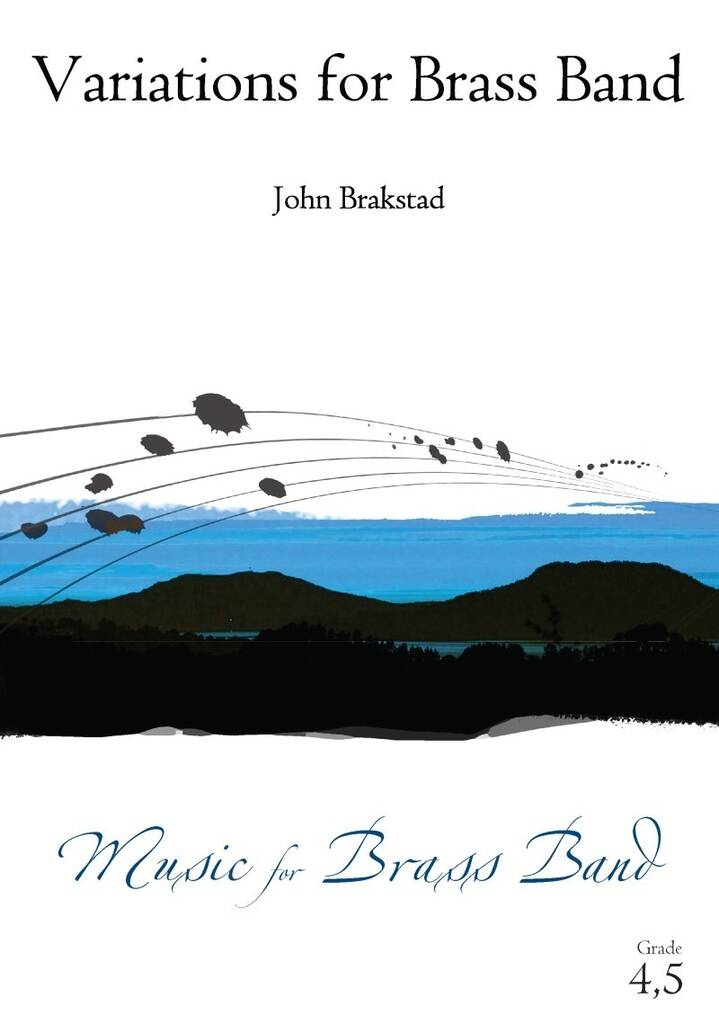
Variations for Brass Band - John Brakstad
"Variations for Brass Band" consists of a chorale and 5 variations of brilliant, lyric and humorous character. The piece also contains several soloparts and elements of ensemble.Each variation has its own title, but the piece should be played in its entirity.The chorale is based on a minor pentachord, and each variation begins with these five notes, with different rhythmical treatment.There is also a little secondary "theme", consisting of five notes which are heard throughout the work (eg. as sixteens/semiquavers in cornets in bar 1).When the beams sweep across the Earth, they can be heard as regular pulses. We call them pulsars.In this piece there are three percussion parts. In addition there is an "optional part" to replace the marimba and vibraphone written in the three original percussion parts if desired. This fourth part is shown in the full score.
Estimated dispatch 5-14 working days
 View Music