
Results
-
 £45.00
Paint The Town Red - Christopher Bond
Paint The Town Red was commissioned by Wotton Silver Band in 2021 as a new signature work for the band. The work is upbeat and celebratory in style with an impactful opening and close. The band, located in Wotton-under-Edge in Gloucestershire, wear red uniforms which provided the inspiration for the title of the work.
Estimated dispatch 10-14 working days
-
 £34.95
Puffing Devil, The - Christopher Bond
The Puffing Devil (2013) was commissioned by Camborne Trevithick Day Committee on the occasion of Camborne's 30th Trevithick Day celebration. The premiere performance of the work, written for brass band and children's choir, saw a massed performance by six brass bands and children from nine local schools. With the intention of being an educational work as well as a musical work, The Puffing Devil reflects the story of Richard Trevithick both in the lyrics and the musical material.A mysterious opening sees running semiquavers in the euphoniums as the flugel horn introduces the work with a solo, before the entry of the horns playing rhythmic quavers. The addition of the voices at the outset is for effect - working with the instruments to create the sound of a steam engine gathering pace simply to the words 'Trevithick'. Once a steady tempo is reached, themes are introduced and sung by the choir, where the vocal writing is a very simple singular-melody; easy for any primary school aged children to learn. An ending of grandeur in a majestic nature is presented, to create a big finish to a feel-good educational work.
Estimated dispatch 10-14 working days
-
 £45.00
Soaring The Heights - Christopher Bond
Soaring The Heights is a tour-de-force opener for brass band, written for and commissioned by Cory Band in 2024 on the occasion of the band's 140th Anniversary. With solos for cornet and euphonium, the work opens and closes with brilliance and vigour - the perfect short concert opener.
Estimated dispatch 10-14 working days
-
 £42.00
The Golden Carol. Arranged for brass band by Lynda Nicholson
Arranged for brass band by by Lynda Nicholson The Golden Carol is a traditional Old English Christmas Carol. The words tell of the Three Kings following the Star to Bethlehem to see Jesus on Christmas morning. The tune is anonymous, but has a medieval feel, similar to other carols, such as I Saw three Ships. The Golden Carol begins in a 5/4 jazz waltz rhythm with a solo Eb Bass being joined a few bars later by by a solo trombone then a solo horn, before more instruments (including percussion) are added and the tune plays out in the cornets and soprano cornet. The second section goes into 4/4 with a strong Rock/Big Band feel driven along rhythmically by the kit drummer. This section then leads to a rousing close for the full band. The Golden Carol is part of the Lynda Nicolson Collection . To hear a sound recording of The Golden Carol scroll down.
-
£83.00
The Devil in I (Bra) - Corey Taylor & James Root - Paul Saggers
Slipknot is an American heavy metal band formed in Des Moines, Iowa, in 1995 by percussionist Shawn Crahan, drummer Joey Jordison and bassist Paul Gray. Slipknot is well known for its attention-grabbing image, aggressive style of music, and energetic and chaotic live shows. The band rapidly rose to fame following the release of their eponymous debut album in 1999. "The Devil in I" is from their fifth album, The Gray Chapter. It is the second single for the album and the first to be released to radio and music channels, with the previous single "The Negative One" being a digital only single.
Estimated dispatch 7-14 working days
-
£100.00
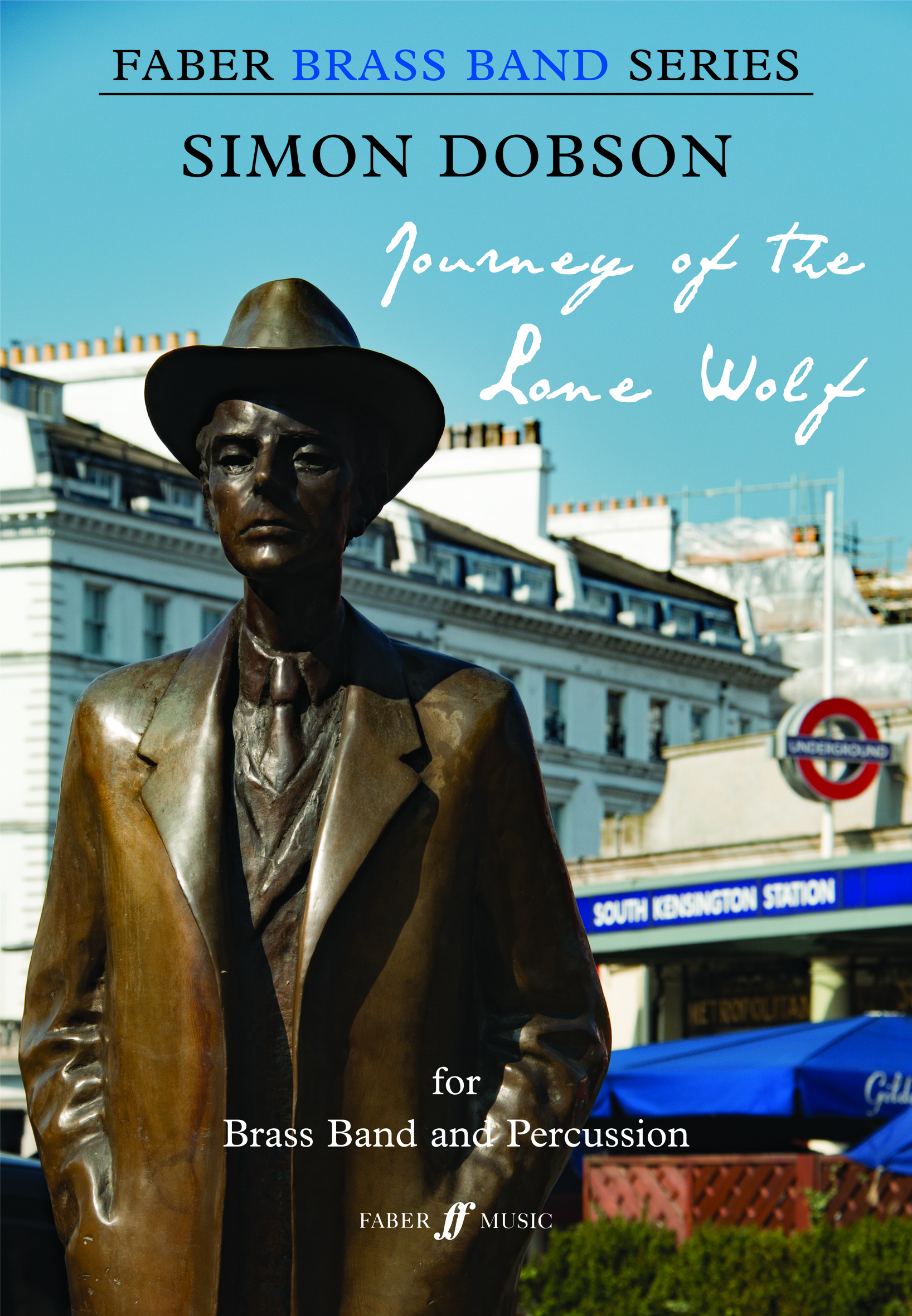
Journey of the Lone Wolf (score & parts) - Simon Dobson
Journey of the Lone Wolf tells the story of the hungarian composer Bla Bartk. It was commissioned by Dr. Nicholas Childs for Black Dyke Band, who gave the first performance on Sunday 26 January 2014 at the Bridgewater Hall, Manchester as part of the Royal Northern College of Music Festival of Brass.The composer's programme notes for each movement: 1. Capturing the Peasants' SongAfter the upheaval of moving to Budapest the young Bla Bartk meets Zoltn Kodly and the pair embark on summertime adventures throughout the Hungarian countryside to collect and catalogue the astonishing variety (both harmonically and rhythmically) of gypsy and folk music heard in the Balkans. The arrival of WW1 plunges Bartk's beloved Hungary into chaos.2. Night MusicBartk was at times a cold man, aloof and lonely. The odd moments of tenderness he showed are portrayed here in a series of evocative solos. His brief but intense affairs speak of a love he could only long for. Jazz is my night music and here there are hints of what Bartk may have heard in the USA later in his life.3. Flight and FightHaving been forced by the world's evils to leave his homeland of Hungary for America, Bartk, the anti-fascist, felt isolated and angry. In this movement we hear his longing for a simpler time of gypsy folk dances as well as his maturity and depth as a composer finally exploring deeper colours and darker themes. Duration: 15 minutes.Level: Championship
In Stock: Estimated dispatch 1-3 working days
-
£110.00
The Final Frontier - Geert Jan Kroon
In The Final Frontier, the composer explores different associations with the universe. Inspired by Stephen Hawking's (1942-2018) book Brief Answers to the Big Questions, the piece describes the wonders and dangers of the universe, the big questions about the smallest elements, and the possibility of space travel. The work consists of four movements. The first movement, 'Energy and Space', is the exposition of both main materials. With energy and space, a universe can be created. The second movement, 'The Great Unknown', is a fast section in which the materials are further explored and depicts the dangers of the universe, like supernovae and black holes. The third movement, 'The Big Questions', is a slow movement with different soloists and music of a reflective nature. Imagine how in the tiniest elements, whole dimensions could be rolled up. Also, a Dutch pioneer in cosmology is hidden in the notes. The fourth movement, 'The Final Frontier', is a big build-up to a majestic finale, portraying the excitement of space travel. The Final Frontier was the set test piece of the 3rd section at the Dutch National Brass Band Championships.
-
 £29.95
Under the Cover of Night - Jonathan Bates
DURATION: 3 minutes. DIFFICULTY: 3rd+. 'Under the Cover of Night' was composed for BD1 Brass as part of a set of music inspired by the fairytale of Robin Hood and Maid Marian. . In BD1's adaption of the fairytale, Maid Marian is held hostage by the evil Sheriff of Nottingham and it is up to Robin Hood and his band of Merry Men to rescue her from captivity. This mysterious bluesy feature for Flugel, Drum Kit and Euphonium & Baritone section paints the picture of the group quietly creeping around in their attempt to rescue Marian. Within the music, there is opportunity for staging, with the Merry Men (Euphoniums & Baritones) moving around the band to reach Marian (Flugel) on the other side of the hall.
In Stock: Estimated dispatch 1-3 working days
-
 £34.95
Mirror of the Heart - Jonathan Bates
DIFFICULTY: 4th+. DURATION: 4'30". Recorded on: Violet Volume 1 (Brass Band Willebroek). 'Mirror of the Heart' was composed for Belgian Cornet soloist Lode Violet for performances and recordings with the Wallberg Band (CH) and Brass Band Willebroek (B). The inspiration for the title of the work is taken from a collection of poems by the same name of late American poet Sara Teasdale (1884 - 1933); the centre of which are 54 deeply personal poems which - as a result - remained unpublished until after Teasdale's death. This work aims to reflect that particularly personal and reflective feel portrayed within the 'heart' of this collection.
In Stock: Estimated dispatch 1-3 working days
-
 £35.00
Ascend the Brightest Heaven...
DescriptionThe band's uniform badges feature a significant local landmark, a transmission tower officially known as The Arqiva Tower but known more colloquially to locals as 'Emley Moor mast'. The current elegantly tapered concrete sculpture, the tallest freestanding structure in the UK at 1084 feet, is the third mast on this site and was built between 1969 and 1971 after the catastrophic collapse of the previous structure.On 19 March 1969 a combination of extreme icing and strong winds caused the tubular mast to collapse across Jagger Lane and the chapel opposite - fortunately, despite the fact that the organist was in the chapel practising, nobody was injured. Several million people lost their BBC2 and ITV signals, until the Independent Television Authority managed to set up a temporary transmitter nearby!Just over two years later the new mast was operational, and despite initial opposition from some locals who feared another, potentially worse, collapse, Emley Moor Mast is now a popular local landmark and a grade II listed building. In 2015 the mast was illuminated with coloured lights at night to mark the 'Grand Depart' of the Tour de France coming to Yorkshire.You can listen and follow the score in the video below:
Estimated dispatch 7-14 working days

 View Music