
Results
-
£60.00
Antiphonary - Lane, L
The Berkeley Family antiphonary is a beautiful book of texts and chants dating back to 1457, and this piece traces an historical timeline of Berkeley Castle's history, incorporating Vivaldi arias from an opera discovered at the castle in 2002. The music has moments of hymn-like reflection as well as great triumph and features the flugel horn.1st section + Duration 6 mins This piece exists in three other formats - Symphonic brass, Brass ensemble, and Wind dectet and piano. For details of these orchestrations please visit Composers Edition
In Stock: Estimated dispatch 1-3 working days
-
 £95.00
Concertante (Piano Solo with Brass Band - Score and Parts) - Gregson, Edward
This work was written in 1966, when I was a student at the Royal Academy of Music in London. It was the first major work to be written for this combination. The Concertante is unashamedly romantic in idiom and is cast in three movements: Prelude, Nocturne and Rondo.The Prelude is in sonata form with a contracted recapitulation. There are two main themes, the first announced after the opening flourish on piano. The second theme is lyrical in character and the interplay between these two themes forms the main focus of the movement.The pensive Nocturne opens with an introduction from the band which contains hints of the two main ideas to follow. The solo piano announces the main theme, which has a slightly 'blues' character in its flattened third and seventh notes of the scale. The band enters with the chorale theme already heard in the introduction. Eventually the first theme returns, this time from piano and band and building to a powerful climax before subsiding to a peaceful ending.The Rondo is full of energetic rhythms and changing time patterns. The main theme is 'giocoso' in character and in the first episode there is more than a hint of the tune 'Onward Christian Soldiers' in what amounts to a good humoured parody. Before the final coda there is a long piano cadenza underlying the virtuoso element of the work.The work had a number of public performances leading up to a memorable one in the Royal Albert Hall in 1989 as part of the Gala Concert that used to be held after the National Brass Band Championship in the Royal Albert Hall. That year, the 'centre band' in the massed bands concert were the GUS Band (then known for sponsorship reasons as 'Rigid Containers Group Band'!) conducted by my great friend and champion, Bramwell Tovey, with myself as the soloist.- Edward GregsonDuration: 18.00
Estimated dispatch 7-14 working days
-
£35.00
Concertante (Piano Solo with Brass Band - Score only) - Gregson, Edward
This work was written in 1966, when I was a student at the Royal Academy of Music in London. It was the first major work to be written for this combination. The Concertante is unashamedly romantic in idiom and is cast in three movements: Prelude, Nocturne and Rondo.The Prelude is in sonata form with a contracted recapitulation. There are two main themes, the first announced after the opening flourish on piano. The second theme is lyrical in character and the interplay between these two themes forms the main focus of the movement.The pensive Nocturne opens with an introduction from the band which contains hints of the two main ideas to follow. The solo piano announces the main theme, which has a slightly 'blues' character in its flattened third and seventh notes of the scale. The band enters with the chorale theme already heard in the introduction. Eventually the first theme returns, this time from piano and band and building to a powerful climax before subsiding to a peaceful ending.The Rondo is full of energetic rhythms and changing time patterns. The main theme is 'giocoso' in character and in the first episode there is more than a hint of the tune 'Onward Christian Soldiers' in what amounts to a good humoured parody. Before the final coda there is a long piano cadenza underlying the virtuoso element of the work.The work had a number of public performances leading up to a memorable one in the Royal Albert Hall in 1989 as part of the Gala Concert that used to be held after the National Brass Band Championship in the Royal Albert Hall. That year, the 'centre band' in the massed bands concert were the GUS Band (then known for sponsorship reasons as 'Rigid Containers Group Band'!) conducted by my great friend and champion, Bramwell Tovey, with myself as the soloist.- Edward GregsonDuration: 18.00
Estimated dispatch 7-14 working days
-
 £45.00
A Song for Bram (Piano Solo with Brass Band - Score and Parts) - Gregson, Edward
A Song for Bram is a short work, originally composed piano and brass band, and is dedicated to the memory of Bramwell Tovey, a close friend and colleague of the composer, and a conductor, composer, pianist and musician of huge talent, who sadly passed away before his time in the summer of 2022. In this short piece the composer has tried to imagine what kind of tune Bram would have improvised at the piano, something he frequently engaged in. No doubt it would have been a mixture of bluesy jazz, hymn tune, and love song, and this is how the solo piano takes off. In the middle section of a what is a simple tertiary structure, introduced are quotes from two hymn tunes Bram particularly loved, never having forgotten his Salvation Army roots. Bram's 'Song' returns, this time on a plaintive flugelhorn horn, and which reaches a climax with the full band before receding, literally, into the distance.....(to a new life beyond?).Duration: 6.00
Estimated dispatch 7-14 working days
-
£15.00
A Song for Bram (Piano Solo with Brass Band - Score only) - Gregson, Edward
A Song for Bram is a short work, originally composed piano and brass band, and is dedicated to the memory of Bramwell Tovey, a close friend and colleague of the composer, and a conductor, composer, pianist and musician of huge talent, who sadly passed away before his time in the summer of 2022. In this short piece the composer has tried to imagine what kind of tune Bram would have improvised at the piano, something he frequently engaged in. No doubt it would have been a mixture of bluesy jazz, hymn tune, and love song, and this is how the solo piano takes off. In the middle section of a what is a simple tertiary structure, introduced are quotes from two hymn tunes Bram particularly loved, never having forgotten his Salvation Army roots. Bram's 'Song' returns, this time on a plaintive flugelhorn horn, and which reaches a climax with the full band before receding, literally, into the distance.....(to a new life beyond?).Duration: 6.00
Estimated dispatch 7-14 working days
-
 £40.00
A Song for Bram (Brass Band - Score and Parts) - Gregson, Edward
A Song for Bram is a short work, originally composed piano and brass band, and is dedicated to the memory of Bramwell Tovey, a close friend and colleague of the composer, and a conductor, composer, pianist and musician of huge talent, who sadly passed away before his time in the summer of 2022. In this short piece the composer has tried to imagine what kind of tune Bram would have improvised at the piano, something he frequently engaged in. No doubt it would have been a mixture of bluesy jazz, hymn tune, and love song, and this is how the solo piano takes off. In the middle section of a what is a simple tertiary structure, introduced are quotes from two hymn tunes Bram particularly loved, never having forgotten his Salvation Army roots. Bram's 'Song' returns, this time on a plaintive flugelhorn horn, and which reaches a climax with the full band before receding, literally, into the distance.....(to a new life beyond?).Duration: 6.00
Estimated dispatch 7-14 working days
-
 £94.99
Piano Concerto No.3, Finale from (Brass Band - Score and Parts) - Rachmaninoff, Sergei - Harper, Philip
Philip Harper has created a fabulous transcription of the energetic third movement of Rachmaninoff's Piano Concerto No.3 in D minor. This movement is comprised of variations on a theme from the first movement of the concerto. The final notes would become Rachmaninoff's musical signature. An outstanding and very spectacular title!Duration: 7.15
Estimated dispatch 7-14 working days
-
 £57.99
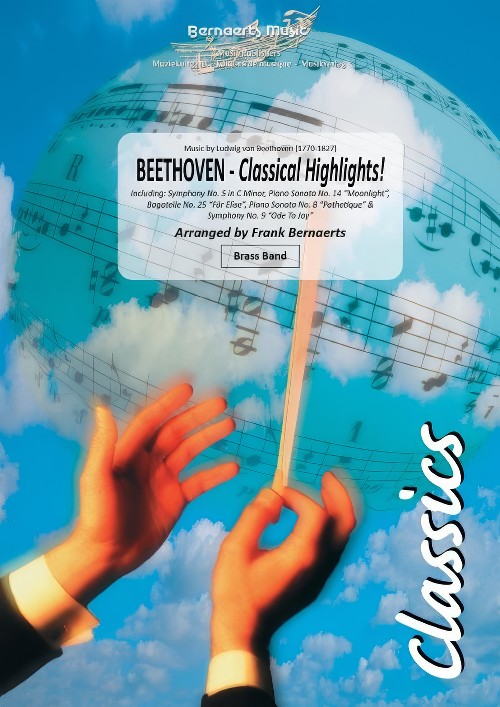
Beethoven - Classical Highlights! (Brass Band - Score and Parts) - Beethoven, Ludwig van - Bernaerts, Frank
Includes: Symphony No.5 in C minor; Piano Sonata No.14 Moonlight; Bagatelle No.25 Fur Elise; Piano Sonata No.8 Pathetique; Symphony No.9 Ode to Joy. Duration: 7.30
Estimated dispatch 7-14 working days
-
 £60.99
Worn Down Piano (Brass Band - Score and Parts)
Worn Down Piano was a huge hit for the Mark & Clark Band in 1977. This arrangement by Klaas van der Woude makes an entertaining piece with its tonal contrasts working exceptionally well for brass band. 07:25
Estimated dispatch 7-14 working days
-
 £107.95
Cornet Concerto (Brass Band - Score and Parts) - Gregson, Edward
The Cornet Concerto was commissioned by Black Dyke Band for their principal cornet, Richard Marshall, and was premiered at the European Brass Band Festival's Gala Concert in Lille, France, on 30 April 2016 by the same performers, conducted by Nicholas Childs.It is challenging work, both musically and technically, and one that exploits the wide range of the instrument's capabilities. Lasting for some 17 minutes, it is in the usual three movements: Sonata, Intermezzo (subtitled 'Of More Distant Memories') and Rondo.The first movement presents four main ideas:Cadenzas (which recur throughout the movement, and indeed appear at the end of the work); a fast and rhythmically energetic motive; Bugle calls (echoing the ancestor of the cornet), and a lyrical and expressive melody, full of yearning. These four ideas are juxtaposed within the broad shape of a Sonata form structure, although here the word 'Sonata' is used in its original meaning of 'sounding together'.The second movement is music in search of a theme, which eventually comes at the end of the movement. In the middle section there are brief quotations, albeit mostly hidden, from three cornet solos written by the Swedish/American composer Erik Leidzen for the Salvation Army in the 1940s and 50s; these are solos I loved as a teenager, and my use of them is by way of tribute, not imitation - a sort of memory bank, just as the main theme of the movement, when it eventually comes, is reminiscent of the tune from my earlier work for brass band, 'Of Distant Memories'.The final Rondo, the shortest of the three movements, is a lively and 'fleet-of foot' Scherzo, its main theme full of cascading arpeggios, but with a contrasting lyrical second theme intertwined in the structure. There is much interplay between soloist and band in the development of the music, but eventually a brief reprise of the opening cadenzas leads to an exciting and climactic coda.Click here for the piano reduction
Estimated dispatch 7-14 working days
 View Music