
Results
-
 £106.99
Vivid Brass - Philip Sparke
Vivid Brass was commissioned by Vivid Brass Tokyo, a brass band that is made up of professional players who meet up for concerts and recording projects. Philip Sparke has been a frequent guest conductor with the band. The result is Vivid Brass, a work in which all sections come to the fore as the energy of the band shines through!
Estimated dispatch 5-14 working days
-
 £228.70
Sollicitus for Brass band and Percussion - Fredrick Schjelderup
The latin title Sollicitus means upset or uneasy is important in terms of the character and form of the work. This work contains several different pcarts, all of them based around a fanfare-like theme which is presented several times. This theme change it's character, form, tonality, rhytmic and tension throughout the piece which triggers the turbulence of the music. Sollicitus is a commission for Midtun Skoles Musikkorps and their conductor Christian Breistein for their participation in the Norwegian Championships for School Bands in 2017. The version for Brass Band was written to Laksevag Musikkforening for their participation at the Norwegian Brass Band Championships 2018.
Estimated dispatch 5-14 working days
-
 £69.99
Adagio for Brass - Jan Van der Roost
Adagio for Brass is full of beautiful lyrical melodies and the warm harmony and full orchestration give the audience and the band the chance to give their thoughts free reign in a contemplative atmosphere. A wonderfully uplifting work suitable for concerts on all occasions and certainly not one to be missed.
Estimated dispatch 5-14 working days
-
 £69.99
Triumphal Brass - Jan de Haan
This exciting and energetic composition calls on all members of the band to try their best to make the audience jump out of their seats when they hear the fi rst notes. Jan de Haan's elaboration of two main themes lets the musicians present themselves as truly Triumphal Brass! The work was written as a test piece for the concert program in the Flemish Open Brass Band Championships 2010.
Estimated dispatch 5-14 working days
-
 £54.99
Joyful March (Brass Band - Score and Parts)
As the title implies, this piece is all joy and cheerfulness. In Joyful March, the themes have been combined to make a spirited work that can give each concert an elated touch. From the opening vivid melody to the softer and colourful themes of the trio, Joyful March is full of joie de vivre. Its fairly simple structure makes it accessible to all brass bands. 03:30
Estimated dispatch 7-14 working days
-
 £29.50
Friends of the Band - Ron Glynn
This lively new Concert March, "Friends of the Band", was written in recognition of those friends and supporters of all Brass Bands whose help financially and in all other ways, are invaluable in the successful running of the organisations. There is a slight hint of the song, "Dear Old Pals, Jolly Old Pals" in the first section which again embeds the feelings all players and conductors have towards our band's supporters. The work was originally composed for the Hook Norton Brass Band, when the composer's wife gave so much of her time encouraging supporters to become friends. This is a great addition to all bands' libraries and a way to pay tribute and thanks.
In Stock: Estimated dispatch 1-3 working days
-
 £50.00
Solemn Procession (Brass Band - Score and Parts) - Strauss, Richard - Hindmarsh, Paul
Richard Strauss (1864 - 1949) was a famous conductor and composer when he wrote Feierlicher Einzug der Ritter des Johanniter-Ordens (Solemn Entrance of the Knights of the Order of Saint John) in 1909. One of only a handful of his works written exclusively for winds, Strauss composed Feierlicher Einzug for the investiture ceremonies of the Order of St. John, a Christian military order that was founded in Jerusalem in 1023 to care for poor, sick, or injured pilgrims journeying to the Holy Land.Strauss scored Feierlicher Einzug (TrV 224) for a large ensemble of fifteen trumpets, four horns, four trombones, two tubas and timpani. He saw enough potential in its stately character and majestic conclusion to produce a version for symphony orchestra with organ and it has been arranged for a variety of brass ensembles with or without organ since then.This version for British style brass band was adapted from the original in 1990 by Paul Hindmarsh for the exclusive use of Besses o' th' Barn Band, of which he was then the musical director. Now that the music of Richard Strauss published in his lifetime is in the public domain, Solemn Procession, as it has been rendered in English, can be enjoyed by all brass bands and their audiences.- Paul HindmarshDuration: 6.00
Estimated dispatch 7-14 working days
-
 £60.99
Camille (Flugel Horn or Trumpet Solo with Brass Band) - Waignein, Andre
The flugel horn has one of the most lush sounds of all brass instruments and this is used to full effect in this magnificent stately work featuring the flugel horn as a soloist.Duration: 6:00.
Estimated dispatch 7-14 working days
-
 £42.70
Thanks for All (Brass Band - Score and Parts) - Ringgenberg, Jorg
This set is March Card sized
Estimated dispatch 7-14 working days
-
 £30.00
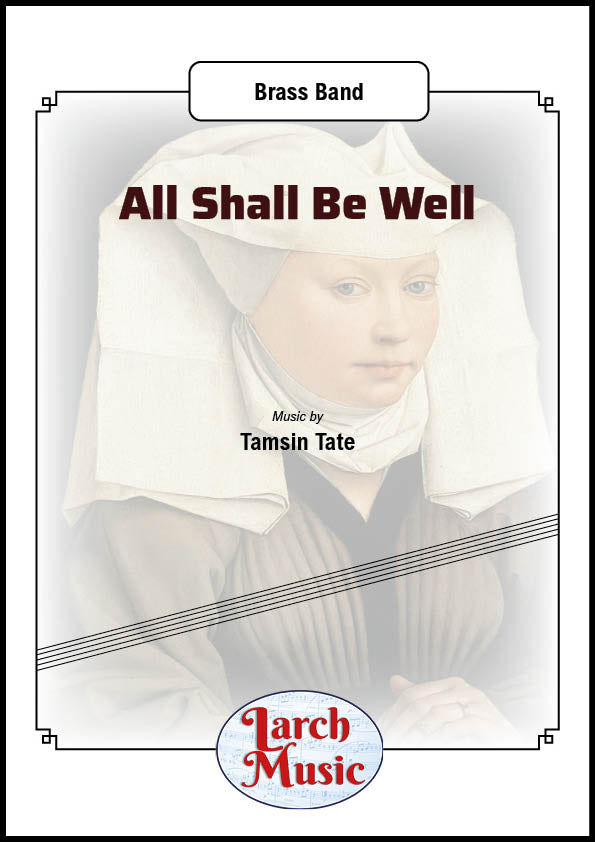
All Shall Be Well - Brass Band Sheet Music Full Score & Parts - LM931
COMPOSER: Tamsin TateCOMPOSERS NOTE"All shall be well" was composed during the first lockdown of the Covid crisis, from May 2020.This was a worrying time for many and a time of great anxiety and sadness for some.I have always tried to be practically optimistic in trying times, but still I needed hope.I am lucky to have a faith in God which gives me hope and assurance that things will be better,and I also know that music, particularly playing it, can help express some of these emotions.Certainly, music through the crisis was a wonderful, enjoyable escape for meand one I shared with my family and my band family through our online recordings.Julian of Norwich was an anchoress in the 14th Century.She set herself apart for God and spent a lot of time in prayer.Interestingly, she was the first published woman in the English language.Julian of Norwich is quoted as saying "all shall be well, all shall be well,and all manner of thing shall be well." The paraphrase of this spurred me on to develop this piece for brass band.Hopefully you will also find that the music portrays the worries and trials of this uniquetime through the natural minor key, with the rhythm hinting towards the phrase"All shall be well" and then the dawning transition to the major keyfollowed by a triumphant ending with the whole band joining together.Thanks to Adam Cable and the Martlesham Brass family for support and encouragement always.Thanks also to Alan Fernie and his supportive critique of my initial efforts.LM931 - ISMN : 9790570009312
In Stock: Estimated dispatch 3-5 working days
 View Music