
Results
-
 £30.00
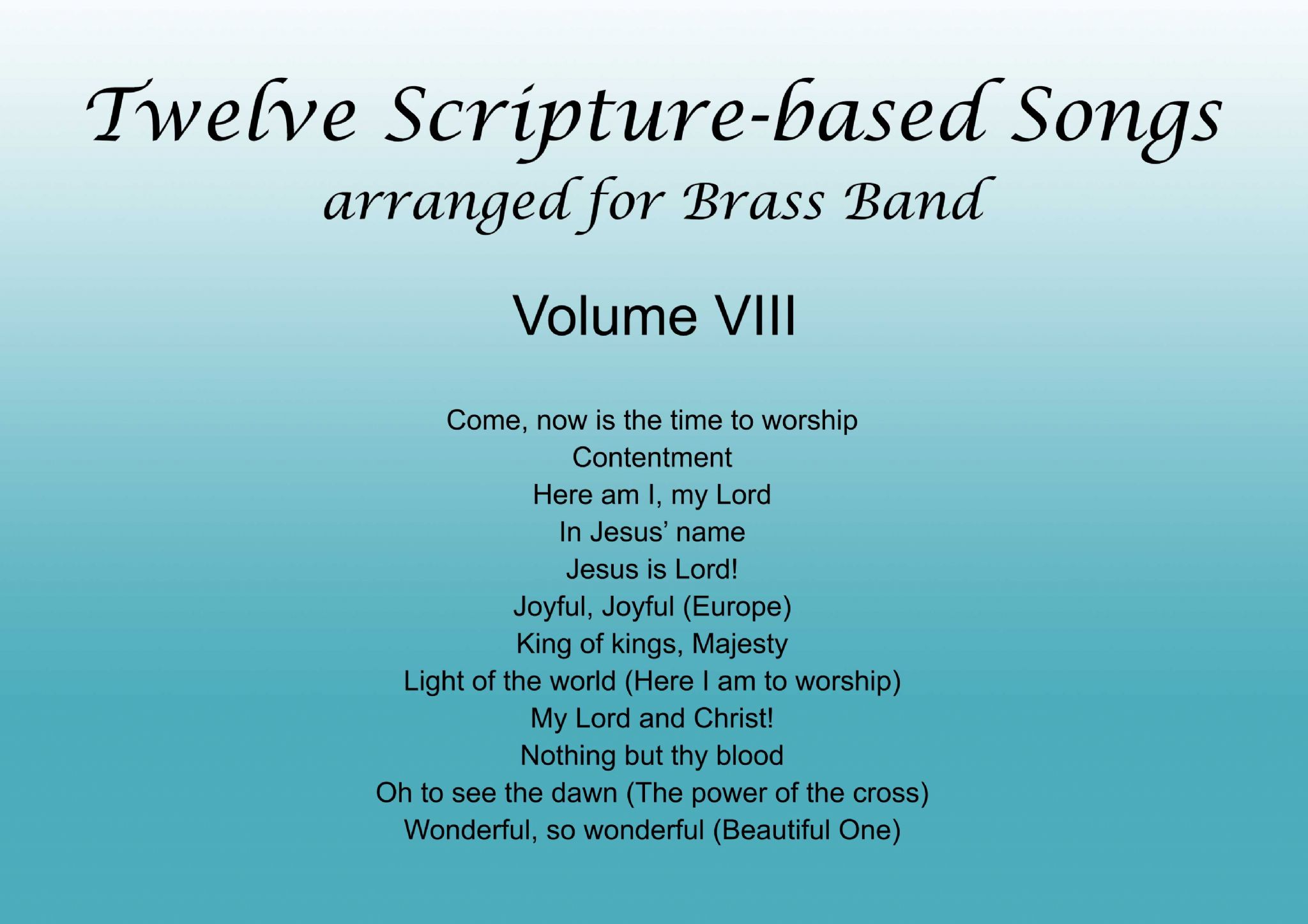
Twelve Scripture-Based Songs Volume VIII
Twelve scripture-Based Songs arranged for Brass Band (Volume VIII) are packaged and marketed in complete sets which include a full score and a set of master parts. It is intended that these parts be used as 'masters', for the purpose of photocopying a quantity of parts to accommodate the precise instrumentation needs of the band for which this has been purchased.Come, now is the time to worshipContentmentHere am I, my LordIn Jesus' nameJesus is Lord!Joyful, Joyful (Europe)King of kings, MajestyLight of the world (Here I am to worship)My Lord and Christ!Nothing but thy bloodOh to see the dawn (The power of the cross)Wonderful, so wonderful (Beautiful One)
Estimated dispatch 7-14 working days
-
 £34.95
Song of the Night Sky (Cornet Solo)
Cornet Solo with Brass BandOrpheus is known as the most talented music player of the ancient times. It is said that god Apollo was his father, from whom took his extreme talent in music, and the Muse Calliope was his mother. Tragedy struck when his wife, Eurydice stepped on a viper which in turn bit her, injecting its fatal venom. Nothing could stop his cries of anguish and sheer pain and sorrow upon realizing his beautiful Eurydice was dead. Orpheus decided to go into the Underworld to get his wife back. Apollo, his father, would talk to Hades, the god of the Underworld to accept him and hear his plea.And so Orpheus set off into the Underworld and was warned that for no reason must he look back while his wife was still in the dark, for that would undo everything he hoped for. As Orpheus was reaching the exit of the Underworld, he could hear the footfalls of his wife approaching him. As his was approaching the exit, his heart was beating faster and faster.The moment he stepped on the world of the living, he turned his head to hug his wife. Unfortunately, he got only a glimpse of Eurydice before she was once again drawn back into the underworld. When Orpheus turned his head, Eurydice was still in the dark, she hadn't seen the sun and, was drowned back to the dark world of the dead. Waves of anguish and despair swept over him and shuddering with grief he approached the Underworld again but this time, he was denied entry, the gates were standing shut and god Hermes, sent by Zeus, wouldn't let him in.His songs were no more joyful but extremely sad. His only comfort was to lay on a huge rock and feel the caress of the breeze, his only vision were the open skies.Song of the Night Sky was recorded by Tom Hutchinson and the Cory Band in June 2015, featuring on his debut solo album.
Estimated dispatch 7-14 working days
-
 £45.00
Mirror, Mirror, I'm The Star - Christopher Bond
Originally part of The GUS Band's 2025 Brass in Concert performance, this tango-inspired solo for soprano cornet is sure to bring attention to any player. In the premiere performance, the solo saw soprano cornetist, Jack Wilson, portraying the role of Gaston in the tale as old as time, Beauty and the Beast, with plenty of confidence and a certain love for... himself. With its cadenza opening and plenty of scope for comedic effect, this is a work which is uniquely striking and showcases the full capability of the soprano cornet's range.
Estimated dispatch 10-14 working days
-
 £52.00
La Bamba - Traditional/Henk Ummels
This single from Ritchie Valens from 1958 is originally a Spanish song from Mexican folklore. Years later it was picked by Rolling Stone magazine as the only non-English song in their 500 Greatest Songs of All Time list at number 345. In 1987 it was covered by the American band Los Lobos, for the film La Bamba, about the life of Ritchie Valens. This arrangement has been made for flexible setting, and is suitable for a developed student band.
Estimated dispatch 10-14 working days
-
 £30.00
Three Pieces from Czechoslovakia - Leos Janacek
This is the music of Leos Janacek (1854-1928) - exciting, powerful, emotive, impassioned, unpredictable, and many other definitions all rolled into one! Janacek was little known in Britain until the 1960's, when the conductor Charles Macherras introduced his unique music and opera to the western audience. His orchestral Sinfonietta was an instant hit. Janacek has since been one of the featured composers in the 'Proms'.The three pieces which I have arranged for brass band are INTRODUCTION, ORGAN SOLO and INTRADA from Janacek's Glagolitic Mass. They work equally well together or on their own, as they each have their own identity. They can be purchased together or separately.1. INTRODUCTIONA great 'starter' for the first or second half of a concert. 2. ORGAN SOLOThis is a 'must' if you want to impress your audience - every section of the band is incredibly busy, (although they can be assured that they do have time to breath)! 3. INTRADAThis piece, (and no.1 "Introduction"), both contain that 'fanfare' like quality which Janacek is famous for in his Sinfonietta.
In Stock: Estimated dispatch 3-5 working days
-
Bernie's Song - Miller/Leiber/Stoller ver.Mulligan, arr.John Dankworth - Len Jenkins
Bernie's Tune is a 1953 jazz standard with music written by Bernie Miller and lyrics by Jerry Leiber and Mike Stoller. It was popularised through a recording by the quartet of the American saxophonist and composer Gerry Mulligan, and the tune was a popular choice for musicians jamming at the time. Information about the composer is scarce. All that people really know of him is that he was a piano player from Washington DC. Gerry Mulligan's version was subsequently arranged by the late, legendary John Dankworth and this arrangement for brass band has been faithfully based on it to evoke the atmosphere of that golden era.
-
 £66.17
Overture - The Flying Dutchman (Brass Band) Wagner arr. Keith M. Wilkinson
The opera The Flying Dutchman (Der Fliegende Hollander) was first performed in Dresden in 1843, conducted by the composer, who had also written the libretto, and 27 years later became Wagner's first opera to be performed in London. The opera describes the search of a Dutch sea-captain for a woman who will be faithful to him. The very popular overture encapsulates much of the story-line of the opera, including the wild swirling ocean, a strong motif depicting the hero and tender music associated with Senta, the lady he seeks. This brass band arrangement was initially prepared for the 50th anniversary in 1983 of the GUS Band, which the arranger was successfully directing at the time. Difficulty Level: 1st Section + Sheet music available from: UK - www.brassband.co.uk USA - www.solidbrassmusic.com Instrumentation: Soprano Cornet Eb Solo Cornet Bb Repiano Cornet Bb 2nd Cornet Bb 3rd Cornet Bb Flugel Horn Bb Solo Horn Eb 1st Horn Eb 2nd Horn Eb 1st Baritone Bb 2nd Baritone Bb 1st Trombone Bb 2nd Trombone Bb Bass Trombone Euphonium Bb Bass Eb Bass Bb Timpani Percussion 1-2
In Stock: Estimated dispatch 1-3 working days
-
 £59.95
Bonnie Northumbria - Brass Band - LM786
COMPOSER: Laurie JohnstonProgramme NotesNorthumberland, or Northumbria as it is also known, is the most northern county in England and has magnificent and stunning landscapes just waiting to be explored. Filled with mystical castles, atmospheric ruins and historical sites and edged by spectacular coastal scenery, there is something wonderful to see at every turn. The Devils Causeway passes through Northumbria and reaches Berwick upon Tweed at the coast. Walkers and cyclists can also take the Coast and Castles Cycle Route or the North Sea Trail which journey through some of the most beautiful scenery along the way.The Blaydon Races is aGeordiefolk songwritten in the 19th century byGeordie Ridley, in a style deriving frommusic hall. It is regarded by many as the unofficialanthemofTynesideand is frequentlysungby supporters ofNewcastle United Football ClubandNewcastle Falconsrugby club.Blaydonis a small town inGateshead, situated about 4 miles (6.4km) fromNewcastle upon Tyne, inNorth East England. The race used to take place on the Stella Haugh 1 mile (1.6km) west of Blaydon.Stella South Power Station(demolished in 1995) was built on the site of the track in the early 1950s, after the races had stopped taking place in 1916.Water of Tyne (sometimes rendered as The Waters of Tyne) is a folk song (Roud number1364) from the north-east of England. The song is sung by a girl or woman lamenting the fact that her paramour is on the opposite bank of theRiver Tyne. Sleeve notes to Michael Hunt's recording of Tyneside songs states that "the ferry is believed to be that atHaughton Castleon theNorth Tyne". Alternatively the "rough river" in the last line may indicate a point further downstream, possiblyTynemouth.The song was collected byJohn Bellin 1810 and published two years later inRhymes of Northern Bards.The Keel Row is a traditional Tyneside folk song evoking the life and work of thekeelmenofNewcastle upon Tyne. A closely related song was first published in aScottishcollection of the 1770s, but may be considerably older, and it is unclear whether the tune is Scottish or English in origin.The opening lines of the song set it inSandgate, that part of the quayside overlooking the River Tyne to the east of the city centre where the keelmen lived and which is still overlooked by theKeelmen's Hospital.Versions of the song appear in both England and Scotland, with Scottish versions referring tothe Canongaterather than Sandgate. The earliest printing was in the 1770s inEdinburghin A Collection of Favourite Scots Tunes, edited by Charles Maclean, though the tune was also found in several late eighteenth-century English manuscript collections. As the term "keel" was used both sides of the border, it has not been determined which version was the original, althoughFrank Kidsonsurmised that like many other songs collected by Maclean it may originally have been aJacobiteair from the time of the1745 rebellion. Some versions of the song make reference to a "blue bonnet[...] with a snowy rose upon it", a clear attempt to evoke Jacobite symbolism, whether dating from 1745 or not.Kidson, however, also noted that he had found the tune of The Keel Row associated with an early dance called "The Yorkshire Lad" as early as 1748.By the 19th century the tune was well associated with the River Tyne; a few years before the 1850s the keelmen had met yearly to celebrate the founding of the Keelmen's Hospital, perambulating the town to the accompaniment of bands playing The Keel Row.Dance To Thy Daddyis a traditional Englishfolksong, originating inNorth East England. An early source for the lyrics, Joseph Robson's "Songs of the bards of the Tyne", published 1849, can be found on the Farne archive. In Farne's notes to the song, it is stated that these lyrics were written by William Watson around 1826.
In Stock: Estimated dispatch 3-5 working days
-
 £119.00
Decennium - Eric Swiggers
'Decennium' was composed in 2003 as a commission by the municipality of Berheze for its tenth anniversary. The composition describes the history of this town in the Province of Brabant, consisting of 6 different villages: Heesch, Heeswijk, Dinther, Nistelrode, Loosbroek and Vorstenbosch. The composition starts with a slow introduction, Adagio Misterioso, suggesting the atmosphere in long-ago days when the area consisted mainly of swamps, meres and low woods. (The word 'Bern' is a synonym of 'Born' meaning source or water, whereas 'Hese' is derived from 'Haisjo' meaning brushwood ). Above the dark sounds we hear far away trumpet signals announcing the Middle Ages. After a piercing crescendo, we hear the full sound of festive trumpets. A medieval dance, as was to be heard in the Heeswijk castle, follows. This dance gets a more and more stirring character and finally turns into a merry popular dance ending with a burst of laughter reproduced by descending scales with the muted trombones and trumpets. A slow transition with a quotation from a Gregorian plainsong (Domine Deus) and church bell ringing, referring to the Abbey of Berne, brings us to a romantic Larghetto. This part describes the quiet rural life in a beautiful natural surrounding. The last dying note contrasts with the threatening ostinato, referring to the rise of the industrialization, which provoked quite some resistance with the local people. Once more we hear the 'Domine Deus' but much more powerful this time. When the resistance calms down, the work concludes with an Alla Marcia. The first notes of the main theme could be heard all through the composition and now we hear the complete main theme again. The new town is born. A festive conclusion refers both to the tenth anniversary and the optimism and confidence as to the future.
Estimated dispatch 10-14 working days
-
£35.00
Elegie - Peter Meechan
The opening unaccompanied passage of this work was originally written as a short memorial piece for saxophone, but was later adapted as the basis of this more developed work for solo euphonium or trombone.The work uses a variation structure, with both the soloist and the accompaniment changing throughout the piece; the harmony, rhythm and melodic lines leading somewhere new and different each time they are heard - similar to the way our memories of a person often wander in different directions, but are still always focused on that person.
Estimated dispatch 12-14 working days
 View Music
 Watch video