
Results
-
£35.00
O Verona - Armstrong, C - Harper, P
If you are looking for a dramatic and epic concert opener, this could be the one for you! Based on O Fortuna from Orff's Carmina Burana, this was used for the opening montage of the 1996 film Romeo + Juliet2nd sectionDuration 2 mins
In Stock: Estimated dispatch 1-3 working days
-
£33.00
Besses O' Th' Barn - Carrie, D
Dedicated to the famous "Besses o' th' Barn Band"Includes a full band set (no score)
In Stock: Estimated dispatch 1-3 working days
-
 £52.30
A Renaissance Christmas (Brass Band) Kevin Norbury
VIEW SCORE PDF This magnificent festive suite was written by Kevin Norbury for the Pierre Elliott Trudeau High School Wind Symphony and features several well known carols set in a Renaissance style. Here it has been set for brass band. Three contrasting movements comprise the work: i. Processional (Personent hodie - On this day earth shall ring) This is a short piece imagining a torchlight Yuletide procession (perhaps bearing the traditional roasted wild boar), using a well-known Christmas melody from the large collection of music compiled in the 16th century called Piae Cantiones (1582). The tune is presented twice with accompanying, related melodic material. ii. Pastorale (Quem pastores laudavere - Shepherds sang their praises o'er him) This is a 14th-century melody which was originally collected by Michael Praetorius at the end of the 16th-century. The treatment throughout is very lyrical without overly complex harmonies. The melody is heard three times with brief linking episodes and a short coda. iii. Celebration! (In dulci jubilo - In sweet celebration - Ding-dong merrily on high)) This magnificent 13th-century melody was also a part of Michael Praetorius's collection. It is traditional associated with the words 'Good Christian men, rejoice!' The opening is a straight transcription of the great chorale prelude for organ by J.S.Bach. After the grandeur of the opening, the tune is heard in more of a 'folky' style. A lot of related melodic material is then presented before the tune Ding-dong merrily on high is heard. After another episode of previously used music In dulci jubilo reappears in a joyful conclusion to the piece. Sheet music available from: UK - www.brassband.co.uk USA - www.solidbrassmusic.com Difficulty Level: 3rd Section + Instrumentation: Soprano Cornet Eb Solo Cornet Bb Repiano Cornet Bb 2nd Cornet Bb 3rd Cornet Bb Flugel Horn Bb Solo Horn Eb 1st Horn Eb 2nd Horn Eb 1st Baritone Bb 2nd Baritone Bb 1st Trombone Bb 2nd Trombone Bb Bass Trombone Euphonium Bb Bass Eb Bass Bb Percussion 1-4
In Stock: Estimated dispatch 1-3 working days
-
 £95.00
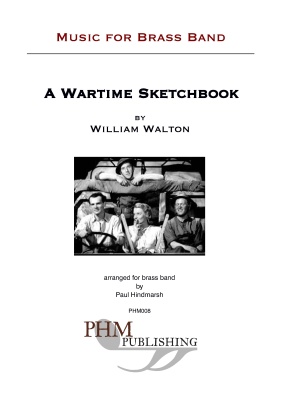
A Wartime Sketchbook (Brass Band - Score and Parts)
Early in 1941 William Walton, 39, received his call-up papers. He was by then one of the most eminent of British composers and was exempted from military service on condition that he provided music for films deemed to be of 'national importance'. Scoring Lawrence Olivier's Shakespeare epic Henry V in 1943 was the most substantial of these wartime projects. His role in patriotic films from 1941 and 42 like The Foreman went to France, Next of Kin, Went the day Well and The First of the Few was to provide appropriate title music and some underscoring at key moments. Walton extracted the most substantial portions of the latter as the popular Spitfire Prelude and Fugue for orchestra. The remaining music remained unpublished until 1990, when Christopher Palmer assembled the highlights into A Wartime Sketchbook. I was intrigued to hear these examples of Walton's wartime music and having discovered that they would fit naturally and idiomatically onto the brass band, I arranged six of the numbers into a suite for Besses o' th' Barn Band, which I was conducting at the time.In 1995 the brass band suite was recorded by the famous Black Dyke Mills Band as part of an all Walton album which I produced for the ASV label (ASV CD WHL 2093). This award- winning CD also included Walton's First Shoot, in the edition by Elgar Howarth, my transcription of movements from Music for Children and two substantial brass versions by Edward Watson of the suite from Henry V (with narrator) and the March and Siegfried Music from The Battle of Britain music.Prologue: This is the stirring title music from Went the day Well, a screen play by Graham Greene about a German airborne invasion of an English village. The main theme leads toBicycle Chase: Characteristic musical high-jinks for J.B.Priestley's The Foreman went to France.Refugees: From the same film, this is a poignant accompaniment to the long march of refugees. As Ernest Irving, the film's musical director, put it, "this really makes your feet sore and your knees sag."Young Siegfrieds: This lively movement comes from the music that Walton composed for The Battle of Britain in 1968, with the assistance of Malcolm Arnold, but which the film's producer rejected. It portrays first the Berliners, cheerfully ignoring the black-out and then, in the trio, the Young Siegfrieds of the Luftwaffe, courtesy of a parody of Siegfried's horn call from Wagner's opera.Romance: A soldier and a Dutch refugee snatch a few tender moments together in Next of Kin.Epilogue: At the end of The Foreman went to France, the French look forward with hope and optimism to eventual liberation.- Paul HindmarshDuration: 14.00
Estimated dispatch 7-14 working days
-
£40.00
A Wartime Sketchbook (Brass Band - Score only)
Early in 1941 William Walton, 39, received his call-up papers. He was by then one of the most eminent of British composers and was exempted from military service on condition that he provided music for films deemed to be of 'national importance'. Scoring Lawrence Olivier's Shakespeare epic Henry V in 1943 was the most substantial of these wartime projects. His role in patriotic films from 1941 and 42 like The Foreman went to France, Next of Kin, Went the day Well and The First of the Few was to provide appropriate title music and some underscoring at key moments. Walton extracted the most substantial portions of the latter as the popular Spitfire Prelude and Fugue for orchestra. The remaining music remained unpublished until 1990, when Christopher Palmer assembled the highlights into A Wartime Sketchbook. I was intrigued to hear these examples of Walton's wartime music and having discovered that they would fit naturally and idiomatically onto the brass band, I arranged six of the numbers into a suite for Besses o' th' Barn Band, which I was conducting at the time.In 1995 the brass band suite was recorded by the famous Black Dyke Mills Band as part of an all Walton album which I produced for the ASV label (ASV CD WHL 2093). This award- winning CD also included Walton's First Shoot, in the edition by Elgar Howarth, my transcription of movements from Music for Children and two substantial brass versions by Edward Watson of the suite from Henry V (with narrator) and the March and Siegfried Music from The Battle of Britain music.Prologue: This is the stirring title music from Went the day Well, a screen play by Graham Greene about a German airborne invasion of an English village. The main theme leads toBicycle Chase: Characteristic musical high-jinks for J.B.Priestley's The Foreman went to France.Refugees: From the same film, this is a poignant accompaniment to the long march of refugees. As Ernest Irving, the film's musical director, put it, "this really makes your feet sore and your knees sag."Young Siegfrieds: This lively movement comes from the music that Walton composed for The Battle of Britain in 1968, with the assistance of Malcolm Arnold, but which the film's producer rejected. It portrays first the Berliners, cheerfully ignoring the black-out and then, in the trio, the Young Siegfrieds of the Luftwaffe, courtesy of a parody of Siegfried's horn call from Wagner's opera.Romance: A soldier and a Dutch refugee snatch a few tender moments together in Next of Kin.Epilogue: At the end of The Foreman went to France, the French look forward with hope and optimism to eventual liberation.- Paul HindmarshDuration: 14.00
Estimated dispatch 7-14 working days
-
 £37.35
El Camino A Belen - Trumpet Solo with Brass Band (Nick Simmons-Smith)
VIEW SCORE PDF This trumpet solo was written by Nick Simmons-Smith at the request of Dallas Brass Band for a Christmas concert featuring Elmer Churampi, international trumpet soloist. The solo features three Christmas songs: i. Mi Burrito Sabanero voy camino de Belen (With my donkey of the Savannah, I'm going to Bethlehem) ii. Noche de paz (Silent night) iii. Campana Sobre Campana (Bell above bells, O bells of Bethlehem) These songs are all very popular in Central and South America - including Peru, where Elmer Churampi is originally from. Each tune has been given a different Latin treatment producing a fast-slow-fast festive concert solo. The solo is not long, but each movement could be played individually. To view a video of Elmer Churampi performing the solo with Dallas Brass Band, please visit: www.youtube.com/watch?v=cpQCFXReEJg PDF download includes score and full set of parts. Sheet music available from: UK - www.brassband.co.uk USA - www.solidbrassmusic.com Instrumentation: Trumpet Soloist Bb Soprano Cornet Eb Solo Cornet Bb Repiano Cornet Bb 2nd Cornet Bb 3rd Cornet Bb Flugel Horn Bb Solo Horn Eb 1st Horn Eb 2nd Horn Eb 1st Baritone Bb 2nd Baritone Bb 1st Trombone Bb 2nd Trombone Bb Bass Trombone Euphonium Bb Bass Eb Bass Bb Percussion 1-3
In Stock: Estimated dispatch 1-3 working days
-
 £30.00
A Scottish Visit (Traditional arr. by Chris Cobon) - Brass Band Sheet Music Full Score & Parts - LM409
COMPOSER: TraditionalARRANGER: Chris CobonISMN : 9790570004096Take a trip to Scotland with your band. This medley comprises ofCock 'O The NorthWi' A Hundred PipersScotland The BraveGet the audience clapping along and maybe a highland fling....!LM409 - ISMN : 9790570004096
In Stock: Estimated dispatch 3-5 working days
-
 £25.00
O Waley, Waley - Traditional
This poetic music based on a Scottish folktale offers any concert programme a moment of tranquility.The haunting theme opens with a solo cornet and travels throughout the band, moving towards a rousing flourish and calming to the ending pause.
In Stock: Estimated dispatch 3-5 working days
-
 £30.00
A Christmas Overture (Various arr. by Stuart J. Rogers) - Brass Band Sheet Music Full Score and Parts - LM493
COMPOSER: VariousARRANGER: Stuart J. RogersA collection of Christmas favourites beautifully arranged into a medley of seasonal joyContainsDeck The HallsDing Dong Merrily on HighSilent NightI Saw Three ShipsIn Dulci JubiloGood King WenceslasO Come, All Ye FaithfulLM493ISMN : 9790570004935
In Stock: Estimated dispatch 3-5 working days
-
 £30.00
A Very Welsh Christmas - Brass Band Sheet Music Score & Parts - LM949
ARRANGER: Alex McGeeA Very Welsh ChristmasDiweddglo NadoligaiddA grand collection of Christmas carols carefully selectedand arranged by Alex McGeeCan you spot all of the carols below...Contains :Deck the Halls - originally Nos GalenCoventry CarolTua Bethlem Dref - we are going to Bethlehem townY gorau o'r boreua - ancient Welsh Plygian tune - translation The Best Of MorningsAngles from the Realms of GloryGood King WenceslasJoy to the worldO Come all Ye FaithfulSuitable for Most Bands - Duration 6 mins (Approx.)LM949 - ISMN : 9790570009497
In Stock: Estimated dispatch 3-5 working days
 View Music
 Watch video
