
Results
-
£60.00
Requiem Paraphrases - Peter Meechan
Requiem Paraphrases uses the opening bars of Mozartas Requiem as its musical material for the whole piece. An aggressive opening is followed by a sounding of Mozartas original theme, in a setting for low brass and solo euphonium. Percussion and woodwind then enter, as the soloist begins to elaborate. A brief return to the opening is followed by a new, percussion driven, section.The euphonium and various soloists in the ensemble interact, exchanging ideas over an ostinato in the marimba. As this section continues towards the cadenza, the ensemble gradually takes on more of an accompanying role, leaving the soloist to again break free, with flourishes and gestures leading to the cadenza.Following this, there is a short recapitulation, before the euphonium brings us to a dramatic conclusion!Requiem Paraphrases was commissioned by, and dedicated to Steven Mead.
Estimated dispatch 12-14 working days
-
 £30.00
1989 - Tim Paton
Tim Paton composed this work originally for piano, and later went on to score it into this effective version for brass band.Tim comments:What happened in 1989? I wrote this piece for piano, and later scored it for brass band! The piece begins in a thoughtful mood, then very soon moves into a bluesy style. After an up-tempo dance section, and a brief re-cap of the beginning, it finishes with a majestic coda, which really shows off that special sound that only a brass band can make. Although it is called 1989, it can be any memorable year that the listener wishes it to be.
In Stock: Estimated dispatch 3-5 working days
-
 £40.00
Little Christmas - Elaine Agnew
An atmospheric, contemporary piece for brass band by prolific composer Elaine Agnew. The work was originally commissioned by the North of Ireland Bands' Association as the 'B Section' test piece for the 2006 European Brass Band Championships, with funds from the Arts Council of Northern Ireland Lottery Unit and Belfast City Council.Programme notes:The night of Sunday the sixth of January 1839 was a night of madness. On this night, Ireland was hit by a devastating storm. Little Christmas focuses on the events of that day, leading to the arrival of the storm itself.The piece opens with a blast, which is quickly hushed by a motionless phrase whose silence suggests something not quite right. A solo euphonium mimics the local seer who prophesizes the coming of the storm but who is ignored by the locals, who are well used to his rantings and ravings.A brief percussion improvisation hints at an uncertainty in the air but this is quickly ignored by the following fast section with the bustle and excitement of the day's preparations.Quiet solo chromatic lines swoosh over harmonic pillars of sound before the final "dizzy" section where the band lets rip at the arrival of the storm!
In Stock: Estimated dispatch 3-5 working days
-
Aldebaran - Maurice Forslund - Maurice Forslund
We are pleased to offer this new piece from our colleague, Maurice Forslund, in Sweden. "Aldebaran" is a traditional-style brass band march, named after one of the brightest and largest stars in the Northern sky. (The star is a red giant over 40 times the size of our Sun). The music starts off in a sombre minor key that turns progressively brighter step by step. This sequence is arrested by a brief section featuring a setting of the hymn tune 'Bangor' which dramatically puts the march firmly back into the minor key before setting it up for progression to the finale. This piece is graded in the range 'easy' to 'intermediate' and is well within the capabilities of most bands.
-
£40.00
Winter Hill - Barry, D
A new euphonium solo from well-loved composer Darrol Barry. A beautiful and nostalgic first lyrical section leads to a brief cadenza, and then a virtuosic and fast-moving Brioso. Band parts are manageable by most, but you'll need a good soloist for this one!2nd section +Duration 4 mins
In Stock: Estimated dispatch 1-3 working days
-
 £39.95
Impulse (Brass Band - Score and Parts)
This work represents a brief, musical study of the practical expression of faith by Salvationists. Why do we do what we do? The beginning of the piece reflects the busyness and drive of those who feel called to Rescue the perishing (S.A.S.B. 927). Motivated by compassion, there is a constant, insistent urgency to accomplish this mission, and referenced is Albert Orsborn's song Except I am moved with compassion (S.A.S.B. 626). From here, the piece builds to a climactic, full statement of Rescue the perishing.
Estimated dispatch 7-14 working days
-
 £39.95
Liberty Trail (Brass Band - Score and Parts)
The Melbourne Staff Band celebrated its 125th anniversary in 2015 and this work was commissioned by Staff Bandmaster Ken Waterworth to feature in their programmes throughout the year.The music opens with fiery rhythmic figures, drawing on the band's technical brilliance. As the music progresses there are hints of traditional marches from early years, both in form and the minor key harmony used.The Trio section features The Homeward Trail, a song from the pen of Colonel Arthur Arnott, a Salvation Army officer who spent the majority of his career serving in Australia. The tune is then developed thematically and, following an interlude and key change, receives another treatment filled with fanfare and flourish that leads into the concluding moments of the work.Just prior to the closing bars, the music pays a brief homage to Australian composer Arthur Gullidge with a quote from his classic march Liberty (G.S. 1296), published in 1948, as a final salute to the great music that has come from this country.
Estimated dispatch 7-14 working days
-
 £29.95
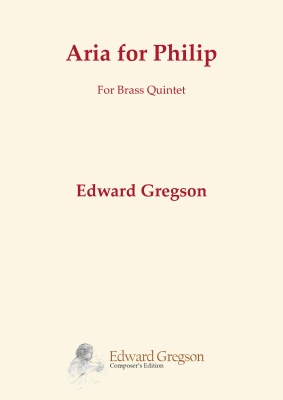
Aria for Philip (Brass Quintet - Score and Parts)
Instrumentation:2 Trumpets in CHorn in FTromboneTubaWritten in memory of Philip Jones, this short work was first performed at his memorial concert held at the Royal Northern College of Music in 2000. Scored for Brass Quintet, it was performed by former members of the Philip Jones Brass Ensemble.My friendship with Philip Jones stretched back to my student days, when my Quintet for Brass was performed during my final year at the Royal Academy of Music. Philip was present at that premiere in 1967, and soon after that his ensemble performed and broadcast the Quintet on a UK Tour, including a performance in the finals of the BBC Young Composer's Competition. I owe him a huge debt of gratitude for promoting a work by a then unknown young composer.I use a brief quote from the opening of my 1967 Brass Quintet in this work, which is generally rather sombre in character, except for the sudden change of mood and tempo in the short final section, when the clouds suddenly lift and the sun shines through.- Edward GregsonDuration: 5.00
Estimated dispatch 7-14 working days
-
 £24.95
Prelude and Capriccio (Cornet Solo with Brass Band)
A condensed score is included with this workGregson wrote his Prelude and Capriccio in 1972. It exists in two versions: one for cornet and band and the other for cornet or trumpet and piano.The work began life in the early sixties, the Capriccio being composed when the composer was 17. A Prelude was added to complete the work, which lasts for approximately 8 minutes. The Prelude is reflective in character and uses long melodic lines over undulating chromatic harmony. The music reaches a climax before a brief reprise of the opening. The Capriccio is somewhat jazzy in its opening syncopated rhythms, but has a more lyrical middle section before a finale exploiting the virtuoso character of the instrument.
Estimated dispatch 7-14 working days
-
 £44.95
Ae Fond Kiss (Tenor Horn Solo with Brass Band - Score and Parts)
Ae Fond Kiss, by the Scottish poet Robert Burns, is widely recognised as being one of the most poignant songs of lost love ever written. A brief affair with a Mrs Agnes Craig McLehose (known to Burns as Nancy) ended with her decision to join her estranged husband in Jamaica. Her parting gift to Burns was a lock of her hair which he had set in a ring. His gift to her included the poem, the first verse of which reflects Burns' feelings of resignation and despair:Ae fond kiss, and then we sever;Ae fareweel, alas, for ever!Deep in heart-wrung tears I'll pledge thee,Warring sighs and groans I'll wage thee!
Estimated dispatch 7-14 working days
 View Music