
Results
-
 £54.99
Hymnus Antverpiae (Brass Band - Score and Parts) - Van der Roost, Jan
This hymn was commissioned by "Antwerpen 93". And this city, on the banks of the river Schelde has been nominated "Cultural Capital of Europe" for 1993. The work-group "animatie" took the initiative and commissioned a hymn, which -as the finale to a grand open-air event on 27th March- was premired by hundreds of musicians from all over Europe. Philippe Langlet (France) was the conductor at this majestic occasion. Musically speaking the piece can no doubt be labelled easy. Indeed it is meant to represent a hymn, playable by all in different instrumental combinations. Consequently a variable instrumentation was chosen and a type of music, which by native is easily accessible and uncomplicated. The conductor is free -in the instrumentation- to score this piece according to his own taste. It is perhaps advisable to use the sharp brass in the forte parts, in order to make the range in the sound of the orchestra as colourful as possible. The percussion parts are not absolutely essential, so that the hymn can also be performed without percussion.Duration: 4:00
Estimated dispatch 7-14 working days
-
 £60.99
The Mayor's Blues (Brass Band - Score and Parts) - Blanken, John
Why should rock musicians have all the fun? Now your band can experience the thrill of playing a piece in a classic 12-bar blues style. Many players are given the chance to show off their skills as a soloist before the work builds to a grand fortissimo finale with the whole band playin' the blues!Duration: 5:00
Estimated dispatch 7-14 working days
-
 £54.99
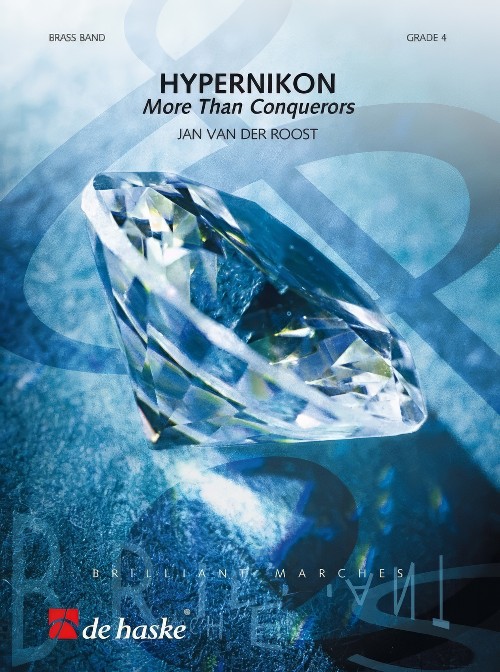
Hypernikon (Brass Band - Score and Parts) - Van der Roost, Jan
The Greek word hypernikon roughly translates as More Than Conquerors, the motto of Gordon College in Wenham, Massachusetts, the commissioner of this piece. The work is inspired by David Rox's very own name, the first two letters of his name, D and A, sets the first theme is in D major, with these notes being the tonic and dominant of the scale. After the stately intrada, the tempo accelerates and the festive feel of the march emerges. The trio melody serves as a beautiful contrast before finally ending with the opening theme in a grand tutti.Duration: 3.45
Estimated dispatch 7-14 working days
-
 £35.00
Fairy Garden, The (from Mother Goose Suite) (Brass Band - Score and Parts) - Ravel, Maurice - Littlemore, Phillip
Ravel wrote his five short piano pieces entitled?Ma M?re l'Oye?(Mother Goose) for two young children, Mimie and Jean Godeski in 1910. The suite invites us to the enchanted world of childhood through these five atmospheric tales. The final part of Ravel's suite is a grand finale, although where Ravel got his inspiration for the fairy garden is unknown. Whatever its origin, it certainly is a delightful piece of music - slow in tempo, quiet to start, with rich harmonies and delicate solos, all leading to a tumultuous climax.?Duration: 3:00
Estimated dispatch 7-14 working days
-
 £25.00
THREE ANCIENT CUSTOMS (Brass Band Score) - Cole, R Huw
2012 National Championships Finals - Third Section. Huw Cole's three-movement work depicts the customs of Wales and the West of England. The traditions are couched in the movements titles: Cwrw Bach; Mari Lwyd; Wassail. The finale offers a grand climax in the festive spirit of a wassail, before transforming into a sea shanty in homage to Gloucester's dependence on the River Severn.
Estimated dispatch 7-14 working days
-
£59.95
THREE ANCIENT CUSTOMS (Brass Band Set - Score and Parts) - Cole, R Huw
2012 National Championships Finals - Third Section. Huw Cole's three-movement work depicts the customs of Wales and the West of England. The traditions are couched in the movements titles: Cwrw Bach; Mari Lwyd; Wassail. The finale offers a grand climax in the festive spirit of a wassail, before transforming into a sea shanty in homage to Gloucester's dependence on the River Severn.
Estimated dispatch 7-14 working days
-
 £65.00
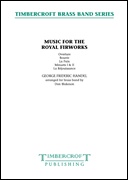
Royal Fireworks, Music from the (Brass Band - Score and Parts) - Handel, George Frideric - Blakeson, Don
Handel's Music For The Royal Fireworks was composed in 1749 to celebrate the signing of the Treaty of Aix-la-Chapelle and the end of the War of the Austrian Succession. The site chosen was the fashionable upper part of St. James Park, which was becoming known at that time as Green Park. The Green Park 'Machine', which housed the pyrotechnics was an elaborate affair adorned with "statues and other figures, festoons of flowers, and other lustres". It was announced that there would be some 10,000 rockets and other devices to be let off, all culminating in a grand, burning sun with 'Vivat Rex' at its centre. There were also rumours that the event was to be accompanied by an impressively large band of military music and mention was made of "40 trumpets, 20 french horns, 16 hautboys (oboes), 16 bassoons, 8 pairs of kettle drums, 12 side drums, a proper number of flutes and fifes; with 100 cannon to go off singly at intervals". It is unlikely that Handel had ever conceived such forces and it was merely the promoter's hyberbole, not least because it was unlikely that there were sufficient numbers of extra military musicians available that could read music, as most played from memory. It is also likely that Handel, and his publisher, were conscious that future performances would be hindered by such forces. The autographed score lists the instrumentation as 9 trumpets, 9 french horns, 24 hautboys, 12 bassoons, 3 pairs of kettle drums and up to 4 side drums. The work is in five movements, although Handel's original score did not indicate in which order they should be played. However, in this score they are arranged to be played as follows: Overture; Bour?e; La Paix; Minuets; La R?jouissance. Duration: 19:00
Estimated dispatch 7-14 working days
-
 £60.99
So nimm denn meine Hande - Friedrich Silcher - Jacob de Haan
This celebrated song is based on a poem by Julie Hausmann (1826-1901), a Latvian teacher who was probably blind. The text draws on her personal experience and unshakeable faith in God, death and eternal life. The melody by Friedrich Silcher is written in a simple and delicate style but also draws on the grand romantic tradition of Wagner and Bruckner. This arrangement can also be performed with a mixed choir. The choir parts are in German.
Estimated dispatch 5-14 working days
-
 £60.99
Helios - Jan Van der Roost
Following in the footsteps of Ceremonial March, Mercury, Arsenal and Minerva, Helios is a concert march in the tradition of grand English marches. In the first passage several connected themes are developed in a combination of contrasting nuances. The melodic line of the trio is long and expressive; a characteristic found in all Jan Van der Roost's marches. Helios represents the ideal combination of rich thematic material with a traditional harmonic structure.
Estimated dispatch 5-14 working days
-
£60.99
Versailles - Christian Bouthier
Versailles, composed by Christian Bouthier, reflects a number of impressions of the royal castle in Versailles, near Paris. There are four movements consisting of Le Chateau, Le grand Trianon, L'Appartement du Roi and Les Grandes Eaux each of which depicts a different aspect of Versailles both inside and outside. Bring a touch of regalness to any concert band programme.
Estimated dispatch 5-14 working days
 View Music