
Results
-
 £20.00
atrium phase
Descriptionatrium phase was inspired by listening to works performed at the 2013 Huddersfield Contemporary Music Festival in the atrium of the Huddersfield University Creative Arts Building. The atrium, despite being a functional area incorporating meeting areas and a cafe, has almost coincidentally evolved into a fantastic (if somewhat resonant) performance space. Performers can be positioned on three different sides and three different levels, making the atrium ideally suited to spatially separated performances of a variety of music from Gabrieli to Christian Wolff.In atrium phase the band is separated into four groups - ideally these should be positioned around the audience as follows: group A to the left of the audience, group B in front of the audience, group C to the right of the audience and group D (the four basses) behind the audience. The music "phases" between the groups in the manner of contemporary electroacoustic music, with the bass group acting as a kind of "subwoofer". Starting very slowly, the music accelerates using metrical modulations to finish at considerable speed.The music is intended to be performed without a conductor wherever possible - the three percussionists should set and control the tempo, and there are clear points of overlap for percussionists to allow synchronisation between groups.atrium phase won the inaugural Foden's Band Composition Competition in 2014 and the first performance was given on 24 January 2015 at the RNCM Festival of Brass by Foden's Band.Performance Notes:The band is separated into four groups - ideally these should be positioned around the audience as follows: group A to the left of the audience, group B in front of the audience, group C to the right of the audience and group D (the four basses) behind the audience. The music "phases" between the groups in the manner of contemporary electroacoustic music, with the bass group acting as a kind of "subwoofer". Starting very slowly, the music accelerates using metrical modulations to finish at considerable speed.Instruments in group A require cup mutes (soprano, 2 x cornets, horn, baritone, trombone, euph), group B harmon mutes (4 x cornets, baritone and trombone - the baritone should use a trombone mute) and group C require fibre straight mutes (3 x cornets, flugel, 2 x horns, euph., bass trom - NOT metal mutes if possible).Percussion instruments required are claves, wood block and 2 x temple blocks. The music is intended to be performed without a conductor wherever possible - the three percussionists should set and control the tempo, and there are clear points of overlap for percussionists to allow synchronisation between groups.Approximate duration 6'17"
Estimated dispatch 7-14 working days
-
 £89.95
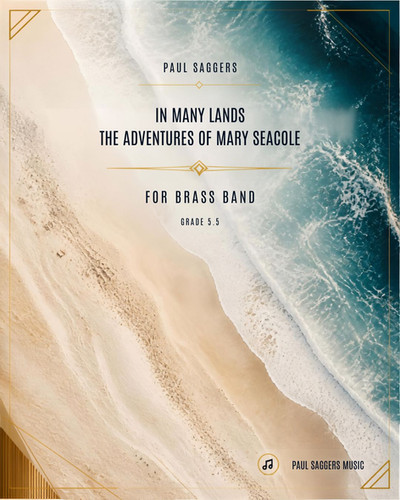
In Many Lands - The Adventures of Mary Seacole - Paul Saggers
In Many Lands - The Adventures of Mary Seacole was commissioned by The Royal Marines Band Service for The National Youth Brass Band of Great Britain. The first performance of the piece was on 16 April 2022 in Huddersfield Town Hall to celebrate the 70th anniversary of the NYBBGB. It was next performed in Birmingham Town Hall (on 28 April 2022) at a joint charity concert of the NYBBGB and The Band of Her Majesty's Royal Marines, Collingwood, for the European Brass Band Association Prelude Concert. The work is a musical account of the life of Mary Seacole who was a British-Jamaican nurse and businesswoman who set up the "British Hotel" behind the lines during the Crimean War. The work takes inspiration from Seacole's biography Wonderful Adventures of Mrs. Seacole in Many Lands. The work is divided into three movements:I Leave Kingston for Isthmus of PanamaIn 1851, Seacole travelled to Cruces to visit her brother. Shortly after her arrival, the town was struck by cholera, a disease which had reached Panama in 1849. Seacole was on hand to treat the first victim, who survived, which established Seacole's reputation and brought her a succession of patients as the infection spread. The rich paid, but she treated the poor for free. She avoided opium, preferring mustard rubs and poultices, the laxative calomel (mercuric chloride), sugars of lead, and rehydration with water boiled with cinnamon. While her preparations had moderate success, she faced little competition, the only other treatments coming from a "timid little dentist", who was an inexperienced doctor sent by the Panamanian government, and the Roman Catholic Church.The Predatory Tribes of BalaclavaSeacole was in London in 1854 when reports of the lack of necessities and breakdown of nursing care for soldiers in the Crimean War began to be made public. Despite her experience, her offers to serve as an army nurse were refused, and she attributed her rejection to racial prejudice. In 1855, with the help of a relative of her husband, she went to Crimea as a sutler, setting up the British Hotel to sell food, supplies, and medicines to the troops. After transferring most of her stores to the transport ship Albatross, with the remainder following on the Nonpareil, she set out on the four-day voyage to the British bridgehead into Crimea at Balaclava. Lacking proper building materials, Seacole gathered abandoned metal and wood in her spare moments, with a view to using the debris to build her hotel. The hotel was completed in July 1855 at a total cost of �800. Seacole's hotel was constantly targeted by thieves, she lost many resources and livestock.NYBBGB YOUTUBE PERFORMANCEhttps://www.youtube.com/watch?v=aCGzYWiKsqY
-
 £84.95
A Tear in the Fabric of Time - Gareth Wood
A Tear in the Fabric of Time is essentially a symphony for brass band and was inspired by the book The Elegant Universe by Brian Greene, which attempts to simplify complex ideas in modern physics for the layperson. This piece...
Estimated dispatch 5-7 working days
-
 £94.95
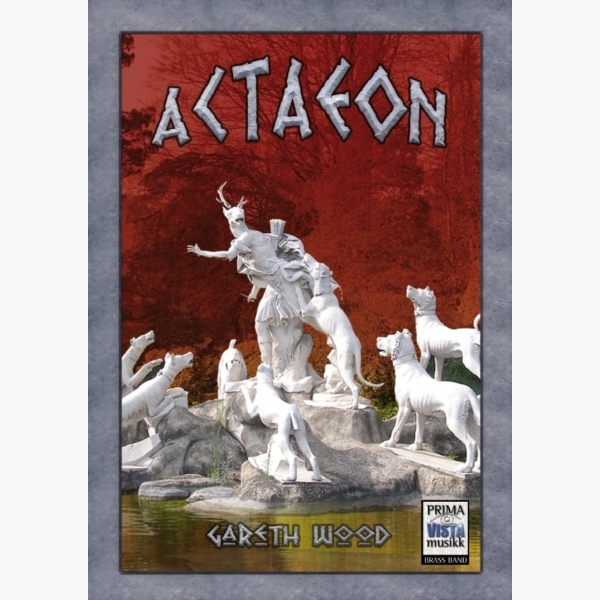
Actaeon - Gareth Wood
This major work for brass band is based on the story of the Greek mythological character, Actaeon. Artemis was bathing in the woods when the hunter Actaeon stumbled across her, thus seeing her naked. He stopped and stared, amazed at...
Estimated dispatch 5-7 working days
-
 £84.95
Brass Triumphant - Gareth Wood
Brass Triumphant is a four-movement work and was composed for the Cory Band during their 125th anniversary year of 2009. The first movement is a celebratory fanfare featuring a strong melody as the thread which runs throughout the whole work....
Estimated dispatch 5-7 working days
-
 £29.95
Bugeilio'r Gwenith Gwyn (Watching the Wheat) - Welsh Traditional - Gareth Wood
Bugeilio'r Gwenith Gwyn is an 18th century Welsh love song known to many by its English title of 'Watching the Wheat'. Although the song describes a tragic love affair, the music remains extremely popular with musicians throughout Wales. This skilful...
Estimated dispatch 5-7 working days
-
 £44.95
Fun and Games - Gareth Wood
Fun and Games is an overture for band in a festive mood, rich in melody and powerfully rhythmic. Written for the Pencampwriaeth Pres BBC Radio Cymru competition, it has all the technical challenges of a test-piece, but is just good...
Estimated dispatch 5-7 working days
-
 £74.95
Helvetia - Gareth Wood
I first went to Switzerland in the early 1970s and regularly played at the Lucerne Festival with the Royal Philharmonic Orchestra. It is a beautiful city, one of my favourite European cities. In writing Helvetia (the Roman name for Switzerland),...
Estimated dispatch 5-7 working days
-
 £29.95
Men of Harlech - Welsh Traditional - Gareth Wood
Men of Harlech is a song and military march which describes events during the seven-year-long siege of Harlech Castle between 1461 and 1468. Commanded by Constable Dafydd ap Ieuan, the garrison held out in what is the longest-known siege in...
Estimated dispatch 5-7 working days
-
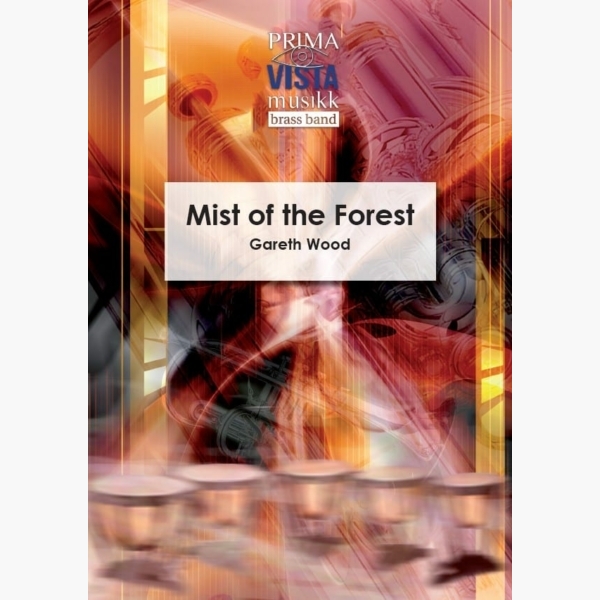 £39.95
Mist of the Forest - Gareth Wood
The inspiration for this work is a part of South Wales where the composer spent his childhood. The AfanForest Park is an old mining area that has been extensively reclaimed and transformed through one of the earliest reclamation schemes in...
Estimated dispatch 5-7 working days