
Results
-
£35.00
March: insieme - Peter Meechan
March: insieme was commissioned by the Swiss charity ainsiemea (www.insieme-vs.ch) in celebration of their 50th anniversary to be performed throughout the year in concerts raising money for the charity.The march is in a broad arc structure, with the fanfare heard at the opening of the work being reprised at the end of the work.
Estimated dispatch 12-14 working days
-
£70.00
Origins - Peter Meechan
Origins is in three movements, with each movement having a different subject matter, all linked by the idea of origins: the first movement refers to musical origins; the second to the origins of life; and the final movement to the space exploration - the research of all origins. The first movement is based on a short motif, heard in the first three notes the soloist plays. These three notes cover the interval of a minor third (an interval that often plays a crucial role in my music) on which the whole concerto is built. The soloist and accompaniment interplay freely throughout the opening section, before an ostinato accompaniment appears - over which the soloist sounds a long legato melody. A short cadenza follows and a return to the opening material leads the movement to an end. The second movement, titled Harryas Song, is - as tradition dictates - a slow movement. Happy and reflective in nature, the main melody was written on the evening that my closest friend, Mark Bousie (a fine euphoniumist himself), and his wife Jayne, had their first child - Harry Bousie. It seemed only fitting that this song should be written for Harry in celebration. The final movement brings me back to a lifelong fascination with space, and in this particular movement, the Space Shuttle Discovery. Having completed 39 missions (including flying the Hubble telescope in to orbit), and spent a total of 365 days in space, SS Discovery made its final voyage in 2011 and was taken to the Smithsonian in Washington D.C. in April 2012. This final movement, titled Discovery, pays tribute to the great shuttle whose missions inspired millions across the generations. Origins was commissioned by Marco Schneider, Adrian Schneider and the Dunshan Symphonic Wind Orchestra, Beijing, China.
Estimated dispatch 12-14 working days
-
 £30.00
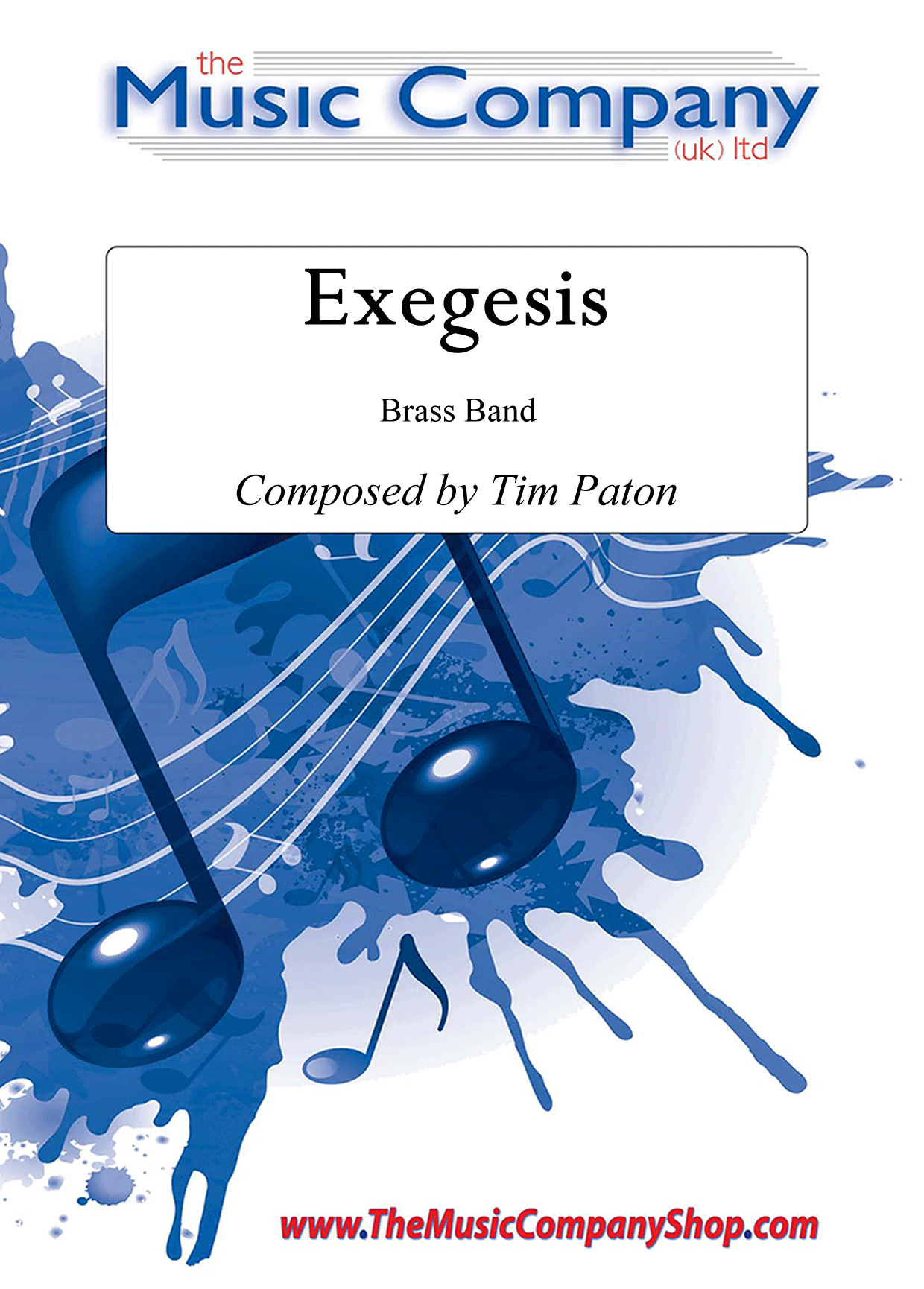
Exegesis - Tim Paton
An exciting, original composition for brass band by Tim Paton. A complex work which entwines melodic lyricism amidst contemporary harmonies and scoring. A tour de force of Tim's creativity and a rewarding challenge for the performers and audience.Tim comments: The term exegesis is applied to a study which works out the meaning of something, an interpretation of a series of events, a comparison of ideas within a given medium, for example, "Biblical exegesis". This brass band piece is a musical exegesis.Section one is made up of three main themes, and although these themes are tonal within themselves, there is a sense that they are trying to understand one another. From the very beginning of this section, there is an element of bi-tonality and dissonance.The middle section is ponderous, where we hear elements of these three themes. It could be called the 'thinking section'.Section three almost interrupts this middle section, with fanfares displaying a realisation, still containing bi-tonality, but in harmony! We are soon led in to a hymn like celebration, followed by a determined, militaristic section for the percussion. Finally, the fanfares which opened this third section, reappear, taking us to a final conclusion.
In Stock: Estimated dispatch 3-5 working days
-
 £30.00
Janacek's 'Taras Bulba' - Janacek
Comments from Tim Paton, the arranger of Janacek's 'Taras Bulba': "I will never forget the day in 1967 when I was introduced to the music of Leos Janacek, a Czech composer born in 1854, who died in 1928. Janacek was little known in Britain until the 1960's, when the conductor Charles Macherras introduced his unique music. I heard a recording of Macherras conducting the Pro Arte Orchestra in a performance of Janacek's "Sinfonietta".It was in 1969 that I first heard Janacek's Symphonic Rhapsody, "Taras Bulba".Janacek's music is exciting, powerful, emotive, impassioned and unpredictable.I have taken the first and third movements of this piece, and adapted them for Brass Band, which was at times extremely difficult, but rewarding. It sometimes took up to an hour to be satisfied that a mere several bars had been reproduced to convey the composer's intentions.The Death of AndriThe Cossaks, under the leadership of Taras Bulba, are fighting against the Poles in the 17th century. Taras's son Andri seeks to rescue his love, a Polish princess, from a city which is being besieged by the Cossaks. Having found her, he throws in his lot with the Poles, but is finally captured by his father, who executes him as a traitor before riding off again to battle.Prophesy and Death of Taras BulbaTaras himself is finally captured and condemned to be nailed to a tree and burned alive. As the flames creep around him, Taras has the satisfaction of seeing histroops escape, and as he dies, sees a vision of his country freed at last.This is incredibly descriptive music. The mood is constantly changing, creating feelings of love and anger, celebration and melancholy, despair and triumph.This Brass Band EditionThe duration of the original symphonic rhapsody, three movements, is approximately 23 minutes. I chose the first and third movements, so the Brass Band edition is approximately 14 minutes. The main reason is twofold: Being realistic about the demands this music would place on the stamina of the brass player; Keeping the piece less than 15 minutes, so that, if desired, it could be used on the contest platform.Two unique qualities of Janacek's music had to be taken into account when preparing this brass band version. His compositional technique was individual, at times not sticking to traditional expectations, in both form and orchestration. I imagined what the genius himself would have said looking at my work, and how to tackle a particular section to emulate his original intentions. This was particularly the case when dealing with high woodwind and violin parts, the use of tremolo in string parts, and the orchestral harp.Percussion: Janacek included timpani, side drum, cymbals, triangle and tubular bells. For reasons stated previously, I have also included xylophone and glockenspiel. I have also added the gong in a couple of places to enhance the dramatic effect of the music.
In Stock: Estimated dispatch 3-5 working days
-
£48.00
Spanning Revolutions - Matthew Hall
Spanning RevolutionsSpanning Revolutions was commissioned by The Ironbridge Gorge Brass Band Festival in celebration of the 25th Anniversary of the Ironbridge Gorge being made a UNESCO World Heritage Site.The premiere performance was given at the Festival in 2011, based at the Museum of Iron, Coalbrookdale, Shropshire, performed by the combined bands of Tongwynlais Temperance and Wellington (Telford) under the direction of the composer.The Ironbridge Gorge is seen as the birthplace of the Industrial Revolution; the section between G and I is a representation of a steam engine starting up.Spanning Revolutions
Estimated dispatch 5-7 working days
-
 £32.00
The Beacons (Score only) - Ray Steadman-Allen
For centuries hilltop beacon fires blazed across the land signals of important happenings or warnings of invasion. This music tells no specific story but the titles of the four thematically related sections are a guide to the idea: The Beacons; Far Horizons; The Invaders; Celebration. The first movement has something of the character of the march and the fanfare; spirited and tightly driving, it promises most of the thematic material of the work. The second is largelt tranquil and is thinly scores with solo passages. The third has the most dramatic potential; its energy and conflict subsides to a lament and a tolling bell before a vigorous rounding off. Appropriately, the fourth movement is in a merry-making mood, and the jubilant music concludes with fragment statements of the main themes. The Beacons was first performed by IMI Yorkshire Imperial Band (James Scott) at the 'Concert of the Century', celebrating the Centenary of the British Bandsman, at the Free Trade Hall, Manchester, on 5 September 1987. Duration: 12:30
Estimated dispatch 7-9 working days
-
 £42.00
The Beacons (Parts only) - Ray Steadman-Allen
For centuries hilltop beacon fires blazed across the land signals of important happenings or warnings of invasion. This music tells no specific story but the titles of the four thematically related sections are a guide to the idea: The Beacons; Far Horizons; The Invaders; Celebration. The first movement has something of the character of the march and the fanfare; spirited and tightly driving, it promises most of the thematic material of the work. The second is largelt tranquil and is thinly scores with solo passages. The third has the most dramatic potential; its energy and conflict subsides to a lament and a tolling bell before a vigorous rounding off. Appropriately, the fourth movement is in a merry-making mood, and the jubilant music concludes with fragment statements of the main themes. The Beacons was first performed by IMI Yorkshire Imperial Band (James Scott) at the 'Concert of the Century', celebrating the Centenary of the British Bandsman, at the Free Trade Hall, Manchester, on 5 September 1987. Duration: 12:30
Estimated dispatch 7-9 working days
-
 £42.00
Hymn at Sunrise (Score only) - Ray Steadman-Allen
The idea for this work was prompted by a poem - Hymn Before Sunrise - which describes the majesty of a mountain in darkness, the sounds of a nearby waterfall and so on. Nothing came of the exposure to these pictures except for general thoughts about the dawn of day and a series of movements expressing a personal response to the wonder of creation in an imaginary moment in time. The movement titles, which were added later, are intended to underline a prevailing sense of worship, wonder and exaltation. The music is pure, not pictoral, though listeners may conjure their own images. An actual hymn - Tallis' Cannon - is incorporated. There are five movements: 1. Thanksgiving: A short prelude in two parts. First a brief passage of 'dawn music' before things become more vigorous: fanfare-like music ushers in the trombone section's presentation of the Tallis tune. A broad band version concludes the movement. 2. De Profundis: A slow movement shot through with anxious questionings featuring flugel and trombone. The mood lightens a little in the centre where the soprano cornet is featured and the movement ends serenely. 3. Celebration is characterised by rhythmic drive, this is buoyant with plenty of incident pointed up by the percussion. 4. Invocation: Melodic in nature and sober in mood, the first section is a series of short solos mingled with chorale-like statements. Central to the movement is a chorale-prelude style presentation of the Tallis tune. The third section reintroduces the earlier solo music by the full ensemble. Dissolving, the music enters the last movement without a break. 5. Paean: Marked allegro con spirito there is, quite rightly, a fair amount of fun in the rejoicing. Snatches of Tallis are heard, then comes a gentle passage with a cornet solo leading to fanfare music and recapitulation. Two recitatives are succeeded by a coda which brings the work to a sonorous and exultant conclusion.
Estimated dispatch 7-9 working days
-
 £52.00
Hymn at Sunrise (Parts only) - Ray Steadman-Allen
The idea for this work was prompted by a poem - Hymn Before Sunrise - which describes the majesty of a mountain in darkness, the sounds of a nearby waterfall and so on. Nothing came of the exposure to these pictures except for general thoughts about the dawn of day and a series of movements expressing a personal response to the wonder of creation in an imaginary moment in time. The movement titles, which were added later, are intended to underline a prevailing sense of worship, wonder and exaltation. The music is pure, not pictoral, though listeners may conjure their own images. An actual hymn - Tallis' Cannon - is incorporated. There are five movements: 1. Thanksgiving: A short prelude in two parts. First a brief passage of 'dawn music' before things become more vigorous: fanfare-like music ushers in the trombone section's presentation of the Tallis tune. A broad band version concludes the movement. 2. De Profundis: A slow movement shot through with anxious questionings featuring flugel and trombone. The mood lightens a little in the centre where the soprano cornet is featured and the movement ends serenely. 3. Celebration is characterised by rhythmic drive, this is buoyant with plenty of incident pointed up by the percussion. 4. Invocation: Melodic in nature and sober in mood, the first section is a series of short solos mingled with chorale-like statements. Central to the movement is a chorale-prelude style presentation of the Tallis tune. The third section reintroduces the earlier solo music by the full ensemble. Dissolving, the music enters the last movement without a break. 5. Paean: Marked allegro con spirito there is, quite rightly, a fair amount of fun in the rejoicing. Snatches of Tallis are heard, then comes a gentle passage with a cornet solo leading to fanfare music and recapitulation. Two recitatives are succeeded by a coda which brings the work to a sonorous and exultant conclusion.
Estimated dispatch 7-9 working days
-
 £42.00
Partita for Band (Postcards from Home) (Score only) - Philip Wilby
The sound and culture of brass bands was part of Philip Wilby's childhood, and this short Partita seeks to commemorate his childish memories in the musical terms of today's currency. Although the music makes technical demands on the players the piece is, nevertheless designed to involve rather than impress its audiences. There are four movements: 'Towers and Chimneys' which is both heraldic and mysterious; 'Churches: Lord of the Dance' is an arrangement of the famous shaker melody made popular in Martin Shaw's hymn of Jesus' life and history; 'Pastorale: Sunday Afternoon recalls those long and languorous days before television, and 'Coronation Day Parade' - a community celebration with a brass band at its centre. Duration: 12:00
Estimated dispatch 7-9 working days