
Results
-
 £33.89
Adoration (Cornet Solo with Brass Band) Florence Price trs. Andrew Wainwright
Florence Price was an American classical composer, pianist, organist and music teacher. She is noted as the first African-American woman to be recognised as a symphonic composer, and the first to have a composition played by a major orchestra. Price composed over 300 works: four symphonies, four concertos, as well as choral works, art songs, chamber music and music for solo instruments. In 2009, a substantial collection of her works and papers that had been previously considered lost was found in her abandoned summer home. Amongst these was this delightful work, Adoration, which had been composed in the 1950s for organ.According to IMSLP.org, the piece "failed to meet notice or renewal requirements to secure statutory copyright with no 'restoration' under the GATT amendments" and therefore is in the public domain. A version for violin and piano by Elaine Fine has become popular. This setting for cornet soloist with brass band has been arranged by Andrew Wainwright. It is also available as a Bb solo with piano here.To view a video of Andrew Roe performing the work, please visit: www.youtube.com/watch?v=_7UYlz8FzxoDifficulty Level: 4th Section +Length: 3.15 minutesSheet music available from:UK - www.brassband.co.ukUSA - https://satradecentral.orgInstrumentation:Cornet Soloist BbSoprano Cornet EbSolo Cornet BbRepiano Cornet Bb2nd Cornet Bb3rd Cornet BbFlugel Horn BbSolo Horn Eb1st Horn Eb2nd Horn Eb1st Baritone Bb2nd Baritone Bb1st Trombone Bb2nd Trombone BbBass TromboneEuphonium BbBass EbBass Bb(Percussion Tacet)
In Stock: Estimated dispatch 1-3 working days
-
 £41.42
Verklarte Nacht (Brass Band) Arnold Schoenberg arr. Rob Bushnell
Composed in just three weeks in 1899, Verklarte Nacht (Transfigured Night) is a string sextet in one movement by Arnold Schoenberg. Whilst known better for tone rows, his dodecaphonic music and the Second Viennese School, Schoenberg was a master of harmony (writing a number of books on the subject) and, in his early life, was inspired by the music of Brahms and Wagner. This is his best-known tonal work. Its description as a tone poem is not surprising given it takes its inspiration from Richard Dehmel's poem of the same name, as well as Schoenberg's strong feelings towards his future wife, Mathilde Zemlinsky, sister of his teacher, Alexander von Zemlinsky.The work is said to have five sections, one for each of the stanzas in the poem. The poem, from 1896, describes a man and woman walking through a dark forest on a moonlit night. The woman shares a secret with him, that she is pregnant but not with his child. The man reflects upon this before warmly accepting (and forgiving) the news.The work premiered on 18 March 1902 in the Vienna Musikverein by the Rose Quartet. As was normal at the time, Schoenberg produced a string orchestra version that was premiered on 29 November 1916 in Prague, conducted by Zemlinsky, which was later revised in 1943 to better support the soloists, also adding more articulation and tempo markings.Whilst the piece was controversial at the time, both musically and due to the poem's "inappropriate" subject matter, Richard Dehmel himself was impressed, writing "I had intended to follow the motives of my text in your composition, but soon forgot to do so, I was so enthralled by the music."This arrangement is for the British-style brass band, with alternative parts for horns in F and bass-clef lower brass.To view a recording of the original composition please visit www.youtube.com/watch?v=vqODySSxYpc.Difficulty Level: 2nd Section +Duration: approx. 6.40 minutesSheet music available from www.brassband.co.ukInstrumentation:Soprano Cornet EbSolo Cornet BbRepiano Cornet Bb2nd Cornet Bb3rd Cornet BbFlugel Horn BbSolo Horn Eb1st Horn Eb2nd Horn Eb1st Baritone Bb2nd Baritone Bb1st Trombone Bb2nd Trombone BbBass TromboneEuphonium BbBass EbBass BbTimpaniPercussion 1-3
In Stock: Estimated dispatch 1-3 working days
-
 £33.89
Men of Harlech (Brass Band) Welsh Traditional arr. Alex McGee
This contemporary take by Alex McGee on the Welsh folk song Men of Harlech will be an entertaining addition to concert programmes.The arranger writes:'Men of Harlech is perhaps one of the most well known of all traditional Welsh folk songs, but not like this. This setting was inspired by a composer who I first encountered as a 14-year-old playing in his first regional brass band, Gareth Wood. Upon learning of the death of Gareth I felt compelled to honour his memory and his music in composition. I struck upon the idea to do what he had done to the tune Sosban Fach to Men of Harlech, to take the tune as the raw material and try to craft it into something new yet recognisable, modern yet accessible.The work attempts to highlight what for me are the underlying characteristics of we Welsh; prone to melancholy but quick to find joy, contradictory, inviting, welcoming and warm but capable of housing a fierce streak of nationalistic pride.I dedicate this work to Gareth Wood and thank him for his music.'To view a rolling score video of the work please visit: https://www.youtube.com/watch?v=YSoZnpnhEjQDuration: 3.30 minutesDifficulty Level: 3rd Section +PDF download includes parts and score.Sheet music available from www.brassband.co.ukInstrumentation:Soprano Cornet EbSolo Cornet BbRepiano Cornet Bb2nd Cornet Bb3rd Cornet BbFlugel Horn BbSolo Horn Eb1st Horn Eb2nd Horn Eb1st Baritone Bb2nd Baritone Bb1st Trombone Bb2nd Trombone BbBass TromboneEuphonium BbBass EbBass BbTimpaniPercussion 1-2
In Stock: Estimated dispatch 1-3 working days
-
 £33.89
Polka from 'The Bartered Bride' (Brass Band) Smetana arr. Rob Bushnell
Considered a major contribution to the develop of Czech music, The Bartered Bride by Bedrich Smetana is a comic opera in three acts that premiered, in its final version, in 1870; having not been a great success when the original two-act version premiered at the Provisional Theatre, Prague on 30 May 1866. The opera was part of Smetana's aim to create a native Czech music after the conductor Johann von Herbeck commented that Czechs were incapable of making music of their own. Whilst he avoided the direct use of folksongs, Smetana did use numerous traditional Bohemian dance forms, such as the furiant and the polka, leading to music that was Czech in spirit.'Sold Bride', a more accurate translation of the original Czech title (Prodana nevesta), tells the story of two lovers (Marenka and Jenik) who want to marry despite Marenka's father's obligations for his daughter to marry the son of a wealthy landowner, Micha. Scheming, condition proposals and secret identities leads to a happy ending.The polka was not in the original 1866 version. A revision in October 1866 saw the addition of a gypsy dance near the start of act 2. But by the next performance in January 1869, this had been replaced by a polka. In June 1869, a new polka replaced the January version's (as well as being moved to the end of act 1) and this is the one that we know and love today.This arrangement is for British-style brass band, with *alternative parts for horns in F and bass-clef lower brass.Instrumentation:Soprano Cornet EbSolo Cornet BbRepiano Cornet Bb2nd Cornet Bb3rd Cornet BbFlugel Horn BbSolo Horn Eb*1st Horn Eb*2nd Horn Eb*1st Baritone Bb*2nd Baritone Bb*1st Trombone Bb*2nd Trombone Bb*Bass TromboneEuphonium Bb*Bass Eb*Bass Bb*TimpaniPercussion (Triangle, Cymbal(s) & Bass Drum)
In Stock: Estimated dispatch 1-3 working days
-
 £60.25
Horizon: The Promise of the Lord (Brass Band) Andrew Wainwright
Horizon: The Promise of the Lord was written at the request of Bandmaster Stephen Cobb for The International Staff Band. It is based on the much loved hymn of the church, Cwm Rhondda (Guide me O thou great Jehovah). The work was recorded on the ISB's CD Manuscripts II (released 2023). This highly descriptive piece will be an excellent addition to concert programs, as well as being appropriate as a test piece.The inspiration for the work comes from the book of Exodus. Whilst the music is not intended to be directly programmatic, like the hymn Cwm Rhondda, the work takes the listener through the Exodus from Egypt to the promised land of Israel as a metaphor of the spiritual pilgrimage of the individual Christian through his or her earthly life. The music aims to evoke a sense of God's guidance through strife and affirm the reality that God provides for us and redeems all the wrong in the world. This God who provided for the Hebrew people wandering amidst 'barren lands' with 'bread of heaven' is still and ever will be a God of provisional grace.Through listening to the music, it is the composer's intention that we are reminded of God's promise of Deliverance as set out in Exodus 6 v7-8:'I will take you as my own people, and I will be your God. Then you will know that I am the Lord your God, who brought you out from under the yoke of the Egyptians. And I will bring you to the land I swore with uplifted hand to give to Abraham, to Isaac and to Jacob. I will give it to you as a possession. I am the Lord.'Like the hymn, Horizon: The Promise of the Lord is intended as a prayer for guidance. The Christian is a pilgrim through 'this barren land'. The music is often chromatic and in large parts verging on atonality, as a reflection of the strife that the Israelites endured in their 40 years in the wilderness. However, it ends in climactic fashion with the Hebrew people finally reaching their destination after many years of wandering in the desert - as they approach the 'Horizon' promised by the Lord.To view a performance of the work by the National Youth Brass Band of Great Britain please visit www.youtube.com/watch?v=LjOHf7QEw1gPDF download includes score and parts.Sheet music available from:UK - www.brassband.co.ukUSA - https://satradecentral.orgDifficulty Level: 1st Section +Length: c11.00 minutesInstrumentation:Soprano Cornet EbSolo Cornet BbRepiano Cornet Bb2nd Cornet Bb3rd Cornet BbFlugel Horn BbSolo Horn Eb1st Horn Eb2nd Horn Eb1st Baritone Bb2nd Baritone Bb1st Trombone Bb2nd Trombone BbBass TromboneEuphonium BbBass EbBass BbPercussion 1-4
In Stock: Estimated dispatch 1-3 working days
-
 £33.89
'Mid all the traffic (Brass Band) Traditional arr. Andy Wareham
This stunning arrangement by British composer Andy Wareham is of the popular hymn 'Mid all the Traffic, which marries the North-American folksong Shenandoah set to lyrics by English journalist, novelist and poet William Arthur Dunkerley (written under the pseudonym of 'John Oxenham'). The hymn is very well-regarded in both the Salvation Army and wider brass band movement thanks to a popular arrangement by renowned Salvationist composer Leonard Ballantine.The arranger writes:'This setting of 'Mid All The Traffic was originally composed during the Covid-19 pandemic as an octet arrangement for single instrument. My hope was to create an arrangement that offers an alternative view on harmony and could be multi-track recorded; allowing performers to give, and share, a performance whilst in isolation. The music was written in dedication to all of the 'key-workers' in the UK, especially in the NHS, who worked tirelessly throughout difficult conditions during the Covid-19 pandemic.'To view a follow-the-score video of the work please visit https://www.youtube.com/watch?v=naajvdsg9WoPDF download includes score and parts.Sheet music available from:UK - www.brassband.co.ukUSA - www.solidbrassmusic.comDifficulty Level: 3rd Section +Instrumentation:Soprano Cornet EbSolo Cornet BbRepiano Cornet Bb2nd Cornet Bb3rd Cornet BbFlugel Horn BbSolo Horn Eb1st Horn Eb2nd Horn Eb1st Baritone Bb2nd Baritone Bb1st Trombone Bb2nd Trombone BbBass Trombone1st Euphonium Bb2nd Euphonium BbBass EbBass BbBass DrumSuspended Cymbal
In Stock: Estimated dispatch 1-3 working days
-
 £37.65
Good Friday Music (Brass Band) Wagner arr. Brian Bowen
This excerpt from Parsifal, the opera Wagner completed in 1882, is a poignant meditation on the chief themes contained in the musical drama: suffering, compassion and redemption. The affirmative six-note Dresden Amen is very present. Here it has been expertly set for brass band by Brian Bowen.Difficulty Level: 3rd Section +Sheet music available from:UK - www.brassband.co.ukUSA - www.solidbrassmusic.comInstrumentation:Soprano Cornet EbSolo Cornet BbRepiano Cornet Bb2nd Cornet Bb3rd Cornet BbFlugel Horn BbSolo Horn Eb1st Horn Eb2nd Horn Eb1st Baritone Bb2nd Baritone Bb1st Trombone Bb2nd Trombone BbBass TromboneEuphonium BbBass EbBass BbTimpani
In Stock: Estimated dispatch 1-3 working days
-
 £52.72
A Renaissance Christmas (Brass Band) Kevin Norbury
This magnificent festive suite was written by Kevin Norbury for the Pierre Elliott Trudeau High School Wind Symphony and features several well known carols set in a Renaissance style. Here it has been set for brass band. Three contrasting movements comprise the work:i. Processional (Personent hodie - On this day earth shall ring)This is a short piece imagining a torchlight Yuletide procession (perhaps bearing the traditional roasted wild boar), using a well-known Christmas melody from the large collection of music compiled in the 16th century called Piae Cantiones (1582). The tune is presented twice with accompanying, related melodic material.ii. Pastorale (Quem pastores laudavere - Shepherds sang their praises o'er him)This is a 14th-century melody which was originally collected by Michael Praetorius at the end of the 16th-century. The treatment throughout is very lyrical without overly complex harmonies. The melody is heard three times with brief linking episodes and a short coda.iii. Celebration! (In dulci jubilo - In sweet celebration - Ding-dong merrily on high))This magnificent 13th-century melody was also a part of Michael Praetorius's collection. It is traditional associated with the words 'Good Christian men, rejoice!' The opening is a straight transcription of the great chorale prelude for organ by J.S.Bach. After the grandeur of the opening, the tune is heard in more of a 'folky' style. A lot of related melodic material is then presented before the tune Ding-dong merrily on high is heard. After another episode of previously used music In dulci jubilo reappears in a joyful conclusion to the piece.Sheet music available from:UK - www.brassband.co.ukUSA - www.solidbrassmusic.comDifficulty Level: 3rd Section +Instrumentation:Soprano Cornet EbSolo Cornet BbRepiano Cornet Bb2nd Cornet Bb3rd Cornet BbFlugel Horn BbSolo Horn Eb1st Horn Eb2nd Horn Eb1st Baritone Bb2nd Baritone Bb1st Trombone Bb2nd Trombone BbBass TromboneEuphonium BbBass EbBass BbPercussion 1-4
In Stock: Estimated dispatch 1-3 working days
-
 £33.89
O Holy Night (Flugel Solo with Brass Band) arr. Kevin Larsson
O Holy Night, also known as Cantique de Noel, was originally based on a poem by Placide Cappeau before being set to music by Adople Adam. This carol has become a favourite to many, being performed all over the world in various styles and forms. This jazz-style arrangement for flugel horn and brass band was written for John Docter for The Salvation Army's Night of Wonder Carol Service in Los Angeles.To view a performance video please visit: www.youtube.com/watch?v=tMobVKBLmMYSheet music available from:UK - www.brassband.co.ukUSA - www.solidbrassmusic.comDifficulty Level: 3rd Section +Instrumentation:Flugel Horn Soloist BbSoprano Cornet EbSolo Cornet Bb1st Cornet Bb2nd Cornet BbSolo Horn Eb1st Horn Eb2nd Horn Eb1st Baritone Bb2nd Baritone Bb1st Trombone Bb2nd Trombone BbBass TromboneEuphonium BbBass EbBass BbTimpaniDrum KitPercussionBongos
In Stock: Estimated dispatch 1-3 working days
-
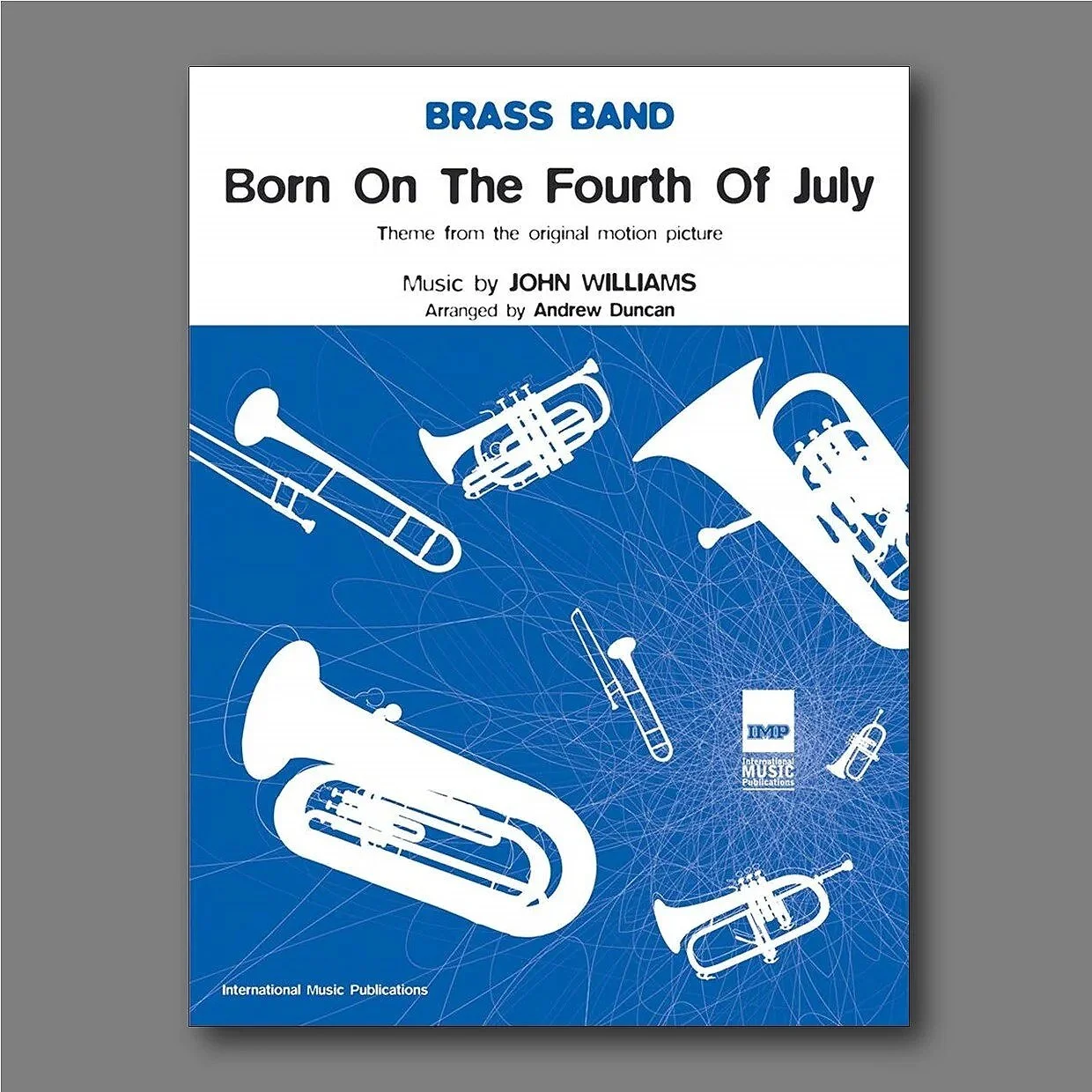 £45.00
Born on the Fourth of July. John Williams. Arranged for Brass Band and Solo for Trumpet (or cornet) by Andrew Duncan
The theme music from the original motion picture, Born on the Fourth of July, starring Tom Cruise. A memorable John Williams patriotic movie soundtrack arranged for brass band by Andrew Duncan with a solo for trumpet or cornet. Composer: John Williams Arranger: Andrew Duncan Difficulty: Suitable for Championship to 2nd Section Bands Duration: 5 mins 146 pages Score and Parts Publisher: International Music Publications
 Watch video