
Results
-
 £43.00
La Perla Negra (Brass Band - Score and Parts) - Skinner, Colin
For this brooding piece the composer has used the following storyline. "A sad elderly man sits alone in a bar whilst an accordionist plays a slow tango. A beautiful woman walks in wearing a single black pearl necklace and proceeds to dance with the old man. Gradually the music becomes more and more spirited and the dance faster as the old man becomes youthful again. With a passionate kiss he passes out in the girls arms and when he awakens he is back in the bar alone save for the accordionist. As he contemplates his dream he notices a single black pearl left behind on the bar. The sombre mood is lightened in the middle section by a deliberately trite and vibrato fuelled section, but we soon return to the opening material for a slow fade-out" Composer Colin Skinner wrote this piece especially for Superbrass' debut CD, Under the Spell of Spain. Duration: 6.30. Suitable for 2nd Section Bands and above.
Estimated dispatch 7-14 working days
-
 £74.95
A Tale of Hope (Brass Band - Score and Parts) - Ponsford, Steven
The piece tells the story of Chicago lawyer and Presbyterian church elder Horatio Gates Spafford. In 1873, the Spafford family planned a vacation to England, but last-minute business demands prevented Horatio from sailing with them. Tragedy struck when the ship collided with an iron sailing vessel while crossing the Atlantic, killing 226 people, including all four of Spafford's daughters. His wife, Anna, survived the tragedy, and upon arriving in Cardiff, Wales, she sent a telegram to Spafford that simply read "Saved alone." Shortly afterwards, as Spafford travelled to meet his grieving wife, he was inspired to write the hymn It Is Well with My Soul as his ship passed near where his daughters had died. The hymn was subsequently set to music by fellow American Philip Bliss, with the tune named after the ship on which Spafford's daughters died, Ville du Havre.Composer Steven Ponsford has chosen to portray this story in a substantial composition for brass band. Much of the early music is turbulent, reflecting the long voyage, and then the disaster that claimed Spafford's daughters. After a darker 'Grave' section, the hymn It Is Well With My Soul softly emerges, with the piece ending on a note of optimism and hope.Duration: 11.30
Estimated dispatch 7-14 working days
-
 £31.95
A Tale of Hope (Brass Band - Score only) - Ponsford, Steven
The piece tells the story of Chicago lawyer and Presbyterian church elder Horatio Gates Spafford. In 1873, the Spafford family planned a vacation to England, but last-minute business demands prevented Horatio from sailing with them. Tragedy struck when the ship collided with an iron sailing vessel while crossing the Atlantic, killing 226 people, including all four of Spafford's daughters. His wife, Anna, survived the tragedy, and upon arriving in Cardiff, Wales, she sent a telegram to Spafford that simply read "Saved alone." Shortly afterwards, as Spafford travelled to meet his grieving wife, he was inspired to write the hymn It Is Well with My Soul as his ship passed near where his daughters had died. The hymn was subsequently set to music by fellow American Philip Bliss, with the tune named after the ship on which Spafford's daughters died, Ville du Havre.Composer Steven Ponsford has chosen to portray this story in a substantial composition for brass band. Much of the early music is turbulent, reflecting the long voyage, and then the disaster that claimed Spafford's daughters. After a darker 'Grave' section, the hymn It Is Well With My Soul softly emerges, with the piece ending on a note of optimism and hope.Duration: 11.30
Estimated dispatch 7-14 working days
-
 £26.95
Golden Lullaby (Brass Band - Score and Parts) - Wiffin, Rob
This is a song-setting giving an opportunity for some lyrical expression. It started life as a song on the subject of gold but ended up by standing alone as an instrumental piece. The gentle lilt of the 5/4 melody suggests a lullaby although the texture of the piece builds in an un-lullaby-like fashion towards the end. There is a little white-note dissonance but it is basically traditional in its language.Duration: 3.45
Estimated dispatch 7-14 working days
-
 £133.70
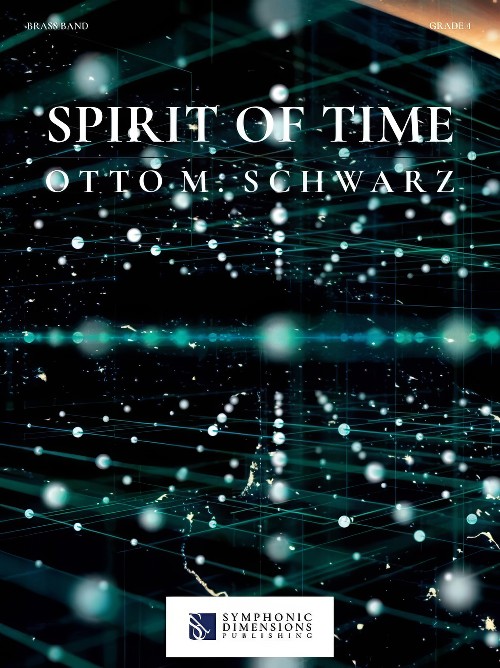
Spirit of Time (Brass Band - Score and Parts) - Schwarz, Otto M.
Zeitgeist; transformations; a departure for new shores... these are buzzwords we often encounter nowadays. Above all in this digital age, it is essential that we face changes positively and that we make the very best of them. Music is emotion! Otto M. Schwarz begins many of his lectures with this phrase, and this is exactly what we feel in this new concert work. Rapid, and full of energy, is the leap into a new chapter, wonderful opportunities are waiting to be discovered in uncharted lands. But change is not only loud and momentous. The creative power of the future lies dormant in the inventive spirit of the individual, quietly, thoughtfully, silently and alone! The final sequence of this work is all about good vibes: it lights the way to a positive future and stands for the dawn of a new era!Duration: 10.00
Estimated dispatch 7-14 working days
-
 £29.95
Lead, Kindly Light (Brass Band - Score and Parts) - Broughton, Bruce
This beautiful hymn is one of trust and faith, building in confidence 'till the night is gone.' This arrangement follows that line of confidence. The melody begins unaccompanied, which is to say 'alone', and the eventual accompanying voices enter sombrely. Instead of a traditional final cadence, the 'leading of the light' continues, using the first four notes of the hymn as a motif that leads to a second, more positive statement of the melody, underscored by a walking motion. The positivity grows and lasts through a final grand statement of the hymn. A short meditative coda follows, and the arrangement ends with a solo note of reflection.
Estimated dispatch 7-14 working days
-
 £73.00
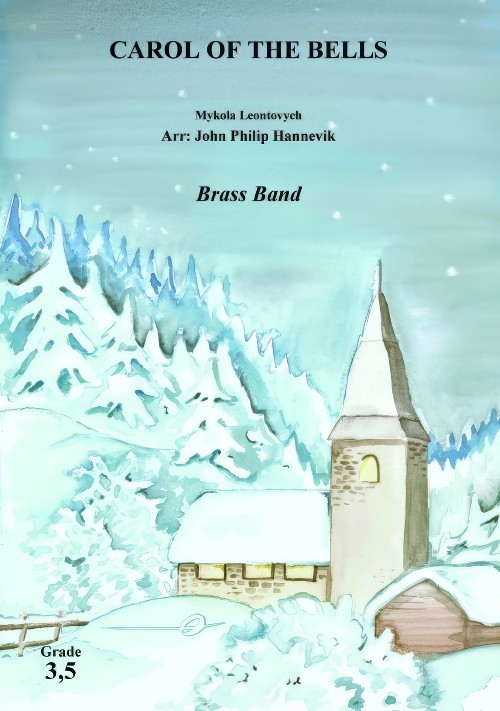
Carol of the Bells (Brass Band - Score and Parts) - Leontovych, Mykola Dmytrovich - Hannevik, John Philip
Ukrainian composer Mykola Leontyovich composed this famous Christmas Carol in 1914. The carol is based on a folk chant called Shchedryk. The composer was a supporter of the independence movement in Ukraina, and was assassinated by a Soviet agent in 1921.The carol was made famous after the adaption by Peter J. Wilhousky in 1936. Wilhousky worked as an arranger for the NBC symphony orchestra. It is also well known from popular culture, like the film Home Alone (1990), and a version by the vocal group Pentatonix.Duration: 2.30
Estimated dispatch 7-14 working days
-
 £24.95
Through The Fair (Flugel Horn Solo with Brass Band - Score and Parts) - Pascoe, Chelsea
Ethereal and refined in style, this arrangement begins with soloist alone while instrumentation is gradually added to build texture and intensity. The opening effects are mirrored in the conclusion to the piece.
Estimated dispatch 7-14 working days
-
£12.50
Through The Fair (Flugel Horn Solo with Brass Band - Score only) - Pascoe, Chelsea
Ethereal and refined in style, this arrangement begins with soloist alone while instrumentation is gradually added to build texture and intensity. The opening effects are mirrored in the conclusion to the piece.
Estimated dispatch 7-14 working days
-
£69.95
Starmaker (Brass Band - Score and Parts) - Steadman-Allen, Ray
Described by the composer as one of his more ambitious works for brass band, this work is in three movements. Although each movement is capable of standing alone, the composer's own concept is totality with the three movements forming a composite whole. Starmaker presents in music the concept of God's creation of the universe. The frantic and sometimes harsh music of the first movement portrays the chaos from which the immortal and invisible wisdom of God created the order and structure of the heavens, with the stars and planets in their ordered places. An exquisite second movement, based on the benediction 'Now the day is over', brings a calm and ordered peace to the universe, also reminding listeners of the night sky, when God's amazing work is best viewed in all its awesome wonder. The final movement is celebratory in nature, with fragments of melodies like 'Praise to the Lord, the Almighty, the King of creation' appearing in various guises.
Estimated dispatch 7-14 working days
 View Music