
Results
-
 £74.99
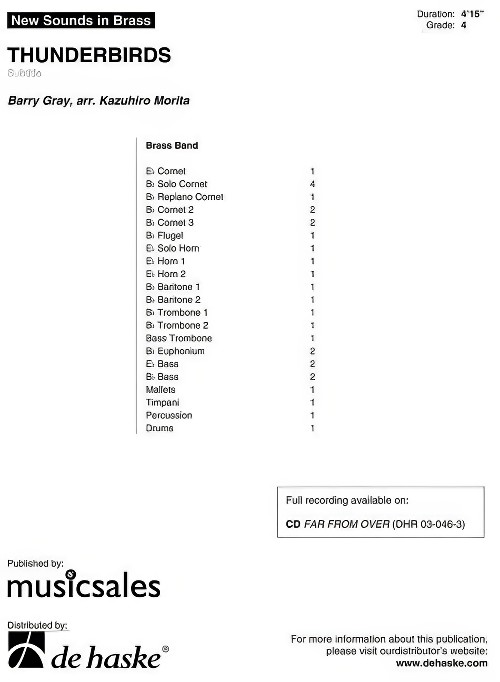
Thunderbirds (Brass Band - Score and Parts) - Gray, Barry - Morita, Kazuhiro
Who doesn't know the children's TV series Thunderbirds. The Gerry Anderson classic is still as popular today with both children and adults as when it was first shown in the sixties. This arrangement of the theme tune will be loved by all and will leave your audience humming it all the way home. Duration: 4.15
Estimated dispatch 7-14 working days
-
 £30.00
One Fine Day (from Madam Butterfly) (Cornet Solo with Brass Band - Score and Parts) - Puccini, Giacomo - Littlemore, Phillip
One Fine Day?is the opera's most famous aria. It comes at the beginning of Act II, which is set three years after the action of Act I. Pinkerton, Butterfly's husband, is a US Naval Officer and he had to return to the sea shortly after their wedding. In the aria, she sings about the day he will return, seeing the ship appear on the horizon, then seeing it enter the harbour. When he arrives, they will be runited for ever. Duration: 3:00
Estimated dispatch 7-14 working days
-
 £30.00
One Fine Day (from Madam Butterfly) (Vocal Solo (Soprano) with Brass Band - Score and Parts) - Puccini, Giacomo - Littlemore, Phillip
One Fine Day?is the opera's most famous aria. It comes at the beginning of Act II, which is set three years after the action of Act I. Pinkerton, Butterfly's husband, is a US Naval Officer and he had to return to the sea shortly after their wedding. In the aria, she sings about the day he will return, seeing the ship appear on the horizon, then seeing it enter the harbour. When he arrives, they will be runited for ever. Duration: 3:00
Estimated dispatch 7-14 working days
-
 £59.99
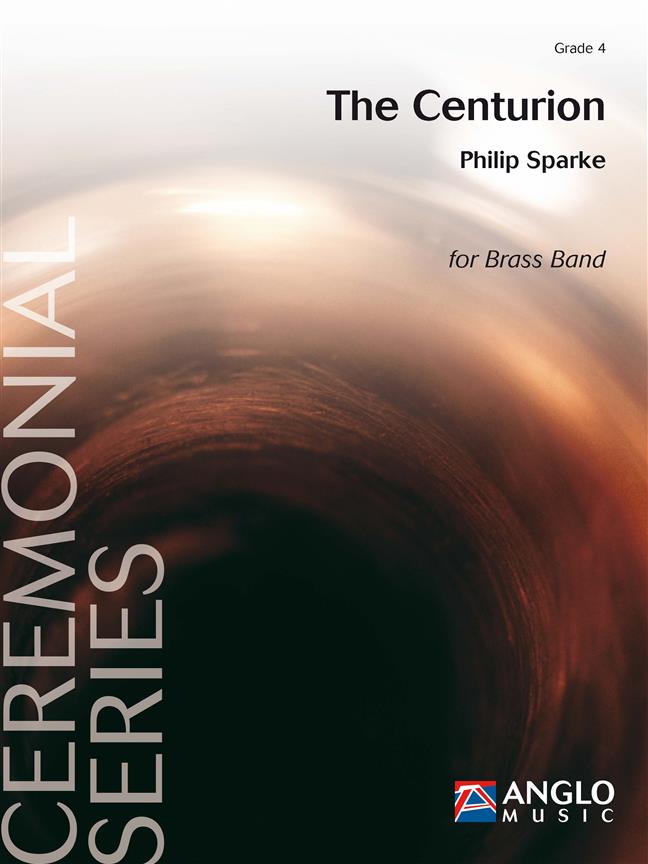
The Centurion (Brass Band - Score and Parts) - Sparke, Philip
A lively upbeat concert march from the pen of the ever-popular Philip Sparke. The Centurion follows the conventional British march format. It is not technically demanding, yet a successful performance will need skill and commitment from every player in the band. The Centurion will make an ideal opening piece for any indoor or outdoor concert and will be a popular item with both players and audiences alike.Duration: 4:10
Estimated dispatch 7-14 working days
-
 £59.99
Marchissimo (Brass Band - Score and Parts) - Sparke, Philip
Marchissimo will make a fantastic opening piece for any concert. It does however come with a twist! It can be played simply as written, but is really designed to be 'staged' with players coming on the concert platform one by one as they begin to play. The piece actually consists of three marches in one, each of which highlights a section of the band. The piece culminates in a final climax where all three march themes are played simultaneously.Duration: 4.30
Estimated dispatch 7-14 working days
-
 £84.95
A Day in the Life of a Knight (Brass Band - Score and Parts) - Lawrence, Phil
Here we have a most descriptive piece of writing - a story through music. A fantastic 1st section test piece and championship concert work:The opening scene would depict standing on the battlements of a castle hearing the thundering hoofs of our brave Knight's horse miles in the distance. His arrival is expected, and his reputation is known across many lands. Today, he is to joust amongst mere mortal knights and compete for the hand of the fair (and local) Princess.He vanquishes all competitors and wins the day. The scene moves to evening and court where reception and dance is to be held for our winning knight. Both Knight and Princess become centre of attention during the dance. Their eyes only for each other.At last, the Knight has a chance to be a lone with his Princess as they steal away from the celebrations to a star lit rampart above the castle gardens, where the Knight declares his ever-lasting love and pledges his life and of honour to her. He asks her hand, meanwhile monks pray in the below chapel hoping for union. She say's yes. It is announced in court, then blown from the battlements.Day breaks; he is brought word of evil doings back in his own land. He leaves word to the Princess that he will be back soon to take her hand. The trouble back home was a rouse to get him away from the Princes so one of the vanquished, a dark knight in yesterdays joust, has summoned a dragon to kidnap the princess for his own.As the truth of the deception reaches our Knight he quickly returns to face the varlet that has taken his Lady. This time tis no joust, but a fight to the death with the dark knight and dragon. Our champion proves his best once again and wins the day and the hand of his Princess forever!- Phil LawrenceSuitable for 1st Section Bands and aboveDuration: 11.15
Estimated dispatch 7-14 working days
-
 £60.99
Antonin's New World (Triangle Solo with Brass Band - Score and Parts) - Dvorak, Antonin - Stratford, Dizzy
Antonin's New World is an excellent piece of musical theatre featuring a comedy act for triangle soloist and band. The music itself does not sound comical, being based on Anton Dvorak's Symphony in E Minor (From the New World), but the right mix of seriousness and humour brings a surprising effect. With a bit of acting talent from your triangle soloist, this interpretation of the well known classical melody will be a major hit. Whether you choose Antonin's New World as a "triangle solo" novelty piece or simply as a delightful adaptation of Dvorak's immensely popular Ninth Symphony, both the band and the audience will love it! 04:20
Estimated dispatch 7-14 working days
-
 £38.00
Brass Braziliana (Brass Band - Score and Parts) - Anderson, Keiron
The Samba has a special significance in Brazilian musical culture and it is symbolic of sheer joy and energy. Music is a mix of communication and energy and this work is designed to allow the players to generate that energy, thus communicating it to the audience. That infectious drive and musical energy will be a high point of any live performance or recording. Duration: 3.00. Suitable for 1st Section Bands and above.
Estimated dispatch 7-14 working days
-
 £54.99
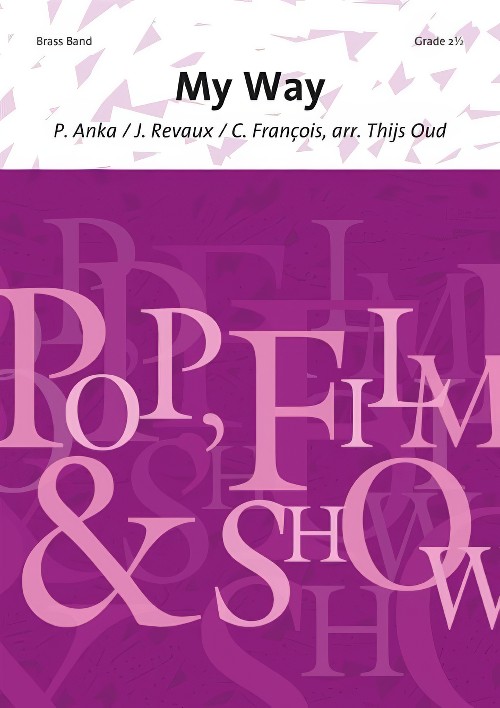
My Way (Brass Band - Score and Parts) - Oud, Thijs
The evergreen My Way, originally a French chanson (Comme d'Habitude), was written by Jacques Revaux and Gillies Thibault and first released by Claude Francois in 1967. Paul Anka wrote the English lyrics which were used by Frank Sinatra who made it in to the American charts with his world famous interpretation in 1969. Since then the song has been covered by a variety of pop stars, including Elvis Presley. This arrangement is based on the Elvis version and within it the chorus appears in a swinging blues style. This popular song will be ideal for that spectacular ending to your concert.Duration: 3:45
Estimated dispatch 7-14 working days
-
 £60.99
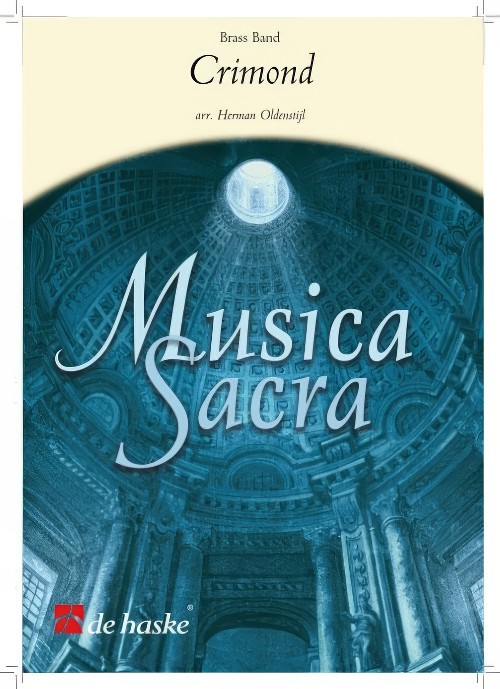
Crimond (Brass Band - Score and Parts - Oldenstijl, Herman
This lovely Scottish hymn, also known as The Lord's My Shepherd, first appeared in 1929 in the Scottish songbook Northern Psalter, where it was incorrectly credited to David Grant, an Aberdeen businessman and amateur musician. It was, in fact, composed by Jessie Irvine the daughter of the parish minister at Crimond. This arrangement will be a musical jewel in your concert repertoire.Duration: 4:10
Estimated dispatch 7-14 working days
 View Music